
Most travelers assume a travel itinerary is simply a list of places to visit and times to be there. But when you hear terms like “curated itinerary,” “bespoke travel plan,” or “hyper-personalized journey,” you’re encountering language that signals something far more sophisticated. These aren’t just marketing buzzwords. They represent distinct approaches to travel planning that blend technology, human expertise, and deep personalization. Understanding these industry terms empowers you to request better travel experiences and evaluate whether a planning service truly delivers customization or just repackages generic templates. This guide breaks down the terminology, explains the methodologies behind personalized travel curation, and shows you how to apply best practices for crafting trips that align perfectly with your preferences.
Table of Contents
Key Takeaways
| Point | Details |
|---|---|
| Personalization terminology cues | Terms like curated itinerary and bespoke travel plan signal meaningful customization beyond generic schedules. |
| Hybrid planning approach | Effective travel curation blends traveler profiling, AI optimization, and human expertise to tailor trips. |
| AI limits addressed | Hybrid methods handle real time disruptions and cultural nuances that pure algorithms miss. |
| Luxury personalization value | 64 percent of luxury travelers value personalization strongly, underscoring the demand for detailed preferences and tailored itineraries. |
Understanding key industry terms for travel curation
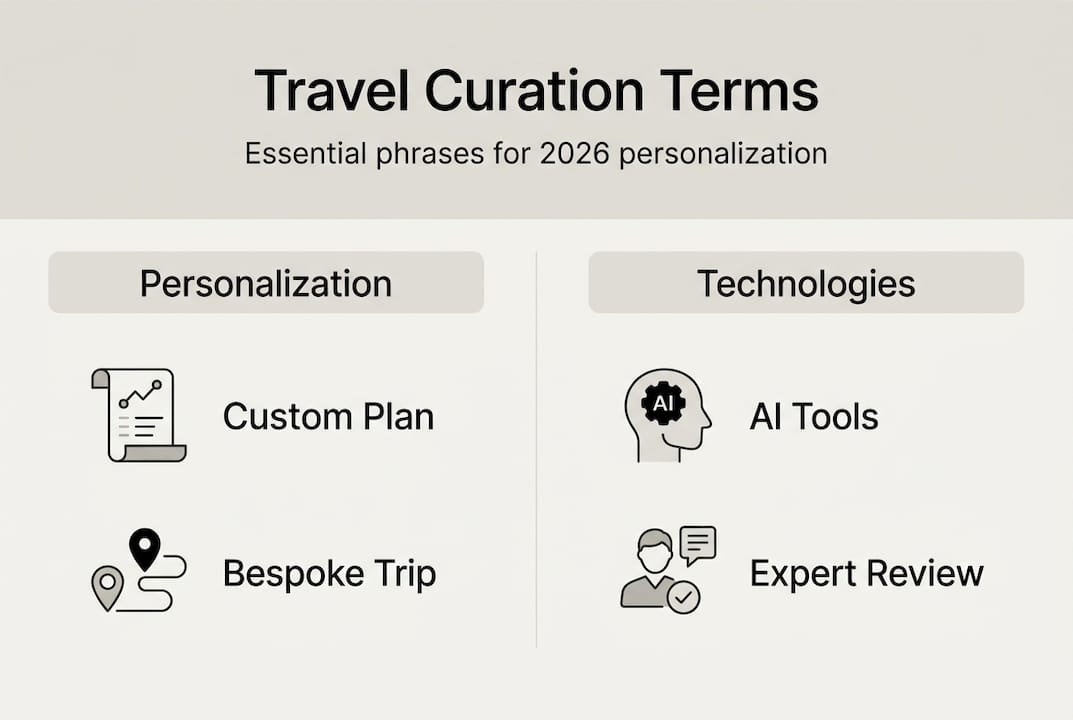
When you encounter travel planning services, you’ll hear various terms that describe different levels of personalization. A “curated itinerary” represents a travel plan crafted with intentional selection of experiences based on your stated preferences. This differs from a generic itinerary that simply lists popular attractions in chronological order. A “personalized travel itinerary” goes further by incorporating your specific constraints, such as mobility limitations, dietary restrictions, or preferred activity intensity levels.
The term “bespoke travel plan” signals the highest tier of customization, where every element from accommodation style to daily pacing reflects your unique travel personality. “Tailored experience” emphasizes adaptation to your circumstances, while “hyper-personalized itinerary” indicates advanced data-driven customization using behavioral insights and predictive modeling. These distinctions matter because they help you communicate expectations clearly when working with travel agents or AI planning tools.
Consider the difference in practice. A generic Paris itinerary might schedule the Eiffel Tower at 10am, the Louvre at 2pm, and dinner in the Latin Quarter. A curated version adapts timing based on your energy patterns, books skip-the-line access matching your budget, and selects restaurants reflecting your culinary interests rather than tourist hotspots. The terminology signals this depth of consideration.
Key terms to master include:
-
Curated itinerary: Intentionally selected experiences aligned with stated preferences
-
Personalized travel itinerary: Plans incorporating individual constraints and requirements
-
Custom journey: Routes and schedules designed specifically for one traveler or group
-
Bespoke travel plan: Comprehensive customization across all trip elements
-
Tailored experience: Adaptation to personal circumstances and travel style
-
Hyper-personalized itinerary: Advanced data-driven customization using behavioral modeling
Using these terms when requesting travel planning services signals that you expect genuine personalization, not templated recommendations with your name inserted at the top.
Mechanics and methodologies behind travel curation
Creating truly personalized travel experiences follows a structured process that combines technology and expertise. The journey begins with traveler profiling, where planners gather detailed information about your preferences, constraints, and travel goals. This goes beyond asking “beach or mountains” to capture nuanced details like preferred walking distance per day, sensory sensitivities, cultural interests, and budget flexibility across different expense categories.

Destination and experience mapping follows, where planners identify potential activities, attractions, and venues that match your profile. AI tools use behavior segmentation and predictive recommendations to surface options you might not discover through standard searches. Machine learning algorithms analyze patterns from thousands of similar traveler profiles to suggest experiences with high satisfaction probability for your specific preferences.
The optimization phase leverages advanced technologies to solve complex scheduling puzzles. Large language models and specialized APIs process constraints like transit schedules, venue opening hours, and geographic distances to create feasible daily plans. Dynamic route optimization ensures smooth flow between activities, minimizing backtracking and maximizing time at preferred experiences. Real-time scheduling capabilities adjust plans based on factors like weather forecasts or crowd predictions.
Personalization layering adds the final polish through these steps:
-
Cultural context integration matching experiences to your interest depth
-
Adaptive scheduling based on your stated energy patterns and preferred pace
-
Narrative flow creation that builds experiences logically throughout your trip
-
Contingency planning for common disruptions specific to your destination
-
Local insight incorporation from human experts familiar with current conditions
Modern online travel planner platforms integrate these technologies seamlessly, allowing you to input preferences through intuitive interfaces while sophisticated algorithms work behind the scenes. The key to maximizing effectiveness lies in providing comprehensive input data rather than minimal responses.
Pro Tip: When using AI planning tools, specify hard constraints explicitly (“must return to hotel by 6pm for medication”) versus soft preferences (“prefer outdoor activities”). This distinction helps algorithms prioritize correctly and prevents scheduling conflicts that undermine your experience.
Navigating edge cases and expert nuances in travel curation
Even sophisticated AI systems encounter challenges that require expert human judgment. Strict spatio-temporal constraints create complex puzzles where transit schedules, opening hours, and geographic distances must align perfectly. A museum closing at 5pm, last entry at 4:30pm, located 45 minutes from your next dinner reservation at 6pm creates tight margins. AI can calculate feasibility, but human planners recognize when rushing diminishes experience quality and suggest alternatives.
Flight delays, weather disruptions, and unexpected closures test itinerary resilience. While AI excels at statistical predictions, human experts draw on experiential knowledge to anticipate cascading effects. A rainy forecast doesn’t just mean “skip outdoor activities.” It means indoor venues will be crowded, requiring earlier arrival times and potentially different routing to avoid congestion.
The personalization gap between statistical matching and experiential tailoring represents another critical nuance. AI identifies that travelers with your demographic profile enjoy art museums with 78% probability. Human curators recognize that your stated interest in “impressionist art specifically” means prioritizing Musée d’Orsay over the Louvre’s broader collection, even though the Louvre ranks higher in generic recommendations.
| Capability | AI Strengths | Human Curation Strengths |
|---|---|---|
| Scalability | Processes thousands of options instantly | Limited by time and capacity |
| Constraint solving | Optimizes complex scheduling puzzles | May miss optimal mathematical solutions |
| Pattern recognition | Identifies statistical preferences accurately | Relies on smaller experience sample |
| Cultural immersion | Suggests popular experiences | Recommends authentic, off-beaten experiences |
| Real-time adaptation | Reroutes based on data feeds | Applies contextual judgment and local knowledge |
| Experiential nuance | Matches statistical preferences | Understands subtle preference distinctions |
Benchmarks like TripCraft and TripTide track improvements in metrics such as Temporal Meal Score, which measures how well meal timing aligns with cultural norms and traveler preferences. Early AI systems scored 61% on this metric, while refined models incorporating expert feedback reach 80%. These improvements translate directly to traveler satisfaction, as poorly timed meals create discomfort and disrupt daily flow.
Constraint Satisfaction Rate measures how successfully an itinerary respects stated requirements. A score below 90% indicates potential frustration points where your needs weren’t fully accommodated. Quality travel planner advanced features display these metrics transparently, allowing you to assess plan quality before committing.
Common edge cases requiring expert attention include:
-
Multi-city trips with complex transit connections
-
Travelers with mobility limitations requiring accessibility verification
-
Family groups with divergent age-appropriate activity needs
-
Luxury experiences requiring relationship-based access or reservations
-
Destinations with rapidly changing conditions or safety considerations
Pro Tip: For complex or luxury trips, always request human review of AI-generated plans. The hybrid approach combines computational efficiency with experiential wisdom, catching issues that algorithms miss while maintaining the optimization benefits of technology.
Applying best practices to curate your personalized travel experience
Armed with industry knowledge and methodology understanding, you can actively improve your travel planning outcomes through strategic practices. Start by using precise terminology when communicating with travel professionals or AI tools. Requesting a “curated itinerary focused on architectural history with moderate walking” communicates far more effectively than “show me cool buildings.”
Provide comprehensive input covering these critical dimensions:
-
Activity intensity preferences (number of scheduled activities per day, preferred pace)
-
Sensory considerations (noise sensitivity, crowd tolerance, temperature preferences)
-
Cultural interests with specificity (“Renaissance art” not just “art”)
-
Hard constraints (mobility limitations, dietary restrictions, medication schedules)
-
Budget flexibility across categories (willing to splurge on dining but not accommodation)
-
Social preferences (group activities versus solo exploration time)
Stress-testing your itinerary’s first day reveals potential systemic issues before you depart. Walk through the schedule mentally, considering realistic timing for each transition. Does the plan allow adequate time for hotel check-in, orientation, and jet lag recovery? Are meal times appropriate for your eating schedule? Does the activity intensity match your stated preferences, or does it pack too much into day one?
Layering local insights onto AI-generated drafts significantly enhances personalization quality. Online forums, recent blog posts, and local social media provide current information about temporary closures, crowd patterns, and emerging experiences. A restaurant that appears highly rated in AI databases might have declined in quality recently, information that human review catches.
Evaluate plans against quality benchmarks to assess whether you’re receiving genuine personalization. Check that meal timing aligns with cultural norms and your preferences (Temporal Meal Score). Verify that all stated constraints are respected (Constraint Satisfaction Rate above 90%). Examine whether activity selection reflects your specific interests or generic popularity (Personalization Depth Score).
Research shows that 64% of luxury travelers highly prioritize personalization, indicating strong market demand for these practices. Yet many travelers accept generic plans because they don’t know how to request better customization. Applying these best practices positions you among the informed minority who extract maximum value from travel planning services.
When using online travel planners, take advantage of features that support detailed input and iterative refinement. Platforms offering preference questionnaires, constraint specification tools, and plan modification capabilities enable you to shape itineraries actively rather than passively accepting initial outputs. The investment of time in thorough input pays dividends in trip satisfaction.
Plan your personalized journey with DestList
Applying these industry insights and best practices becomes effortless when you have the right tools. DestList combines advanced AI optimization with expert human curation to deliver truly personalized travel itineraries that reflect your unique preferences and constraints. The platform guides you through comprehensive preference input, then generates detailed day-by-day plans covering flights, accommodations, activities, routes, and timing.
What sets DestList apart is the hybrid approach that addresses both AI strengths and limitations. Sophisticated algorithms handle complex scheduling optimization and constraint satisfaction, while human experts review plans for experiential quality and cultural authenticity. Coverage spans major U.S. cities with deep local insights that surface authentic experiences beyond tourist hotspots.
Key benefits include:
-
Scalable personalization that adapts to individual traveler profiles
-
Easy itinerary customization with intuitive modification tools
-
Real-time adjustment capabilities for handling disruptions
-
Transparent quality metrics showing constraint satisfaction and personalization depth
-
Budget-conscious matching across flights, hotels, and activities
Whether you’re planning a weekend getaway or a multi-city adventure, DestList’s travel planner features transform your preferences into ready-to-book trips within 24 hours. The platform eliminates the stress of manual planning while ensuring your itinerary reflects genuine personalization, not templated recommendations.
FAQ
What are the most important industry terms to know for travel curation?
Curated itinerary, bespoke travel plan, tailored experience, and personalized travel itinerary are essential terms reflecting different levels of customized travel planning. Understanding these terms helps you communicate preferences clearly to travel professionals or AI planning tools, ensuring you receive the depth of personalization you expect rather than generic templates.
How does AI improve personalized travel itineraries?
AI uses traveler profiling and predictive recommendations to optimize routes and schedules dynamically, processing complex constraints like transit times and venue hours that humans struggle to juggle mentally. However, AI may lack deep experiential nuance and cultural context, which is why hybrid human-AI approaches combining computational efficiency with expert judgment yield the best results for complex or luxury trips.
What are best practices for travelers to get the most personalized itineraries?
Use precise industry terms like “curated itinerary” when requesting plans to signal expectations for genuine customization. Provide detailed preferences covering activity intensity, sensory considerations, cultural interests, hard constraints, and budget flexibility across categories. Stress-test your itinerary’s first day to identify potential timing or pacing issues, and layer local insights from recent sources onto AI-generated drafts to enhance current relevance.
How can travelers handle disruptions in curated travel plans?
Plan flexibility and real-time itinerary adjustment capabilities are essential for handling disruptions like flight delays, weather changes, or unexpected closures. Combining AI capabilities for dynamic rescheduling based on data feeds with human judgment that applies contextual knowledge improves travel experience resilience, allowing you to adapt smoothly rather than scrambling when conditions change unexpectedly.