
TL;DR:
- Niche itinerary guides focus on specific interests or traveler identities, offering personalized, expert-curated experiences. They help travelers allocate budgets efficiently, access exclusive insights, and build community, enhancing trip satisfaction and repeat visits. Choosing a guide aligned with one's primary motivation ensures more meaningful, spontaneous, and confident travel experiences.
Niche itinerary guides are specialized travel plans built around a specific interest, identity, or travel style rather than a broad destination overview. 84% of modern travelers want experiences that reflect their personal identity and cannot be replicated through standard packages. That demand has turned specialized planning from a luxury into a practical necessity. Whether you are a solo food enthusiast, an adventure seeker, or a wellness-focused traveler, a guide built around your passion delivers more value per hour than any generic travel resource.
Why use niche itinerary guides over generic travel resources?
Niche itinerary guides are defined by depth, not breadth. A generic travel guide covers the Eiffel Tower, the Louvre, and a handful of brasseries. A niche guide for a culinary traveler in Paris maps out specific market vendors in the 11th arrondissement, wine producers in Burgundy accessible by train, and cooking classes taught by Michelin-trained chefs. The difference is not cosmetic. It is the difference between a trip you could have taken and a trip built for you.

The niche travel market is growing at a compound annual rate of 13% and is projected to reach $17.4 billion by 2035. That growth reflects a fundamental shift in how travelers prioritize their time and money. People are no longer satisfied with seeing the same sights as everyone else.
Generic guides also suffer from a reliability problem. Professional travel publishers provide expert curation that filters out unreliable online information and focuses on vetted recommendations aligned with enthusiast goals. A Reddit thread or a top-ten listicle cannot replicate that level of editorial accountability.
Pro Tip: Before booking any trip, identify your single strongest travel motivation, whether that is food, history, outdoor sport, or cultural immersion. That one answer should determine which niche guide you use, not the destination itself.
What are the key benefits of using niche itinerary guides?
The advantages of specialized travel guides go well beyond personalization. Here is what you actually gain when you plan with a niche guide instead of a mass-market resource.
- Budget precision. Niche travel is less about luxury and more about strategic budget allocation to the experiences you genuinely value. A surfer does not need a five-star hotel near the city center. A niche guide directs that budget toward surf camps, board rentals, and coastal transport instead.
- Reduced compromise fatigue. Generic group travel forces constant negotiation between conflicting preferences. A niche guide eliminates that friction by assuming your priorities from the start.
- Specialist insight and exclusive access. Niche operators and guide publishers maintain deep community relationships that mass-market providers cannot replicate. That translates into access to private tours, off-calendar events, and local contacts that never appear in mainstream guides.
- Community formation. Niche guides act as a social lubricant, turning strangers with shared passions into a tight-knit group within days. If you join a photography tour in Kyoto or a cycling itinerary through Tuscany, the guide itself becomes a conversation starter and a shared reference point.
- Higher repeat value. Niche traveler communities show significantly higher repeat booking rates than mass tourism participants. When a trip genuinely matches your identity, you want to do it again.
The tailored itinerary benefits compound over time. Travelers who use specialized guides consistently report that they spend less time on logistics and more time on the experiences that motivated the trip in the first place. That is not a minor convenience. For anyone with limited vacation days, it is the entire point.
How do niche guides compare to generic travel packages?
The comparison between niche and generic guides comes down to four variables: depth, personalization, expert insight, and cost-effectiveness. The table below makes the distinction concrete.
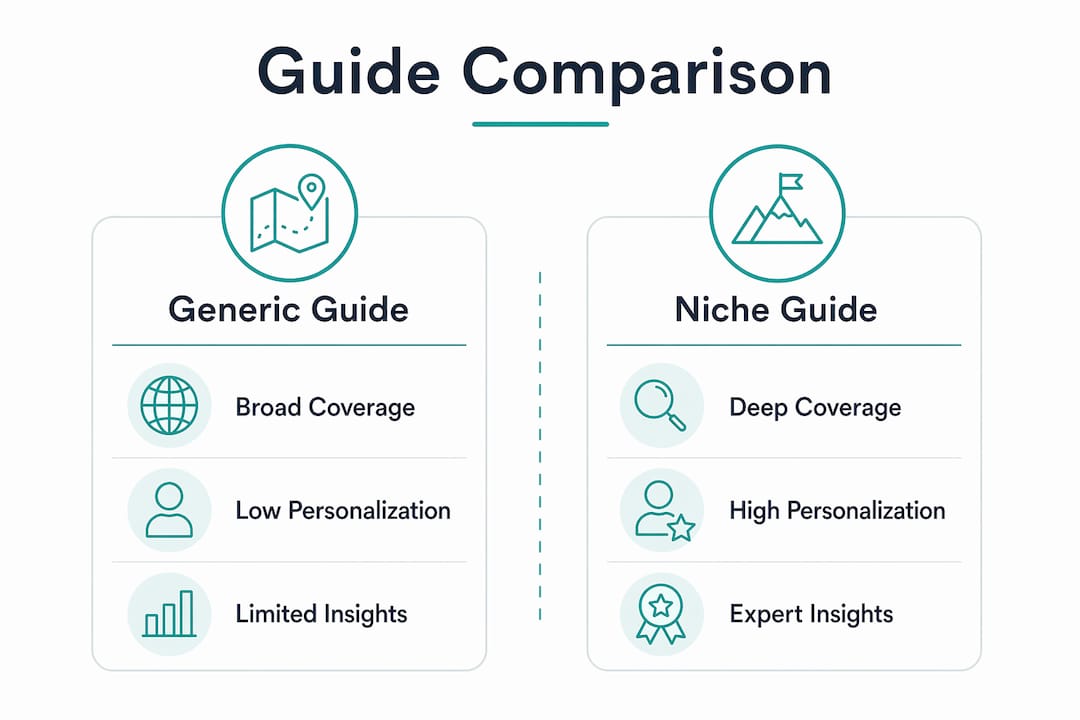
| Feature | Generic travel guide | Niche itinerary guide |
|---|---|---|
| Coverage | Broad destination overview | Focused on one interest or traveler type |
| Personalization | Minimal, one-size-fits-all | Built around specific passions or demographics |
| Expert insight | General editorial content | Specialist knowledge, vetted local contacts |
| Community | None | Built-in network of like-minded travelers |
| Cost-effectiveness | Low upfront cost, poor experience fit | Higher upfront investment, higher per-hour value |
Niche tourism operators consistently document 15 to 30% higher profit margins than mass-market operators. That margin exists because travelers willingly pay a premium for specialization. The per-experience value justifies the price. A generic package might cost less on paper, but if half the itinerary does not interest you, the effective cost per meaningful hour is far higher.
The curated vs. generic itinerary debate also has a practical dimension. Generic guides require you to do significant secondary research to fill the gaps. A niche guide arrives with those gaps already closed by someone with domain expertise.
Pro Tip: When evaluating a niche guide, check whether the author or curator has firsthand experience in that specific travel category. A culinary guide written by a trained chef carries different authority than one assembled from aggregated reviews.
What practical ways can travelers use niche guides on the ground?
Knowing why to use a niche guide is only half the equation. Here is how to get the most from one before and during your trip.
- Use it as a framework, not a script. Niche guides provide mental clarity that enables spontaneity rather than restricting it. When logistics and context are handled, you are free to follow a local recommendation or linger somewhere unexpected without losing the thread of your trip.
- Pair it with real-time digital tools. Apps like Google Maps, Rome2rio, and weather platforms handle live conditions. Your niche guide handles the why and what. Combining both gives you expert curation with real-time flexibility.
- Lean on offline reliability. Travel guides work anywhere and capture cultural nuances that search engines miss. In remote areas of Patagonia or rural Japan, a downloaded or printed niche guide is more reliable than any data connection.
- Use the community angle actively. If your niche guide connects to a tour group, online forum, or social channel, engage with it before you travel. Fellow niche travelers are your best source of real-time updates, local tips, and on-the-ground support.
- Build your schedule around anchor experiences, not time slots. Identify the two or three non-negotiable experiences in your guide and protect those. Let everything else flex around them. This approach preserves the spirit of the guide while leaving room for the unexpected.
For travelers who want expert trip curation without spending weeks on research, pairing a niche guide with a planning platform that handles logistics is the most time-efficient approach available.
What types of niche itinerary guides are available?
Niche guides exist for virtually every travel motivation, and the category you choose should match your primary reason for traveling, not just your destination.
- Adventure travel guides cover trekking routes, surf breaks, climbing areas, and multi-sport itineraries. Niche guides for adventure travel typically include gear lists, fitness prerequisites, and safety protocols that generic guides omit entirely.
- Culinary tour guides map out food markets, regional producers, restaurant reservation windows, and cooking class schedules. These are particularly valuable in destinations like Japan, Italy, and Mexico where food culture is hyper-regional.
- Cultural immersion guides focus on language basics, local customs, festival calendars, and neighborhood-level history. They are built for travelers who want to understand a place, not just photograph it.
- Eco-tourism and sustainability guides identify certified operators, low-impact accommodations, and conservation projects that welcome visitors. This category is growing rapidly as travelers seek to align spending with values.
- Wellness retreat guides cover yoga centers, thermal spas, meditation programs, and nutrition-focused resorts. They often include practitioner credentials and program structures that standard booking platforms do not surface.
Solo travelers benefit particularly from niche guides because the built-in community effect reduces the social isolation that can accompany independent travel. Identity-driven groups, such as LGBTQ+ travelers, senior adventurers, or families with specific dietary needs, find that niche guides address their requirements directly rather than as an afterthought. Budget-conscious explorers also gain from customized travel planning because a guide that matches their priorities eliminates spending on experiences they would not have chosen anyway.
The key is identifying your travel niche before you start planning. Ask yourself what you would do on a free afternoon in an unfamiliar city. That answer usually points directly to the guide category that will serve you best.
Key takeaways
Niche itinerary guides outperform generic travel resources because they match expert-curated content to a traveler's specific identity, maximizing value from every hour and dollar spent.
| Point | Details |
|---|---|
| Personalization drives demand | 84% of travelers want itineraries that reflect their identity, making niche guides the default choice for intentional travel. |
| Budget efficiency is built in | Niche guides direct spending toward experiences you value, eliminating waste on irrelevant activities. |
| Expert curation beats aggregation | Vetted specialist knowledge and local contacts deliver access that generic guides and search engines cannot match. |
| Community is a core feature | The social connections formed through shared-interest travel increase satisfaction and repeat booking rates. |
| Flexibility, not rigidity | Niche guides provide a reliable framework that frees travelers to embrace spontaneity rather than constraining it. |
Why intentional travel starts with the right guide
I have planned trips using every format available, from thick destination bibles to algorithm-generated day plans. The most consistently satisfying trips I have taken shared one thing: the planning started with a clear answer to why I was going, not just where.
Generic guides are built for the average traveler. The problem is that the average traveler does not exist. Every person sitting on a plane has a different reason for being there, a different budget ceiling, and a different definition of a good day. A guide that tries to serve all of them ends up serving none of them particularly well.
What I find most underrated about specialized guides is the confidence they create on the ground. When you arrive in a city with a guide that was built for someone exactly like you, the decision fatigue disappears. You are not scrolling through reviews at 9 p.m. trying to figure out where to eat. You already know, because someone who shares your priorities made that call in advance.
The social dimension also tends to surprise people. I have watched complete strangers bond over a shared niche itinerary faster than any organized icebreaker could manage. A cycling route through Provence or a street food tour in Penang gives people an immediate shared language. That is not a side benefit. For many travelers, it becomes the most memorable part of the trip.
My honest advice: stop choosing your guide after you choose your destination. Choose your guide first, based on what you care about most, and let it point you toward the right place.
— Helen
Plan your next trip with Destlist
Destlist combines AI-powered planning with human travel curators to build itineraries around what you actually care about, whether that is adventure, food, culture, or wellness. Every plan includes day-by-day activities, mapped routes, flight and hotel matching, and weather alerts, all delivered within 24 hours. You do not need to spend evenings cross-referencing travel blogs. Explore custom travel itineraries built to your exact preferences, or browse specialized adventure destinations to find the niche that fits your next trip. Tailored planning is not a premium add-on. It is the starting point.
FAQ
What are niche itinerary guides?
Niche itinerary guides are travel plans built around a specific interest, traveler identity, or travel style rather than a general destination overview. They provide expert-curated recommendations, vetted local contacts, and structured experiences aligned with a traveler's core motivation.
How do niche itinerary guides save money?
Niche guides direct your budget toward experiences you genuinely value and eliminate spending on activities that do not match your interests. This strategic allocation means you spend less overall while getting more from every dollar.
Are niche guides only for luxury travelers?
No. Niche travel is defined by passion and specificity, not price point. Budget-conscious travelers benefit significantly because a guide built around their priorities removes the guesswork and prevents costly mismatches between expectations and reality.
What types of travelers benefit most from niche guides?
Solo travelers, hobbyists, identity-driven groups, and anyone with a strong primary travel motivation gain the most from specialized guides. The built-in community effect and expert curation are particularly valuable for travelers who want depth over breadth.
How do I choose the right niche travel guide?
Identify your single strongest reason for traveling, whether that is food, adventure, culture, wellness, or sustainability, and select a guide built by specialists in that category. Verify that the guide author has firsthand experience in the niche, not just editorial familiarity with the destination.