
TL;DR:
- A themed itinerary centers travel around a specific focus, creating cohesive, meaningful experiences.
- Key tools and templates help quickly build flexible plans with prioritized bookings, supporting activities, and buffers.
- Flexibility and selective planning lead to more enjoyable trips, trusting the theme to guide spontaneous experiences.
You've spent three evenings researching restaurants, museums, and hotels, only to arrive at your destination and realize your days zigzag across town, your dinner reservation clashes with your tour, and half your "must-dos" don't actually connect. This is what happens when travel planning lacks a central thread. A themed itinerary fixes that by organizing every element of your trip around one clear focus, whether that's culinary adventures, wellness retreats, outdoor exploration, or cultural immersion. This guide walks you through exactly how to build one efficiently, even if you only have a few hours to plan.
Table of Contents
- What makes a great themed itinerary?
- Tools and templates for fast, structured planning
- Step-by-step: Building your personalized themed itinerary
- Mistakes to avoid and troubleshooting your itinerary
- How to verify, optimize, and enjoy your themed itinerary
- The truth most guides miss about themed itineraries
- Streamline your next themed trip with DestList
- Frequently asked questions
Key Takeaways
| Point | Details |
|---|---|
| Anchor bookings first | Start your themed itinerary by securing main reservations, like restaurants or tours, before adding supporting activities. |
| Use planning tools | Leverage templates, apps, and checklists to streamline your trip planning and stay organized. |
| Balance structure and flexibility | Limit your schedule to 2-3 key activities per day and leave room for spontaneity to increase enjoyment. |
| Plan backups and buffers | Always prepare for weather changes or cancellations with alternative indoor options and free time in your schedule. |
What makes a great themed itinerary?
To build the right foundation, let's clarify what sets an effective themed itinerary apart from just making a list of activities.
A themed itinerary is a travel plan built around a central idea or interest. That theme becomes the filter for every decision you make, from which hotel you book to which neighborhoods you explore. A food-focused trip in Barcelona looks radically different from a wellness escape in Bali, even if both include beaches and beautiful scenery. The theme is what gives your trip a narrative and makes experiences feel cohesive rather than random.
The key ingredients of a strong themed itinerary include:
- A clear anchor booking. This is your centerpiece reservation or event, such as a chef's table dinner, a guided hiking experience, or a spa day. Customized travel itineraries consistently perform better when they start with one anchor and build outward from there.
- Supporting activities that reinforce the theme. These are 2-3 experiences per day that complement the anchor without overwhelming the schedule.
- Structured time blocks with budget notes. A good itinerary isn't just a list. It includes when things happen, how long they take, and roughly what they cost.
- Built-in flexibility. The most enjoyable itineraries leave about 20% of the schedule intentionally open.
Per travel itinerary templates, prioritizing one anchor booking first, then filling in supports using templates with time blocks, budgets, and checklists, is the most efficient approach for time-poor travelers. It prevents the trap of spending hours on minor details before confirming the most important reservation.
Here's a quick look at how themed itineraries compare to standard ones:
| Feature | Standard itinerary | Themed itinerary |
|---|---|---|
| Structure | Activity list by day | Organized around a central focus |
| Decision-making | Arbitrary | Filtered through theme |
| Flexibility | Often rigid or vague | Built-in buffers and open slots |
| Enjoyment level | Variable | Consistently higher |
| Planning time | Longer | Shorter with the right tools |
Pro Tip: Always confirm your single most important booking before planning anything else. If that anchor falls through, your entire schedule could need to be rebuilt anyway.
Tools and templates for fast, structured planning
With the essentials established, let's move to the hands-on tools and formats that make themed trip planning faster and more reliable.
The right tools dramatically reduce the time it takes to go from idea to ready-to-go plan. According to travel itinerary planning tools, practical tools like templates and apps, combined with real-world testing of feasibility and balance, are what separate stress-free travel from frustrating trips, especially for time-poor travelers.
Here's how some of the most popular planning options compare:
| Tool | Best for | Speed | Customization | Cost |
|---|---|---|---|---|
| Notion/Google Docs templates | Manual planners | Moderate | High | Free |
| TripIt | Organizing confirmations | Fast | Low | Free/Paid |
| Wanderlog | Visual map-based planning | Fast | Moderate | Free/Paid |
| DestList | Done-for-you themed itineraries | Very fast | Very high | Premium |
| Rome2Rio | Transport logistics | Fast | Low | Free |
Learning about itinerary formatting for efficiency can help you structure any of these tools more effectively. The format matters as much as the content, especially when you're sharing the plan with travel companions.
To create a usable template quickly, follow these steps:
- Choose your time blocks. Divide each day into morning, afternoon, and evening slots. Each block gets one primary activity.
- Input your anchor booking first. Lock in the time, location, and any preparation it requires (dress code, transport, duration).
- Add supporting activities by theme. Fill remaining slots with experiences that reinforce your central focus.
- Attach rough budget figures to each item. This prevents overspending and helps you make fast swap decisions if needed.
- Run a quick feasibility check. Map out the physical locations of each activity to confirm you're not spending more time in transit than actually enjoying the experience.
Using AI tips for travel planning can cut the time spent on step 5 dramatically. AI-powered tools can detect routing conflicts, suggest alternatives, and even flag seasonal closures before they become real problems.
It also helps to understand what best types of trip planners work for different travel styles. A solo adventurer needs different tools than a family of five planning a multi-city trip.
Step-by-step: Building your personalized themed itinerary
Now it's time to assemble your real-world themed itinerary, step by step.
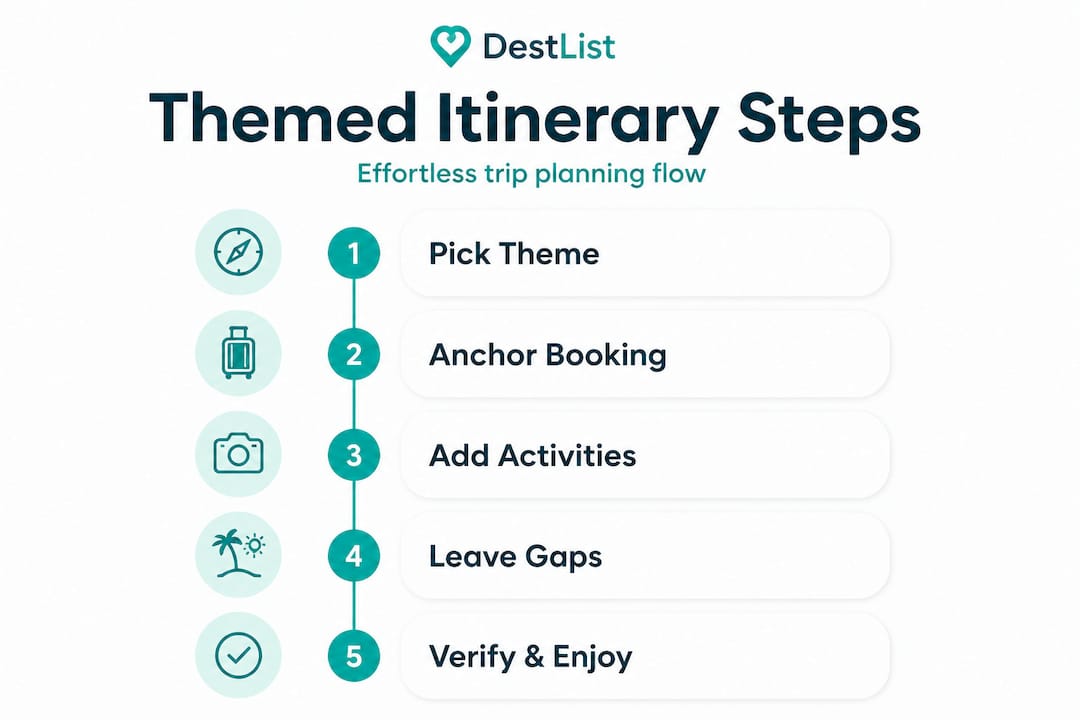
Most families spend 16 to 20 hours researching a single trip. Following a themed structure cuts that research time roughly in half because you're only evaluating options that fit your focus. Every decision runs through the same filter: does this match the theme?
Here's the full process:
-
Define your theme clearly. Be specific. "Food" is too broad. "Farm-to-table dining and local food markets in Tuscany" gives you a precise filter for every booking decision.
-
Anchor with one key reservation or event. This could be a cooking class, a private winery tour, or a reservation at a Michelin-starred restaurant. Book this first. It becomes your scheduling center of gravity. Experts recommend planning at least 30 days ahead for popular bookings to lock in availability and better rates.
-
Build 2-3 supporting activities per day. These activities reinforce the theme without packing the schedule too tightly. A food trip might include a morning market visit, an afternoon cooking demonstration, and an evening tapas walk. Leave the rest open.
-
Add 20% time buffers throughout. If a cooking class runs from 10am to 1pm, don't book lunch at 1:15pm. Give yourself real transition time, especially in unfamiliar cities where delays are common.
-
Fill in transport, meals, and logistics. Map the physical flow of each day so you're not unnecessarily crossing the city multiple times. Group nearby activities together.
-
Schedule a review session. Before finalizing, read through the itinerary as if you're living it. Does the energy level vary enough between days? Are there any obvious gaps or conflicts?
Pro Tip: Saving time on trip planning starts before you open a single booking site. Write your theme and anchor idea on paper before touching a device. It keeps you from falling into the research rabbit hole before you've set your parameters.
For travelers who want the full picture, the custom itinerary guide on DestList walks through how to go from a raw travel idea to a fully mapped, ready-to-book plan.
Mistakes to avoid and troubleshooting your itinerary
Even the best plans encounter challenges. Here's how to sidestep mistakes and stay adaptable.
The single most common mistake in themed itinerary planning is over-scheduling. It's tempting to fill every hour, especially when you've done hours of research and don't want to waste a single discovery. But packed schedules create stress, eliminate serendipity, and often lead to less enjoyment, not more.
Research on itinerary flexibility shows that weather disruptions, closures, and group-routing conflicts are among the top reasons trips feel frustrating. The fix is designing for flexibility from the start, not as an afterthought.
Common mistakes and their fixes:
- Over-planning: Leave at least 20% of each day completely open. These gaps often become the best memories.
- Single-point-of-failure bookings: If your anchor activity cancels, do you have a backup? Always identify one alternative for your most critical reservation.
- Ignoring group dynamics: If you're traveling with others, crowd-aware sequencing matters. This means planning popular attractions for off-peak hours to avoid long waits that derail schedules.
- Ignoring weather patterns: Budget itinerary tips often include a note about weather, and for good reason. Always have at least one indoor alternative per day for outdoor-heavy themes.
- Locking in too many paid activities upfront: Refundable or flexible booking options protect your schedule if something shifts.
"Retain 20% spontaneity to maximize flexibility and enjoyment." This isn't just advice for people who hate planning. Even the most organized travelers find that some of their best travel stories come from moments that weren't on any list.
The concept of crowd-aware sequencing is worth explaining more. It simply means visiting your most popular, high-traffic activities at times when fewer people are there. Museums and landmarks often have predictable peak periods. Scheduling around them, rather than defaulting to midday visits, keeps your flow smoother and your mood better.
How to verify, optimize, and enjoy your themed itinerary
The final touch is reviewing and tweaking your itinerary for the smoothest possible experience.

A plan that looks perfect on paper can still have hidden friction. The verification stage is where you catch those problems before they cost you time or enjoyment during the actual trip. Drawing from travel itinerary optimization research, the most satisfying trips result from plans that prioritize real-world feasibility over theoretical completeness.
Follow these steps to verify and optimize:
-
Walk through the itinerary realistically. Read each day as if you're experiencing it in real time. Note anywhere the timing feels rushed or the transitions feel awkward.
-
Check for geographic flow. Are you bouncing between opposite ends of the city? Group activities by neighborhood or district whenever possible to reduce transit fatigue.
-
Review all backup plans. For each anchor booking, confirm your alternative. For each outdoor activity, confirm your indoor option.
-
Confirm all bookings at least one week before departure. Reservations occasionally drop off without notification. A quick email or call confirms everything is in place and gives you time to adjust if not.
-
Do a final energy audit. Look at the overall pacing. Are early mornings followed by lighter afternoons? Are there recovery windows after long or physically demanding days? The 8-step travel planning guide from DestList includes a helpful framework for this final check.
-
Visualize the trip emotionally. Close your eyes and mentally walk through the highlights. Does the itinerary feel energizing or exhausting? If it feels like a checklist rather than a trip, cut something.
The goal of verification isn't perfection. It's confidence. You want to arrive at your destination knowing you've thought through the important details, left room for the unexpected, and set yourself up to actually enjoy the experience.
The truth most guides miss about themed itineraries
After mastering the mechanics, here's what years of real-world themed trip planning reveal that most guides won't tell you.
Most planning advice focuses on what to include. The better question is what to leave out.
Rigid itineraries feel productive in the planning phase. You've researched everything, confirmed every slot, and built a schedule that seems airtight. But in practice, the most rigid trips tend to produce the most frustration. One delay snowballs. One preference shifts. One recommendation from a local changes everything. And suddenly you're torn between following the plan and following the moment.
Here's the uncomfortable truth: the travelers who enjoy their trips most are rarely the ones who planned the most. They're the ones who planned well, then stayed open. They chose a theme with intention, secured the one or two bookings that truly mattered, and then let the rest unfold with curiosity rather than anxiety.
A great theme isn't a cage. It's a compass. It points you in a direction without telling you every step to take. When you realize that, you stop trying to optimize every hour and start trusting that a well-chosen focus will naturally surface the right experiences.
The platforms and guides that talk about customization for more enjoyable trips are onto something important: personalization isn't about more options. It's about the right options, filtered through what actually matters to you. That's the real power of a themed itinerary. Not efficiency for its own sake, but clarity that makes enjoyment feel effortless.
Leave the intentional gaps. Say yes to the unplanned dinner. Let a local redirect your afternoon. The theme will still be there, holding the experience together.
Streamline your next themed trip with DestList
If building from scratch still feels overwhelming, there's an easier way.
DestList combines AI-powered planning with real human expertise to build custom travel itineraries that are themed, mapped, and ready to book within 24 hours. You share your preferences, your travel style, and your must-haves, and we do the rest.
For busy professionals and time-strapped travelers, done-for-you planning means no more spreadsheet rabbit holes, no more conflicting tabs, and no more second-guessing your research. Every itinerary includes matched flights and hotels, curated day-by-day activities, mapped routes with walking times, and weather alerts. The DestList travel planner also includes packing lists, budget estimates, and a free destination discovery tool to help you choose where to go if you haven't decided yet. It's everything a great themed itinerary requires, without the hours it normally takes to put one together.
Frequently asked questions
What is a themed itinerary?
A themed itinerary is a travel plan organized around a central interest, such as food, history, art, or adventure, to give your trip focus and memorable experiences.
How early should I start planning a themed itinerary?
Experts recommend starting at least 30 days before your trip to secure popular bookings, improve availability, and save money.
How many activities should I include in a day?
Limit your schedule to 2-3 activities per day and leave roughly 20% of your time unplanned to keep the experience flexible and enjoyable.
How do I keep a group itinerary flexible?
Build backups for key bookings, use crowd-aware sequencing to time activities for off-peak hours, and always keep at least 20% of your schedule open to adapt to group preferences and unexpected changes.