
TL;DR:
- Proper trip planning saves time, money, and reduces stress for busy professionals.
- An iterative framework focusing on goals, destination, budget, and flexibility ensures effective travel plans.
- Using tools and strategies like early booking, geographic grouping, and backup options enhances resilience.
Most travelers assume that winging it feels freeing, but the reality hits hard once you're standing in a foreign city with no restaurant reservation, a hotel that's fully booked, and three hours burned on logistics. Spending just 3 to 5 hours planning before you leave can save you more than 10 hours of wasted time during the trip itself. For busy professionals, that math is impossible to ignore. This guide breaks down a proven, flexible framework for trip planning that works whether you have two weeks or two days to prepare. No fluff, no vague advice. Just a structured approach you can actually use.
Table of Contents
- Why trip planning matters for busy professionals
- Core framework: The iterative approach to comprehensive trip planning
- Time-saving strategies and smart tools for professionals
- Personalization, flexibility, and contingency planning
- Our perspective: The truth about what actually works in trip planning
- Take the next step: Plan smarter with DestList
- Frequently asked questions
Key Takeaways
| Point | Details |
|---|---|
| Smart prep saves time | A few hours of structured planning can reclaim more than 10 hours on your actual trip. |
| Iterative approach wins | Non-linear, flexible frameworks deliver better results than rigid checklists. |
| Strategic tool use | Blend proven digital tools, checklists, and AI with human oversight for optimal efficiency. |
| Personalize and adapt | Tailor itineraries for your must-sees, keep 30 percent unplanned for flexibility, and plan for surprises. |
Why trip planning matters for busy professionals
There's a persistent myth that over-planning kills the magic of travel. But for professionals who already manage packed calendars, the opposite is true. Structure creates space for genuine enjoyment. Without a plan, you spend your vacation making decisions you could have made from your couch.
"Well-structured travel saves time and money. The leisure travel market is projected to grow from $5 trillion in 2024 to $15 trillion by 2040, and travelers who invest time upfront consistently get more from their trips."
That growth signals one thing: more competition for the best hotels, flights, and experiences. Waiting until the last minute means paying premium prices for second-rate options. Planning ahead is a competitive advantage, not a chore.
Understanding why trip planning matters goes beyond logistics. It's about protecting your mental energy. When your itinerary is ready, your brain shifts from problem-solving mode to experience mode. That's the whole point of a vacation.
Here's what consistently goes wrong without a plan:
- Last-minute bookings that cost significantly more and offer fewer choices
- Missed experiences because iconic spots require advance reservations
- Wasted transit time from poor geographic routing between activities
- Decision fatigue that drains energy better spent on enjoying the trip
- Reactive stress from delays or cancellations with no backup plan
For busy professionals, every one of those pain points is amplified. You have less tolerance for wasted time and fewer mental resources to troubleshoot on the fly. An expert guide to streamlined planning treats planning not as overhead but as the first investment in a great trip.
Core framework: The iterative approach to comprehensive trip planning
Most people think of trip planning as a straight line: pick a destination, book flights, done. But experienced travelers know it's a loop. You revisit decisions as new information comes in, and that's not inefficiency. That's how good plans get built.
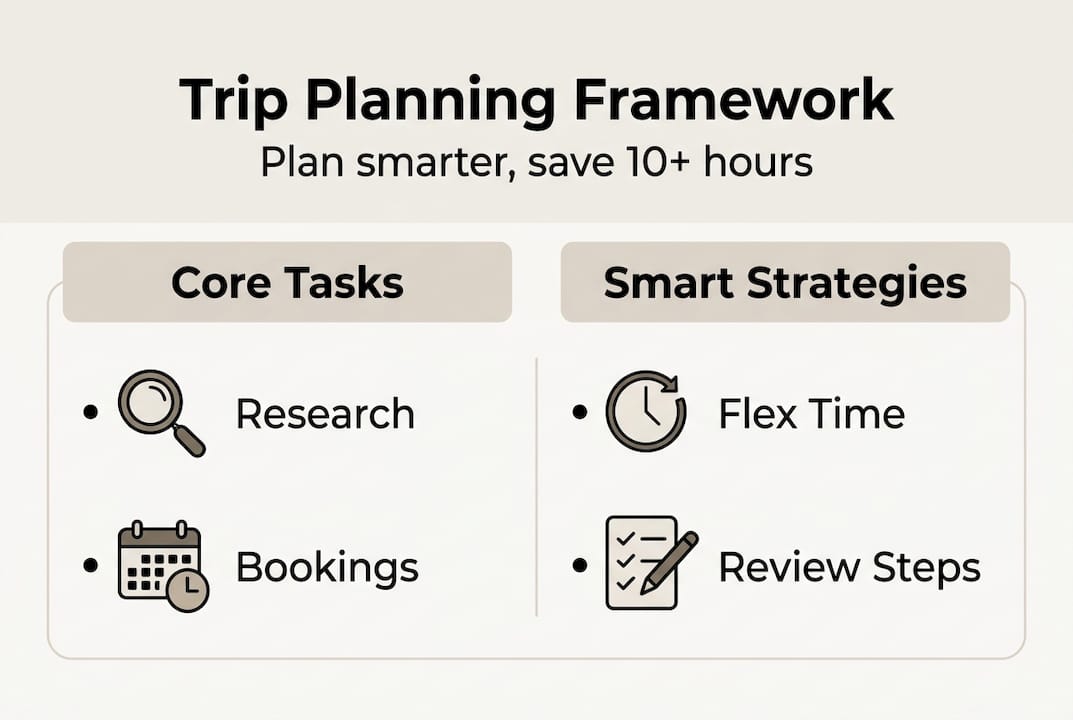
The iterative planning process follows these key phases:
- Define your trip goals — Rest, adventure, culture, food? Get specific before you search for anything.
- Choose your destination — Let your goals filter the options rather than picking a place and forcing your goals to fit.
- Set a realistic budget — Include flights, accommodation, meals, activities, and a 15% buffer for surprises.
- Book the essentials — Flights and accommodation first. Everything else builds around these anchors.
- Design your daily itinerary — Group activities by neighborhood to minimize transit. Use the 8-step planning process as a reference.
- Build contingency options — Have a backup restaurant, a rainy-day activity, and a flexible checkout option where possible.
The most important rule: plan about 70% of your time and leave 30% open. Rigid schedules collapse under real travel conditions. Flexibility isn't laziness. It's resilience.
Pro Tip: Before you open a single booking site, write down your top three non-negotiables for the trip. Every planning decision should serve those three things. This single step prevents scope creep and saves hours of indecision.
Here's a quick reference for how to allocate your pre-trip planning time:
| Planning phase | Recommended time investment | Priority level |
|---|---|---|
| Goal setting and destination research | 60 to 90 minutes | High |
| Flight and hotel booking | 45 to 60 minutes | High |
| Daily itinerary design | 60 to 90 minutes | Medium |
| Contingency and document review | 30 minutes | High |
For travelers watching their budget, budget-friendly planning tools can help you stretch every dollar without sacrificing quality. And for those who want a step-by-step walkthrough, stress-free planning steps lay out the process in plain language.
Time-saving strategies and smart tools for professionals
Knowing the framework is one thing. Executing it efficiently is another. The right tools and booking habits can cut your planning time in half without cutting corners.

Booking windows matter more than most travelers realize. Book domestic flights 4 to 8 weeks in advance and international flights 9 to 12 months out for the best combination of price and availability. Waiting longer doesn't just cost more money. It limits your options entirely.
| Trip type | Ideal booking window | Risk of waiting |
|---|---|---|
| Domestic flights | 4 to 8 weeks ahead | Higher prices, fewer seats |
| International flights | 9 to 12 months ahead | Sold-out routes, premium pricing |
| Popular hotels | 3 to 6 months ahead | Limited room types |
| High-demand tours | 2 to 4 months ahead | Waitlists or no availability |
For digital tools, a few stand out for busy professionals:
- Google Sheets for building a master trip document with links, costs, and confirmation numbers
- Google MyMaps for plotting activities geographically so you can spot routing inefficiencies
- AI itinerary generators for rapid first drafts. Review AI itinerary tips to learn how to prompt these tools effectively
- Standardized packing checklists that you reuse and adjust per trip rather than rebuilding from scratch. A solid packing checklist saves 30 to 45 minutes per trip
For professionals managing frequent travel, corporate travel strategies offer additional workflow ideas worth borrowing even for leisure trips. Delegation is underused. If you have an executive assistant or access to a travel management company, hand off complex multi-leg bookings. Your time has a dollar value. Use it on decisions that actually require your judgment.
Pro Tip: Create a reusable "trip starter" template in Google Docs with sections for goals, budget, flights, hotels, daily plans, and emergency contacts. Copy it for every new trip. You'll never start from zero again.
Personalization, flexibility, and contingency planning
A plan built for someone else isn't really a plan. The most efficient itinerary is one that fits your specific energy levels, interests, and risk tolerance. Generic templates are a starting point, not a finish line.
Start by identifying your non-negotiables. These are the two or three experiences that would make the trip feel worthwhile regardless of anything else. Build your schedule around those first, then fill in the rest.
Geographic grouping is one of the most underused tactics in itinerary design. Cluster your activities by neighborhood or district each day. You'll cut transit time dramatically and feel less rushed. Think of it as batching your errands, but for experiences.
"Integrating business and leisure travel, verifying travel documents six or more months before departure, and planning for disruptions are the three moves that separate smooth trips from stressful ones."
Here's a practical contingency checklist every professional traveler should run through:
- Passport validity — Many countries require six months of remaining validity beyond your travel dates
- Visa requirements — Check at least three months out; some visas take weeks to process
- Travel insurance — Covers cancellations, medical emergencies, and lost luggage. Non-negotiable for international trips
- Backup accommodation — Know your options if your hotel has an issue
- 24/7 support contact — Your airline, hotel chain, or travel platform should have one
- Sustainable choices — Where possible, opt for local guides, regional transport, and low-impact activities
For a deeper look at making your entire planning process more resilient, stress-free travel optimization covers the specific moves that reduce disruption risk. The goal isn't a perfect plan. It's a plan that holds up when things go sideways.
Our perspective: The truth about what actually works in trip planning
After working with thousands of travelers, one pattern stands out: the people who have the best trips aren't the ones with the most detailed itineraries. They're the ones who invested the most time in goal-setting at the very beginning and then stayed flexible throughout.
Most planning guides treat AI tools as a silver bullet. They're not. AI-generated itineraries accelerate the process significantly, but they hallucinate. They'll suggest a restaurant that closed two years ago, recommend a walking route that takes twice as long as listed, or miss the fact that a major attraction is under renovation. Human review isn't optional. It's the whole job.
The two most overlooked moves in trip planning are scheduling "nothing blocks" and double-checking all AI output against real sources. A nothing block is a two-hour window with no agenda. It sounds wasteful. It's actually where the best travel memories happen, because you're present and unhurried rather than racing to the next pin on the map.
For better itinerary formatting tips that make your plan easier to follow in the field, small structural choices make a big difference. The travelers who struggle most are those who outsource their thinking entirely to a tool and never stress-test the output against reality.
Take the next step: Plan smarter with DestList
If building all of this from scratch still sounds like more work than you want to take on, that's exactly the problem DestList was built to solve.
DestList combines AI-powered planning with human expertise to deliver personalized, ready-to-book itineraries for top destinations, including flights, hotels, day-by-day activities, and mapped routes with estimated walking times. You share your preferences, and within 24 hours you get a complete plan tailored to your schedule and budget. As your online travel planner, DestList handles the research, routing, and logistics so you can focus on actually looking forward to your trip. For busy professionals, that's not a luxury. It's the only approach that makes sense.
Frequently asked questions
How early should I start planning a complex trip?
For international travel to high-demand destinations, start planning 9 to 12 months in advance. Domestic trips typically need just 4 to 8 weeks of lead time to secure good options.
What's the most efficient way to build an itinerary?
Group activities geographically to reduce transit time, lock in your must-sees first, and keep 30% of your schedule open for flexibility. This structure prevents both over-planning and under-planning.
Are AI itinerary planners reliable for all trips?
AI tools speed up the drafting process considerably, but AI-generated plans need careful human review to catch errors in timing, availability, and local accuracy before you rely on them.
How can I make my travel plans more resilient to unexpected changes?
Build buffer time into each day, verify documents and insurance at least six months before departure, and always have a backup option for your most critical bookings.