
Travelers visit 38 sites and spend more than 8 hours planning a single one-week trip. That's a full workday lost to browser tabs, conflicting reviews, and second-guessing yourself before you've even packed a bag. For busy leisure travelers, that kind of time drain isn't just frustrating. It's a real cost. The good news is that a smarter approach to trip planning doesn't just save hours. It makes the trip itself better, cheaper, and far less stressful from start to finish.
Table of Contents
- The emotional and practical impact of trip planning
- What happens when you don't plan? Time, cost, and stress
- Trip planning strategies for maximum efficiency
- How personalized plans save time and boost trip enjoyment
- Turning knowledge into action: fast-track your next trip
- Plan smarter with DestList's online travel planner
- Frequently asked questions
Key Takeaways
| Point | Details |
|---|---|
| Boosts happiness | Planned trips make you happier before and during travel by reducing stress and raising anticipation. |
| Saves time and money | Efficient planning helps you avoid wasted hours and last-minute expenses. |
| Personalized flexibility | Customizing your itinerary creates a better fit for your group’s needs and boosts overall enjoyment. |
| Reduces travel regret | Smart planning prevents missing out on must-see experiences and minimizes FOMO. |
The emotional and practical impact of trip planning
Most people think of trip planning as a chore. But research tells a different story. When you have a trip booked and mapped out, your brain starts enjoying the vacation before it even begins. Anticipation is a genuine source of happiness, and a well-planned trip delivers it in full.
The numbers back this up. According to travel research, 82% of travelers report an improved mood after booking a trip, and 97% say they feel happier when their trip is properly planned. That's not a small effect. That's nearly every traveler experiencing a measurable emotional lift just from having a plan in place.
Beyond mood, planning reduces the anxiety that comes from uncertainty. When you know where you're sleeping, how you're getting around, and what you're doing each day, you stop worrying. You stop second-guessing. You actually relax.
Here's what poor planning typically costs travelers emotionally:
- Constant decision fatigue during the trip itself
- FOMO from missing out on must-see spots due to poor routing
- Regret over overpaying for last-minute options
- Exhaustion from trying to figure things out on the fly
"A planned trip isn't just more organized. It's more enjoyable from the moment you book it."
For practical stress-free travel tips that go beyond the basics, the difference between a rushed trip and a well-paced one often comes down to a few hours of upfront effort.
What happens when you don't plan? Time, cost, and stress
Skipping the planning phase feels like a time-saver. It rarely is. The costs show up later, and they're bigger than most travelers expect.

One of the clearest examples is accommodation pricing. Last-minute hotel bookings routinely cost significantly more than reservations made weeks in advance. The same room, the same hotel, but a dramatically higher price just because you waited. And 29% of travelers book last-minute specifically because they ran out of time to plan earlier, which means the cost spike is entirely avoidable.
Here's a quick comparison of planned versus unplanned travel outcomes:
| Factor | Planned trip | Unplanned trip |
|---|---|---|
| Hotel cost | Lower, locked-in rates | Higher last-minute prices |
| Flight cost | Better fares booked early | Premium pricing or poor timing |
| Time on research | Concentrated upfront | Scattered and ongoing |
| Stress level | Low, clear expectations | High, constant decisions |
| Experience quality | Curated, smooth flow | Reactive, hit or miss |
Beyond cost, unplanned trips create a cascade of small frustrations. You waste time on scattered research mid-trip. You miss experiences because you didn't know they required advance booking. You end up eating at whatever restaurant is nearby rather than the one you actually wanted.
Pro Tip: Before your next trip, spend 30 minutes identifying the three experiences you absolutely cannot miss. Book those first. Everything else can flex around them.
For travelers who want to cut research time even further, exploring trip planning tools that consolidate flights, hotels, and activities into one view can eliminate hours of tab-switching. And if packing stress is part of your pre-trip anxiety, a solid guide to efficient travel packing can remove one more item from your mental load.
Trip planning strategies for maximum efficiency
Knowing that planning matters is one thing. Actually doing it efficiently is another. The good news is that a few proven frameworks can cut your planning time dramatically without sacrificing quality.
Structured planning approaches like anchor-first booking, the 80/20 rule, time buffers, and one-page dashboards are consistently the most effective methods for time-strapped travelers. Here's how each one works in practice:
- Anchor-first booking: Lock in your flights and main hotel before anything else. These are the hardest to change and the most expensive if left to the last minute. Once anchored, everything else builds around them naturally.
- The 80/20 rule: Focus 80% of your planning energy on the 20% of experiences that will define the trip. A great dinner, a bucket-list landmark, a specific neighborhood. The rest can be spontaneous.
- Time buffers: Build 90-minute gaps between major activities. Travel always takes longer than expected, and buffers prevent one delay from ruining the rest of your day.
- One-page dashboard: Summarize your entire trip on a single page or document. Dates, confirmations, key addresses, and daily highlights. No digging through emails mid-trip.
For a deeper look at how these planning frameworks apply to curated travel, the principles are the same whether you're planning solo or for a group.
| Strategy | Time saved | Best for |
|---|---|---|
| Anchor-first | 2-3 hours | All trip types |
| 80/20 rule | 1-2 hours | Experience-focused travelers |
| Time buffers | Reduces on-trip stress | Families, first-time visitors |
| One-page dashboard | 30-60 minutes | Busy professionals |
Pro Tip: Use activity planning checklists to pre-sort your must-dos by neighborhood or area. Grouping activities geographically cuts transit time and keeps your days flowing smoothly.
For travelers who want to take this further, AI travel planning tools can apply these frameworks automatically, generating optimized day-by-day itineraries in minutes rather than hours.
How personalized plans save time and boost trip enjoyment
Efficiency matters, but personalization is what turns a good trip into a great one. A generic itinerary might cover the highlights, but it won't account for the fact that your group includes a 7-year-old who needs a nap by 2pm, or a parent with limited mobility, or a colleague who wants to squeeze in a morning run.
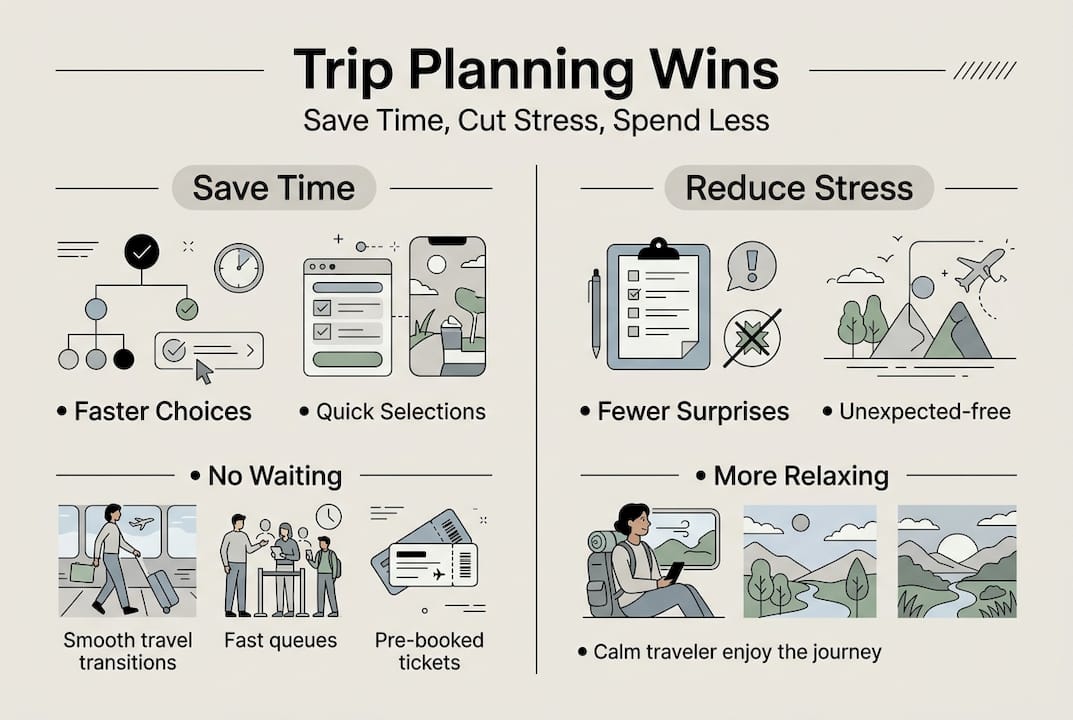
Purpose-driven, flexible plans with built-in contingencies are especially valuable when your vacation time is limited. When you only have five days off, a single bad day from poor planning isn't just annoying. It's a significant portion of your entire trip gone.
Personalization also addresses the mental side of travel. Research from HospitalityNet shows that travelers who plan with purpose, rather than just logistics, experience less FOMO, spend more within their budget, and feel more flexible when things don't go exactly as expected. That mental preparation is just as valuable as knowing your hotel check-in time.
Here's what a truly personalized plan accounts for:
- Group energy levels and pace preferences
- Kid-friendly or accessibility-friendly routing
- Weather contingencies and backup indoor options
- Budget limits per activity category
- Personal interests beyond the standard tourist circuit
"The best itinerary isn't the most packed one. It's the one that fits your group like it was made for them."
For families or groups navigating group travel planning, the coordination layer adds real complexity. Having personalized itinerary tools that adapt to multiple travelers' needs at once removes a significant amount of back-and-forth.
Turning knowledge into action: fast-track your next trip
You now know why planning matters, what it costs to skip it, and which strategies work best. Here's how to put it all into motion quickly.
Iterative planning works best: define your scope first, book the key anchors, then refine the details as the trip approaches. You don't need to plan everything at once. You just need to start with the right things.
Follow this fast-track checklist for your next trip:
- Set your destination, dates, and rough budget in one sitting
- Book flights and main accommodation immediately after
- List your top three must-have experiences and reserve them
- Build a simple day-by-day outline with time buffers included
- Create a one-page trip summary with all confirmations
- Add a packing list and weather check one week before departure
Pro Tip: Don't wait until you have time to plan everything perfectly. Book the anchors now and fill in the rest later. A half-planned trip beats a perfectly imagined one that never gets booked.
For a complete trip planning checklist that walks you through each stage, you can adapt the framework to any destination or trip length without starting from scratch every time.
Plan smarter with DestList's online travel planner
For travelers ready to put efficient planning into practice, the fastest path forward is a tool built specifically for this problem. DestList is an online travel planner that combines AI and human expertise to turn your preferences into a complete, ready-to-book itinerary within 24 hours. Flights, hotels, day-by-day activities, mapped routes, and estimated walking times are all handled for you.
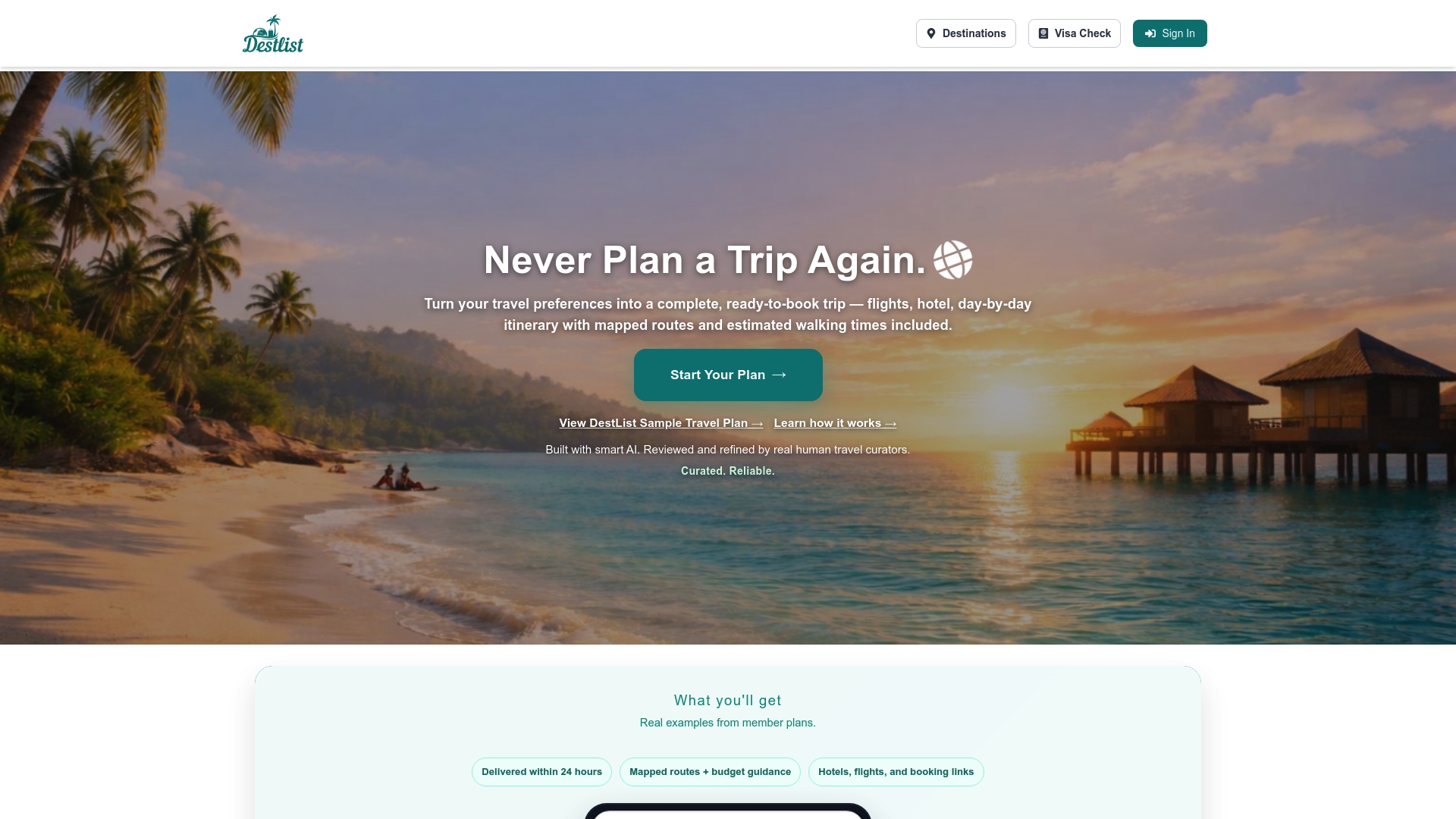
Instead of spending a full workday across 38 browser tabs, you answer a few questions about your trip and get back a personalized plan that's already optimized for flow, budget, and your group's specific needs. For busy professionals and leisure travelers who want the experience without the planning grind, it's the most direct route from "I want to travel" to "I'm ready to go." Explore stress-free trip advice alongside the platform to get the most out of every trip you take.
Frequently asked questions
How much time should I spend on trip planning?
Most travelers spend 8+ hours planning a one-week trip, but using structured frameworks like anchor-first booking and one-page dashboards can cut that down to just a couple of hours.
Can planning really save me money on travel?
Absolutely. 29% of travelers book last-minute because they ran out of planning time, and those bookings consistently come with higher costs for both flights and hotels.
What's the best way to personalize my trip plan?
Start with your anchor experiences, build in time buffers, and adapt the schedule for your group's specific needs. Anchor-first and 80/20 strategies combined with flexible, group-adapted plans consistently produce the best results.
Does trip planning help with travel anxiety?
Yes. Having a clear plan boosts anticipation and reduces pre-trip stress. 97% of travelers report feeling happier when their trip is properly planned, which means the planning itself is part of the enjoyment.
Recommended
- How to optimize trip planning for stress-free travel
- Online Travel Planner for New York, San Francisco, Austin, Atlanta and Los Angeles | DestList
- Streamline your travel itinerary process with AI tips
- Packing list essentials for efficient leisure travel
- Checkliste til familieudflugter: Planlæg trygt og effektivt - Rejs i Danmark