
Most professionals assume travel planning falls apart because of bad luck. Wrong. 90% of AI-generated itineraries contain errors, especially for complex, multi-stop trips. The real problem is a broken process, not a bad destination. Busy professionals face a unique challenge: limited time, high expectations, and zero tolerance for wasted days. Whether you're squeezing a vacation between back-to-back meetings or planning a family trip across three time zones, the difference between a smooth trip and a stressful one comes down to how you plan, not how much you spend. This guide breaks down a proven, step-by-step approach built specifically for people who don't have hours to spare.
Table of Contents
- Why efficient travel planning matters for busy professionals
- Step-by-step breakdown of the travel planning process
- Expert tips and common pitfalls: What most planners miss
- Personalizing your travel plan: Tools and automation
- Streamline your next trip with DestList
- Frequently asked questions
Key Takeaways
| Point | Details |
|---|---|
| Start early and be strategic | Booking flights and hotels 3–6 months ahead maximizes options and minimizes stress. |
| Personalize and monitor plans | AI tools are helpful but require human review and customization for best results. |
| Build in buffers for flexibility | Leave 20–30% unscheduled time and 50% transit buffer to avoid overplanning setbacks. |
| Leverage automation and central locations | Using apps and staying near transit hubs can cut your planning and transport time by up to half. |
Why efficient travel planning matters for busy professionals
Time is the one resource you can't recover. For busy professionals, a poorly planned trip doesn't just mean a bad vacation. It means missed connections, wasted budget, and returning home more exhausted than when you left. Understanding why trip planning matters is the first step toward fixing the process.
Business travelers and leisure travelers have fundamentally different needs, and conflating them is a common mistake. Business travelers need to anchor their schedule around fixed events like meetings or conferences, build in risk buffers for delays, and stay compliant with company travel policies. Leisure travelers, on the other hand, prioritize flexibility and spontaneity. Applying the wrong framework to either type of trip creates friction from day one.
The data backs this up. Corporate AI travel solutions deliver a 23% cost reduction with an 8.5-month payback period, but only when implemented with proper oversight and personalization. AI tools alone are not enough. Human judgment is still essential for catching errors, adapting to real-world conditions, and tailoring plans to individual needs.
Here's what time-constrained travelers consistently get wrong:
- Overloading the itinerary with too many activities per day
- Ignoring local transit realities like rush hours, closures, and walking distances
- Skipping documentation checks until the last week before departure
- Booking reactively instead of strategically, leading to higher costs
- Failing to build buffer time for delays, rest, or spontaneous detours
Recognizing these patterns is half the battle. The other half is replacing them with a structured, repeatable system.
Step-by-step breakdown of the travel planning process
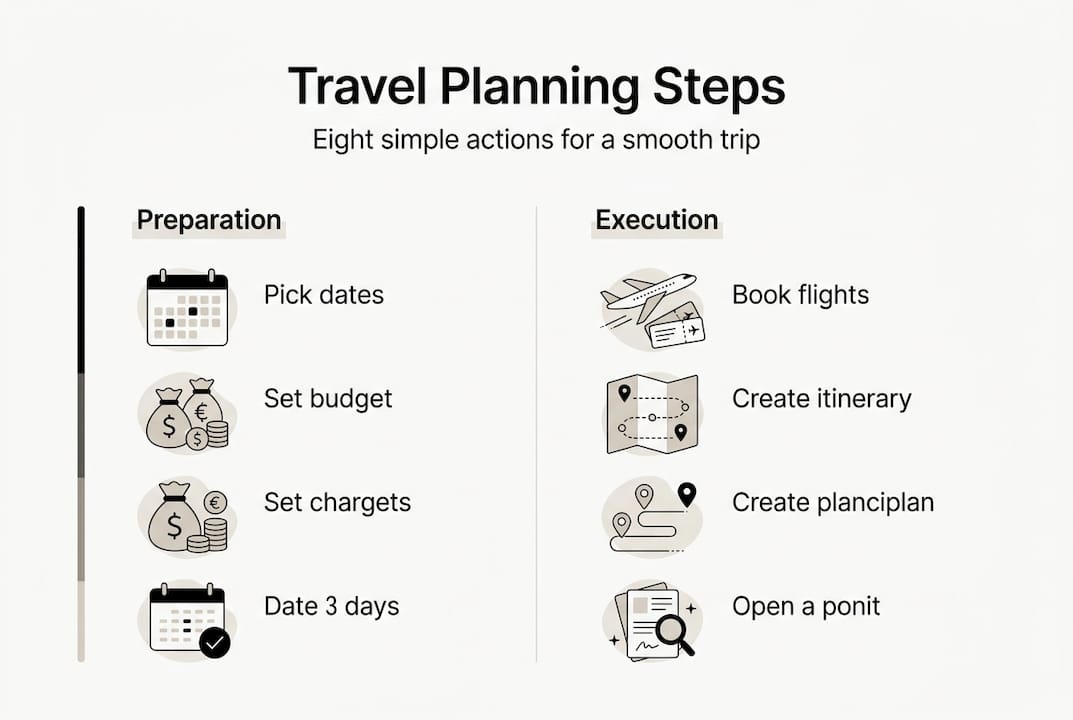
Structured methodologies for travel planning follow 8 to 10 key steps, from goal-setting all the way through execution. Here's a framework you can actually use, whether you're planning a weekend getaway or a two-week international trip.
- Define your goals and vibe. Are you after relaxation, adventure, culture, or a mix? Set your time limits and a realistic budget before you look at a single destination.
- Shortlist destinations. Filter by season, flight time, visa requirements, and budget. Don't fall in love with a destination before checking if it fits your constraints.
- Set dates strategically. Avoid peak travel seasons when possible. Shoulder season travel (just before or after peak) often cuts costs by 20 to 40% while offering better experiences.
- Map your route logically. Minimize geographic zigzagging. If you're visiting multiple cities, plan them in a loop or linear path to reduce transit time.
- Build a flexible itinerary. Limit yourself to one main activity per day, with one or two optional extras. This is where most people overplan and burn out.
- Book flights and hotels early. For international trips, aim for 3 to 6 months in advance. For domestic, 4 to 8 weeks is usually sufficient.
- Allocate your budget by category. A practical split: flights (30 to 40%), accommodation (30%), food and activities (20 to 30%), and a 10% emergency buffer.
- Handle documentation and insurance. Passport validity, visas, travel insurance, and vaccination requirements should be confirmed at least 8 weeks out.
Pro Tip: When optimizing trip planning, treat your itinerary like a project plan. Assign time blocks, not just activities. This prevents the classic mistake of scheduling three things that are geographically impossible to do in one afternoon.

Here's a quick reference for budget allocation by trip type:
| Category | Budget trip | Mid-range trip | Luxury trip |
|---|---|---|---|
| Flights | 40% | 35% | 30% |
| Accommodation | 25% | 30% | 35% |
| Food and activities | 25% | 25% | 25% |
| Emergency buffer | 10% | 10% | 10% |
Don't forget your packing list essentials before departure. A repeatable packing system saves 30 to 60 minutes per trip and eliminates the panic of forgotten items.
Expert tips and common pitfalls: What most planners miss
With the basic steps in place, let's look at the nuances that separate a good trip from a great one, and a smooth plan from a disaster.
The single biggest mistake experienced travelers make is overplanning. Packing 6 activities into a single day feels productive on paper. In reality, it creates a race-against-the-clock experience that leaves you exhausted and resentful. Build in 20 to 30% unscheduled time every day. That's roughly 2 to 3 hours in a 10-hour travel day. Use it for rest, unexpected discoveries, or simply sitting in a café without guilt.
Transit time is almost always underestimated. 90% of AI travel plans have errors, and the most common one is unrealistic transit assumptions. A 20-minute drive on Google Maps can become 50 minutes during rush hour in a city like Bangkok or Rome. Apply a 50% buffer to every transit estimate, especially in unfamiliar cities.
"The best travel plans leave room for the unexpected. Rigid itineraries don't survive contact with reality."
Here's a comparison of common planning approaches and their real-world outcomes:
| Planning approach | Time investment | Flexibility | Error rate | Best for |
|---|---|---|---|---|
| Generic AI-generated plan | Low | Low | High | Simple, solo trips |
| Manual DIY planning | High | Medium | Medium | Detail-oriented planners |
| Expert-curated plan | Low | High | Low | Busy professionals |
| Hybrid (AI + human review) | Medium | High | Low | Most travelers |
For streamlining with AI tips, the key is using AI as a starting point, not a final answer. Generate a draft, then review it against real-world logistics: actual transit times, local holidays, museum reservation requirements, and restaurant booking windows.
Group and multi-generational trips add another layer of complexity. When you're planning for mixed ages, mobility levels, or dietary needs, generic solutions break down fast. Knowing the right industry terms for travel curation helps you communicate your needs clearly to travel services and get better results.
Pro Tip: Check local public holidays and major events at your destination before finalizing dates. A national holiday can close museums, spike hotel prices, and gridlock transit all at once. This single check has saved countless trips from unnecessary chaos.
Additional pitfalls to watch for:
- Ignoring weather windows. Rainy season in Southeast Asia or hurricane season in the Caribbean can ruin an otherwise perfect trip.
- Skipping travel insurance. A single medical evacuation can cost more than the entire trip.
- Booking non-refundable everything. Leave at least 30% of bookings with flexible cancellation policies.
- Underestimating jet lag. Build a recovery day into any trip crossing more than 5 time zones.
Personalizing your travel plan: Tools and automation
After learning the dos and don'ts, here's how to use modern tools and automation to elevate your planning without adding hours to your prep time.
The numbers are striking. 58% of millennials use AI for travel planning efficiency, yet benchmarks show large language models have less than a 5% full success rate without human review. That gap tells you everything. Automation is a starting point, not a finish line.
Here's how to use tools effectively without falling into the automation trap:
- Use corporate travel apps for business trips to automate booking, expense tracking, and policy compliance in one place.
- Build repeatable packing templates in a notes app or spreadsheet. Categorize by trip type (beach, city, business) and update after every trip.
- Choose central accommodations near major transit hubs. This single decision can cut your daily transit time by 30 to 50%, freeing up hours for actual experiences.
- Book direct flights whenever the price difference is under 20%. Layovers add unpredictability, especially for tight schedules.
- Use destination-specific apps for local transit, restaurant reservations, and attraction tickets. Pre-booking popular sites eliminates same-day queues entirely.
For professionals evaluating planning platforms, reviewing personaltripplan.com alternatives gives a useful benchmark for what features actually matter versus what's just marketing noise.
Personalization is where professional services outperform generic automation every time. A curated plan built around your specific preferences, travel style, and schedule constraints delivers a fundamentally different experience than a template. For business travel tips that go beyond the basics, the consistent recommendation is to invest in tools and services that adapt to you, not the other way around.
The most time-efficient travelers treat planning as a system, not a one-off task. They reuse frameworks, refine packing lists, and build a personal database of trusted hotels, airlines, and local contacts. Over time, this system compounds. Each trip becomes faster and easier to plan than the last.
Streamline your next trip with DestList
You now have a clear framework for planning smarter, not harder. But knowing the steps and executing them under time pressure are two very different things. That's where having the right platform makes all the difference.
DestList is built specifically for travelers who want expert-level itineraries without spending hours researching. The platform combines AI efficiency with human expertise to deliver ready-to-book trip plans within 24 hours. You get matched flights and hotels within your budget, day-by-day itineraries with mapped routes and estimated walking times, weather alerts, and packing lists, all in one place. Whether you're planning a solo business trip or a family vacation, DestList handles the complexity so you can focus on actually enjoying the trip. For busy professionals who value their time, it's the most direct path from "I need to plan a trip" to "I'm ready to go."
Frequently asked questions
What is the ideal timeline for booking international trips?
Book flights and hotels at least 3 to 6 months in advance for international travel to secure the best rates and maintain flexibility if plans change.
How can I avoid overplanning my travel itinerary?
Limit each day to one main activity plus one or two optional extras, and protect 20 to 30% of your daily schedule as unscheduled buffer time for rest or spontaneous detours.
Are AI travel planning tools reliable?
AI is a useful starting point, but 90% of generated plans contain errors without human review. Always vet and personalize any AI-generated itinerary before booking.
What's the fastest packing strategy for frequent travelers?
Build repeatable packing lists by trip type and use a carry-on system whenever possible. Pairing this with central hotel locations near transit hubs can save 30 to 50% of your daily transport time.