
You finally have a few days off, but the moment you open a browser to start planning, you're buried in tabs, conflicting prices, and decision fatigue. For busy professionals, the planning process itself often feels like a second job. Direct flights, central hotels, loyalty programs, and cancellation policies all demand attention before you've even packed a bag. The good news is that a smarter, more structured approach can cut that chaos down to a manageable checklist, saving you time, money, and the kind of stress that follows you home.
Table of Contents
- Clarify your travel priorities and constraints
- Choose your destination and ideal travel window
- Build an efficient itinerary: flights, lodging, and transport
- Pack and organize for minimal stress on the go
- Stay on budget and avoid costly travel mistakes
- Let DestList handle the planning for you
- Frequently asked questions
Key Takeaways
| Point | Details |
|---|---|
| Clarify trip goals | Knowing your must-haves and deal-breakers simplifies every travel decision. |
| Flexible planning pays off | Being open on dates and destinations leads to better deals and experiences. |
| Book for efficiency | Central stays, direct flights, and loyalty programs save time and add perks. |
| Pack like a pro | Minimalist, organized packing reduces both stress and wasted time during your trip. |
| Stick to your budget | Avoiding vacation debt ensures the trip is a joy, not a financial burden later. |
Clarify your travel priorities and constraints
Understanding why trip planning matters starts with a simple question: what do you actually need from this trip? Are you blending work with leisure, escaping solo, or coordinating a family getaway? Your answer shapes every decision that follows.
Before you search for flights or hotels, run through these core questions:
- Trip purpose: Is this pure vacation, a work trip with leisure time bolted on, or a family milestone?
- Time available: How many days do you realistically have, including travel days?
- Must-haves: What one experience or amenity would make this trip feel worth it?
- Budget ceiling: What's the maximum you can spend without carrying debt afterward?
- Flexibility: Can you shift your dates by a few days, or are they locked in?
Flexibility is a bigger asset than most people realize. Advance structured planning gives you the most stress-free control, especially when you're coordinating multiple people or tight schedules. Last-minute planning can work for solo travelers with open calendars, but it trades control for spontaneity.
Pro Tip: Write down your one non-negotiable (a beach, a specific city, a spa day) and one area where you're willing to compromise (hotel star rating, departure airport, travel dates). This single exercise cuts decision time in half.
Choose your destination and ideal travel window
Once you know what really matters, it's time to turn those priorities into an actionable plan, starting with where and when to go.
Narrowing your destination doesn't have to take hours. Match your trip purpose to a region, then filter by travel time and budget. A four-day window works better for a domestic city break than a long-haul international trip. A week opens up more options. Be honest about how much of your vacation you want to spend in transit.
Timing matters more than most travelers expect. 89% of Americans take active steps to save on travel, with 30% choosing off-peak travel days and 32% using loyalty points. Mid-week flights and shoulder-season travel windows consistently deliver lower prices and thinner crowds.

Here's a quick comparison to help you decide your booking approach:
| Approach | Best for | Key advantage | Main risk |
|---|---|---|---|
| Book 6-8 weeks out | Fixed schedules, families | Lower flight prices, more choice | Less flexibility if plans change |
| Book 2-4 weeks out | Solo or couple travelers | Balance of price and availability | Popular hotels may be full |
| Last-minute (under 1 week) | Flexible dates and destinations | Hotel discounts, spontaneous deals | Limited flight options, higher fares |
For last-minute trips, be flexible on dates and consider mid-week travel, alternative transport like trains or buses, and package deals. Hotels discount last-minute rooms far more aggressively than airlines discount seats, so your accommodation budget can stretch further when you move fast.
Smart destination shortcuts for time-pressed travelers:
- Use an AI itinerary process to match destinations to your mood and available days
- Filter by direct flight availability first, then narrow by destination
- Check weather patterns for your window before committing
- Look at package deals that bundle flights and hotels for a single price
Build an efficient itinerary: flights, lodging, and transport
Destination in mind, it's time to make your bookings work as hard for you as possible with smart, streamlined choices.
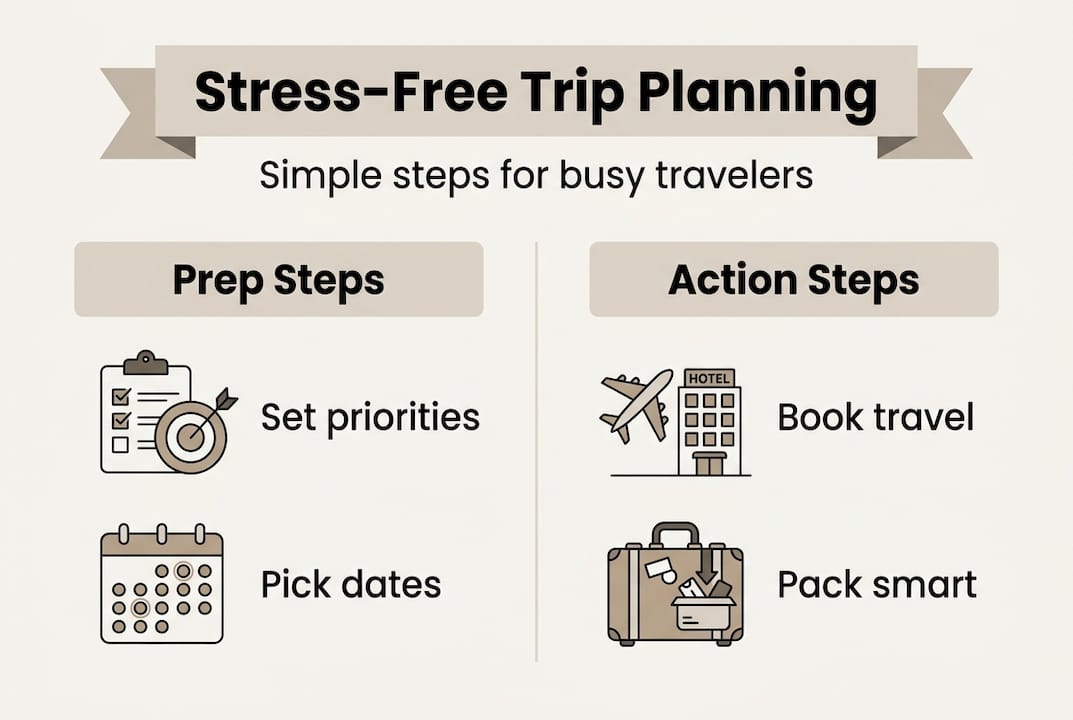
For busy travelers, door-to-door time is the real metric, not just flight duration. A cheap flight that requires two connections and a 45-minute bus ride to the city center can cost you half a day. Prioritize direct flights and centrally located hotels, even if they cost slightly more. The time you save is worth it.
Here's a practical booking checklist to work through in order:
- Lock in your dates before searching for anything else. Flexible searches waste time.
- Search direct flights first. Filter by nonstop only and compare two or three departure airports if you have options.
- Choose a central hotel. Proximity to your main activities reduces daily transit time and decision fatigue.
- Check cancellation policies on every booking. Flexible rates are worth a small premium for unpredictable schedules.
- Confirm key amenities upfront: reliable WiFi, fitness access, or breakfast inclusion depending on your needs.
- Calculate total travel time from your front door to the hotel, not just flight time.
Loyalty status building through one airline and one hotel brand pays off faster than most people expect. Upgrades, priority boarding, and late checkout are not just perks; they reduce friction on every trip. Spreading bookings across multiple brands earns you nothing.
Pro Tip: Bundling flights and hotels through a single platform often saves money, but compare the bundle price against booking each separately. Sometimes the bundle wins on price; sometimes it wins on convenience alone, which is still a valid reason to use it.
For deeper research on trip planner alternatives or to brush up on travel curation terms before you book, both resources can sharpen your decision-making.
Pack and organize for minimal stress on the go
Even the best-laid travel plans can stall without smart prep at home and on arrival. Packing is where chaos often creeps in.
The KonMari method, developed by organizing consultant Marie Kondo, applies surprisingly well to travel. The core idea is simple: bring only what genuinely serves you, and organize what you bring so you can find it instantly.
"You need less than you think. Bring only what sparks joy and serves a real purpose, fold everything upright in pouches by category, and unpack immediately when you arrive. A calm, organized space changes how you feel about the whole trip." — Marie Kondo approach to travel, via BBC Travel
Practical packing habits that actually work:
- Use packing pouches by category: clothes, tech, toiletries, documents. One pouch, one purpose.
- Fold clothes upright (KonMari style) so you can see everything at a glance without unpacking the whole bag.
- Unpack immediately when you reach your hotel. It takes five minutes and eliminates the daily "where did I put that" spiral.
- Limit shoes to two pairs unless the trip specifically demands more.
- Pack a small day bag for activities so your main luggage stays organized at the hotel.
For a full breakdown of efficient packing essentials or a broader look at stress-free trip planning, both guides offer practical, tested advice.
Stay on budget and avoid costly travel mistakes
An organized trip means nothing if it leaves you financially stressed. Getting this part right is crucial for a trip you actually enjoy.
The numbers are sobering. 35% of travelers carry vacation debt after their trip, which means the stress doesn't end when they get home. It follows them for weeks or months. The average American summer trip costs $3,940 for flights and lodging combined, which is a real number that deserves a real plan.
Here's how to keep your trip financially clean:
- Set a total budget before you search, not after. Searching first and budgeting second always leads to overspending.
- Use loyalty points strategically. 32% of travelers plan to use points to offset costs. If you have them, deploy them on flights or hotel nights, not just upgrades.
- Pay off existing travel debt before booking a new trip. Stacking debt on debt turns a vacation into a financial burden.
- Choose meaningful experiences over luxury defaults. A great local meal beats a mediocre hotel restaurant at twice the price.
- Build a 10% buffer into your budget for unexpected costs: transport delays, a spontaneous activity, or a meal you didn't plan for.
Pro Tip: Review your stress-free trip planning checklist before you finalize any booking. Catching one overlooked cost early is worth more than any discount you'll find at checkout.
Let DestList handle the planning for you
If reading through all of this still feels like more work than you have time for, that's exactly the problem DestList was built to solve. You share your travel preferences, budget, and dates, and the platform combines AI with real human expertise to deliver a complete, ready-to-book itinerary within 24 hours.
Every plan includes matched flights and hotels, a day-by-day activity schedule with mapped routes and estimated walking times, weather alerts, and packing list support. There's even a free destination discovery tool if you're not sure where to go yet. For busy professionals who want a real vacation without the planning overhead, DestList turns a week of research into a single, confident decision. Your next trip deserves that kind of attention.
Frequently asked questions
How far in advance should I plan a trip if I'm short on time?
Aim for at least one month ahead for the most stress-free control over flights and hotel availability. If your dates are open, last-minute flexibility can unlock solid hotel deals.
What travel booking mistakes should I avoid?
Skip overbooking activities, always check cancellation policies, and never put a trip on a credit card you can't pay off immediately. 35% of travelers carry post-vacation debt, which is a mistake that's easy to avoid with a firm budget set before you search.
How can I pack efficiently for quick business or leisure trips?
Organize by category using pouches, fold clothes upright KonMari style, and unpack the moment you arrive at your hotel. Keeping your space organized from day one eliminates daily friction.
What's the best way to save money while traveling for work or fun?
Flex your travel dates toward mid-week, use loyalty points to offset flight or hotel costs, and consider package deals that bundle both. Being open to alternative transport like trains or buses can also cut costs significantly on shorter routes.