
TL;DR:
- Different trip planners suit varying needs, from AI tools to human agents and spreadsheets.
- A hybrid approach combining AI, digital apps, and spreadsheets offers the best flexibility and reliability.
- Prioritize tools based on efficiency, personalization, support, and trip complexity for optimal planning.
Trip planning should feel exciting, not exhausting. Yet most busy professionals spend an average of 10 or more hours researching, comparing, and booking a single vacation, often across dozens of browser tabs. The market now offers a wide range of planning solutions, from human travel agents to AI-powered platforms, and knowing which one fits your needs can save you serious time, money, and frustration. This guide breaks down every major type of trip planner, what each one does well, where each one falls short, and how to pick the right one for your next trip.
Table of Contents
- Key criteria for evaluating trip planners
- Traditional human travel agents and personal planners
- Digital trip planner apps and organizers
- AI-powered trip planners and virtual assistants
- Manual and hybrid planning methods
- Our perspective: Why a hybrid trip planning approach wins
- Plan your next trip the easy way with DestList
- Frequently asked questions
Key Takeaways
| Point | Details |
|---|---|
| Match planner to need | Choose based on your priorities—speed, personalization, or complexity. |
| AI saves time | AI planners can cut planning time dramatically but need careful review. |
| No single best choice | The smartest travelers mix tools and approaches for every trip. |
| Manual is still useful | Spreadsheets give ultimate control but require more effort. |
Key criteria for evaluating trip planners
Before you commit to any tool or service, it helps to know exactly what you're evaluating. Not all planners are built for the same traveler, and choosing the wrong one can cost you more time than just doing it yourself.
Here are the five core criteria worth measuring every planner against:
- Efficiency: Does it reduce your workload? Look for calendar integration, automated reminders, and low mental effort to get results.
- Policy compatibility: If you travel for work, can it track expenses, enforce corporate travel policies, and coordinate across multiple travelers?
- Adaptability: Can it handle last-minute changes, flight delays, or offline use when you're in a spotty signal zone?
- Personalization: Does it learn your preferences, or does it hand you a generic itinerary that could belong to anyone?
- Support: Is there live help available when something goes wrong, or are you stuck with a chatbot at 2 a.m.?
Understanding why trip planning matters goes beyond just booking flights. It affects your stress levels, your budget, and the quality of the experience itself. The right planner removes friction at every step.
"For busy professionals: Prioritize tools with calendar integration, policy enforcement, multi-user coordination, offline access, and low cognitive load."
Pro Tip: Before testing any planner, write down your top three non-negotiables. Speed? Customization? Cost? That short list will cut your decision time in half.
Many travelers also overlook travel planning app features like offline maps and shared itinerary views, which matter most when you're actually on the ground.
Traditional human travel agents and personal planners
Human travel agents have been around for decades, and they still hold a real advantage in specific situations. When your trip involves complex logistics, multiple countries, or VIP-level access, a skilled agent can do things no app can replicate.
The personalized service from travel agents shines brightest in ambiguous situations. Need a private villa that isn't listed online? Coordinating a 15-person corporate retreat across three cities? An experienced agent handles those details with relationships and negotiation skills that algorithms simply don't have.
Here's where human planners stand out:
- Complex itineraries: Multi-destination trips, group coordination, and special requests are handled with nuance.
- Exclusive access: Agents often have industry contacts for upgrades, private tours, and sold-out experiences.
- Crisis management: When flights get canceled or hotels overbook, a human advocate works faster than a help center ticket.
- Corporate travel: Policy compliance, expense reporting, and multi-traveler coordination are core strengths.
The drawbacks are real, though. Human planners are expensive, often charging flat fees or commissions that add up quickly. They also operate on business hours, which doesn't always align with a professional's schedule.
"Main types of trip planners include human travel agents and planners who provide personalized service, especially for high-stakes or complex trips."
Best for: Executives, luxury travelers, corporate groups, and anyone whose trip involves genuine complexity or high financial stakes.
Digital trip planner apps and organizers
If you prefer doing things on your own schedule, digital apps are a compelling alternative to human agents. Tools like TripIt and Wanderlog have redefined what self-service planning looks like, turning a pile of confirmation emails into a clean, shareable itinerary in minutes.
Organizing with itinerary apps works by pulling in your bookings automatically. Forward a confirmation email to TripIt, and it parses the details into your master trip timeline. Wanderlog goes further, letting you collaborate with travel companions in real time.
Key strengths of digital planner apps:
- Automated consolidation: Flights, hotels, and car rentals all appear in one place without manual entry.
- Smart reminders: Check-in alerts, gate change notifications, and day-of reminders keep you on track.
- Offline access: Most top apps store your itinerary locally so you're never stranded without info.
- Collaboration: Share your trip with colleagues or travel partners and edit together.
| Feature | TripIt | Wanderlog |
|---|---|---|
| Auto-import bookings | Yes | Partial |
| Collaborative editing | Limited | Yes |
| Offline access | Yes (Pro) | Yes |
| Maps and routes | Basic | Advanced |
| Free tier available | Yes | Yes |
Pro Tip: Use a dedicated travel email address just for booking confirmations. It keeps your main inbox clean and makes auto-import tools far more reliable.
The main limitation is flexibility. Digital apps organize what you've already booked. They don't generate ideas, negotiate rates, or adapt creatively when your plans fall apart. You can save time with digital planners, but you still need to do the research and booking yourself.
Best for: Frequent travelers who book their own trips and want fast, reliable organization without paying for a service.
AI-powered trip planners and virtual assistants
For those who crave ultimate automation and speed, AI-driven solutions are changing the game. These platforms don't just organize your bookings. They generate full itineraries from scratch based on your preferences, budget, and travel dates.
The speed is genuinely impressive. AI planners generate itineraries in seconds using methodologies like prompt-based generation, natural language processing, and route optimization, with 85% user satisfaction reported across tested systems. That's a dramatic shift from the hours a manual search requires.
Here's how the process typically works:
- You input your destination, travel dates, budget, and preferences.
- The AI clusters activities by location and interest type.
- It sequences the itinerary for logical flow and minimal backtracking.
- It outputs a day-by-day plan with estimated times and suggested bookings.
- You review, adjust, and confirm.
Cost savings are another real benefit. AI tools often reduce planning costs by eliminating agent fees and surfacing better-priced options through data comparison.
| Dimension | AI planners | Human agents |
|---|---|---|
| Speed | Seconds | Hours to days |
| Cost | Free to low | Retainer or commission |
| Customization | Good | Excellent |
| Handling ambiguity | Limited | Strong |
| Availability | 24/7 | Business hours |
The catch? AI limitations in preference optimization under constraints are well documented. If your trip has unusual requirements, dietary restrictions, or accessibility needs, AI tools can miss the mark. Always verify the output before booking.
Our expert AI planning guide walks through how to prompt AI tools effectively to get better results. You can also use an AI smart packing tool to complement your itinerary once it's set.
Best for: Simple to moderately complex trips, last-minute planning, and repeat travelers who know what they want.
Manual and hybrid planning methods
While technology has advanced, some still find value in manual and blended methods. Spreadsheets, shared documents, and project management tools like Notion or Airtable give you complete control over every detail of your trip.

Manual and spreadsheet methods using project management techniques are particularly useful for travelers who want to track budgets, share plans across large groups, or maintain a backup copy of every booking in one place.
Here's where manual planning shines:
- Full control: You decide exactly what goes in, how it's organized, and who can see it.
- Budget tracking: A simple spreadsheet can track every expense in real time, which no app does perfectly.
- Collaboration at scale: Shared documents work well for group trips where everyone needs input.
- Backup and redundancy: When apps go down or accounts get locked, your spreadsheet still works.
The obvious downside is time. Building a detailed trip spreadsheet from scratch takes hours. That's why the hybrid approach is gaining traction among power users. Use an AI planner or digital app to generate the structure, then import it into a spreadsheet for customization, budget tracking, and sharing.
Pro Tip: Download a pre-built trip planning template from a tool like Notion or Google Sheets. Starting from a structured template cuts your setup time by more than half and ensures you don't miss critical details like visa requirements or local emergency numbers.
For those who want clean formatting and shareable outputs, trip planning with spreadsheets is still one of the most flexible options available.
Our perspective: Why a hybrid trip planning approach wins
Now that you've seen the landscape, here's our hard-won take on what actually works in the real world. The biggest mistake travelers make is searching for a single perfect tool. That tool doesn't exist.
Your needs change trip by trip. A quick weekend getaway calls for a fast AI-generated itinerary. A two-week international trip with elderly parents calls for a human agent who knows the terrain. Trying to force one solution onto every scenario is what leads to frustration.
The professionals who travel best use a blend. They run an AI planner to get a working draft fast, cross-check it against their own knowledge and preferences, and bring in a human expert only when the stakes or complexity justify the cost. They also keep a simple spreadsheet as a backup, because no platform is immune to outages.
AI/virtual assistants combining automation with low-effort interfaces deliver the most value for busy professionals, but no single tool excels universally. Test two or three options on a low-stakes trip before relying on any one platform for something important.
Our recommendation: Start with AI for speed, layer in a digital app for organization, and use a spreadsheet for budget and backup. Explore AI planner alternatives when your needs outgrow any single tool.
Plan your next trip the easy way with DestList
You've now got a clear picture of every major planning type and how to choose between them. The next step is putting that knowledge to work without spending another weekend buried in browser tabs.
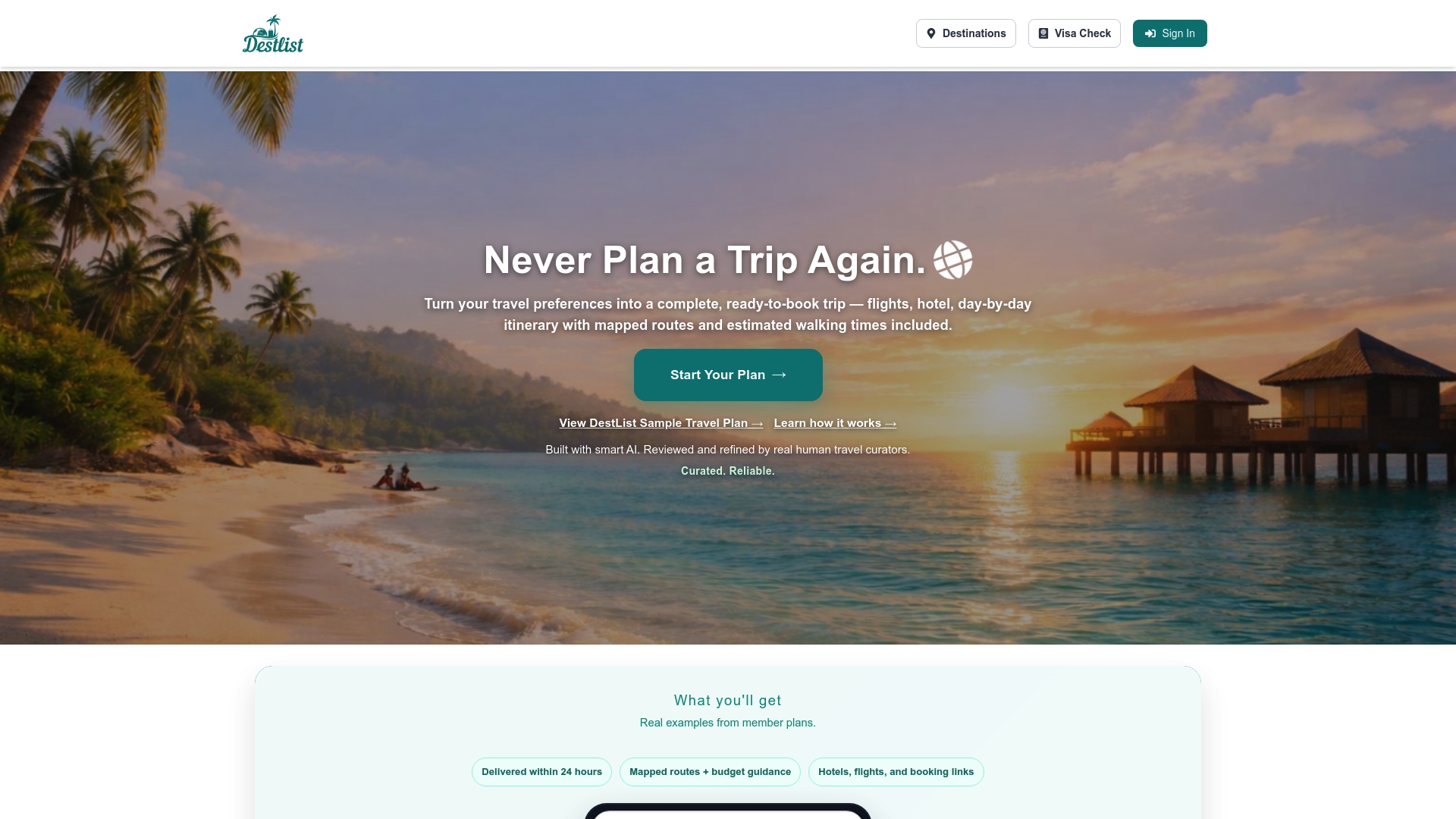
DestList combines AI speed with human-curated expertise to deliver ready-to-book itineraries within 24 hours. Whether you want to plan your trip online from scratch, explore adventure destinations that match your mood and budget, or browse amazing tours handpicked by travel experts, DestList handles the heavy lifting so you can focus on actually enjoying your trip. It's the hybrid approach, built into one platform.
Frequently asked questions
What type of trip planner is fastest for building itineraries?
AI-powered planners are fastest, generating complete itineraries in seconds, but you should always verify the details before booking anything.
Are digital trip planner apps secure with my bookings?
Most reputable apps like TripIt and Wanderlog use encryption and clear privacy policies, so check app reviews and data disclosures before connecting your accounts.
What if my trip plans change at the last minute?
AI planners and digital apps handle last-minute changes faster than manual methods, but a human agent is your best option when the situation involves real complexity or negotiation.
Can I combine AI tools and spreadsheets for my trips?
Absolutely. Many travelers use AI to generate a base itinerary and then import it into a spreadsheet for customization and budget tracking.
How do I choose the right type of trip planner?
Start by identifying your top needs: speed, personalization, cost, or support level. Then test multiple tools on a low-stakes trip before committing to one for something important.