
TL;DR:
- Expert trip curation creates personalized, efficient itineraries saving travelers up to 60% planning time.
- Curators prevent overcrowding, optimize routes, and balance activity with downtime for stress-free travel.
- Using curated plans enhances satisfaction by focusing on quality experiences and avoiding common pitfalls.
Planning a trip should feel exciting, not like a second job. Yet most travelers spend an average of 10 to 15 hours researching destinations, comparing flights, and piecing together itineraries before they ever pack a bag. For busy professionals and leisure travelers, that kind of time investment is simply not realistic. Expert trip curation changes the equation entirely. Instead of drowning in browser tabs and conflicting reviews, you get a tailored, efficient travel plan built around your specific preferences, schedule, and budget. This article breaks down why curation works, how experts build these plans, and how you can apply those same principles to your next trip.
Table of Contents
- Why travelers need expert trip curation
- How expert curators design personalized, efficient itineraries
- Comparing expert-curated vs. DIY itineraries
- Applying expert trip curation: Practical strategies for travelers
- What most guides miss: Real-world wisdom from trip curators
- Start your stress-free travel with expert-curated itineraries
- Frequently asked questions
Key Takeaways
| Point | Details |
|---|---|
| Minimize planning stress | Expert trip curation takes the guesswork and overwhelm out of designing your itinerary. |
| Prioritize quality experiences | Travel curators balance must-see sights with flexible downtime, ensuring memorable trips. |
| Save valuable time | Expert curation shortens planning and lets you focus on enjoying your destination. |
| Personalize every trip | Curators use your interests and goals to create unique, tailored travel plans. |
Why travelers need expert trip curation
Modern travel planning has never been more overwhelming. The sheer volume of options available today, from booking platforms and review sites to social media recommendations and travel blogs, creates what researchers call "choice overload." When you have too many options, decision quality drops and stress rises. That's not a great starting point for a vacation.
For busy professionals, the problem is compounded by time. Most professionals report having fewer than five hours per week to dedicate to personal projects outside of work. Planning a two-week international trip within that window is genuinely difficult. You end up with a half-finished itinerary, a flight booked without checking nearby hotel options, and a vague list of "things to see" that never gets prioritized. The result? Missed highlights, wasted hours, and the creeping feeling that your vacation wasn't quite what it could have been.
Leisure travelers face a different but equally real set of challenges. Without professional guidance, it's easy to:
- Overload your daily schedule with too many activities, leaving no room to breathe
- Miss hidden gems because they aren't prominently listed on popular review sites
- Misjudge distances between attractions, leading to rushed transitions and exhausted evenings
- Book accommodations that don't align with your planned route, adding unnecessary commute time each day
These are not small inconveniences. They shape how you feel about a destination and whether you come home refreshed or drained.
"The key to success is balancing structure with flexibility, avoiding common pitfalls like overcrowding, and prioritizing quality experiences over quantity for leisure travelers."
Expert curation directly addresses all of these friction points. A seasoned curator brings destination knowledge, logistical intelligence, and an understanding of your personal travel style to create a plan that actually works. You still have room to improvise, but the backbone of your trip is solid. For stress-free travel tips that go beyond the basics, curated planning is consistently the highest-leverage tool available. And if you want a streamlined planning guide built specifically for travelers with limited planning time, the difference between curated and non-curated trips becomes immediately obvious.
The bottom line is that expert trip curation isn't a luxury reserved for high-end travelers. It's a practical solution for anyone who values their time and wants to get the most out of every trip they take.
How expert curators design personalized, efficient itineraries
The process behind a well-crafted itinerary is more disciplined than most travelers realize. It starts long before any flights are booked or restaurants are reserved. Here's how skilled curators actually build plans that work.
1. Discovery: understanding who you are as a traveler
The first step is a deep-dive conversation about your preferences, goals, and constraints. A good curator asks: What kind of pace do you prefer? Do you want cultural immersion, outdoor adventure, culinary exploration, or a mix? What's your budget range? How many consecutive days can you spend on your feet before you need a slower morning? These questions aren't small talk. They are the raw material for a plan that genuinely fits your life.
2. Framework building: structure with flexibility built in
Once your preferences are mapped, curators build a day-by-day framework. This framework divides each day into must-see anchors, flexible activity slots, and open buffer time. The must-see anchors are the non-negotiables: the experiences you would genuinely regret missing. Flexible slots let you choose in the moment based on energy and mood. Buffer time prevents the whole plan from collapsing if one experience runs long or you simply want to sit in a plaza and watch the world go by.
3. Pitfall prevention: avoiding the overcrowding trap
One of the most valuable things a curator does is say no. When a traveler wants to visit seven museums in three days, an experienced curator will push back. Not because they don't care about your interests, but because they know that quality moments over quantity is the actual goal. Three deeply experienced museum visits beat seven rushed ones every single time. This discipline is hard to apply to yourself when you're excited about a destination, which is exactly why having an outside perspective matters.

4. Route optimization: making geography work for you
Expert curators group activities by geographic proximity. This sounds obvious, but most self-planned itineraries ignore it completely. The result is travelers who spend more time in transit than at attractions. A curated plan sequences your day so that you move through a neighborhood logically, reducing walking time and maximizing time spent actually experiencing the destination. Check out how customized itineraries save real, measurable time in destination.
5. Final review: cross-checking logistics
Before the plan is delivered, experienced curators cross-check opening hours, seasonal closures, local event conflicts, and weather patterns. This layer of review catches the mistakes that kill trips: arriving at a famous site on its weekly closing day, or booking an outdoor activity during a predictable rainy season.
Pro Tip: Ask your curator, or yourself if you're self-planning, to leave at least 90 minutes of unstructured time per day. Research on traveler satisfaction consistently shows that spontaneous discoveries made in that buffer time become the most memorable moments of a trip. This is especially important for understanding travel curation terminology like "soft scheduling," which is exactly this concept in practice.
Comparing expert-curated vs. DIY itineraries
Now let's look at how expert-curated trips actually stack up against traditional self-planned itineraries, using concrete outcomes rather than vague promises.
The most striking difference is planning efficiency. Travelers who use expert curation report spending up to 60% less time on pre-trip logistics compared to those who plan everything themselves. For a professional who values their evenings and weekends, that's a significant return on investment before the trip even begins.
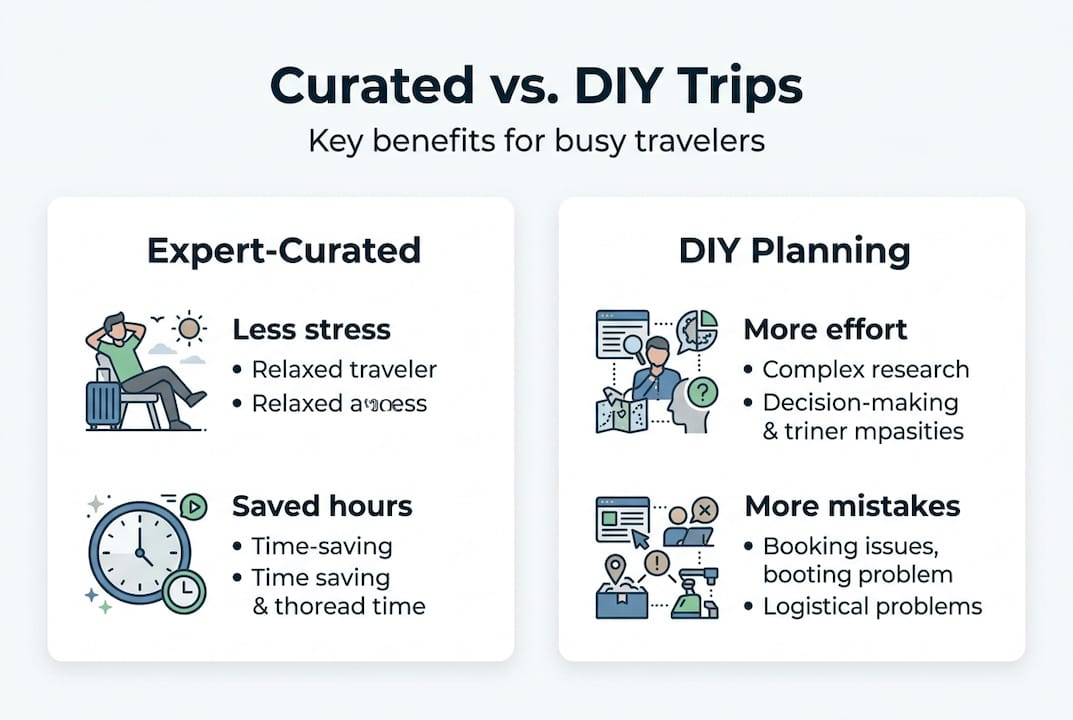
Satisfaction rates tell an equally clear story. Travelers with curated itineraries report higher satisfaction with their overall experience, particularly in complex, multi-city destinations where logistics coordination is demanding. The reason is straightforward: they spend more time experiencing and less time troubleshooting.
| Category | Expert-curated trips | DIY trips |
|---|---|---|
| Pre-trip planning time | 2 to 4 hours | 10 to 20 hours |
| Missed key attractions | Rare | Common |
| Schedule overcrowding | Actively prevented | Frequently reported |
| In-destination transit efficiency | Optimized by route logic | Often disjointed |
| Satisfaction with downtime balance | High | Variable |
| Ability to adapt plans on the go | Built-in flexibility | Rigid or chaotic |
Beyond the numbers, curated trips tend to deliver a qualitatively different experience. When your plan already accounts for weather, crowd patterns, and geographic flow, you arrive at each experience with energy rather than stress. That's the compound benefit of working with someone who has already solved the problems you haven't even thought of yet.
Consider a traveler planning a first visit to Japan. Self-planning a 10-day itinerary across Tokyo, Kyoto, and Osaka requires understanding train passes, temple reservation windows, seasonal cherry blossom timing, and restaurant booking etiquette. Getting any one of those wrong creates friction throughout the trip. A curator who specializes in Japan has already navigated all of these variables dozens of times. They know which ryokan books out six weeks in advance and which ramen shop is worth a 40-minute wait.
Another significant advantage of curated trips is how they handle personalized cultural trips in unfamiliar regions. When you don't know what you don't know, a cultural specialist can surface experiences that would never appear on a standard tourist checklist. These are often the moments travelers remember most vividly, years after the trip.
The balancing of structure with flexibility is ultimately what separates a curated trip from a rigid tour package. You're not locked into a group schedule. You have a personal blueprint designed specifically for how you travel.
Applying expert trip curation: Practical strategies for travelers
Whether you're working with a professional curator or applying curation principles yourself, these strategies will immediately improve your travel experience.
Communicate your non-negotiables first. Before anything else, write down the two or three experiences that would make the trip feel complete. Then write down two or three things you absolutely want to avoid, whether that's crowded tourist traps, early morning starts, or itineraries with no downtime. This clarity alone transforms the quality of the planning conversation.
Use a tiered priority system for activities. Sort every potential activity into three categories: must-do, want-to-do, and nice-if-possible. Build your itinerary around the must-dos first, then slot in want-to-dos during natural geographic windows. The nice-if-possibles fill buffer time or get dropped entirely. This mirrors exactly what professional curators do, and it prevents the "everything feels essential" trap.
Plan around energy, not just time. Most travelers build itineraries based on hours available, ignoring the reality that energy fluctuates across a trip. Put your most demanding experiences at the start of the trip when energy is highest. Schedule lighter activities toward the end. Build rest days into any trip longer than five days.
| Strategy | Why it works | How to apply it |
|---|---|---|
| Non-negotiables first | Prevents regret and overcrowding | Write your list before opening any booking site |
| Tiered priority system | Creates natural flexibility | Categorize before scheduling |
| Energy-based scheduling | Reduces burnout | Map demanding vs. relaxed days explicitly |
| Geographic grouping | Cuts transit time | Cluster activities by neighborhood or district |
| 90-minute daily buffer | Allows spontaneity | Block it in your calendar like a meeting |
For travelers managing multiple trips across a year, streamlined multi-trip planning becomes an even higher priority. Developing a repeatable planning template saves considerable time and cognitive energy across bookings.
Pro Tip: Tools that combine AI with human expertise tend to outperform either alone. AI excels at processing logistics, comparing flight options, and identifying geographic clusters. Human curators excel at reading between the lines of your preferences and catching the nuances that algorithms miss. When both work together, the result is faster, sharper, and more genuinely personalized. Understanding the benefits of route planning is one of the clearest ways to see this advantage in action.
Finally, be honest about your travel style when communicating with a curator or when self-assessing. Travelers who describe themselves as "flexible" often aren't, and that gap between self-image and reality creates itineraries that feel off. The more accurate the input, the better the output.
What most guides miss: Real-world wisdom from trip curators
Here's the uncomfortable truth about travel planning advice: most of it encourages you to do more. More destinations. More activities. More experiences crammed into fewer days. This advice feels helpful on the surface, but it often leads to the exact burnout and disappointment it claims to prevent.
Experienced curators operate from a different philosophy. They know that a single afternoon spent slowly exploring one neighborhood, with a long lunch and an unplanned detour into a bookshop, often outweighs a packed day of five checked-off attractions. This "less is more" approach requires real confidence to recommend, because it looks like you're giving the traveler less value. In reality, you're giving them more of what travel is actually for.
The quality-over-quantity principle is foundational to great curation, but it's rarely applied with real conviction in mainstream travel guides. Most guides hedge. Curators commit. And that commitment, backed by destination expertise and genuine understanding of how people experience travel, is what makes the difference between a good trip and an unforgettable one. Finding stress-free planning wisdom that actually tells you to do less, not more, is rarer than it should be. That's the perspective shift that changes how you travel permanently.
Start your stress-free travel with expert-curated itineraries
Reading about expert trip curation is one thing. Experiencing it is another.
DestList combines AI-powered logistics with real human expertise to deliver fully personalized, ready-to-book itineraries within 24 hours. Whether you're planning a solo city break or a complex multi-destination family trip, your custom travel itinerary is built around your preferences, budget, and schedule. No spreadsheets. No conflicting reviews. No planning stress. Just a complete trip plan, mapped and ready to go. If you're ready to hand off the logistics and focus on the adventure, explore done-for-you travel planning and see what your next trip could look like when someone else handles the hard part.
Frequently asked questions
What makes expert trip curation different from standard travel planning?
Expert trip curation customizes itineraries to specific traveler goals and actively prevents overcrowding and rushed experiences, focusing on quality over quantity rather than simply listing attractions.
How much time can expert-curated itineraries save a traveler?
Curated itineraries can reduce planning time by up to 60%, freeing you to focus on the experience itself rather than pre-trip logistics.
Can I personalize my itinerary even with expert curation?
Absolutely. Expert curators start by gathering your specific preferences, goals, and constraints, then build a plan that reflects exactly how you like to travel.
What's a typical mistake expert curators help travelers avoid?
The most common fix curators make is preventing itinerary overcrowding, ensuring each day has a manageable, balanced flow that leaves room for the unplanned moments that make a trip truly memorable.