
TL;DR:
- Thoughtful route planning saves time, reduces costs, and minimizes travel stress.
- Using core principles like clustering and the 70% rule enhances trip efficiency and flexibility.
- Modern tools combined with human oversight optimize itineraries while allowing room for unexpected moments.
Most travelers assume that winging it saves time. In reality, skipping route planning is one of the biggest hidden drains on your vacation. Planning travel routes optimizes time, reduces costs, and minimizes stress by eliminating backtracking, unrealistic transit times, and last-minute scrambles. Whether you have five days in Europe or a long weekend in a new city, how you sequence your stops determines whether you return refreshed or exhausted. This guide breaks down why route planning matters, how to do it well, and which tools make it easier for busy people who want to travel smarter.
Table of Contents
- The hidden costs of not planning routes
- Core principles and frameworks for route planning
- Adapting to real-world complexities and common pitfalls
- Route planning tools and expert tricks
- Why purposeful route planning beats both spontaneity and over-scheduling
- Unlock smarter travel with DestList
- Frequently asked questions
Key Takeaways
| Point | Details |
|---|---|
| Time and cost savings | Smart route planning can save travelers over 10 hours and significantly reduce expenses on every trip. |
| Expert-backed frameworks | Using weighted scoring, clustering, and flexibility rules ensures efficient, enjoyable itineraries. |
| Pitfall prevention | Buffers, real-world checks, and avoiding energy stacking protect against common travel disasters. |
| Tech tools boost results | Modern apps and AI tools make multi-stop planning faster—but always review for best outcomes. |
| Balanced approach wins | Combining logical structure with planned flexibility delivers the most rewarding travel experiences. |
The hidden costs of not planning routes
Most people think of a poorly planned trip as mildly inconvenient. The reality is much more expensive. Backtracking across a city, rushing to a museum that closes at 5 p.m., or booking a hotel on the wrong side of town all add up fast. These are not rare mistakes. They are the default outcome when travelers skip route planning entirely.
The numbers are striking. Saving over 10 hours per trip and cutting fuel costs by 22% are realistic outcomes from thoughtful route planning, based on travel and logistics data. That is not a marginal improvement. For a five-day trip, 10 hours is essentially an entire extra day of sightseeing. Losing it to poor sequencing is a real cost.
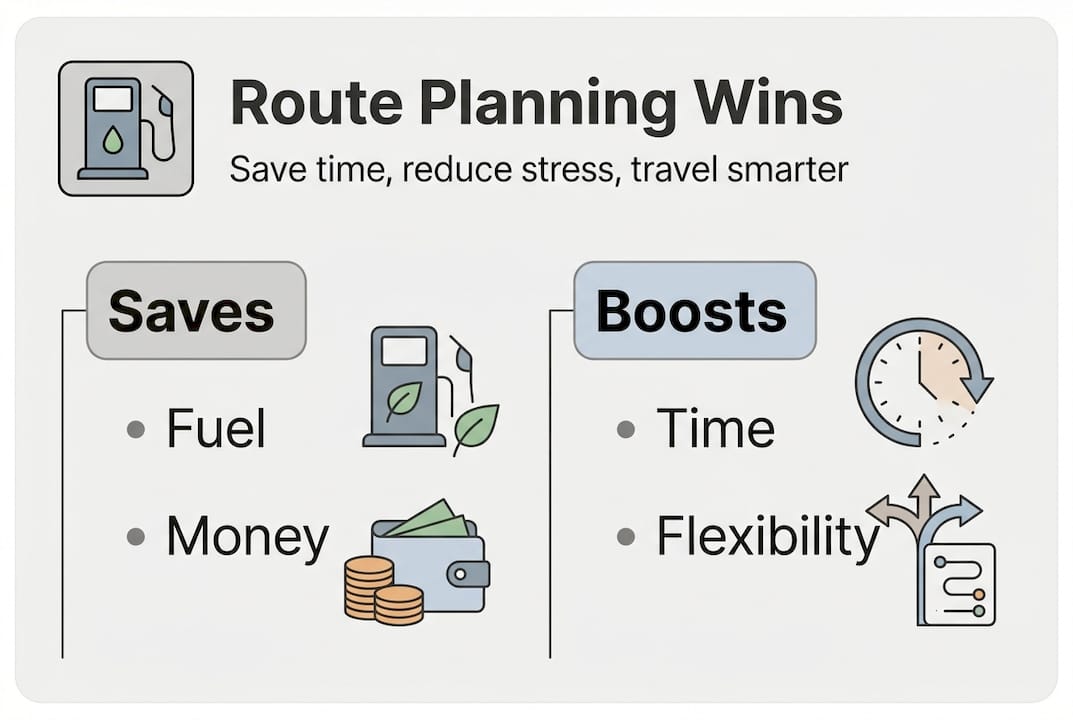
The financial impact scales quickly. Organizations that apply route optimization see 318 to 340% ROI in year one, a benchmark that translates directly to individual travel. Every detour you avoid, every missed connection you sidestep, and every rushed meal you skip represents money and energy saved.
Here is what poor route planning actually looks like in practice:
- Backtracking: Visiting a neighborhood twice because you did not cluster nearby attractions together
- Rushed days: Packing too many major sites into one day, leaving no time to enjoy any of them
- Missed attractions: Arriving at a site that is closed because you did not check hours in advance
- Stress spikes: Last-minute scrambles for transport, tickets, or accommodation that drain your energy
- Budget bleed: Extra taxis, impulse hotel upgrades, and missed prepaid bookings from poor timing
As one travel researcher put it: "The difference between a good trip and a great trip is rarely the destination. It's the sequence."
These are exactly the time, stress, and money savings that structured route planning delivers. The good news is that you do not need to be a logistics expert to get them. You just need a framework.
Core principles and frameworks for route planning
Once you recognize the costs of poor routing, the next step is applying a system that works. The best travel route frameworks use three core methodologies: weighted attraction scoring, geographic and time clustering, and the 70% rule for flexibility.
Weighted attraction scoring means ranking each stop by two factors: how much you personally want to see it, and how unique it is to that destination. A famous cathedral you can visit in three other cities scores lower than a local market that only exists in that town. This prevents you from filling your itinerary with generic tourist stops at the expense of genuinely memorable experiences.
Geographic clustering is the single biggest time-saver in route planning. Group attractions by neighborhood, not by category. Visiting all the museums in one day sounds logical, but if they are spread across the city, you waste hours in transit. Instead, plan each day around a geographic zone and hit everything in that area, regardless of type.
Opening hour clustering pairs naturally with geographic clustering. Some sites open early, others run late. Matching your schedule to opening windows means you never arrive to a locked door.
Here is how these approaches compare:
| Approach | Time saved | Flexibility | Best for |
|---|---|---|---|
| Geographic clustering | High | Medium | City trips |
| Weighted scoring | Medium | High | Multi-city routes |
| Opening hour clustering | Medium | Low | Museum-heavy days |
| 70% rule | Low | Very high | All trip types |
The 70% rule is simple: plan 70% of your day and leave 30% open. That open space is not wasted time. It is where the best travel moments happen. A conversation with a local, a detour down an interesting street, or a long lunch that turns into an afternoon. You can follow our 8-step travel planning guide to apply these principles step by step, and check our itinerary formatting tips to structure your plan clearly.
Pro Tip: Cap yourself at three major activities per day and no more than two significant transit moves. More than that and you are scheduling exhaustion, not a vacation.
Modern route planning apps can automate much of this process, but understanding the underlying logic makes you a better user of any tool.

Adapting to real-world complexities and common pitfalls
Frameworks give you structure. Real travel gives you surprises. The gap between a plan and a trip is where most itineraries fall apart. Building resilience into your route from the start is what separates experienced travelers from frustrated ones.
The most common planning mistakes are predictable. Unrealistic transit times top the list. People consistently underestimate how long it takes to get from point A to point B, especially with luggage, in an unfamiliar city, or when using multiple transport modes. A 50% transit time buffer is the recommended standard. If Google Maps says 40 minutes, plan for 60.
Multi-modal transfers deserve special caution. Switching from train to bus to metro in under 90 minutes is a recipe for missed connections. If your route requires it, either extend the window or simplify the transfer.
Here are the most common pitfalls and how to avoid them:
| Pitfall | Impact | Fix |
|---|---|---|
| Unrealistic transit times | Missed connections | Add 50% buffer to all estimates |
| No buffer days | Burnout, no recovery time | Add 1 buffer day per week of travel |
| Energy stacking | Exhaustion by day three | Alternate intense and relaxed days |
| Unverified opening hours | Wasted trips | Check hours within 48 hours of visiting |
| Skipped visa checks | Denied entry | Research requirements 30+ days out |
Energy stacking is an underrated risk. Scheduling three physically demanding days in a row, even with perfect routing, leads to burnout. Alternate high-energy days with slower, more relaxed ones. Your body will thank you, and you will actually enjoy the demanding days more.
For a full approach to stress-free trip planning, the core principle is the same: build in slack before you need it. The planning benefits of this approach extend well beyond comfort. They directly affect your budget, your health, and how much you actually enjoy the trip. You can also explore stress-free travel optimization strategies to layer on top of your route plan.
Pro Tip: Vet opening hours, booking requirements, and ticket availability at least two weeks before departure. Many top attractions sell out weeks in advance, and discovering this on the day is a trip-ruining surprise.
Route planning tools and expert tricks
The right tools make route planning faster and more accurate. The wrong ones give you false confidence. Knowing the difference is a real skill.
For multi-stop routing, the best apps combine map visualization with time estimates and customizable stop ordering. Tools like Google Maps, Rome2rio, and TripIt each handle different parts of the problem. Google Maps excels at transit and walking routes. Rome2rio is best for comparing transport modes across long distances. TripIt organizes bookings and creates a readable daily view.
AI tools are increasingly powerful for routing efficiency, with logistics data showing 20 to 35% efficiency gains for travelers who use them well. But AI requires human oversight. It does not know that you hate early mornings, that a particular neighborhood feels unsafe at night, or that you would rather skip a famous landmark to spend more time at a local food market. Always review AI-generated routes against your own preferences. Our guide to AI travel routing tips covers exactly how to do this.
Here are expert moves that most travelers overlook:
- Open-jaw tickets: Fly into one city and out of another to avoid backtracking entirely. This single move can save a full travel day on multi-city trips.
- Cluster by energy, not just geography: Put your most physically demanding activities on days two and three, when energy peaks after initial travel fatigue fades.
- Red flag itinerary check: If your plan has more than four major transit moves in one day, it is almost certainly too ambitious. Cut it.
- Reverse-engineer from closing times: Start with sites that close earliest and work backward to plan your day's sequence.
For a broader look at how to save time on your next trip, these expert moves are the difference between a good itinerary and a great one. You can also explore AI itinerary alternatives if you want a human-curated approach alongside digital tools.
Pro Tip: Screenshot your daily route map and save it offline before you leave your accommodation each morning. Data roaming issues at the worst moment are a real travel hazard.
Why purposeful route planning beats both spontaneity and over-scheduling
Here is the uncomfortable truth most travel content avoids: both extremes fail you. Fully spontaneous travel sounds romantic, but for busy professionals with limited vacation days, it often means spending real money and real time on inefficiency. You do not get those days back.
But over-scheduling is just as damaging. A 15-item daily itinerary does not give you more trip. It gives you a checklist you race through without absorbing anything. That is not a vacation. That is project management with better weather.
The optimal approach is purposeful flexibility. Pre-plan your routes for structure and efficiency, then protect the open space you built in. The 70% rule is not a compromise. It is the actual strategy. The trips people remember most are rarely the ones where everything went exactly to plan. They are the ones where a solid structure created the conditions for something unexpected and wonderful to happen.
Realistic travel planning is not about controlling every hour. It is about removing the friction that wastes your time so the hours you do have feel expansive, not rushed.
Unlock smarter travel with DestList
If route planning sounds like a lot of work on top of an already packed schedule, that is exactly the problem DestList was built to solve. The platform combines AI-powered routing with human travel expertise to deliver a complete, ready-to-book itinerary within 24 hours, including mapped routes, estimated walking times, curated daily activities, and budget-matched flights and hotels.
You bring your preferences and travel dates. DestList handles the sequencing, the clustering, the buffer days, and the logistics. It is the practical application of everything in this travel route guide, done for you. Start your next trip smarter, not harder.
Frequently asked questions
How much time and money can route planning really save?
Travel route planning can save 10 or more hours per trip and cut fuel and transit costs by over 20%, based on both travel and logistics data. For a week-long trip, that is the equivalent of a full extra day of experiences.
Are AI travel planning tools accurate for building routes?
AI tools greatly improve routing efficiency but still need human review to catch errors, account for personal preferences, and adapt to real-world conditions. Use them as a strong starting draft, not a final answer.
What's the best way to avoid getting overwhelmed by travel planning?
Apply the 70% rule: plan your main routes and must-see stops, then deliberately leave 30% of your schedule open for flexibility, rest, or unexpected discoveries.
How can route planning handle unpredictable events like weather or closures?
Add one buffer day per week of travel, verify opening hours within 48 hours of your visit, and research visa or booking requirements well in advance to avoid last-minute surprises.