
TL;DR:
- Curated trip plans personalize itineraries using AI and expert insights, saving time and reducing stress.
- They optimize logistics, adapt to disruptions, and improve the overall travel experience for busy travelers.
- For complex or multi-stop trips, curated planning is more efficient and stress-free than DIY methods.
Imagine landing in a new city and realizing your hotel is on the opposite side of town from every activity you planned. That's a common DIY disaster. For time-strapped travelers, stress reduction through curation is no longer a luxury — it's a practical necessity. Curated trip plans use a mix of AI and human expertise to handle the logistics you'd otherwise spend hours figuring out. In this article, we break down exactly what curated plans are, how they work, and why they outperform DIY planning for most busy travelers. If you've ever wondered whether the convenience is worth it, keep reading.
Table of Contents
- What are curated trip plans?
- How curated trip plans work: The mechanics explained
- Curated vs. DIY trip planning: Which is better for busy travelers?
- The real-world benefits: Saving time, lowering stress, and enhancing trips
- A fresh perspective: Why curated trip plans are the smart default for modern travelers
- Ready to make your next trip effortless?
- Frequently asked questions
Key Takeaways
| Point | Details |
|---|---|
| Save time efficiently | Curated plans eliminate hours of research and logistical headaches for busy travelers. |
| Lower travel stress | Professional handling and real-time adaptability reduce stress by up to 38 percent during disruptions. |
| More personalized experiences | Curated plans align activities with your unique interests and travel style for a customized journey. |
| Ideal for complex trips | The more complicated the trip, the bigger the payoff from expert planning and dynamic adjustments. |
| Smart use of resources | Delegating planning lets you focus on enjoying travel, making the most of your valuable time. |
What are curated trip plans?
A curated trip plan is a personalized travel itinerary built around your specific interests, budget, and schedule. Unlike a generic travel package, it's shaped by data about you: where you want to go, what you want to do, how much you want to spend, and how much time you actually have.
The appeal is simple. Instead of spending evenings cross-referencing hotel reviews, flight times, and restaurant lists, you get a single, cohesive plan that fits together logically. No wasted transit time. No double-bookings. No gaps in the schedule that leave you scrambling.
Modern curated plans are built using a combination of AI tools and expert judgment. The AI profiling process includes traveler profiling, preference analysis, dynamic optimization, and real-time adjustments for constraints like transit schedules and local event conflicts. That's a level of coordination that's nearly impossible to replicate manually in a reasonable amount of time.
When you personalize your travel through a curated service, you're not just getting a list of suggestions. You're getting a plan where the morning museum visit is near your hotel, the afternoon restaurant is en route to your evening activity, and your transit options are already mapped out.
Here's what a well-built curated trip plan typically includes:
- Traveler profiling: Understanding your travel style, pace, and priorities
- Preference analysis: Matching activities, dining, and accommodations to your tastes
- Dynamic updates: Adjusting the plan if weather, closures, or delays occur
- Expert and local insights: Recommendations that go beyond what a quick Google search returns
- Logistics coordination: Flight timing, hotel proximity, and transit routes all aligned
If you want to get familiar with the language around this space, brushing up on travel curation terms can help you ask better questions and get better results from any planning service you use.
How curated trip plans work: The mechanics explained
Now that you know what curated trip plans are, let's break down how they're constructed for maximum efficiency and personalization.
The process is more structured than most people expect. It's not just someone picking nice hotels and calling it a day. There's a real system behind it.
Step-by-step: How a curated plan is built
- Traveler profiling: You share your travel dates, group size, budget range, interests, and any hard requirements (accessibility needs, dietary restrictions, etc.).
- Preference gathering: The system or planner digs deeper — do you prefer boutique hotels or large chains? Fast-paced sightseeing or slow mornings? Cultural experiences or outdoor adventures?
- Itinerary optimization: AI analyzes interests, budget, and logistics to build a schedule with spatio-temporal coherence, meaning activities are grouped by location and timed to avoid unnecessary backtracking.
- Real-time adjustment: If a flight is delayed or a venue is closed, the plan updates automatically or through expert intervention.
- Feedback loop: After the trip, your feedback improves future recommendations.
Here's a quick look at how each travel aspect gets optimized:
| Travel aspect | How it's optimized |
|---|---|
| Lodging | Matched to budget, proximity to key sites, and guest reviews |
| Dining | Filtered by cuisine preference, location, and reservation availability |
| Transit | Routed to minimize travel time and align with activity timing |
| Activities | Sequenced by location and personal interest score |
For AI tips on itinerary planning, the key insight is that the technology doesn't replace human judgment — it amplifies it. An expert can catch nuances (like a neighborhood that's lively at night but dead in the morning) that raw data might miss. Together, they produce plans that feel both logical and personal.
The result is a trip that flows. You're not wasting 20 minutes figuring out which subway line to take or realizing too late that two of your top restaurants are closed on Tuesdays.

Curated vs. DIY trip planning: Which is better for busy travelers?
Understanding the mechanics, it's natural to wonder how curated approaches compare to doing it yourself.
The honest answer? It depends on the trip. But for most busy travelers handling complex, multi-stop, or international itineraries, curated plans win by a significant margin.
"Some travelers prefer DIY for the control and satisfaction it brings on simple trips, while curated planning shines for complex, multi-city, or international travel where disruptions are more likely."
Here's a direct comparison:
| Factor | Curated plan | DIY planning |
|---|---|---|
| Time spent planning | 1 to 2 hours (input only) | 10 to 20+ hours |
| Stress level | Significantly lower | High, especially pre-trip |
| Adaptability to disruptions | Real-time re-optimization | Manual troubleshooting |
| Trip quality | Consistently high | Variable |
| Local insight | Built in | Requires extra research |
Pro Tip: DIY planning works well when your trip is short, single-destination, and you genuinely enjoy the research process. But if your trip involves multiple cities, international connections, or tight windows between activities, save time with a guide and let experts handle the heavy lifting.
The stress gap is real. Travelers using curated or AI-driven plans report dramatically better experiences when things go wrong, because the plan adapts instead of collapsing. For a deeper look at stress-free planning strategies, the data consistently points toward delegation as the smarter move for time-constrained people.
The key insight here is that DIY planning has hidden costs. The hours you spend researching are hours you're not resting, working, or spending time with people you care about. That's a real trade-off, and most travelers underestimate it.
The real-world benefits: Saving time, lowering stress, and enhancing trips
Let's move from theory to what curated plans actually deliver for real travelers with packed schedules.
The numbers are striking. When disruptions hit, travelers using professionally curated plans spend an average of just 4.3 minutes resolving issues, compared to 27 minutes for DIY travelers. That's more than 20 minutes saved per disruption, and disruptions happen on almost every trip.
Top benefits of curated trip planning:
- Hours saved per trip: Most travelers reclaim 10 to 20 hours of planning time they'd otherwise spend on research
- Reduced friction: Fewer booking errors, transit mistakes, and scheduling conflicts
- High customization: Plans reflect your actual preferences, not generic recommendations
- Peace of mind: Knowing someone (or something) is monitoring your trip and ready to adapt
- Better trip outcomes: More time enjoying, less time troubleshooting
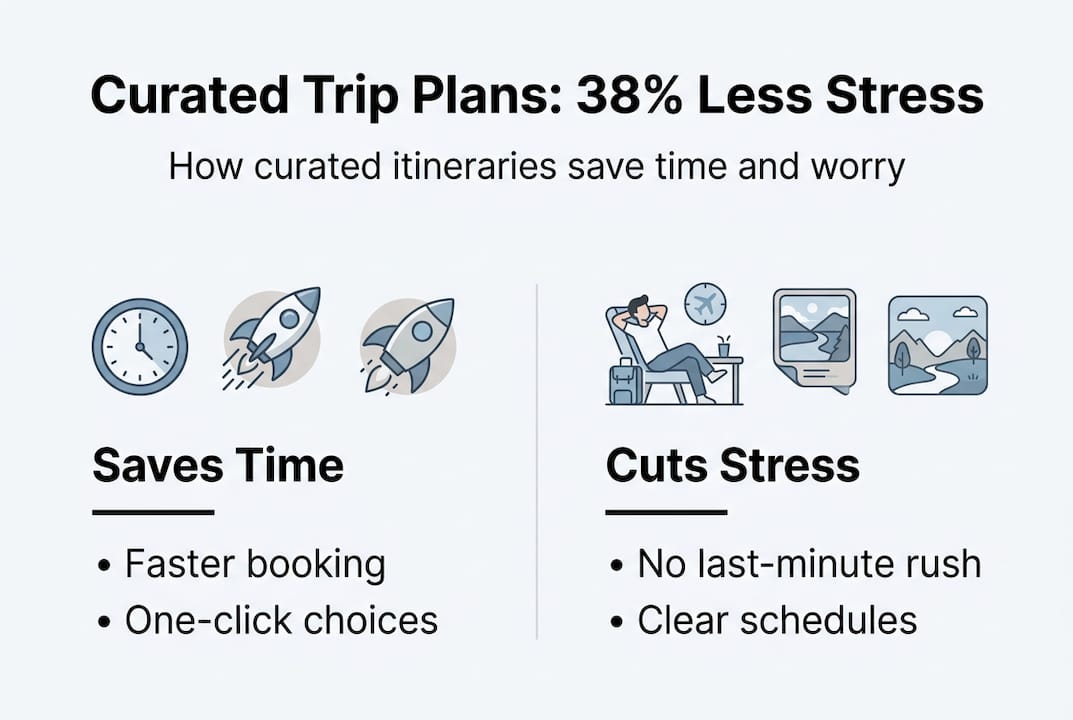
38% lower stress is the figure that stands out most. Travelers using AI-powered curated plans report measurably lower cortisol levels compared to those managing their own complex itineraries. For frequent travelers, that compounds fast.
Consider a family planning a two-week Europe trip with four cities, three different airlines, and a mix of adults and kids. DIY, that's a logistical puzzle that could take 40 hours to piece together. With curation, the same trip gets mapped out in a fraction of the time, with hotel proximity, kid-friendly activity timing, and transit connections all handled.
For travelers who want to optimize for stress-free travel, the compounding effect of small time savings is worth noting. If you take four trips a year and save 15 hours of planning per trip, that's 60 hours returned to your life annually. And understanding why trip planning matters goes beyond convenience — it's about protecting your energy and making the most of every trip you take.
A fresh perspective: Why curated trip plans are the smart default for modern travelers
Here's something most travel content won't tell you: the real cost of DIY planning isn't money. It's mental bandwidth.
Every tab you open, every review you read, every flight comparison you run takes a small toll. Multiply that across a complex trip and you arrive at your destination already tired. That's not a great way to start a vacation.
We think the conventional wisdom that "DIY means more control" is mostly a myth for busy travelers. Control over what, exactly? The hours you spend on logistics? The anxiety of hoping nothing goes wrong? Real control is deciding how you want to experience a destination, not micromanaging every transit connection.
For streamlined travel planning, the smartest move is treating your time as the finite resource it is. Curated plans aren't about giving up control. They're about redirecting your energy toward the parts of travel that actually matter to you.
DIY still makes sense for short, simple trips where you have time to enjoy the research. But for most modern travelers juggling work, family, and limited vacation days, smart delegation is the higher-return choice.
Pro Tip: Think of a curated plan the way you'd think of a good accountant. You could do your own taxes, but the time and stress you save by delegating often outweighs the cost many times over.
Ready to make your next trip effortless?
If the data resonates and you're ready to stop spending your evenings buried in browser tabs, there's a smarter way to plan. DestList combines AI precision with human travel expertise to build personalized itineraries that are ready to book within 24 hours.
Whether you're planning a weekend getaway or a multi-city international adventure, DestList's online travel planner handles the logistics so you can focus on the experience. Browse amazing tours curated for every travel style, or explore adventure destinations matched to your mood and budget. Your next trip should feel like a vacation from the moment you start planning it.
Frequently asked questions
How do curated trip plans actually save time for travelers?
Curated trip plans use AI to analyze logistics and optimize schedules, eliminating hours of manual research and replacing it with a ready-to-use itinerary built around your preferences.
Are curated trip plans better for complex or simple trips?
Curated plans offer the most value for complex, multi-stop, or international trips — as simple trips may suit DIY for travelers who enjoy the planning process and have the time for it.
Can curated trip plans adapt to last-minute changes?
Yes. Advanced curated plans use real-time AI adaptability to re-optimize your itinerary when disruptions, closures, or new preferences arise during your trip.
Is expert planning worth the extra cost?
For travelers who value their time and want lower stress and better outcomes, the cost of curation is typically offset by the hours saved and the overall improvement in trip quality.