
TL;DR:
- AI tools optimize multi-trip itineraries, reducing travel times by 20% and missed connections by 35%.
- Modern planning algorithms enhance personalization, handling disruptions and constraints effectively.
- Combining AI with human judgment creates efficient, feasible, and tailored travel plans for busy professionals.
Planning multiple destinations at once sounds like a recipe for chaos. But AI tools reduce travel times by 20% and missed connections by 35%, turning what used to be a spreadsheet nightmare into a smooth, sequenced journey. For busy professionals, every hour saved in planning is an hour gained at the destination. The real problem is not the complexity of multi-trip travel. It is the outdated assumption that you have to figure it all out manually, destination by destination. Modern planning methods flip that script entirely, and the results speak for themselves.
Table of Contents
- What is multi-trip planning and why it matters
- Advanced algorithms and AI: how the tech works
- Handling disruptions, constraints, and real-world challenges
- Expert nuances: best practices, pitfalls, and personalization
- The truth experts won't tell you about multi-trip planning
- Streamline your next trip with DestList
- Frequently asked questions
Key Takeaways
| Point | Details |
|---|---|
| Technology saves time | Advanced algorithms and AI reduce travel times by up to 20%, streamlining complex itineraries. |
| Robust against disruptions | Planners use buffer days, hybrid systems, and data-driven approaches to handle delays and real-world constraints. |
| Personalization makes a difference | AI-driven multi-trip planning delivers curated journeys tailored to your schedule and preferences. |
| Expert strategies matter | Linear or loop routes, minimum stays, and clustering help maximize efficiency for busy travelers. |
What is multi-trip planning and why it matters
Multi-trip planning is the practice of organizing travel across several destinations within a single journey, treating the whole trip as one interconnected system rather than a series of separate bookings. Instead of planning Tokyo, then Kyoto, then Osaka as three isolated trips, you optimize the full route from start to finish, minimizing backtracking, maximizing time at each stop, and keeping costs in check throughout.
The core mechanics rely on three pillars:
- Route sequencing: Determining the most logical order to visit destinations, often using mathematical models like the Traveling Salesman Problem (TSP). Algorithms like TSP, Simulated Annealing, and Genetic Algorithms power smarter itineraries by calculating the shortest or most efficient path through multiple stops.
- Mode selection: Choosing the right mix of flights, trains, buses, or rental cars based on cost, time, and convenience at each leg of the journey.
- Time allocation: Assigning the right number of days to each destination so you are not rushing through one city while spending too long in another.
For professionals with limited vacation days, this matters enormously. A poorly sequenced trip can waste an entire day in transit that could have been spent exploring. A well-sequenced one feels effortless, almost like someone else did all the thinking for you.
Statistic callout: Travelers who use optimized multi-trip planning report spending up to 30% less time in transit compared to those who book each segment independently.
The appeal goes beyond efficiency. Multi-trip planning also creates a more personalized experience because it forces you to define your priorities upfront. Do you want adventure-heavy mornings and relaxed evenings? Do you prefer cultural immersion over beach time? These preferences shape the entire route. For a deeper look at how AI fits into this process, AI travel itinerary tips can help you see how technology and personal preferences work together to build itineraries that actually fit your life.
Advanced algorithms and AI: how the tech works
Behind every great multi-trip itinerary is a set of powerful tools working quietly in the background. The algorithms that drive modern travel planning are not new, but their application to personalized travel has accelerated dramatically in recent years.
TSP (Traveling Salesman Problem) is the classic framework: find the shortest route that visits every destination exactly once. Simulated Annealing mimics the cooling of metal to escape local optima and find better global solutions. Genetic Algorithms evolve solutions over many iterations, selecting the best-performing routes and combining them to produce even better ones. These are not just theoretical tools. They power the route logic behind today's best travel platforms.
What makes modern AI different is personalization. AI and LLMs integrate retrieval, clustering, and spatial optimization to match itineraries to individual traveler profiles. Clustering groups nearby attractions so you are not zigzagging across a city. Spatial optimization ensures your hotel sits at the geographic center of your planned activities. Retrieval pulls relevant recommendations based on your stated preferences and past behavior.
| Method | Strength | Best for |
|---|---|---|
| TSP variants | Route efficiency | Multi-city trips |
| Simulated Annealing | Avoids poor local solutions | Complex constraints |
| Genetic Algorithms | Evolves better solutions over time | Long itineraries |
| LLM personalization | Natural language understanding | Preference matching |
Pro Tip: When using an AI planning tool, give it as many specific preferences as possible upfront. Vague inputs produce generic itineraries. Specific inputs, like "I prefer walking tours over bus tours and need a rest day every four days," produce plans that actually fit your style.
The benchmarks are impressive. LLMs achieve 91 to 97% feasibility on standard travel planning tests, meaning the vast majority of AI-generated itineraries are logistically sound. That said, feasibility is not the same as desirability. A route can be technically possible and still feel exhausting. That gap is where human curation still adds real value. Explore AI trip planning alternatives to understand where pure automation ends and expert judgment begins. For practical application, streamlining itineraries with AI walks through how to blend both effectively.
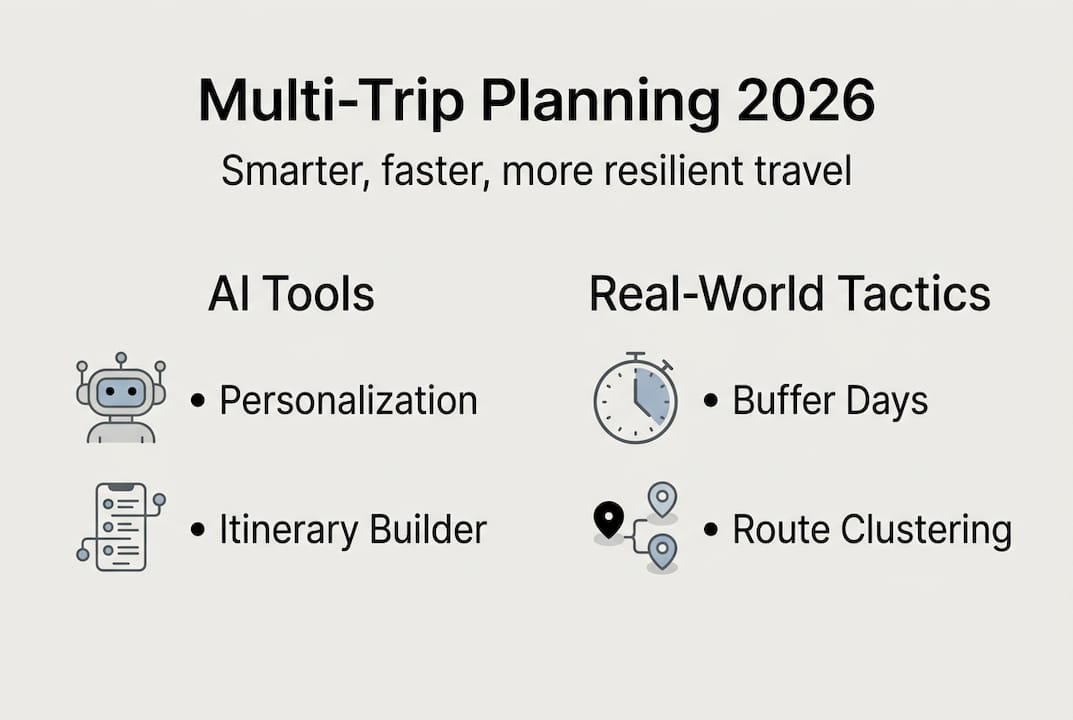
Handling disruptions, constraints, and real-world challenges
No itinerary survives first contact with reality completely intact. Flights get delayed. Trains get canceled. A museum you planned around is closed for renovation. Multi-trip planning, done well, accounts for these possibilities before they happen.

Common edge cases include delays, cancellations, hub-spoke routing limitations, and tight time windows or budget constraints. Hub-spoke limitations are particularly tricky: not every city has direct connections to every other city, so your itinerary may require routing through a major hub even when that adds time. Budget constraints create hard limits that can force trade-offs between speed and cost.
Here is how robust planning addresses these challenges:
- Buffer days: Adding one flexible day between major legs gives you room to absorb delays without derailing the rest of the trip.
- Time windows: Scheduling activities with realistic start and end times, including travel between locations, prevents the domino effect where one delay cascades into missed bookings.
- Geographic clustering: Grouping nearby destinations together reduces the risk that a disruption in one area affects plans in a completely different region.
- Hybrid planning systems: LLMs alone lack real-world robustness, but hybrid rule-based and LLM systems improve reliability significantly by combining the flexibility of AI with the predictability of hard rules.
| Challenge | Strategy | Outcome |
|---|---|---|
| Flight delays | Buffer days between legs | Missed connections avoided |
| No direct routes | Hub-spoke planning | Seamless connections |
| Budget overruns | Hard cost constraints | Stays within budget |
| Cancellations | Backup activity clusters | Minimal disruption |
Understanding the language of travel planning also helps. Knowing what terms like "open-jaw flights" or "positioning legs" mean can save you money and stress. A quick review of industry terms for travel gives you the vocabulary to make smarter decisions. And if you want a broader framework for reducing stress across the entire planning process, stress-free trip planning covers the full picture.
Expert nuances: best practices, pitfalls, and personalization
Once you understand how disruptions are managed, the next level is refining your approach with expert-level nuances that separate good trips from great ones.
Route types matter more than most people realize. Linear routes (point A to point B with stops along the way) work best when you have a clear start and end point, like flying into London and out of Rome. Loop routes (returning to your starting city) are better when you want to avoid one-way flight premiums and prefer a sense of narrative closure to your journey.
Here are the key expert practices that consistently produce better outcomes:
- Apply a two-night minimum per destination. Feasibility-first optimization recommends at least two nights per stop to avoid the exhaustion of constant packing and unpacking, and to actually experience a place rather than just pass through it.
- Use geographic clustering to build your sequence. Group destinations by region before optimizing order. Visit all your northern stops before heading south, not back and forth.
- Build buffer days strategically, not randomly. Place them after long travel days or before critical bookings, not just at the end of the trip where they go unused.
- Start with feasibility, then optimize for preference. Get a logistically sound route first, then adjust for personal preferences. Trying to optimize both at once leads to paralysis.
- Avoid the "highlight reel" trap. Packing in every famous landmark creates a rushed, surface-level experience. Choose depth over breadth.
Pro Tip: Use progressive constraint narrowing. Start with your hard limits (dates, budget, must-see destinations), then layer in soft preferences (pace, activity type, accommodation style). This approach produces itineraries that are both realistic and genuinely enjoyable.
"The best itinerary is not the one that fits the most in. It is the one that fits the most of you in."
For practical guidance on formatting your itinerary so it is easy to follow on the road, itinerary formatting efficiency is worth a read. And if you want a step-by-step approach to the full planning process, optimizing trip planning breaks it down clearly.
The truth experts won't tell you about multi-trip planning
Here is the uncomfortable reality: most travel advice treats AI as either a magic solution or a useless gimmick. Neither is true. AI is genuinely powerful at route logic, cost comparison, and feasibility checks. It is genuinely weak at understanding that you hate early mornings, that you need quiet time after crowded spaces, or that a particular city feels wrong for you even if it looks great on paper.
The professionals who travel best are not the ones who hand everything to an algorithm. They are the ones who use algorithms to handle the math and then apply their own judgment to the human parts. That means knowing when to override a suggested route because it does not feel right, even if it is technically optimal.
Conventional wisdom says plan everything in advance. Our experience says plan the structure in advance and leave room for the unexpected. The rigid itinerary is the one that breaks under pressure. The flexible one bends and recovers. For professionals who want to reclaim their vacation time without sacrificing quality, saving time on trips offers a practical framework that balances structure with breathing room.
Streamline your next trip with DestList
You now have the framework for building efficient, resilient multi-trip itineraries. But knowing the theory and having the time to execute it are two different things. That is where DestList steps in.
DestList combines AI-powered route logic with human travel expertise to deliver ready-to-book itineraries within 24 hours. Every plan includes day-by-day activities, mapped routes, estimated walking times, budget-matched flights and hotels, and weather alerts so nothing catches you off guard. Whether you are planning a two-week multi-city adventure or a quick long-weekend escape, DestList handles the complexity so you can focus on the experience. Browse curated options across adventure travel destinations and find your next trip without the planning fatigue.
Frequently asked questions
What is multi-trip planning and how is it different from single-trip planning?
Multi-trip planning optimizes the sequence and logistics for several destinations in one journey, reducing wasted time versus planning each segment separately. Route sequencing using TSP variants and time allocation are central to making this work efficiently.
Can AI fully automate travel planning for busy professionals?
AI greatly streamlines planning but still requires human input for personal preferences and handling real-world disruptions. AI and LLMs enhance personalization but hybrid approaches are needed for reliable, real-world results.
How does multi-trip planning manage unexpected disruptions like delays or cancellations?
Modern planners use buffer days, geographic clustering, and hybrid algorithms to absorb disruptions before they cascade. Edge cases like delays and cancellations are specifically addressed through robust optimization strategies built into the planning framework.
Does multi-trip planning reduce travel costs?
Yes, optimized routes and advanced planning typically cut travel costs by 15 to 20% compared to manual planning. Optimization reduces costs 15 to 20% and also cuts emissions by 4 to 46%, making it a smarter choice financially and environmentally.