
TL;DR:
- Effective travel planning for 2026 involves choosing destinations based on seasonality, visa requirements, and travel trends like cultural experiences and food exploration. It requires aligning budgets, booking flights early within optimal windows, and designing flexible itineraries focused on meaningful experiences. Utilizing AI tools alongside local insights streamlines preparation and enhances personal, authentic trip experiences.
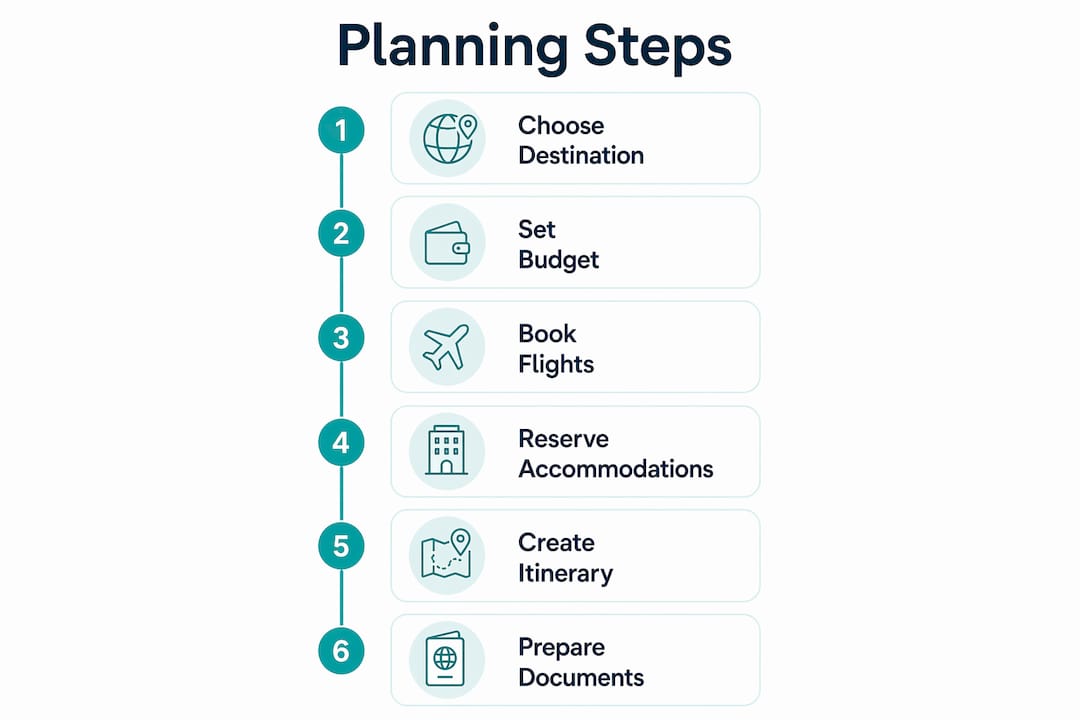
Travel planning is the process of organizing your destination, budget, bookings, itinerary, and documents to produce a smooth and enjoyable 2026 trip. Done right, it turns a stressful scramble into a confident sequence of decisions. This travel planning guide 2026 covers every major step: where to go, what to spend, when to book, how to structure your days, and what paperwork to secure before you leave. Tools like Google Flights, TripIt, and AI-powered platforms have changed how travelers approach each of those steps, and this guide shows you exactly how to use them.
How to research and choose the right destination for your 2026 trip
Destination choice is the decision that controls every other decision you make. Pick the wrong season or the wrong country for your passport, and your budget, itinerary, and booking windows all shift.

Start with climate and seasonality. Every destination has three travel seasons: peak, shoulder, and low. Peak season means crowds and high prices. Low season often means rain or extreme heat. Shoulder seasons deliver 20–30% savings on accommodations with far fewer crowds. For most of Europe, that window runs april through may and september through october. For Southeast Asia, it falls between the monsoon and the holiday rush.
Next, check visa and entry requirements before you fall in love with a destination. Rules vary by passport and change frequently. The European Union's ETIAS system, launched in 2025, requires travelers from dozens of countries to apply for pre-authorization before entering the Schengen Area. Missing this step can ground your trip entirely.
Two travel trends are reshaping how people pick destinations in 2026. American Express Travel identifies "Sight-Doing" and "Snackpacking" as top priorities: hands-on cultural experiences and food-focused local exploration. If those appeal to you, destinations like Oaxaca, Lisbon, and Chiang Mai rank higher than generic tourist hubs.
- Use Google Trends and travel forums like TripAdvisor to spot emerging destinations before they get crowded.
- Cross-reference your passport against official government visa databases, not travel blogs.
- Match your destination to your travel style: active, cultural, culinary, or relaxed.
- Check local public holidays at your destination since they affect prices and crowd levels.
Pro Tip: AI-driven tools like Destlist's free destination discovery feature analyze your mood, budget, and travel style to surface destinations you would not have found through a standard Google search.
What does budget planning look like for a mid-range traveler in 2026?
A realistic budget is the backbone of any solid travel plan. Without one, you either overspend or under-experience.
A mid-range daily budget in 2026 runs $120–$250 per person, covering hotel, meals, local transport, and activities but not international airfare. That breaks down roughly as $150 for accommodation, $60 for food and drinks, and $40 for transport and entry fees. The number shifts significantly by region. Southeast Asia sits at the lower end of that range. Western Europe and Australia push toward the top.
| Category | Daily Cost (Mid-Range) |
|---|---|
| Accommodation | ~$150 |
| Food and drinks | ~$60 |
| Local transport | ~$20 |
| Activities and entry fees | ~$20 |
| Buffer and incidentals | ~$20 |
Your budget also determines your accommodation type, which affects your itinerary. A centrally located hotel at $180 per night saves you $30 in daily taxi costs compared to a cheaper property 45 minutes from the city center. Factor in total cost, not just nightly rate.
- Use apps like Trail Wallet or TravelSpend to track daily spending in real time.
- Build a 10–15% contingency into your total trip budget for unexpected costs.
- Research regional price differences: the same trip costs 40% less in Eastern Europe than in Scandinavia.
- Book activities in advance to lock in lower prices and avoid sold-out experiences.
Pro Tip: Set up price alerts on Google Flights and Kayak at least three months before your trip. Historical fare data shows when prices are genuinely low versus artificially inflated by demand spikes.
When and how should you book flights and accommodations in 2026?
Booking timing is one of the most misunderstood parts of the travel planning process. Most travelers book too late for international trips and too early for domestic ones.
The optimal booking window for long-haul international flights is 4–6 months before departure. For domestic flights, 1–2 months ahead hits the price sweet spot. Booking outside these windows almost always costs more. Airlines price seats based on demand curves, and the middle window is where supply and demand balance in the traveler's favor.
For multi-city trips, the booking order matters as much as the timing. Regional flights should be booked first because smaller routes have fewer flights and fill faster. If you book your transatlantic flight before confirming your regional connection in Southeast Asia, you may find the connecting leg is sold out or prohibitively expensive.
One of the most common planning mistakes is booking flights before confirming visa eligibility and seasonal conditions. This leads to cancellation fees and rebooking costs that wipe out any savings from early booking.
- Confirm visa eligibility and entry requirements for every country on your itinerary.
- Research peak and shoulder seasons for each destination to time your visit correctly.
- Book regional and connecting flights before locking in your main international route.
- Use Google Flights price tracking to monitor fare trends and identify genuine price drops.
- Book accommodations near transit hubs to reduce daily transport costs and time.
- Choose refundable hotel rates when booking far in advance since plans change.
Pro Tip: Book your hotel early to secure the best room categories, then cancel and rebook if prices drop. Most major hotel chains and booking platforms allow free cancellation up to 48 hours before arrival.
How do you build a daily itinerary that maximizes your 2026 trip?
A well-structured daily itinerary is what separates a memorable trip from an exhausting one. The goal is not to see everything. The goal is to experience the right things at the right pace.
Start by anchoring each day around one or two core attractions. Then layer in immersive experiences around them. A morning at the Uffizi Gallery in Florence pairs naturally with an afternoon pasta-making class nearby. That combination reflects the "Sight-Doing" trend: moving from passive sightseeing to active participation. Over 33% of travelers now use AI specifically to plan their day-to-day itineraries, and the results show in how much more varied and personalized those plans are.
The 2026 trend called "Lore Chasing" adds another layer. Travelers seek out locations tied to specific stories, films, books, or local legends. Visiting the filming locations of a favorite series or tracing a historical figure's route through a city creates a personal narrative that standard tourist itineraries miss entirely.
Pacing is where most self-planned itineraries fail. Scheduling five major attractions in one day sounds productive but produces fatigue by 2 p.m. A better structure is two major experiences per day with unscheduled time built in for spontaneous discoveries. You can explore different itinerary types to find the format that matches your travel style, whether that is a relaxed cultural immersion or a high-activity adventure schedule.
- Anchor each day around one major attraction and one immersive local experience.
- Group activities by neighborhood to minimize transit time between stops.
- Build at least 90 minutes of unscheduled time into each day for flexibility.
- Use AI itinerary planners to generate a base plan, then customize it to your preferences.
- Check opening hours and advance booking requirements for popular sites before finalizing your schedule.
What travel documents and prep steps do you need for 2026?
Documentation is the least exciting part of trip planning and the most consequential if you get it wrong. One missing form can cancel a trip that took months to organize.
Passport validity is the first check. Many countries require six months of validity beyond your travel dates. A passport expiring in three months may be rejected at the border even if your trip ends before it expires. Renew early since processing times in 2026 remain longer than pre-pandemic norms.
Digital entry systems like ETIAS have added a new layer of pre-trip preparation for travelers visiting Europe. The application is online and takes minutes, but approval is required before boarding. Missing it means being denied at the gate. Apply at least two weeks before departure to allow processing time.
Travel insurance is non-negotiable for international trips. Policies covering medical evacuation, trip cancellation, and lost luggage protect you from costs that can reach tens of thousands of dollars. Compare policies on platforms like InsureMyTrip or Squaremouth before buying.
- Verify passport validity and visa requirements for every country on your itinerary at least three months out.
- Apply for ETIAS or any required digital travel authorization well before your departure date.
- Purchase travel insurance that covers medical emergencies, cancellations, and baggage loss.
- Create digital backups of your passport, visa approvals, insurance policy, and hotel confirmations stored in cloud services like Google Drive or Dropbox.
- Research local SIM card options or international data plans to stay connected without roaming fees.
Pro Tip: Email yourself a single PDF containing all your travel documents. If your phone is lost or stolen, you can access everything from any device at any internet cafe or hotel lobby.
Key takeaways
Effective 2026 trip planning requires matching destination choice, booking timing, and daily itinerary structure to your budget and travel style before you spend a dollar.
| Point | Details |
|---|---|
| Book flights at the right time | Long-haul flights: 4–6 months out. Domestic flights: 1–2 months out. |
| Shoulder seasons save money | Traveling outside peak periods cuts accommodation costs by 20–30%. |
| Regional flights book first | For multi-city trips, secure connecting routes before your main international flight. |
| Documents before bookings | Confirm visa eligibility and ETIAS requirements before purchasing any flights. |
| AI tools accelerate planning | Over 60% of informed travelers use AI for trip planning; 33% use it for daily itineraries. |
What i've learned planning trips in the AI era
The biggest shift I have noticed in travel planning over the past two years is not the tools themselves. It is how much faster you can move from "I want to go somewhere" to "here is my confirmed itinerary" when you use AI correctly.
I used to spend three weekends researching a single trip. Now I use AI to generate a working itinerary in under an hour, then spend my real time refining it with local knowledge and personal preferences. That is the right balance. Travelers in 2026 prefer curated, human-vetted content over purely AI-driven suggestions. The technology gets you 80% of the way there. Your judgment and research close the gap.
Shoulder season travel has also changed how I think about value. I stopped chasing peak-season destinations and started asking which places are best in their off-peak months. Portugal in november, Japan in early december, and Colombia in april all deliver exceptional experiences at a fraction of the summer price. The crowds are thinner, the locals are more relaxed, and the trip feels more authentic.
The one thing AI cannot replace is local knowledge. I always cross-reference AI-generated itineraries with recent posts from travel communities on Reddit and local food blogs. That combination of algorithmic efficiency and human specificity produces plans that actually work on the ground. If you want to use AI for planning without losing the personal touch, treat it as a starting point, not a final answer.
— Helen
Plan your 2026 trip without the guesswork
Pulling together a complete trip plan takes time most people do not have. Destlist solves that by combining AI-generated itineraries with human travel curators who refine every detail before you see it.
You get a custom travel itinerary built around your budget, travel style, and preferred destinations, delivered within 24 hours and ready to book. Destlist handles flights, hotels, day-by-day activities, mapped routes, and walking times so you can focus on the experience rather than the logistics. Whether you are planning a 7-day Bali escape or a multi-city European trip, Destlist turns the planning process into a single, confident decision.
FAQ
What is the best time to book international flights in 2026?
The optimal booking window for long-haul international flights is 4–6 months before departure. Booking outside this window typically results in higher fares due to demand-based airline pricing.
How much should i budget per day for a 2026 trip?
A mid-range traveler should budget $120–$250 per day, covering accommodation, meals, local transport, and activities but excluding international airfare. Costs vary significantly by region.
What is ETIAS and do i need it?
ETIAS is the European Union's digital pre-authorization system for travelers from visa-exempt countries visiting the Schengen Area. It launched in 2025 and is required before boarding any flight to participating European countries.
How do i use AI tools for travel planning?
Over 60% of travelers aware of AI now use it for trip planning, with 33% using it specifically for daily itinerary creation. Tools like Destlist combine AI generation with human review to produce personalized, ready-to-book plans.
What are the top travel trends shaping itineraries in 2026?
American Express Travel identifies "Sight-Doing" and "Snackpacking" as the defining trends: travelers want hands-on cultural experiences and food-focused local exploration rather than passive sightseeing.