
TL;DR:
- Effective trip planning combines clear goals, tool selection, and contingency strategies for efficiency.
- Using a hybrid approach of AI drafts and manual validation produces the most reliable itineraries.
- Preparing for disruptions with backup plans ensures smooth travel and avoids last-minute stress.
Trip planning should feel exciting, not like a second job. Yet most travelers spend an average of 10 or more hours researching destinations, comparing flights, and cobbling together itineraries that still feel incomplete by departure day. If you're a busy professional or someone who simply wants to maximize every vacation day, that kind of time drain is a real problem. This guide walks you through a proven, step-by-step framework that cuts through the noise, eliminates common planning mistakes, and gets you from "where should we go?" to "can't wait to leave" without the stress.
Table of Contents
- Define your travel goals and constraints
- Gather tools and resources for efficient planning
- Plan your itinerary: A step-by-step workflow
- Prepare for edge cases, disruptions, and fine-tuning
- The uncomfortable truth most travelers miss about trip planning
- Plan your perfect trip faster with DestList
- Frequently asked questions
Key Takeaways
| Point | Details |
|---|---|
| Start with clear goals | Knowing your travel style and non-negotiables saves hours later on. |
| Use the right tools | Mix expert-curated resources and smart tech for efficient planning. |
| Plan step by step | Follow a structured workflow and always include backup options. |
| Prepare for the unexpected | Anticipating edge cases and disruptions guarantees less stress on your trip. |
| Combine tech and human insight | Hybrid approaches outperform one-size-fits-all planning for busy travelers. |
Define your travel goals and constraints
Every well-planned trip starts with clarity, not a Google search. Before you open a single booking site, take 20 minutes to write down exactly what you want from this trip. That simple exercise will save you hours of backtracking later.
Start by identifying your non-negotiables. These are the things your trip absolutely must include or avoid. They vary wildly from one traveler to the next, which is why a custom travel itinerary almost always outperforms a generic one. As manual planning emphasizes, in-depth research is what drives truly customized trips that match real traveler needs.
Here is what to clarify before you do anything else:
- Budget range: Set a realistic total budget and break it into buckets: flights, accommodation, food, activities, and buffer.
- Travel dates: Know your hard limits for departure and return, and flag any blackout periods.
- Pace preference: Do you want a jam-packed adventure or slow, relaxed days with room to wander?
- Group dynamics: A solo trip, a couple's getaway, a friends trip, and a multigenerational family vacation each require a completely different approach.
- Physical needs and special requirements: Accessibility needs, food allergies, fitness levels, and age-related considerations all shape what's actually enjoyable vs. what looks good on paper.
- Climate and destination preferences: Beach, mountains, city, or countryside? Warm or cool? Knowing this narrows your options fast.
Once you have these factors written out, you'll notice your destination list shrinks naturally. That's the point. You're not eliminating options; you're filtering for fit. Personalized travel itineraries consistently outperform generic plans precisely because they account for these individual details from day one.
Pro Tip: Open a simple spreadsheet or notes app and create one column for "must-haves" and another for "dealbreakers." Share it with your travel companions before any bookings are made. It prevents disagreements later and keeps everyone aligned.
Gather tools and resources for efficient planning
Once your goals and constraints are clear, the right set of tools can transform trip planning from a chore into a streamlined process. Not all tools are created equal, and using the wrong one for the wrong task wastes more time than starting from scratch.

Here's a practical breakdown of the most common planning tools and when each one earns its place:
| Tool | Best for | Watch out for |
|---|---|---|
| AI trip planners | Quick drafts, inspiration, logistics overviews | Hallucinations, outdated info, missing permits |
| Travel aggregators (e.g., Google Flights, Kayak) | Flight and hotel price comparisons | Hidden fees, non-refundable traps |
| Spreadsheets | Budget tracking, group coordination | Time-intensive to build from scratch |
| Guidebooks | Local context, off-the-beaten-path finds | Can be outdated by 1 to 2 years |
| Travel forums (e.g., Reddit, TripAdvisor) | Real-time tips, recent traveler experiences | Opinions vary wildly; hard to verify accuracy |
The growing popularity of AI tools is hard to ignore. A striking 91% of travelers now use AI for trip planning at some stage. However, general-purpose AI often misses critical details like route closures, local regulations, or permit requirements. That's a risk you don't want to take when your whole trip hinges on getting those details right.
For practical AI trip planning tips that actually work, the smartest approach is using AI to generate a first draft, then validating every key detail manually or through a specialist service. Think of AI as a starting point, not a finished product.
- Use travel aggregators for price tracking, not final booking decisions
- Cross-reference forum recommendations with at least two independent sources
- Check government travel advisories for any destination, especially international ones
- Confirm attraction opening hours and reservation requirements directly on official websites
Pro Tip: Always verify AI-generated itinerary details for route closures, schedule changes, or updated local regulations. What was accurate three months ago may already be outdated, especially in popular national parks or tourist-heavy destinations.
This efficient planning guide pairs well with a solid tool stack to help you move faster without cutting corners.
Plan your itinerary: A step-by-step workflow
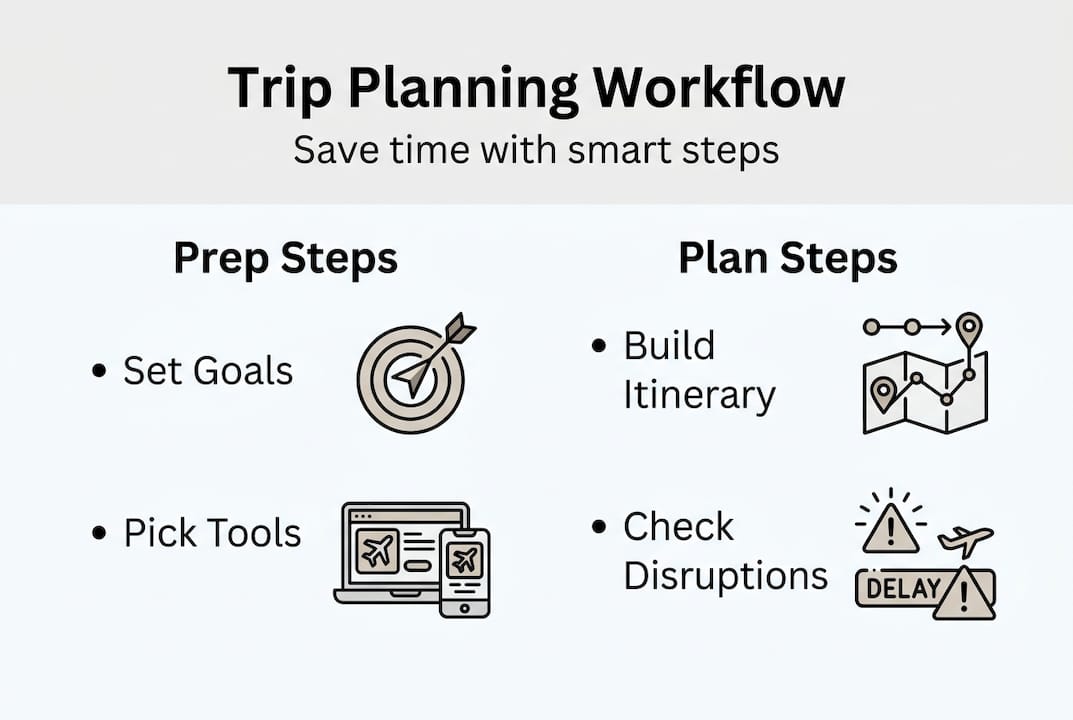
Armed with tools, it's time to build your actual plan. Here's a proven sequence to get from ideas to a confirmed, ready-to-book itinerary.
- Set your destination and route: Confirm your primary destination and map the most logical travel route to minimize backtracking and transit fatigue.
- List your anchor activities: Identify the 2 to 3 experiences that define this trip. Everything else is built around them.
- Block out travel days: Mark arrival and departure days as light days. Overloading them is one of the most common planning mistakes.
- Fill in daily structure: Assign activities to specific days based on location proximity, operating hours, and physical intensity. Mix high-energy and low-key days.
- Book essentials first: Flights, accommodation, and any high-demand activities or permits should be locked in before everything else.
- Layer in dining and logistics: Research and note restaurant options and transportation links. You don't need reservations everywhere, but having options mapped out saves real-time scrambling.
- Build in buffer time: Leave at least one free half-day per four days of travel for rest, spontaneity, or recovery from delays.
The method you use to create this itinerary matters. Research shows that specialized planning systems achieve a 97.9% success rate for constraint-satisfying itineraries compared to just 0.6 to 4.4% for general AI tools. That's not a small gap; it's a fundamentally different level of reliability.
| Method | Accuracy | Time required | Best for |
|---|---|---|---|
| General AI | Low (0.6 to 4.4%) | Fast | Inspiration only |
| Manual research | High | Slow | Complex, niche trips |
| Specialized planner | Very high (97.9%) | Fast | Most travelers |
For those managing multiple destinations, multi-trip planning tips can help you layer trips without creating scheduling conflicts. And if you're unsure which format suits your style, exploring trip planner types is worth a few minutes of your time.
Manual planning offers the benefit of built-in flexibility, especially when you leave deliberate slack in your schedule for disruptions. The key is combining that flexibility with structure, not choosing one over the other.
For a deeper look at how formatting affects your planning speed, check out this guide on itinerary formatting efficiency.
Prepare for edge cases, disruptions, and fine-tuning
With a draft itinerary in place, it's crucial to anticipate what could go wrong and get ahead of the most common and costly mistakes. Most trips don't fail because of bad destinations. They fail because of overlooked details.
Here's a checklist of edge scenarios every traveler should review before finalizing any plan:
- Permits and reservations: Many national parks, popular hiking trails, and cultural sites now require advance booking. Check requirements months out, not weeks.
- Weather windows: Research average conditions for your travel dates and identify which activities are weather-dependent. Have a rainy-day plan ready.
- Fees and surcharges: Entry fees, resort fees, national park passes, and city tourism taxes add up fast. Factor them into your budget early.
- Group capability gaps: If you're traveling with a multigenerational group, make sure each major activity has a gentler alternative for those who can't participate at full intensity.
- Transportation disruptions: Strikes, road closures, and ferry cancellations happen more often than most travelers expect. Know your backup transit options in advance.
As edge cases for road trips remind us, contingency planning for shuttles, permits, parking, weather, fees, and multigenerational alternatives is not optional; it's what separates a great trip from a stressful one.
"Your trip doesn't fall apart because of big disasters. It falls apart because of small, fixable details you didn't check ahead of time."
Pro Tip: Create a "Plan B" list for each major activity day. Just one solid alternative per day is enough. You'll rarely need it, but when you do, you'll be glad it's already written down.
For more practical strategies, this guide on how to save time on planning covers additional techniques that work especially well for time-crunched travelers.
The uncomfortable truth most travelers miss about trip planning
Here's what years of watching travelers plan trips teaches you: the people who stress the most are usually committed to one extreme. Either they trust a single app to handle everything, or they refuse to use any tool and drown in browser tabs. Neither works reliably.
The reality is that combining manual and tech-driven planning consistently produces better outcomes than either approach alone. Technology delivers speed and scale. Human judgment delivers nuance and error-catching. Together, they produce trips that actually match what you wanted when you first started planning.
The smartest travelers we see use a simple mental rule: delegate the research-heavy parts, stay hands-on for the priorities that matter most to them. That could mean using a specialized planner for logistics and personally researching two or three restaurants you've been dreaming about. This efficient planning guide shows exactly how to apply that balance in practice. Rigid plans and fully automated itineraries both tend to crack under real-world pressure. Flexible, hybrid plans bend instead.
Plan your perfect trip faster with DestList
If this guide gave you a clearer picture of what good trip planning looks like, DestList is built to do the heavy lifting for you.
DestList combines AI precision with human expertise to deliver ready-to-book itineraries within 24 hours. Whether you need a done-for-you travel planning experience or a fully personalized custom travel itinerary service built around your exact budget, pace, and group, DestList handles the research, routing, and logistics so you don't have to. Browse curated adventure destinations or start with a free destination-match tool to find where you should go next. Your next great trip is closer than you think.
Frequently asked questions
How much time should I budget for comprehensive trip planning?
Most travelers can complete thorough, stress-free trip planning in 2 to 6 focused sessions when following a structured, step-by-step workflow rather than researching randomly.
Can AI tools replace manual planning for complex trips?
AI tools handle the basics well, but complex trips need hybrid approaches that combine AI speed with manual verification and human expertise for the best results.
What's the most commonly overlooked step when planning a trip?
Most travelers skip contingency planning entirely. Disruptions like strikes and permit issues can derail even well-researched itineraries without a backup plan in place.
How do I manage trip planning for a diverse group, like multigenerational families?
Building in adaptable alternatives for varying ability levels and interests ensures every member of a multigenerational group has genuinely enjoyable options throughout the trip.