
Pick the neighborhood that fits your trip's purpose first, then filter for the shortest, most reliable transit connection to it. That's the whole rule. Distance to a landmark on a map means far less than whether you can get there without three transfers or a 20-minute wait at 11 PM.
Do two things right now, before you open a single hotel listing:
- Write your non-negotiables. Arrival time, the two or three things you must see or do, and any mobility needs (stroller, wheelchair, bad knees, heavy luggage).
- Open a map and check transit at the edges of the day. Look at how buses, trains, or rideshare availability run when you land and when you'd be coming home late. Frequency at 2 PM tells you nothing about frequency at 11 PM.
Transportation access is the single biggest factor separating a hotel location that works from one that quietly ruins a trip. Research on hotel site-selection published in Scientific Reports found transportation accessibility accounts for a large share of the information used to classify successful hotel locations, more than any other variable measured. That's not a small edge. It's the dominant signal, and most travelers never check it before booking.
Key Takeaways
The single most reliable way to choose a hotel location is to match the neighborhood to your trip's purpose, then confirm transit works at the actual hours you'll be traveling, not just at midday.
| Point | Details |
|---|---|
| Purpose beats proximity | Match the neighborhood to your trip type before comparing distance to landmarks. |
| Test transit at the edges | Check schedules and transfers at arrival, late-night, and departure times, not midday. |
| Distance is a weak proxy | Route quality and transfer count matter more than raw miles to the center. |
| Calculate total stay cost | Add transit, parking, and meal costs to the nightly rate before comparing hotels. |
| Let Destlist run the check | Destlist maps activities to neighborhoods and verifies transit within a 24-hour turnaround. |
Table of Contents
- How Do You Choose the Right Hotel Location, Step by Step?
- What Should You Check About a Neighborhood Beyond the Photos?
- How Do You Test Transit Friction Before You Book?
- How Do You Spot an Unsafe Hotel Area Before You Book?
- How Do You Calculate the Real Cost of a Hotel Location?
- Does Your Ideal Hotel Location Change by Trip Type?
- How Destlist Applies This Method for You
- What Most Travel Advice Gets Wrong About Location
- Skip the Research and Get a Hotel Match Built Around Your Trip
- Frequently Asked Questions
- Sources
How Do You Choose the Right Hotel Location, Step by Step?
You don't need a spreadsheet to get this right. Four steps, done in order, will get you there in under 30 minutes.
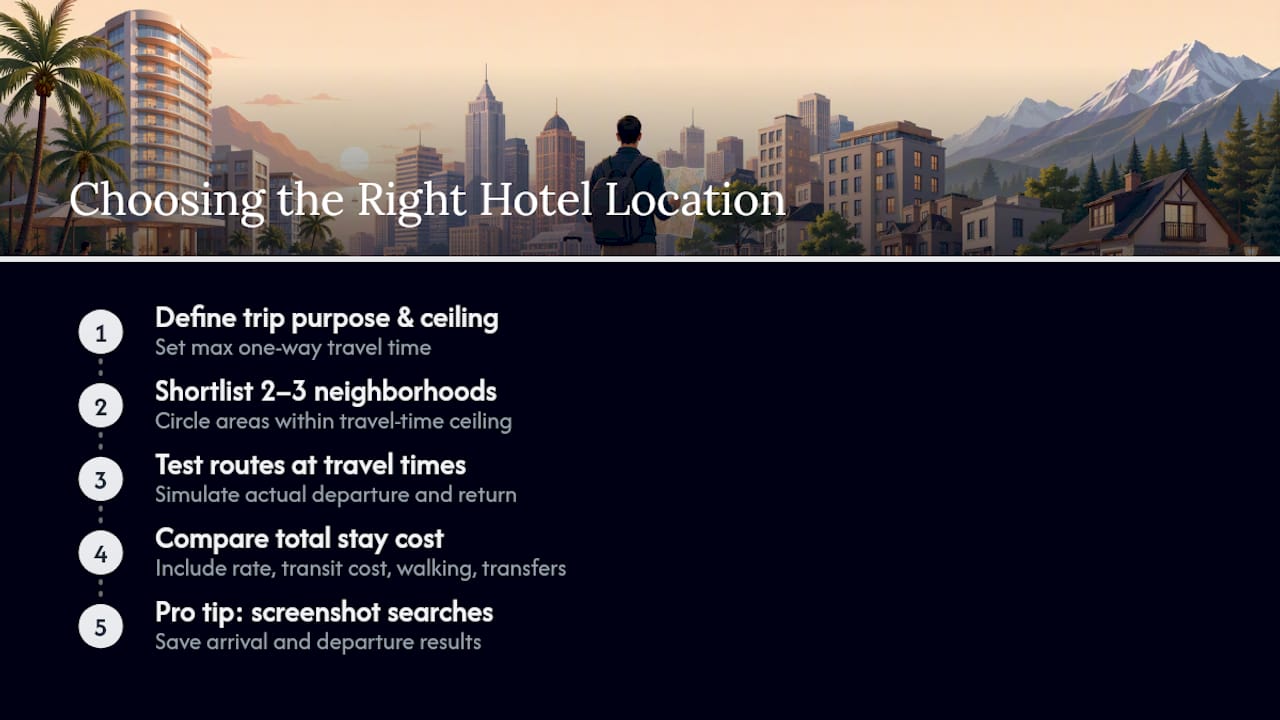
1. Define your trip purpose and your travel-time ceiling. A honeymoon, a conference, a family reunion, and a solo hiking trip all point to different neighborhoods. Decide the maximum one-way travel time you'll tolerate to your main activity or venue, and write it down as a hard number, not a vibe.
2. Shortlist two or three neighborhoods. Pull up a map and mark your must-visit places, your venue, or your embarkation point. Circle the areas within your travel-time ceiling. Resist the urge to compare every neighborhood in the city; a focused shortlist of two or three areas is what keeps this decision from turning into a research project.
3. Test actual routes at the actual times you'll travel. Use transit apps to simulate your morning departure and your late return, not a generic midday trip. Check whether the walk from the station involves stairs, a dark stretch, or a busy intersection with no crosswalk.
4. Compare total stay cost and pick the practical winner. Weigh nightly rate against transit cost, walking convenience, and how many transfers you'll eat every single day of the trip.
Pro Tip: Screenshot your transit route search results for arrival day and departure day before you book. Schedules and last-train times get buried in listings but show up instantly in a transit app.
What Should You Check About a Neighborhood Beyond the Photos?
"Distance to the center" is one of the most overrated numbers in hotel shopping. A hotel that's 1.2 miles from downtown but sits on a direct tram line can beat one that's 0.4 miles away but requires cutting through a confusing transit hub or a hill with no sidewalk. Route quality, not raw distance, decides whether you actually enjoy getting around.
Before booking, run through this checklist for any neighborhood you're considering:
- Grocery and pharmacy access. A 24-hour pharmacy or a corner grocery within a five-minute walk matters more than it sounds like until you need one at 9 PM.
- Evening options. Are there restaurants or cafes open past 8 PM, or does the block go dark?
- Green space or a place to walk. Even a small park changes how a neighborhood feels on a multi-day stay.
- Noise profile. A hotel above a nightlife strip or next to a fire station will not read as "central and lively" by night three.
- Everyday conveniences. Laundromat, ATM, coffee shop, a place to grab breakfast without a 15-minute detour.
Street View is underused here. Drop the pin on the exact block and look at what's actually there, not what the hotel's photos imply. Cross-reference with recent reviews (the last three months matter more than the last three years) and a local blog or subreddit if the city has one. Destination guides can help translate a neighborhood's reputation into something concrete. Vancouver's official tourism site, for example, breaks its city down by traveler type rather than just proximity to downtown, which is the model worth copying when you evaluate any city.
How Do You Test Transit Friction Before You Book?
Transit friction is the gap between what a map shows and what a trip actually feels like. A route that looks like "12 minutes" on paper can become 35 minutes once you add a transfer, a 10-minute wait, and a flight of stairs with a rolling suitcase. Testing this before you book, not after you arrive, is what separates a smooth trip from a frustrating one.
Run these checks against your actual itinerary, not a hypothetical average day:
- Simulate your full day: hotel to main activity, activity to dinner, dinner back to hotel, at the real times you'll be moving.
- Check late-night schedules specifically. Many systems cut frequency in half or stop entirely after midnight.
- Count transfers. Each one adds wait time and a chance of missing a connection with kids or luggage.
- Look for elevators or ramps on the last leg. Stairs at 11 PM with a suitcase is a different experience than stairs at 2 PM with a day bag.
This isn't a minor consideration. Research on transportation's role in hotel demand confirms that transit access is the single most influential variable in how successful a hotel location turns out to be, ahead of price tier, star rating, or brand.
How Do You Spot an Unsafe Hotel Area Before You Book?
Star ratings and glossy photos tell you nothing about how a block feels at 10 PM. A few minutes of targeted checking usually will.
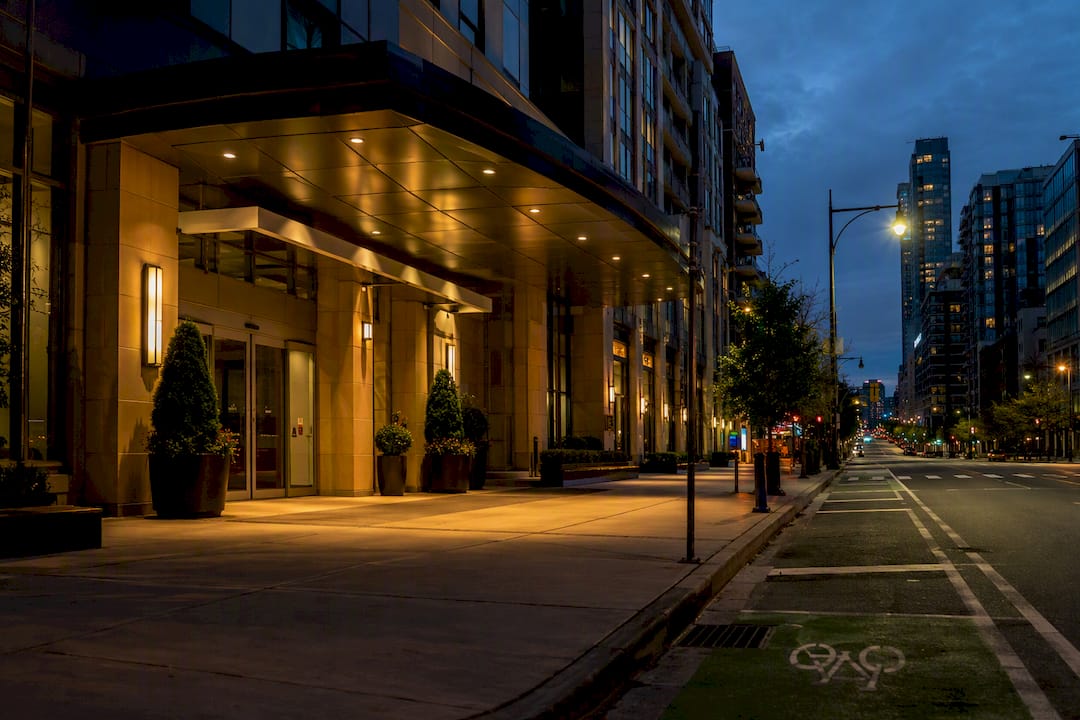
Drop into Street View and look at lighting, sidewalk condition, and whether storefronts look active or boarded up. Then scan reviews from the last few months specifically for mentions of the walk to and from the hotel after dark, not just the room itself.
Watch for these red flags:
- Repeated, specific safety complaints across multiple reviews, not a single outlier comment.
- No visible late-night transport option within a reasonable walk.
- A walking route that passes through poorly lit stretches, underpasses, or empty lots.
- Local forums or municipal safety pages flagging the specific block, not just the general district.
One negative comment in fifty reviews is noise. Three or four independent mentions of the same issue, especially about the walk from transit, is a pattern worth taking seriously.
How Do You Calculate the Real Cost of a Hotel Location?
The nightly rate is only part of what a hotel location actually costs you. A cheaper room in an inconvenient spot can end up pricier once you add everything else.
Build your comparison with these line items for each shortlisted neighborhood:
- Nightly room rate plus taxes and mandatory fees.
- Estimated daily transit or rideshare cost to your main destinations.
- Parking, if you're driving.
- Breakfast or meal premiums if the area lacks affordable options nearby.
Here's a simple illustration. Say Hotel A runs $150 a night but sits a 10 minute walk from a subway that reaches your conference venue directly. Hotel B runs $120 a night but requires a $25 round-trip rideshare each day because the nearest transit stop is unreliable after dark. Over four nights, Hotel B's "savings" evaporate, and you've spent more time in transit to boot.
The decision rule: when the price gap between two hotels is smaller than the value of the time and hassle you'd save, take the more convenient one. Multi-criteria approaches used in academic site-selection research, including fuzzy decision models, formalize exactly this tradeoff between cost and access.
Does Your Ideal Hotel Location Change by Trip Type?
Your priorities shift depending on why you're traveling, and the "best" area for a honeymoon is rarely the best area for a work trip.

Families should weight larger rooms or suites, a grocery store within walking distance, and quieter evening hours over being steps from nightlife. Nearby parks and easy access to a pharmacy or urgent care clinic matter more than they seem to until you need them. A family travel planning guide is worth a read if you're building out a multi-stop trip with kids.
Business travelers should prioritize a consistent, repeatable commute to the meeting venue over a scenic neighborhood, plus reliable workspace, early breakfast service, and flexible cancellation in case plans shift.
One-night stays and early flights call for a different rule entirely: pick proximity to the airport or a confirmed express connection, and always confirm late check-in policy before booking.
Cruise passengers should look for hotels genuinely adjacent to the embarkation point, or ones with a confirmed port transfer, since a beautiful but disconnected neighborhood creates real risk on departure morning.
How Destlist Applies This Method for You
Destlist runs this exact process, just faster. The platform maps your planned activities against neighborhood options, checks transit connections for your specific dates, and returns hotel matches that already account for the friction points covered above, rather than sorting by star rating and price alone. Every plan combines AI-driven matching with a review from a human travel curator, and Destlist delivers a ready-to-book trip plan within 24 hours of your request.
If you ask Destlist for hotel-focused planning, here's what comes back:
- A shortlisted hotel match tied to your actual daily itinerary, not a generic "central" recommendation.
- A transit check for your specific arrival and departure times.
- A day-by-day route map with walking times built in.
- A total-cost view that accounts for more than the nightly rate.
Pro Tip: If you're planning a multi-city trip, ask for the neighborhood rationale behind each hotel pick. It tells you exactly why that block was chosen over the alternatives nearby.
What Most Travel Advice Gets Wrong About Location
Most hotel guides still lead with "stay central" as if proximity were the whole game. It isn't. The research is clear that transit conditions, not raw distance, drive whether a location actually works, and yet almost no consumer-facing advice tells readers to test a route at 11 PM before booking. That's the gap between what gets published and what actually prevents a bad trip.
The conventional advice also assumes travelers have time to research a dozen neighborhoods. Most don't, and that's exactly where decision fatigue creeps in, and people default to whichever hotel has the most photos. A tighter shortlist, tested against your real schedule, beats an exhaustive comparison every time.
If you take one thing from this: define your non-negotiables before you start browsing, not after you've fallen for a listing. The order matters more than the depth of the research.
Skip the Research and Get a Hotel Match Built Around Your Trip
If everything above sounds like the right process but not something you want to run yourself at 11 PM before a trip, that's exactly the gap Destlist closes. Instead of testing transit routes and cross-referencing reviews across three neighborhoods, you tell Destlist your trip purpose, dates, and priorities, and get back hotel matches already checked against transit access, walking routes, and total cost, not just star rating.

The service works for exactly the traveler this guide is written for: someone who wants a smart location decision without spending an evening on it. Destlist pairs AI matching with a human curator's review, and a plan lands in your inbox within 24 hours. Browse curated trip plans to see how the matching works, or head straight to the custom travel itinerary page to submit your trip details and get a hotel-focused plan built around your actual schedule.
Frequently Asked Questions
What's the single most important factor in choosing a hotel location? Transit access. It's the factor most strongly tied to how well a hotel location actually performs for a trip, ahead of price, star rating, or raw distance to downtown.
Should I always pick the hotel closest to the city center? No. A hotel farther out on a direct, frequent transit line often beats one that's closer but requires transfers or a walk through a confusing area. Route quality matters more than distance on a map.
How do I check if a neighborhood is safe at night? Use Street View to check lighting and upkeep on the exact block, then scan reviews from the last few months for repeated, specific mentions of the walk to and from the hotel after dark.
How many neighborhoods should I compare before booking? Two or three. A focused shortlist based on your trip purpose is easier to test properly than a long list of every neighborhood in the city.
Does a lower nightly rate always mean a better deal? Not once you add transit costs, parking, and meal premiums. A slightly pricier hotel with better transit access can cost less overall and save real time every day of the trip.
Sources
- Few-shot hotel industry site selection prediction method based on meta learning algorithms and transportation accessibility
- Where to stay in Vancouver (destination guide)