
TL;DR:
- Personalized itineraries based on your needs enhance travel experience and reduce planning stress.
- Using a hybrid of AI tools and human expertise offers the best balance of efficiency and customization.
- Flexibility and ongoing adjustments during the trip lead to more memorable and enjoyable travels.
Generic travel itineraries are everywhere. You've probably downloaded one promising a "perfect week in Rome" only to realize it assumes you love museums, have unlimited energy, and never want to sit down for a long lunch. The truth is, cookie-cutter plans waste your time and drain your excitement before the trip even starts. A personalized itinerary, built around what you actually want, doesn't just make travel easier. It makes it genuinely better. This guide walks you through every step of building a travel plan that fits your pace, budget, and personality, so your next trip feels less like a schedule and more like an experience.
Table of Contents
- Assess your needs and trip goals
- Choose your planning tools and resources
- Step-by-step: Building your personalized itinerary
- Refine, troubleshoot, and adapt as you go
- Rethinking personalization: Why your itinerary should evolve with you
- Get your trip expertly tailored with DestList
- Frequently asked questions
Key Takeaways
| Point | Details |
|---|---|
| Start with your priorities | Clarify your travel goals and constraints before using any planning tool. |
| Use tech for convenience | AI trip planners speed up itinerary creation but benefit from human touch for uniqueness. |
| Refine and adapt | Update your itinerary as you go to get the most satisfying travel experience. |
| Leverage hybrid planning | Combine rapid AI drafts with expert or personal review for the perfect custom trip. |
Assess your needs and trip goals
Before you touch a planning tool or browse a single hotel, you need to get honest about what you want from this trip. Not what sounds impressive on Instagram. What actually matters to you.
Start by identifying your travel style. Are you chasing cultural immersion, outdoor adventure, pure relaxation, or a mix? There's no right answer, but knowing this shapes every decision that follows. A food-focused traveler in Tokyo needs a very different itinerary than a hiker visiting Patagonia, even if both trips are the same length.
Next, build your priority list. Think through:
- Must-see sights or experiences you'd genuinely regret missing
- Activities you'd choose over anything else (cooking classes, snorkeling, art galleries)
- Food preferences, including dietary restrictions and cuisine types you love
- Desired pace, whether that's packed days or plenty of breathing room
- Deal-breakers, things you won't do regardless of how popular they are
Then layer in your hard constraints: budget ceiling, travel dates, group size, and any physical limitations. These aren't obstacles. They're parameters that help narrow your options into choices that actually work for your life.
Gathering inspiration from real travelers is also worth the time. Forums, travel blogs, and communities of experienced travelers often surface local gems and honest warnings that no official guide includes. Look for people who've traveled with a similar style or budget to yours.
According to MIT research on AI trip planning, starting with clear needs helps AI tools generate far more accurate personalized itineraries. The clearer your input, the better the output, whether you're using software or talking to a human expert.
Pro Tip: Write down your three non-negotiables before you look at anything else. These become your filter for every decision, helping you personalize your travel without getting overwhelmed by options. You'll also save time with custom itineraries when your priorities are locked in from the start.
Choose your planning tools and resources
With your priorities in hand, the next decision is choosing the best tools for your planning style. Not every approach works for every traveler, and picking the wrong one leads to frustration before your bags are even packed.
Here's a quick breakdown of your main options:
- Manual planning (spreadsheets, notebooks, bookmarked tabs): Maximum control, zero shortcuts. Great for detail-oriented planners with plenty of time.
- AI trip planners: Fast, flexible, and increasingly powerful. Best for generating a solid starting framework that you can refine.
- Human travel experts or services: High-touch, experience-driven, and ideal when you want curated quality without doing the research yourself.
The research is clear: AI tools use LLMs and solvers to create feasible and complete itineraries from user prompts, handling complex variables like timing, routing, and availability that would take hours to map manually.
| Planning method | Speed | Customization | Expert input | Best for |
|---|---|---|---|---|
| Manual (spreadsheets) | Slow | Very high | None | Control-focused planners |
| AI trip planner | Fast | High | Limited | Quick drafts and iteration |
| Human travel expert | Medium | Very high | Strong | Complex or high-stakes trips |
| Hybrid (AI + expert) | Fast | Very high | Strong | Most travelers |
For most people, the hybrid approach wins. Start with an AI tool to generate a working structure, then run it by an expert or experienced traveler to catch what the algorithm might miss. Local nuances, seasonal quirks, and hidden gems rarely show up in a first-pass AI draft.
For AI tips for itinerary planning that go beyond the basics, it helps to know how to prompt these tools effectively. And if you're still figuring out which format suits you best, reviewing the types of trip planners can save you from choosing the wrong tool for your trip style.
Step-by-step: Building your personalized itinerary
After selecting your planning method, you're ready to build out your itinerary. This is where your priorities become an actual plan.
- Input your preferences and constraints into your chosen tool. Be specific. Don't just say "I like food." Say "I want two restaurant experiences per day, one casual and one sit-down, with a focus on local cuisine under $40 per person."
- Review the preliminary itinerary and mark what stays and what goes. Flag must-sees you notice are missing and cut anything that doesn't match your style or pace.
- Refine timing and transitions. The biggest mistake most itineraries make is ignoring how long it actually takes to get from point A to point B. Add realistic travel buffers, especially in cities with heavy traffic or long subway lines.
- Confirm logistics. Check opening hours, entry requirements, reservation windows, and any local events that could affect your plans. AI trip planners can process complex constraints and adjust recommendations in real time, but you still need to verify on official sources.
Here's a simple sample day structure to use as a template:
| Time of day | Activity type | Notes |
|---|---|---|
| Morning | Landmark or active experience | Visit before crowds arrive |
| Midday | Local lunch and buffer time | Build in 30-60 min flex |
| Afternoon | Cultural or leisure activity | Lighter pace, optional extra |
| Evening | Dinner and neighborhood walk | Reserve ahead for popular spots |
Balancing speed and curated quality is genuinely possible when you combine AI efficiency with thoughtful human review. For a deeper look at how to pull this together, the travel planning expert guide is a strong resource.

Pro Tip: Before you finalize your trip, use a packing list generator to make sure your gear matches your actual itinerary. What you need for a museum-heavy city trip is very different from what a hiking-focused week demands.
Refine, troubleshoot, and adapt as you go
Even a perfect plan can hit snags. Here's how to refine and troubleshoot before and during your trip.
The most common itinerary problems are predictable. Over-planning tops the list. Trying to fit eight things into a day sounds ambitious, but it usually means rushing through everything and enjoying nothing. Underestimating transit time is a close second, especially in sprawling cities or regions with limited transport options. Forgetting downtime is the third. Rest is part of a good trip, not the enemy of it.
"Every plan needs a safety margin; flexibility is essential for real-world travel."
When things go sideways, the ability to adapt is what separates a great trip from a stressful one. AI itinerary systems suggest alternatives if constraints are too strict or unsatisfiable, which makes it easier to pivot without rebuilding everything from scratch.
Here's how to stay adaptable without losing your plan entirely:
- Build buffer days or half-days into multi-week trips for spontaneous detours
- Keep a shortlist of backup options for restaurants, activities, or neighborhoods in case something closes or disappoints
- Check conditions daily, especially for outdoor activities, and adjust the next day's plan each evening
- Use AI tools on the go to quickly reshuffle priorities when something unexpected changes
- Let go of the plan occasionally. Some of the best travel moments come from following a local recommendation instead of your schedule
For more on keeping things smooth, the guide on save time with custom itineraries covers practical shortcuts worth bookmarking. And if you're coordinating across multiple destinations, these multi-trip planning tips are worth a read before you finalize anything.
Rethinking personalization: Why your itinerary should evolve with you
Here's a perspective most travel advice skips: personalization doesn't end when you leave home. Most travelers treat their itinerary like a fixed document, something you build before departure and then just execute. That mindset leads to frustration when reality doesn't match the plan.
The trips we remember most aren't the ones where everything went according to schedule. They're the ones where we found a market not on the map, stayed an extra hour somewhere because the vibe was right, or skipped a famous landmark because we were tired and chose a quiet café instead. That's not poor planning. That's smart travel.
Modern tools, including the AI itinerary process strategies available today, make real-time adaptation practical and fast. Use them.
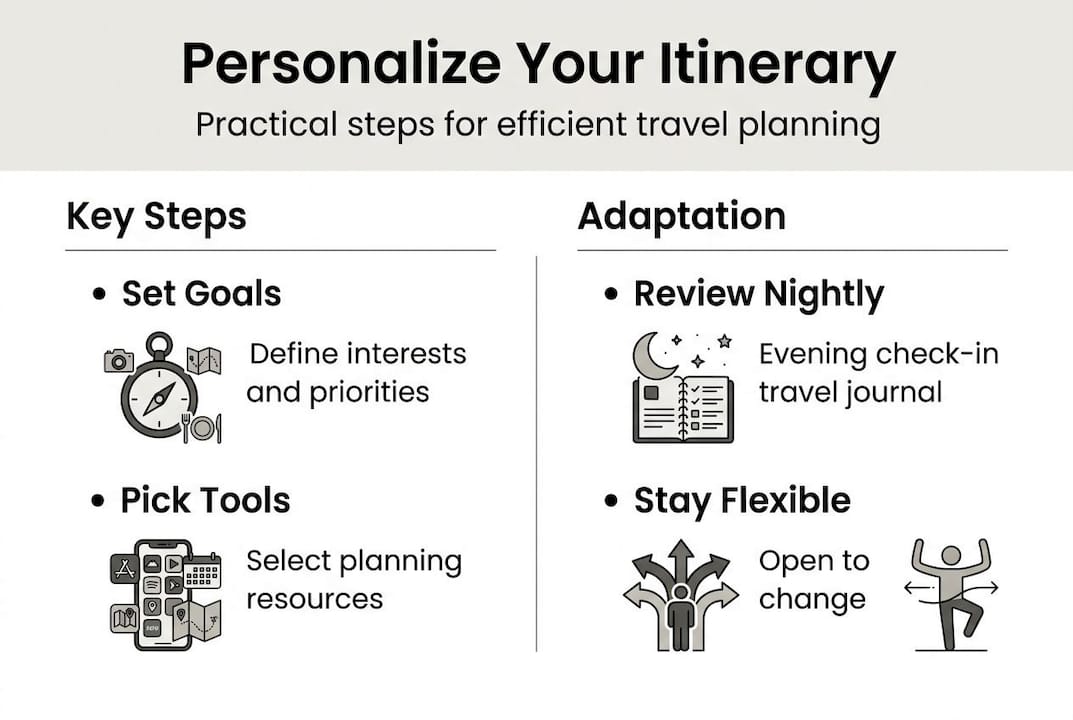
Pro Tip: Each evening during your trip, spend five minutes reviewing what worked and what didn't. Then update tomorrow's plan accordingly. You'll catch small improvements that compound into a noticeably better second half of any trip. The best itinerary is the one you're willing to revise.
Get your trip expertly tailored with DestList
If building and refining your own itinerary sounds like exactly the kind of work you were hoping to avoid, that's where DestList steps in.
DestList blends AI-powered planning with hands-on human curation to deliver a complete, ready-to-book travel plan built around your preferences. Whether you need done-for-you travel planning from scratch or a polished custom travel itinerary service that handles flights, hotels, and daily flow, DestList does the heavy lifting so you don't have to. Ready to see where you're going next? Explore top destinations and let DestList turn your travel goals into a trip you'll actually love.
Frequently asked questions
How can I personalize my trip itinerary quickly?
Start with an AI-powered tool to generate a fast working draft, then refine based on your specific interests. AI provides rapid skeleton itineraries that human review then shapes into something truly personal.
What if my trip constraints are too complex for most tools?
Advanced platforms are built for exactly this. AI planners offer alternatives for constraints that can't all be met simultaneously, so you can find feasible trade-offs without starting over.
Should I finalize my itinerary before my trip starts?
Have a solid plan, but don't lock it in completely. Leaving room to adapt during your travels consistently leads to greater satisfaction and more memorable moments.
What's better: manual planning, AI tools, or expert services?
A hybrid approach wins for most travelers. Combining AI and human input gives you the speed of automation with the depth and judgment that only experience provides.