
The fastest reliable way to pick a vacation destination is a five-step experience-first decision stack: pick an experience headline → set hard constraints → generate 10 fast candidates → score down to 3 → pick the winner with a one-question excitement test. Travel psychologist Dr. Charlotte Russell argues that destination choice is a psychological decision before it's a logistical one, and multiple travel guides confirm this stack produces a shortlist in roughly 20 minutes with far less post-trip regret.
Copy this into your notes app right now:
- Step 1: Write your experience headline in one sentence ("deep rest + sun" or "food + walkable city")
- Step 2: Lock in your hard constraints (dates, budget ceiling, group size, energy level)
- Step 3: Generate 10 candidate destinations without filtering yet
- Step 4: Score each on Experience fit, Real cost, Timing, and Execution (1–5 per axis)
- Step 5: Ask yourself: "Which of my top 3 would I be excited to leave for tomorrow?"
That's the whole method. Everything below shows you how to execute each step well.
Key Takeaways
The fastest way to pick a destination is the experience-first decision stack: headline → constraints → 10 candidates → score to 3 → excitement test, executable in roughly 20 minutes.
| Point | Details |
|---|---|
| Start with your experience headline | Name what you need emotionally before you name a place. |
| Count usable days, not calendar days | Door-to-door travel time can reduce a 7-day trip to 4–5 days on the ground. |
| Score on four axes | Rate each candidate on Experience, Real cost, Timing, and Execution (1–5 each). |
| Use the 24-hour pause rule | Sleep on your shortlist winner before booking to avoid impulse regret. |
| Destlist handles the stack for you | A human-verified, ready-to-book itinerary arrives within 24 hours of submitting your preferences. |
Table of Contents
- What's your 'why'? How to name the emotional goal before picking a place
- Hard constraints that eliminate bad destinations immediately
- How to match your interests to the right destination type
- Quick logistics checks that can disqualify a destination fast
- A simple decision matrix to score your candidates right now
- Fast sanity tests before you commit to booking
- When does hiring a planner actually make sense?
- How I choose a destination when I only have a weekend
- Destlist takes the decision stack off your plate
- Sources
What's your 'why'? How to name the emotional goal before picking a place
Your experience headline is the single sentence that describes what you need from this trip, not where you want to go. Dr. Charlotte Russell recommends starting by identifying your current emotional need: restoration, stimulation, connection, or perspective. That need determines which version of any destination will actually satisfy you. A beach in Cancún delivers deep rest; the same beach during spring break delivers stimulation and noise. Same place, completely different trip.

Understanding how travel preferences shape your planning before you open a single booking tab saves hours of circular research.
Pro Tip: For couples or groups, each person writes their experience headline privately, then you compare. If they overlap by even one word, that's your shared headline. If they don't, negotiate one before you touch a map.
Here are seven experience headlines you can adapt:
- "Deep rest + warm water + no itinerary"
- "Food culture + walkable neighborhoods + history"
- "Big nature + physical challenge + minimal crowds"
- "City energy + nightlife + art museums"
- "Family connection + kid-friendly activities + easy logistics"
- "Romance + privacy + luxury"
- "Adventure + novelty + local immersion"
Hard constraints that eliminate bad destinations immediately
Once you have your headline, apply your constraints in this order: exact travel window, usable trip length, all-in budget ceiling, energy level, and group composition. Each one cuts the candidate list fast.
Usable days matter more than calendar days. A 7-day trip with a long door-to-door travel time each way leaves you significantly fewer days on the ground. For trips under five days, a single-city base almost always beats a multi-stop itinerary. For 3–5 day windows, avoid destinations requiring long domestic transfers after landing.
Budget is the constraint most travelers underestimate. Factor in the full real cost, not just the flight price. Southeast Asia and Central America typically run significantly cheaper per day than Western Europe, which changes the math entirely when your ceiling is firm.
If that number clears your ceiling, the destination stays in.*
For a quick reference on choosing the right travel budget type, Destlist's budget guide breaks down what to include at each spending level.
| Cost category | What to include |
|---|---|
| Flights | Round-trip, including baggage fees |
| Lodging | Nightly rate × trip length |
| Daily spending | Food, local transport, activities |
| Transfers | Airport to hotel, day trips |
| Mistake tax | 15% buffer for surprises |
A 4-day window versus a 10-day window doesn't just change how far you can go. It changes the entire category of trip that makes sense.
How to match your interests to the right destination type
Your experience headline maps directly to a destination category. Here's a short matching guide:
- Food + walkability → Mid-size European cities (Lisbon, Bologna, Lyon) or food-focused Asian cities
- Big nature + minimal logistics → National-park-adjacent lodges or island resorts with direct flights
- Adventure + physical challenge → Mountain regions, trekking hubs, or coastal areas with water sports
- Culture + history → Capital cities or UNESCO-dense regions with strong museum infrastructure
- Romance + privacy → Private-villa destinations, smaller islands, or boutique-hotel towns
- Nightlife + city energy → Major metros with late-night transit and dense entertainment districts
- Family connection → Beach resorts with kids' programs or cities with low-friction logistics
The most common mismatch: choosing a photogenic Instagram destination for deep rest, or booking a resort for food culture when the resort's restaurant is the only option within miles. Gastronomy-driven travel requires a destination with a real local food scene, not just a hotel kitchen.
Cross-filter your interest mapping with energy level. A "big nature" trip that requires 6-hour hikes every day is a poor fit if your group includes anyone recovering from burnout. Exploring the seven types of travel experiences can help you name the category that fits your current capacity.
Quick logistics checks that can disqualify a destination fast
Three checks eliminate the most costly mistakes before you invest more research time.
Flight door-to-door time. Search the actual itinerary, not the flight duration. Add airport transit time, check-in buffers, and layovers. A 6-hour flight with a connection can easily become a 12-hour door-to-door day.
Visa and entry requirements. Check the U.S. Department of State's travel site for your specific passport. Some destinations require visas that take weeks to process. Others have entry fees, health documentation requirements, or reciprocity taxes payable on arrival.
But some shoulder-season windows coincide with local festivals that spike hotel prices anyway. Check both.
A quick checklist for each shortlisted destination:
- Flight door-to-door time confirmed (not just flight duration)
- Visa or entry requirements verified on a government source
- Weather for your specific travel dates checked (not just the "best time to visit" average)
- Major local events or closures during your dates researched
- Neighborhood safety and hotel location reviewed on recent traveler posts
- Sustainable tourism considerations noted (overtourism hotspots, fragile ecosystems)
For hotel location specifically, verifying the neighborhood before booking prevents the expensive mistake of a great room in an inconvenient or unsafe area.
A simple decision matrix to score your candidates right now
Score each candidate destination on four axes, 1–5 each. Experience fit: how well does this place deliver your headline? Real cost: does it clear your budget with room to spare? Timing: does the season, weather, and your schedule align? Execution: how hard is the logistics to pull off?
How to use it in three steps:
- List your 10 candidates and score each on all four axes
- Drop any destination scoring below 3 on Experience or Real cost
- Your top 3 by total score become your shortlist
Here's how that looks with three imaginary candidates:
Lisbon wins on this stack. But if the Maldives scores a 5 on Experience and your budget ceiling is flexible, the tie-breaker settles it: which destination would you be genuinely excited to leave for tomorrow morning? That gut-check question surfaces the real preference faster than any spreadsheet. This decision-making framework is the same one Destlist uses to build personalized itineraries.
Fast sanity tests before you commit to booking
Six checks, in order of how often they catch a problem:
- First-day logistics: Where does your flight land, and how long does it take to reach your hotel? A 90-minute airport transfer on arrival day eats your first evening.
- Neighborhood safety: Read the most recent 10–20 Google reviews for your shortlisted hotel, filtered to the last 3 months. Recent beats average.
- Recent traveler reports: A Reddit thread from the last 60 days surfaces current issues (construction noise, beach closures, political unrest) that no travel guide has caught yet.
- Mobile connectivity: Check whether your carrier's international plan covers the destination or whether you need an eSIM.
- Refund and cancellation terms: Confirm before booking, not after. Non-refundable rates are fine when you're certain; they're expensive when you're not.
- Season-specific closures: Some attractions, restaurants, or entire resort areas close during off-season. Verify the specific dates.
Pro Tip: Search "[destination name] Reddit 2026" and sort by New. You'll surface problems that no polished travel blog has published yet. Takes 5 minutes and has saved many trips.
Booking timing matters too. Pause 24 hours before confirming any booking. Impulse decisions on flights and hotels account for a disproportionate share of travel regret. Sleep on the shortlist winner, then book with confidence.
When does hiring a planner actually make sense?
DIY works well for straightforward trips: one destination, familiar region, flexible dates, and enough time to research. Four scenarios shift the math toward hiring help.
- Complex multi-stop itinerary: Coordinating flights, hotels, and transfers across 3+ cities multiplies the failure points exponentially.
- Tight timeline with high stakes: A honeymoon or milestone trip where execution failure is genuinely costly.
- No time to research: When the planning itself would take more hours than the trip is worth in stress saved.
- Unfamiliar region: Destinations where local knowledge (which neighborhoods, which operators, which seasons) makes a material difference to the experience.
A planner adds vetted logistics, negotiated rates, contingency support, and the kind of local knowledge that takes years to accumulate. Ask yourself: do I have 10+ hours to research this trip well, and am I confident in the region? If both answers are yes, DIY. If either is no, a service like Destlist is worth the cost.
How I choose a destination when I only have a weekend
The winner: a direct-flight coastal city within a 2-hour flight, chosen in under 15 minutes.

Experience headline: "sun + water + no planning required." Hard constraints: Friday evening departure, Sunday return, budget under $600 all-in, solo. Generated 10 candidates using a flight map view to see what was reachable within 2 hours. Scored each on the four axes. Three finalists emerged. The tie-breaker: which one would I actually be excited to pack for tonight?
The final call came down to arrival logistics. One finalist required a 45-minute transfer from a secondary airport, which would have consumed Friday night entirely. That dropped it to third. The winner had a hotel walkable from the terminal and a beach within 10 minutes. Usable days won the argument, not the destination name.
Destlist takes the decision stack off your plate
Destlist delivers a curated, ready-to-book itinerary built from the same experience-first stack described in this article, with one difference: you skip the 20 minutes of scoring and get a human-verified plan within 24 hours.
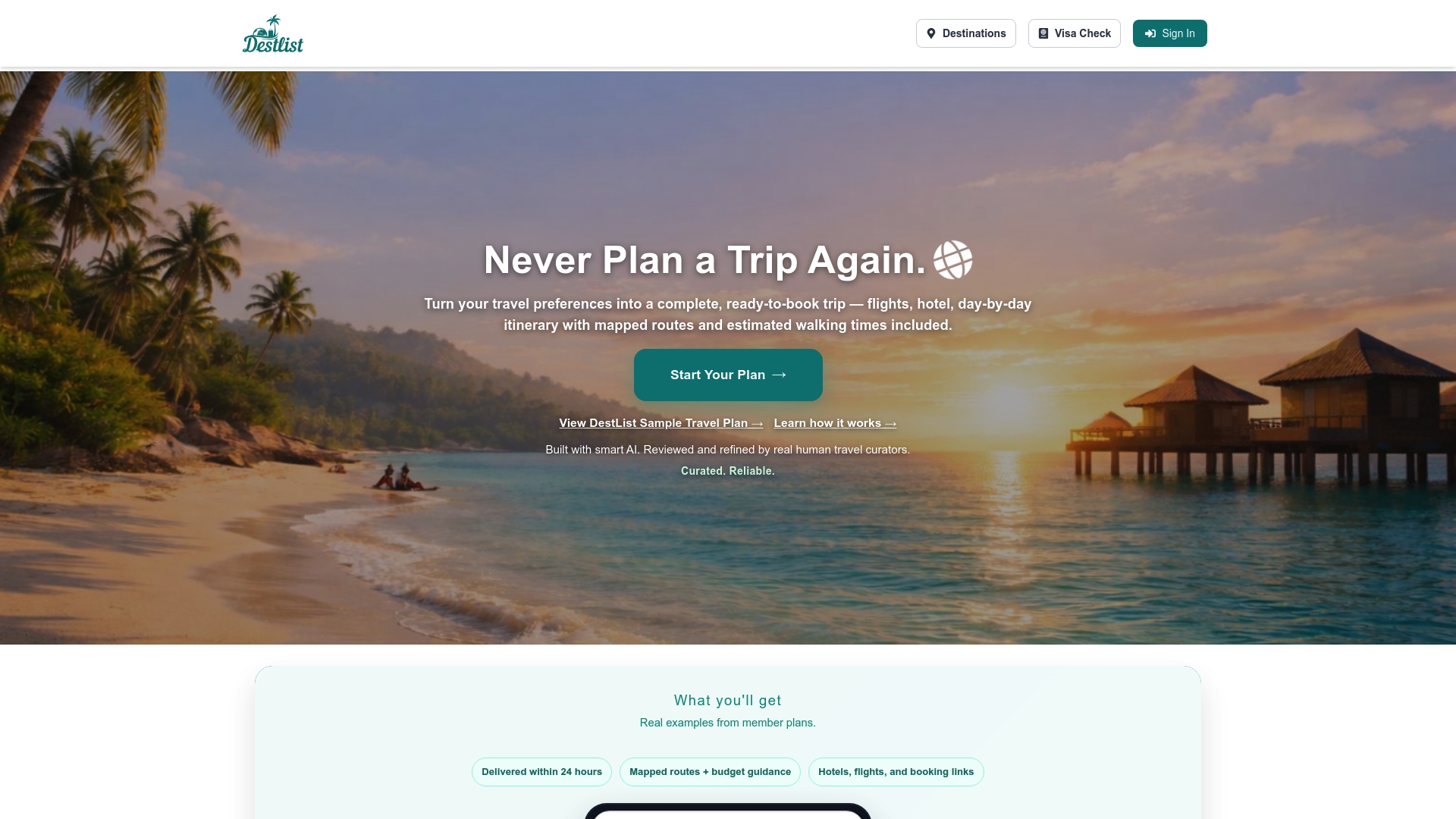
The platform matches your experience headline and budget to flights, hotels, and a day-by-day route map with estimated walking times. Weather alerts flag potential issues before you travel. Private travel perks and vetted logistics mean the execution layer is handled before you land. For travelers who want the result without the research, a custom travel itinerary from Destlist is the direct next step. Browse curated destination plans to see what a finished itinerary looks like for your region.
Sources
- How to Decide Where to Travel (Without Guessing) | Journo Travel Journal
- How to Pick the Right Travel Destination Every Single Time - QTTAR
- How to Choose the Perfect Travel Destination - Better Easier Simpler Things
- Too Many Beautiful Places? Here’s How To Pick
- How to choose where to travel - The Travel Psychologist
For up-to-date visa requirements, health advisories, and entry rules, always verify directly with the U.S. Department of State and the destination country's official tourism authority before booking.