
TL;DR:
- Flexible travel planning emphasizes prioritizing must-see activities and leaving room for spontaneity.
- AI and digital tools help optimize itineraries, adjust plans, and save time during travel preparation.
- Overpacking schedules causes stress; building adaptable plans enhances enjoyment and memorable experiences.
Overpacked schedules, missed connections, and zero downtime: this is what rigid travel planning looks like in practice. For busy professionals and leisure travelers alike, spending weeks piecing together a trip only to feel exhausted by day two defeats the whole purpose. Gen AI use in travel planning tripled in recent years, signaling that travelers are actively searching for smarter, faster ways to organize their trips. This guide walks you through exactly how to build a travel plan that stays flexible, fits your lifestyle, and leaves room for the moments you didn't plan but will always remember.
Table of Contents
- Assessing your travel needs and constraints
- Building a flexible itinerary: structure meets spontaneity
- Leveraging AI and digital tools for time savings
- Common pitfalls and how to stay flexible on the road
- Flexible travel: the overlooked time-saver for smart travelers
- Streamline your travel planning with DestList
- Frequently asked questions
Key Takeaways
| Point | Details |
|---|---|
| Prioritize what matters most | Identify your true must-sees and leave room for surprises to save time and stress. |
| Structure enables spontaneity | Plan anchor points but keep space for downtime and unexpected discoveries. |
| Use tech to adapt faster | AI-driven tools streamline planning and make it easy to change plans on the go. |
| Avoid overpacking your itinerary | Too many scheduled activities can diminish enjoyment and cause burnout. |
| Flexibility is a traveler’s best asset | Being open to change leads to more rewarding and memorable trips. |
Assessing your travel needs and constraints
Before you open a single booking site, you need a clear picture of what your trip actually requires. Skipping this step is one of the most common reasons travelers end up with overscheduled, underenjoyed vacations. Think of it as laying a foundation: the stronger it is, the more confidently you can build.
Start by defining your non-negotiables. These are the experiences, locations, or requirements you cannot trade off under any circumstances. A food lover visiting Tokyo might have a specific restaurant reservation on their list. A parent traveling with young children might need a hotel near a park. Write these down first, because everything else in your itinerary gets built around them.
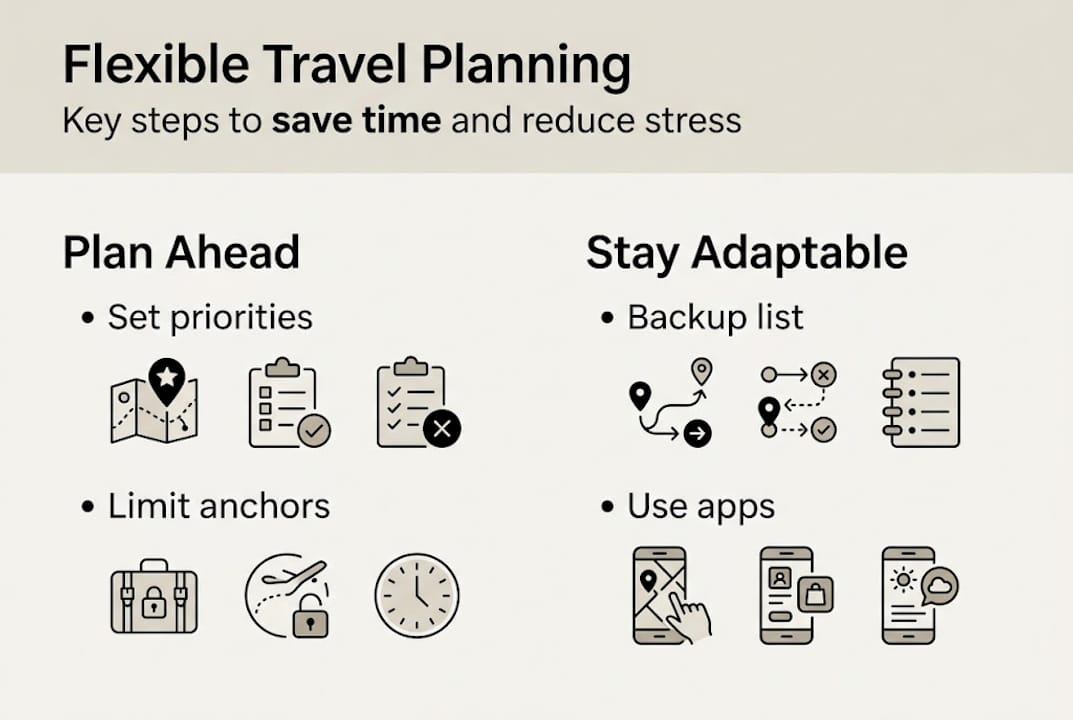
Next, be honest about your time limits. A long weekend in New York is very different from a week in Southeast Asia. Trying to replicate a seven-day itinerary in four days will leave you running between attractions instead of experiencing them. A practical framework is to count your actual free hours per day rather than your total trip days. Factor in jet lag recovery (typically one day per five time zones crossed), airport transfers, and meal times. Most travelers only have four to six productive sightseeing hours per day, even on vacation.
| Trip duration | Realistic daily activities | Buffer time recommended |
|---|---|---|
| Weekend (2 days) | 1 to 2 major sights per day | 30 min per activity |
| Short trip (4 to 5 days) | 2 to 3 sights per day | 45 min per activity |
| Full week (7+ days) | 2 to 3 sights per day | 60 min per activity |
Constraint balancing matters especially for group travel. What one person considers essential, another might find optional. Use a simple priority list: each traveler ranks their top three must-do activities, and the group builds the itinerary around shared overlap. Solo travelers can follow the same logic by separating must-do items from nice-to-have ones.
Key questions to answer before any trip:
- How many hours per day are you realistically available for activities?
- What is your total budget for the trip, including meals and transport?
- Are there physical limitations, dietary needs, or age-related factors to plan around?
- How much downtime does your group need to recharge?
- What is your tolerance for uncertainty or last-minute changes?
Post-pandemic conservative planning trends show that travelers are more thoughtful about value and experience than ever before, with higher-income groups especially sensitive to whether a trip feels worth the investment. This makes upfront clarity even more critical: knowing your parameters early leads to better decisions throughout the booking process.
Pro Tip: Start your planning with budget-friendly travel planning tools that let you see cost estimates before you commit to destinations. Setting a realistic per-day budget early prevents overspending surprises mid-trip.
Building a flexible itinerary: structure meets spontaneity
Once you know your constraints, the real art of trip planning begins. The goal is to create a schedule that guides you without boxing you in. Think of it like a skeleton: you need enough structure to stay oriented, but enough open space to breathe and explore.

The single most effective rule is to plan one major anchor activity per day. This sounds counterintuitive if you're used to filling every hour. But when your morning is anchored by a booked tour of the Colosseum in Rome, your afternoon becomes genuinely free. You might wander into a side street market, linger over lunch, or stumble into a neighborhood festival. None of that would have happened if you had back-to-back museum visits from 9am to 6pm.
Geographic grouping is another technique that saves enormous amounts of time. Grouping activities by neighborhood or district means you spend less time on buses and more time exploring. If you're visiting Barcelona, cluster your Gaudí-related visits on the same day rather than bouncing across the city twice. This strategy cuts average daily transit time by 30 to 45 minutes, which adds up to hours over a week-long trip.
| Planning style | Flexibility level | Stress level | Discovery potential |
|---|---|---|---|
| Fully scripted itinerary | Very low | High | Low |
| One anchor per day | High | Low | High |
| No plan at all | Maximum | Very high | Unpredictable |
| Grouped with buffer time | High | Low | High |
A realistic example of a well-balanced day looks like this:
- Morning anchor activity (booked in advance): Guided tour or high-demand attraction with a set time slot, typically 9am to 12pm.
- Lunch window (flexible): 60 to 90 minutes, with two or three local options researched but not reserved.
- Afternoon exploration (unstructured): Walk a nearby neighborhood, visit a local market, or rest at a cafe.
- Evening option (loosely planned): A restaurant shortlist, not a confirmed reservation, unless it's a must-visit spot.
Booking a limited set of items early while keeping the rest flexible is the approach that consistently produces the best travel experiences. It protects your must-have moments without turning the whole trip into a checklist.
"The best travel memories are rarely from the planned moments. They're from the hour you had nothing to do and decided to follow a sound, a smell, or a stranger's recommendation."
For high-demand experiences like Sagrada Família in Barcelona, Machu Picchu in Peru, or any popular national park during peak season, book at least four to six weeks in advance. For everything else, keep your options open. Explore stress-free trip planning steps and the expert travel planning guide to build this habit systematically. When you save time on your next vacation through smart pre-planning, you reclaim hours that would otherwise be lost to logistics.
Pro Tip: Use a shared digital note or app to store your shortlist of backup activities. When plans shift, you won't waste time searching. You'll just pull up the list and pivot immediately.
Leveraging AI and digital tools for time savings
A solid itinerary structure is worth even more when you back it with the right technology. AI and digital travel tools have matured significantly in the past few years, moving from basic trip aggregators to genuinely intelligent planning assistants.
Gen AI use for trip planning tripled recently, meaning travelers across all income levels are testing these tools in real planning scenarios. The reason is simple: they work. An AI planner can process thousands of flight and hotel options in seconds, flag pricing patterns, and generate day-by-day itineraries based on your stated preferences.
Here are the key features to look for in any digital travel tool:
- Real-time pricing alerts: Notifies you when flight or hotel prices drop or spike, so you book at the right moment.
- Geographically optimized routing: Automatically groups activities by proximity, minimizing transit time.
- Dynamic rescheduling: Allows you to drag and drop activities when plans change, with automatic recalculation of travel times.
- Weather integration: Flags rain-heavy days so you can swap outdoor activities for indoor ones proactively.
- Smart packing suggestions: Generates gear lists based on destination, duration, and planned activities.
One of the more exciting developments in AI-driven itinerary tools is the application of reinforcement learning, or RL. RL-based systems improve over time by learning from millions of past traveler interactions, adjusting recommendations based on what actually worked versus what sounded good in theory. Tools built on this technology, such as those benchmarked in the TripTide research framework, show measurable improvements in real-time adaptability, particularly when disruptions like flight delays or sudden closures force same-day replanning.
Callout: According to Deloitte's 2026 US Travel and Hospitality Outlook, gen AI use in planning tripled, confirming that smarter tools are no longer a novelty but a mainstream planning strategy.
For time-pressed travelers, the most practical digital habits include booking your central hotel first (minimizing daily transit across a city), using an AI planner for customized itineraries that match your actual pace, and maintaining a digital AI smart packing list you can update and reuse across trips.
Pro Tip: Don't just use AI tools for initial planning. Keep the app active during your trip. Real-time rebooking support, live weather updates, and on-the-ground restaurant suggestions turn your phone into a personal travel advisor.
Common pitfalls and how to stay flexible on the road
Even the best-designed itinerary can fall apart under pressure. The difference between a stressful trip and a memorable one often comes down to how you respond when things don't go as planned.
The top pitfalls to avoid:
- Overbooking activities: Filling every time slot leaves no margin for error. One late start can cascade into a day of running behind schedule, which drains energy and mood quickly.
- Ignoring downtime: Rest is not wasted travel time. Fatigue kills enjoyment faster than missing a tourist attraction ever could.
- Skipping local research: Relying entirely on guidebooks or apps means missing neighborhood-specific tips. Asking your hotel concierge or a local cafe owner for recommendations often surfaces better options than any algorithm.
- Assuming everything goes to plan: Trains run late. Attractions close unexpectedly. Weather shifts. Building mental and logistical flexibility before you travel makes these moments manageable instead of devastating.
- Failing to have a Plan B: Every high-priority activity should have a backup. If your outdoor hike gets rained out, what's the indoor alternative within the same area?
Here's how to actively maintain flexibility while traveling:
- Check the weather forecast every morning and adjust afternoon plans accordingly.
- Keep a shortlist of walkable alternatives for each day in a notes app.
- Build a one-hour "cushion block" into every day, treated as free time unless you need to use it for replanning.
- Accept that pivoting is a skill, not a failure. Some of the best travel experiences come from detours.
Booking limited items early while leaving room for local discoveries is the practical framework that separates confident travelers from stressed ones. When you've already committed to a sensible baseline, any change becomes an addition rather than a disruption.
"A traveler who adapts is always one step ahead. Flexibility isn't a backup plan. It's the whole plan."
For flight cancellations or major delays, having travel insurance and the airline's app downloaded gives you rebooking options immediately. Don't wait in a line if you can resolve it digitally. To further optimize trip planning for stress-free travel and manage multiple destinations efficiently, structured frameworks help you streamline multi-trip planning so disruptions in one leg don't unravel the entire trip.
Mental flexibility matters just as much as logistical flexibility. Frequent travelers consistently report that trips where something unexpected happened turned into their most vivid memories. A missed train that led to a four-hour layover in a small town. A closed museum that sent them into an art district they never intended to visit. These outcomes aren't accidents. They're the product of travelers who stayed open, curious, and willing to adjust.
Flexible travel: the overlooked time-saver for smart travelers
Here's an opinion that runs counter to what most planning guides tell you: more structure does not produce better trips. It produces more anxiety. We've spoken with hundreds of travelers who spent 40-plus hours building detailed minute-by-minute itineraries, only to feel more stressed on the ground because reality kept deviating from the plan.
Adaptability is not a consolation prize for poor planning. It's actually the most sophisticated planning strategy available. When you accept that conditions will change and you design your trip around that reality, every unexpected moment becomes an asset rather than a problem.
AI and tech tools support this mindset in a powerful way. They're not just time-savers for the research phase. They're real-time co-planners that help you pivot intelligently when the ground shifts. Exploring AI travel alternatives shows just how far these capabilities have evolved, helping travelers discover options they never would have found through manual research.
The most rewarding travel experiences are almost never the ones that matched the plan exactly. They're the ones where a traveler trusted their instincts, stayed present, and let the destination show them something new. Build enough structure to feel safe. Then let the rest unfold.
Streamline your travel planning with DestList
Ready to make flexibility a built-in feature of your next adventure?
DestList combines AI precision with human travel expertise to build itineraries that are detailed where it matters and open where it counts. Every custom travel itinerary includes geographically grouped activities, estimated walking times, hotel recommendations matched to your budget, and weather-aware scheduling. Whether you want full done-for-you travel planning delivered within 24 hours or want to explore options at your own pace, DestList adapts to how you travel. Visit DestList to start building a smarter, more flexible trip today.
Frequently asked questions
Why is flexible travel planning important for busy people?
It lets you maximize enjoyment, reduce stress, and fit meaningful experiences into limited time, since grouping activities and including downtime consistently produces better travel outcomes than overscheduling.
Which digital tools best support flexible itinerary creation?
Look for trip planners powered by AI, offering real-time updates, smart packing lists, and easy rebooking features, especially as gen AI planning tools have tripled in use and improved dramatically in accuracy and personalization.
How do I balance must-see sights with spontaneous discoveries?
Limit major activities to one per day and leave schedule space for unplanned local experiences, which protects your priorities while keeping afternoons genuinely free for exploration.
What is the biggest mistake in travel planning?
Overfilling your itinerary causes stress and prevents you from enjoying unexpected highlights, since rigid back-to-back booking leaves no margin for the detours that often become the best memories.
Do tech solutions really save time for travel planning?
Yes, AI-driven tools can cut hours from trip research and help adjust on the go, with gen AI travel use tripling as travelers recognize the real efficiency gains these platforms deliver.