
TL;DR:
- Hybrid AI-human methods significantly streamline trip planning, saving time and enhancing personalization.
- Proper traveler profiling reduces decision fatigue and guides destination choice effectively.
- Building flexible, route-optimized itineraries with buffers improves trip feasibility and handles disruptions.
Planning a trip should feel exciting, not like a second job. Yet most travelers spend upward of 17 hours researching, comparing, and second-guessing before booking a single flight. For busy professionals, that time simply doesn't exist. One wrong assumption about transit times or hotel locations can unravel an entire itinerary. The good news is that a proven, step-by-step method exists to build personalized, efficient trips without the chaos. This guide walks you through traveler profiling, smart destination research, route optimization, and disruption handling, plus the hybrid AI-human tools that make all of it faster and smarter.
Table of Contents
- Understanding traveler profiling and preparation
- Research and select destinations with smart tools
- Optimizing routes, schedules, and integrating flexibility
- Verification, troubleshooting, and handling trip disruptions
- Our insight: Hybrid methods are the new gold standard
- Take your customized trip planning further
- Frequently asked questions
Key Takeaways
| Point | Details |
|---|---|
| Profiling first | Defining preferences and constraints upfront is the first step to efficient trip customization. |
| Leverage smart tools | Using AI, Virtual Assistants, and checklists streamlines destination research and planning. |
| Hybrid wins | Combining AI automation with human expertise delivers the most personalized, disruption-proof itineraries. |
| Build flexibility | Incorporating transit buffers and fallback options prepares you for travel surprises. |
| Verify and refine | Check your itinerary for feasibility and adaptability before departure to ensure a smooth trip. |
Understanding traveler profiling and preparation
Every great trip starts with knowing exactly what you want before you open a single browser tab. Skipping this step is why so many travelers end up with bloated, mismatched itineraries that feel exhausting rather than enjoyable. The core methodology for customizing trips involves traveler profiling and preference gathering as the critical foundation.
Start by writing down your non-negotiables. These are the things that, if missing, would make the trip feel like a failure. Then layer in your preferences and nice-to-haves. This simple hierarchy saves enormous time later when you're weighing options.
Here's what a solid traveler profile should cover:
- Travel pace: Do you prefer two or three deep-dive experiences per day, or a packed schedule with eight stops?
- Budget range: Set a firm ceiling for flights, hotels, and daily spending.
- Activity types: Culture, adventure, food, relaxation, or a mix?
- Mobility and accessibility needs: Any physical constraints that affect venue or transport choices?
- Must-see locations: The three to five places that are truly non-negotiable.
- Trip duration and date flexibility: Fixed dates or open windows?
Once you have these answers, organize them into a simple reference table before you start researching:
| Profile element | Your input | Priority level |
|---|---|---|
| Destination type | City, beach, mountain | High |
| Daily budget | $150 to $300 per day | High |
| Travel pace | Moderate (4 to 5 stops/day) | Medium |
| Must-see locations | 3 to 5 specific sites | High |
| Flexibility window | Plus or minus 2 days | Low |
| Special requirements | Dietary, mobility, visa | High |
This table becomes your filter. Every destination, hotel, and activity you research gets measured against it. Travelers who invest 20 minutes in this step report far less decision fatigue throughout the planning process. You can also explore saving time on trip planning with structured approaches that compress the entire research phase.
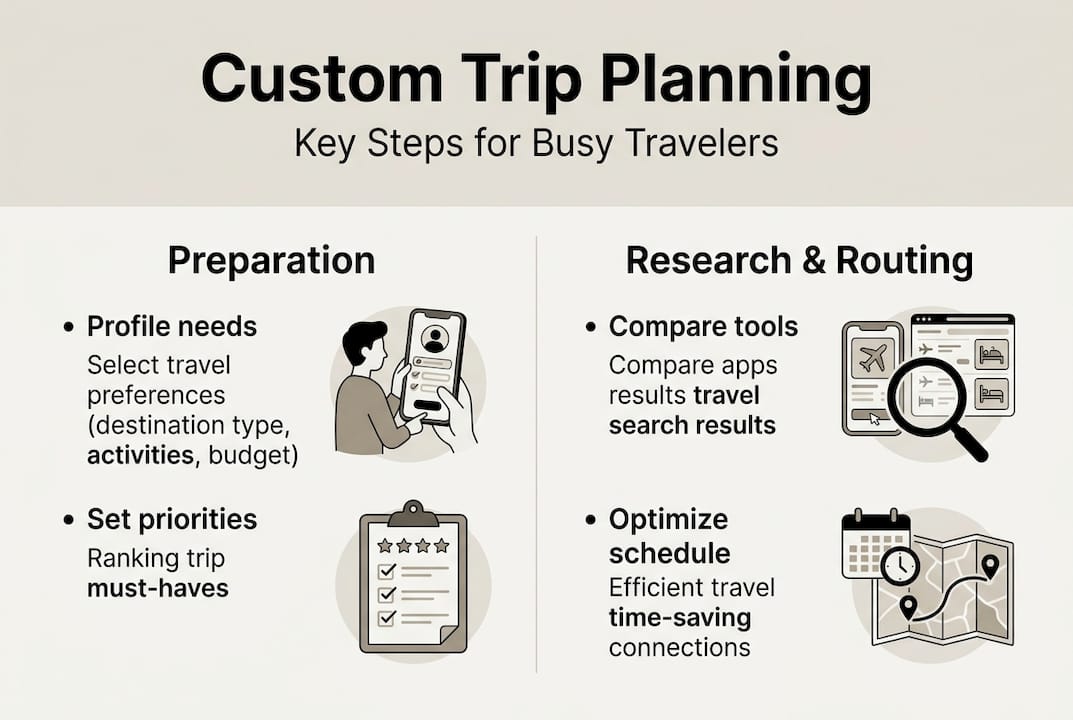
Pro Tip: Use a pre-trip profiling checklist to capture your preferences in one place before you search anything. It prevents scope creep and keeps your planning focused. The customized itinerary benefits become most visible when your profile is specific rather than vague.
Research and select destinations with smart tools
With your preferences locked in, the next challenge is researching and selecting destinations that fit your unique needs. This is where most travelers either waste the most time or make the most avoidable mistakes.
Traditional manual research means opening dozens of tabs, cross-referencing travel blogs, and spending hours comparing options that may not even fit your profile. It's slow, inconsistent, and prone to bias toward whatever article ranks first in search results. AI-powered tools use large language models combined with solvers and APIs to automate destination comparison and surface options that genuinely match your constraints.
Here's how the three main research methods compare:
| Method | Time required | Personalization | Cost | Best for |
|---|---|---|---|---|
| Manual research | 12 to 17 hours | High (if done right) | Free | Detail-obsessed planners |
| AI tools only | 3 to 5 hours | Medium | Low to free | Speed-focused travelers |
| Hybrid AI + human | 5 to 8 hours | Very high | Moderate | Busy professionals |
The numbers are striking. AI saves 12 hours compared to manual planning, cutting the process from 17 hours down to roughly 5. Virtual assistants can handle research, comparisons, and shortlisting at a fraction of the time cost.
When using AI tools for destination research, focus on these actions:
- Feed your traveler profile directly into the tool as a structured prompt.
- Ask for three to five destination options with pros and cons for each.
- Request a comparison of flight costs, weather windows, and visa requirements.
- Filter results by your must-have activities and budget ceiling.
- Cross-check AI suggestions with one or two trusted human reviews.
For AI travel planning tips that go beyond basic prompting, the key is treating AI as a research assistant rather than a decision-maker. It narrows the field. You make the final call.
Pro Tip: Before committing to a destination, run a quick packing and logistics check. Some destinations that look ideal on paper require gear, vaccinations, or visas that add hidden time and cost. Explore effortless trip planners that bundle this research automatically.
Optimizing routes, schedules, and integrating flexibility
Now that you've picked your destinations, it's time to optimize travel routes and build realistic schedules with needed flexibility. This is the step most travelers rush, and it's where itineraries fall apart in the field.

Hybrid AI-human methods deliver a 90%+ feasibility rate for itineraries that include proper buffers and route logic. That's a meaningful benchmark. Purely manual schedules rarely hit that standard because humans tend to underestimate transit times and overestimate their own energy levels.
Here's a step-by-step process for building an optimized schedule:
- Map all locations geographically. Group activities by neighborhood or district to minimize backtracking.
- Assign time blocks. Estimate realistic time for each activity, including entry queues and meals.
- Add transit buffers. Build in 20 to 30 minutes between each stop for delays, navigation, and rest.
- Sequence by energy level. Put high-effort activities in the morning and lighter ones in the afternoon.
- Flag flexible slots. Mark one or two daily slots as optional so you can swap without stress.
- Run a feasibility check. Total up each day's hours and confirm it fits within your waking window.
"90%+ pass rate achievable for feasible, buffer-inclusive itineraries when hybrid AI-human methods are applied to route optimization."
It's also worth noting that LLMs improve significantly when paired with external tools and solvers, but still struggle with deep personalization on their own. That's exactly why the human layer matters. A well-structured AI draft, refined by someone who understands your preferences, produces far better results than either approach alone.
For expert trip planning steps that cover this optimization process in depth, the core principle is the same: structure first, flexibility second. You can also apply these methods across multi-trip planning scenarios when you're managing several trips in a single year.
Pro Tip: Always leave at least one unscheduled hour per day. Local discoveries, spontaneous restaurant finds, and unexpected weather all benefit from breathing room in your schedule.
Verification, troubleshooting, and handling trip disruptions
With your plan built, the final piece is making sure it works and knowing what to do if things change on the fly. Verification is the step most travelers skip entirely, and it's the reason so many well-planned trips hit avoidable snags.
Start with a feasibility checklist before you finalize anything:
- Transit buffers confirmed: Every connection has at least 20 minutes of cushion.
- Opening hours verified: Museums, restaurants, and attractions are open on your planned days.
- Booking requirements checked: Any reservations that need advance purchase are secured.
- Weather windows reviewed: No outdoor-heavy days scheduled during likely rain or heat peaks.
- Mandatory stops flagged: Any non-negotiable visits are protected in the schedule.
- Fallback options identified: At least one alternative activity per day if a primary option falls through.
60% of travelers still prefer humans for handling disruptions and last-minute itinerary changes. That preference reflects a real gap in what AI can do when things go sideways.
"Humans shine where AI falls short: real-time adaptation and personal nuance are the two areas where human judgment consistently outperforms automated systems."
Common disruption scenarios and how to handle them:
- Flight delays: Always book morning flights when possible. Delays compound throughout the day.
- Attraction closures: Keep a shortlist of nearby alternatives in your notes app.
- Over-scheduling: If a day feels too packed during the trip, drop the lowest-priority item without guilt.
- Transit strikes or weather events: Edge cases like mandatory visits and sudden disruptions require pre-built contingency blocks in your schedule.
For travelers who want to explore personal trip plan alternatives that include built-in disruption handling, the key differentiator is whether the platform offers human support alongside its automated tools.
Pro Tip: Keep a printed or offline copy of your itinerary. International data issues or dead phone batteries are real, and having a physical backup has saved countless trips.
Our insight: Hybrid methods are the new gold standard
Having covered the step-by-step process, here's why we believe hybrid systems are transforming trip customization for busy travelers. The debate between AI-only and manual planning misses the point entirely.
AI-only solutions are fast and cheap. They're excellent at processing large amounts of destination data, comparing prices, and generating draft schedules. But they consistently underperform on the things that make a trip feel yours: the specific neighborhood vibe you love, the dietary quirk that rules out half the restaurant options, the preference for quiet mornings over packed sunrise tours.
Human planners, on the other hand, excel at nuance and adaptation. Humans remain preferred for disruption handling and complex personalization because they can read context in ways algorithms can't yet replicate. But human-only planning is slow and expensive at scale.
Hybrid systems solve both problems. AI handles the structure, speed, and data processing. Humans add the judgment, local knowledge, and real-time adaptation. For busy professionals who need a trip that's both efficient and genuinely personal, this combination consistently outperforms either approach alone. Explore hybrid trip customization options that balance automation with expert human refinement.
Pro Tip: Use hybrid planning models specifically for complex or multi-activity trips. Simple weekend getaways can often be handled with AI alone, but anything involving multiple cities, tight schedules, or special requirements benefits enormously from the human layer.
Take your customized trip planning further
If you've made it through this guide, you now have a clear, repeatable method for building trips that actually fit your life. The profiling, research, optimization, and verification steps work together as a system, and the hybrid AI-human approach is what makes it sustainable for time-constrained travelers.
DestList is built exactly for this. Whether you want a custom travel itinerary tailored to your preferences or a fully done-for-you planning service that delivers a ready-to-book trip within 24 hours, the platform combines AI efficiency with human expertise. Busy professionals get curated, flexible itineraries without spending a single weekend buried in browser tabs. Your next trip should feel exciting from the start, not exhausting.
Frequently asked questions
How long does trip customization take with AI versus manual methods?
AI planning reduces the process from 17 hours to about 5 hours, saving approximately 12 hours compared to fully manual planning.
What's the best way to handle unexpected trip disruptions?
Combine hybrid AI-human planning with flexible time buffers, and rely on human judgment for real-time adaptation when disruptions occur.
Are travel itineraries built with AI fully personalized?
AI-powered itineraries can be highly customized, but deep personalization and constraint handling are best achieved with hybrid human-AI models that reach 90%+ feasibility rates.
What are the main steps in customizing a trip?
The core methodology involves profiling preferences, researching destinations, optimizing schedules and routes, adding flexibility, and verifying your itinerary before departure.