
TL;DR:
- Setting clear trip criteria before researching helps travelers filter options efficiently and reduce decision fatigue.
- Using delegation, packing cubes, and loyalty programs significantly saves time and enhances travel convenience.
Even skilled professionals hit a wall when piecing together the perfect trip. Between comparing flights, hunting for hotels, building itineraries, and trying to avoid rookie mistakes, the planning phase can eat up more time than the vacation itself. The good news? A handful of tested, reliable hacks can cut through the chaos and turn weeks of scattered research into a streamlined process you can actually enjoy. This article walks you through the most effective planning strategies used by frequent travelers, so your next trip comes together faster and with far less stress.
Table of Contents
- Establish your must-have criteria before you start
- Pack smarter, not harder: Time-saving packing hacks
- Personalized packing lists: The secret to never forgetting essentials
- Leverage loyalty programs for VIP perks and convenience
- At-a-glance comparison: Which travel hacks save you the most time?
- Why most people overcomplicate planning—and how pros stay effortlessly organized
- Get even more out of your next trip with DestList
- Frequently asked questions
Key Takeaways
| Point | Details |
|---|---|
| Set clear criteria | Identifying must-haves first streamlines your options and focuses your planning energy. |
| Pack efficiently | Packing carry-on only with smart gadgets saves hours and cuts airport stress. |
| Automate packing lists | Packing list generators tailored to your trip prevent forgotten essentials and wasted time. |
| Join loyalty programs | Frequent travelers get upgrades and fast solutions by leveraging loyalty memberships. |
| Delegate when possible | Handing off logistics to pros or using custom planning services is the ultimate time-saver. |
Establish your must-have criteria before you start
The single biggest time drain in trip planning is not the actual research. It is starting research without knowing what you are looking for. When you sit down to plan without clear priorities, every option looks potentially good, and you end up spiraling through hundreds of hotel reviews, flight combinations, and activity suggestions with no clear way to filter.
Before you open a single booking site, take ten minutes to write down your non-negotiables. This means your trip goal (relaxation, adventure, culture, family time), your hard budget ceiling, your travel dates, and two or three must-see or must-do experiences. Everything else is flexible.
Here is a quick checklist to run through before planning begins:
- Trip goal: Rest and recharge, active adventure, sightseeing, food and culture
- Hard budget: Maximum total spend, broken down by flights, accommodation, and activities
- Travel window: Exact dates or a flexible range of two to three weeks
- Group dynamics: Solo, couple, family with kids, or group of friends
- Must-have experiences: Two to three specific things you refuse to miss
- Deal breakers: Things you absolutely want to avoid (long layovers, budget hostels, extreme heat)
This list does something powerful: it turns an open-ended research project into a filtering task. Instead of asking "where should I go?", you are now asking "which options fit my criteria?" That mental shift alone can save hours on travel planning and dramatically reduce decision fatigue.
For extremely busy professionals, there is another option worth considering seriously. Delegating trip planning to a travel agent or executive assistant can save weeks of planning time while often unlocking exclusive deals and seamlessly managed logistics that are hard to replicate on your own. If your time is genuinely worth more than the delegation cost, this is not laziness. It is strategy.
Pro Tip: Build a simple one-page trip brief template you can reuse for every vacation. Include your budget, dates, preferences, and deal breakers. Share it with whoever is helping you plan, whether that is a platform, an agent, or a travel companion, and watch how much faster decisions get made. You can also use streamlined travel planning steps to structure this process from the start.
Pack smarter, not harder: Time-saving packing hacks
With your priorities set, it is time to tackle what often derails efficient travelers: overpacking and wasted airport time. Packing might seem like a minor logistical detail, but a bad packing strategy can cost you hours across a trip, between waiting at baggage claim, untangling a disorganized bag, or scrambling to find a travel-size shampoo at security.
The single most impactful packing decision you can make is committing to carry-on only. It sounds restrictive, but most trips of up to ten days are entirely manageable with a single carry-on and a personal item. The payoff is massive. You skip baggage check lines on the way out, skip baggage claim on the way back, and eliminate the small but real risk of lost luggage. For a busy professional, that is 30 to 60 minutes saved per trip, easily.
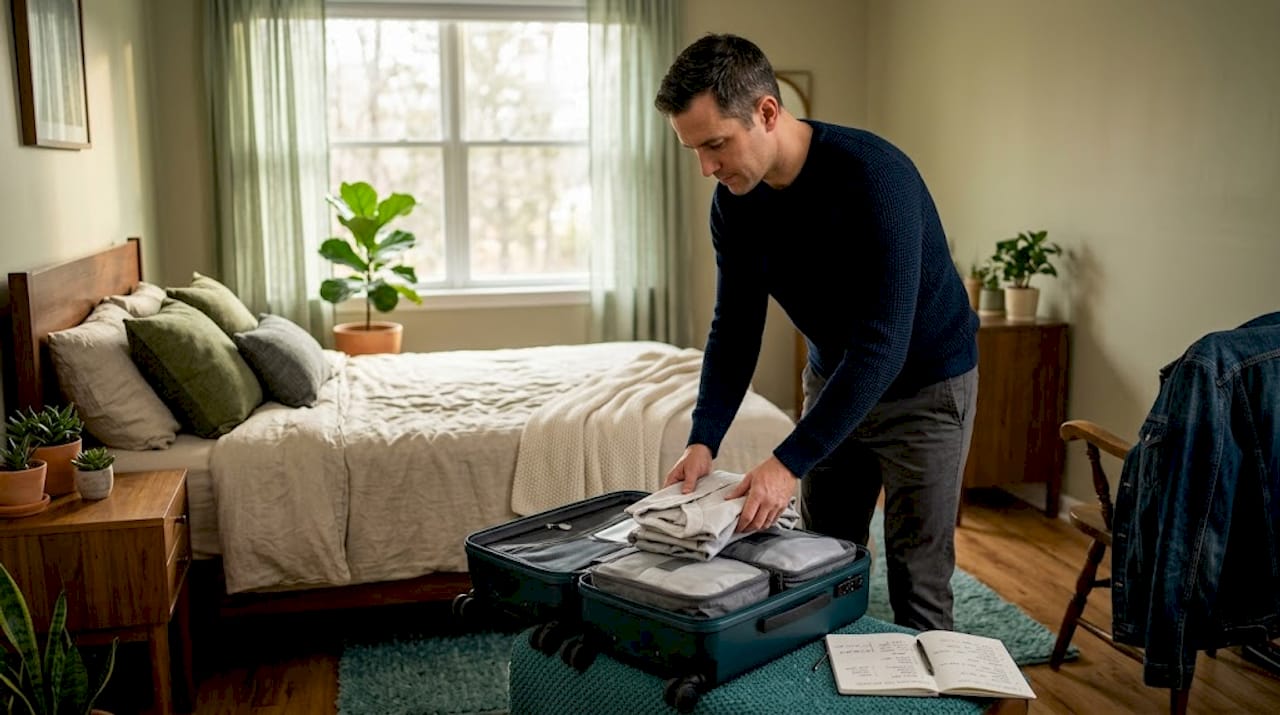
The tool that makes carry-on-only realistic is the packing cube. These fabric organizers compress your clothes, separate categories (tops, bottoms, workout gear, underwear), and let you unpack your suitcase in under two minutes at the hotel. Frequent travelers report cutting their packing time to under 15 minutes once they master a cube system.
Here is a quick-reference packing checklist built for speed and efficiency:
- Use compression packing cubes to maximize space and maintain organization
- Keep all liquids in one clear quart-sized bag, ready to pull out at security in seconds
- Roll clothes instead of folding to reduce wrinkles and save space
- Wear your bulkiest items on the plane (boots, thick jacket, heavy jeans) to free up bag space
- Pack a second outfit in your personal item in case your carry-on gets gate-checked
"Always pack carry-on only. It removes an entire layer of airport stress and hands back time you did not even realize you were losing."
Pro Tip: Lay out everything you plan to pack, then remove one-third of it. You will almost always find you brought that final third home unworn. Pair this habit with packing list essentials designed for your specific trip type to pack confidently without overstuffing.
Personalized packing lists: The secret to never forgetting essentials
Even with efficient packing methods, what you bring can make or break a trip. A forgotten prescription, a missing phone charger, or no umbrella during monsoon season are all avoidable with the right system. The problem with manually written packing lists is that they rely entirely on memory and context you may not have fully thought through.
Packing list generators solve this by factoring in your specific destination, weather forecast, trip duration, and planned activities. They ask you targeted questions and produce lists you would not have thought to build yourself. A customized packing list accounts for details like high altitude requiring lip balm, beach trips needing reef-safe sunscreen, or winter city breaks where layers matter more than bulk.
Using a packing list generator tailored by destination, weather, and trip type prevents both overpacking and underpacking, two problems that waste time and money in different ways.
Here is how the two approaches compare directly:
| Feature | Packing list generator | Manual packing list |
|---|---|---|
| Accuracy | High, adapts to trip specifics | Variable, depends on memory |
| Time to create | 2 to 5 minutes | 15 to 30 minutes |
| Stress level | Low | Medium to high |
| Customization | Tailored by weather, activities, destination | Generic unless carefully thought through |
| Risk of forgetting items | Low | High, especially for edge cases |
| Reusability | Templates reusable across trips | Requires rebuilding each time |
The numbers make the case clearly. When you are pressed for time, spending 15 minutes manually writing a list that still misses a few items is simply not worth it. A generator handles the thinking for you, leaving you to just check items off and pack.
Leverage loyalty programs for VIP perks and convenience
Packing sorted, let us maximize the perks and comforts you can access as a time-savvy traveler. Loyalty programs are one of the most underused tools in the frequent traveler's toolkit, especially among professionals who travel multiple times a year but never get around to actually signing up for points programs.
The core value of airline and hotel loyalty programs is not just the free flights or free nights, although those are a nice bonus. It is the operational convenience. Here is what status-level membership typically unlocks:
- Priority boarding so you are seated and settled before the masses board
- Guaranteed overhead bin space when you are carry-on only
- Lounge access for quiet, productive pre-flight time
- Complimentary seat selection including exit rows and bulkheads with extra legroom
- Expedited rebooking during delays and cancellations, skipping the gate agent line
- Late checkout at hotels, which is invaluable for full-day trips near checkout dates
Airline and hotel loyalty programs for upgrades deliver priority access and faster rebooking, which for frequent flyers translates directly into hours saved per year.
Pro Tip: Sign up for loyalty programs at any airline or hotel brand you use more than twice a year. Even base-level membership unlocks benefits like free seat selection and bonus points that accelerate faster than most people expect. Use one primary airline and one primary hotel chain to concentrate your status rather than spreading points across programs you rarely use. This is one of the fastest ways to save time with smart travel strategies without changing your travel behavior at all.
At-a-glance comparison: Which travel hacks save you the most time?
Having covered each hack individually, here is how they stack up when time truly matters. Not every hack delivers equal value for every traveler. This comparison helps you prioritize based on your biggest pain points and travel style.
| Travel hack | What it does | Estimated time saved | Best for |
|---|---|---|---|
| Set clear trip criteria first | Eliminates decision paralysis before research begins | 2 to 5 hours per trip | All travelers |
| Delegate to travel agent or EA | Outsources research and logistics entirely | Weeks of planning time | Executives, ultra-busy pros |
| Carry-on only packing | Skips baggage check and claim entirely | 30 to 60 minutes per trip | Most travelers, especially short trips |
| Packing cubes | Cuts packing and unpacking time dramatically | 30 to 45 minutes per trip | Anyone who repacks mid-trip |
| Packing list generator | Prevents forgotten items and overpacking | 15 to 20 minutes per trip, prevents errors | Occasional travelers, new destinations |
| Loyalty program membership | Unlocks priority services and faster rebooking | 1 to 2 hours per delay or disruption | Frequent travelers, 4+ trips per year |
Two edge cases stand out in this comparison. First, delegation is the most powerful hack for executives and senior professionals, but it requires trust in whoever is doing the planning. Second, the packing generator vs manual list gap is larger than most people expect. Manual lists carry a hidden cost in both forgotten items and the mental load of building them from scratch each time.
For a full breakdown of how to combine these approaches into a seamless planning process, exploring stress-free travel planning strategies can help you layer these hacks into a repeatable system.
Why most people overcomplicate planning—and how pros stay effortlessly organized
Here is the uncomfortable truth most travel content refuses to say out loud: over-planning is just as damaging as under-planning. Many travelers spend so much time researching and optimizing that they arrive exhausted and mentally depleted before the trip even starts.
Experienced travelers do not spend more time planning. They spend less time planning, more deliberately. The difference is that they trust systems and criteria rather than trying to evaluate every possible option. They make three to five major decisions and delegate or automate everything else.
Most of the anxiety around trip planning comes from trying to hold too many variables in your head simultaneously. Should the hotel be closer to the airport or the city center? Is this flight connection tight enough? What if the weather is bad on the beach day? These are real concerns, but trying to manually optimize every one of them leads to decision fatigue and a worse final plan.
The pro move is to define your criteria tightly upfront, then filter ruthlessly. If it does not meet your must-haves, it is off the table. No second-guessing. This is exactly the mindset behind efficient trip customization for busy travelers who want high-quality experiences without the planning overhead.
Automation and delegation are not cop-outs. They are force multipliers. Trusting a well-designed system to handle flight matching, hotel sequencing, and itinerary flow frees you to focus on the parts of travel you actually love. That mental shift from "I need to control every detail" to "I need to set great criteria and let the system work" is what separates perpetually stressed planners from travelers who always seem to have effortless trips.
Get even more out of your next trip with DestList
You have now got a solid toolkit of planning hacks, from criteria-setting and smart packing to loyalty perks and list generators. The next step is putting it all together without spending another ten hours doing it yourself.
DestList combines AI-powered planning with real travel expertise to build personalized itineraries matched to your preferences, budget, and schedule. Whether you want to plan your next destination from scratch or hand off the details entirely, the platform delivers ready-to-book trips within 24 hours. From flight and hotel matching to day-by-day activity flow and packing lists, every detail is handled. If you are ready to stop planning and start traveling, explore custom travel itineraries built around your exact needs, or try done-for-you planning for a completely hands-off experience.
Frequently asked questions
What is the best way to avoid forgetting essentials when packing?
Use a packing list generator customized to your destination, weather forecast, and planned activities. It catches items a manual list often misses, especially for unfamiliar destinations or trip types.
Do loyalty programs really save time for travelers?
Yes. Loyalty program membership unlocks priority boarding, faster rebooking during disruptions, and lounge access, all of which directly reduce time spent waiting during and around flights.
Is it really possible to pack in under 15 minutes?
Absolutely. Committing to carry-on only combined with a packing cube system allows most travelers to pack a full week's worth of clothes and gear in 15 minutes or less once they have a system down.
What is the fastest way for a busy professional to plan a trip?
Delegating to a travel agent or executive assistant is the fastest route, as it saves weeks of planning time by outsourcing all research, bookings, and logistics to someone equipped to handle them efficiently.