
TL;DR:
- Time-efficient travel planning relies on early booking, strategic decisions, and technology tools to save hours.
- AI and hybrid planning platforms significantly reduce planning time while improving itinerary accuracy.
- Building a system with clear goals, batching decisions, and using curated services enhances travel experience and reduces stress.
Most travelers spend between 4 and 10 hours researching and organizing a single trip, time that busy professionals simply don't have. The frustration is real: endless browser tabs, conflicting advice, and half-finished itineraries that leave you more stressed than excited. Time-efficient travel planning flips that equation by pairing strategic decisions with smart technology, so you spend your limited hours on the experiences that matter, not the logistics. This guide cuts through the noise and shows you exactly what works for time-strapped travelers who want reliable, enjoyable trips without the planning grind.
Table of Contents
- What is time-efficient travel planning?
- Key strategies: How to plan smarter, not harder
- Technology's role: AI, smart planners, and what actually works
- Real-world comparison: Manual vs. automated travel planning
- Success checklist: Build your time-efficient travel system
- Why most travel advice fails busy people—and what we've learned
- Ready to travel smarter? Try curated, time-saving solutions
- Frequently asked questions
Key Takeaways
| Point | Details |
|---|---|
| Plan early for less stress | Booking and batching decisions early drastically reduces planning fatigue and errors. |
| Leverage smart tools | AI-driven planners and apps automate tasks, saving hours and customizing your ideal itinerary. |
| Delegate and automate | Hand off tasks to assistants or use professional services for maximum time savings. |
| Blend AI and expert review | Hybrid solutions outperform pure tech or manual methods for busy travelers demanding reliability. |
| Use a personal checklist | A repeatable system—plus a simple go-to checklist—means you travel more and stress less every time. |
What is time-efficient travel planning?
Let's clarify what time-efficient travel planning really means before we explore exactly how it works.
At its core, time-efficient travel planning means organizing your trip so every decision, booking, and activity fits together before you ever leave home. It's not about cutting corners. It's about making the right moves early, in the right order, so you're not scrambling the night before departure.
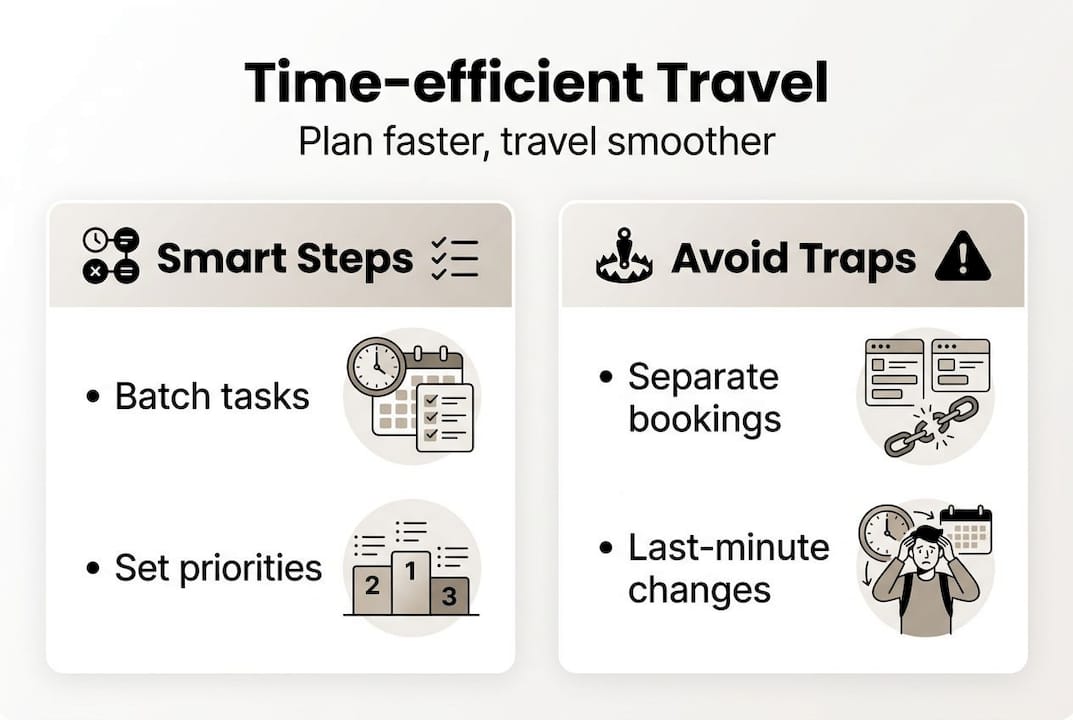
Strategic early booking combined with technology tools like AI itinerary generators and booking platforms are the engine behind this approach. You set your priorities once, then let systems do the heavy lifting.
Here's why it matters so much for professionals and busy vacationers:
- Time is non-renewable. Hours lost to tab-hopping and comparison shopping come out of your workday or family time.
- Decision fatigue is real. The more small choices you make during planning, the more exhausted you arrive at your destination.
- Fragmented plans cost money. Uncoordinated bookings often lead to missed connections, poor hotel locations, and awkward layovers.
- Reliability matters more than perfection. A solid, well-structured plan beats an overly optimized one you never finish.
Common pitfalls when planning is inefficient include booking flights and hotels on separate occasions, skipping buffer times between activities, ignoring weather alerts, and relying solely on generic travel blogs instead of curated sources. You can save hours on trip planning by avoiding these mistakes from the start.
The 8-step travel planning guide approach used by experienced travelers breaks the process into clear phases: define goals, book anchors, fill in activities, add logistics, and confirm. Each phase is contained, focused, and fast. That structure is what separates efficient planners from the ones still Googling hotel reviews at midnight before their flight.

Key strategies: How to plan smarter, not harder
Now that you know what time-efficient planning is, here's how to put it into practice with strategies that save real hours.
- Batch your decisions in one session. Book flights, hotels, and major tours in a single sitting. Spreading these decisions across days forces you to reload context every time, wasting energy and creating gaps.
- Leverage AI and travel apps. AI-powered itinerary tools generate personalized day-by-day plans in minutes. Delegation to AI tools for day-wise itinerary generation saves significant time compared to manual research.
- Delegate what you can. If you use a concierge service or travel planning platform, hand off the research phase entirely. Your job is to approve, not to investigate every option from scratch.
- Build buffer times into every day. Leave 30 to 45 minutes between activities and a half-day buffer at the start and end of your trip. This absorbs delays without derailing everything else.
- Use a go/no-go decision filter. For each activity or booking, ask: does this add real value to my trip, or am I adding it out of FOMO? Ruthless filtering keeps your itinerary lean and manageable.
"The goal isn't to plan the perfect trip. It's to plan a trip you can actually enjoy without it consuming your calendar beforehand."
Pro Tip: Create a personal travel preferences doc, one page listing your must-haves, deal-breakers, and budget range. Share it with any tool or service you use, and you'll never repeat the same onboarding questions twice. This single habit cuts planning time by a third for repeat travelers.
Avoiding common traps like booking through too many separate platforms or leaving activity planning for the last week makes the process dramatically smoother. The more you systematize, the less mental energy it costs each time.
Technology's role: AI, smart planners, and what actually works
With strategies in mind, let's dive into how technology supercharges time efficiency, and where it still falls short.
AI has genuinely changed travel planning for the better. AI systems achieve 92% constraint satisfaction and measurably improve time-saving scores compared to manually assembled itineraries. That means when you tell an AI planner your dates, budget, preferred activities, and pace, it builds a plan that fits your actual needs with high accuracy.
Here's a quick breakdown of how different tools stack up:
| Tool type | Time saved | Personalization | Reliability | Best for |
|---|---|---|---|---|
| AI itinerary generator | High | Medium | Medium | Solo trips, short getaways |
| Human travel advisor | Low | Very high | High | Complex, multi-stop trips |
| Hybrid AI + human review | Very high | Very high | Very high | Busy professionals |
| DIY booking platforms | None | Low | Variable | Budget-first travelers |
The table makes one thing clear: hybrid platforms that combine AI speed with human review are the strongest option for professionals who need both accuracy and nuance.
That said, AI still has real limits. LLMs struggle with real-time data and local nuances like festival crowds, sudden closures, or seasonal transport changes. A tool that doesn't pull live availability or local context can produce itineraries that look great on paper but fall apart on the ground.
Pro Tip: When using any AI planning tool, always cross-check the top two or three activity recommendations with a quick current-year search. AI models train on historical data, so recent openings or closures may not be reflected. Use AI travel itinerary tips to get the most accurate results. Exploring best trip planners side by side also helps you find the right fit fast.
Real-world comparison: Manual vs. automated travel planning
To make it practical, here's how manual and time-efficient planning methods stack up in real life.
| Factor | Manual planning | Automated planning |
|---|---|---|
| Avg. hours spent | 6 to 10 hours | 1 to 2 hours |
| Decision points | 20 to 40 separate choices | 5 to 8 core inputs |
| Risk of missed bookings | High | Low |
| Itinerary flow quality | Inconsistent | Optimized |
| Stress level | High | Low |
| Personalization | High (if you know what you want) | High (with AI + human layer) |
AI-based approaches show up to 92% improved constraint satisfaction compared to manual methods, which explains why the gap in stress levels is so wide.
In real scenarios, manual planners often end up with hotel locations that add unnecessary commute time, activity clusters that cause fatigue, or flights that leave no room for check-in. Automated and curated plans solve these problems by design.
Who benefits most from each approach?
- Automated planning is ideal for: Professionals with under 2 hours to plan, travelers visiting a destination for the first time, and anyone who finds research exhausting.
- Manual planning still works for: Travelers with very specific niche interests, those who enjoy the research process, or repeat visitors who already know a destination well.
For multi-trip planning across a full year, automation becomes even more valuable. The efficiency compounds when you're not rebuilding your planning process from scratch each time. And if route logistics matter to you, faster travel route planning tools can reduce in-destination friction significantly.
Success checklist: Build your time-efficient travel system
To wrap up the explainer, here's a checklist you can use right now to make your next trip smoother and more efficient.
- Define your must-haves. List your top 3 priorities: pace, experience type, budget range. Write them down before touching any booking platform.
- Book anchors first. Flights and primary hotels are your anchors. Book them in a single session, ideally 6 to 8 weeks out for domestic trips and 3 to 4 months out for international.
- Generate or request an itinerary. Use an AI tool or a done-for-you service to build your daily schedule. Don't build it manually unless you genuinely enjoy that process.
- Add buffer zones. Insert a half-day flex window early in the trip and keep at least one meal slot per day unscheduled. This preserves spontaneity without risking your core plans.
- Pack with a system. Use a smart packing list tool to generate a trip-specific list based on your destination, weather, and activities. This alone saves 30 to 60 minutes of mental preparation.
- Confirm 48 hours out. Run one final check on flights, hotel confirmations, and any pre-booked tours. Nothing else needs reviewing.
Using structured planning and technology measurably reduces stress and creates a smoother overall experience, and this checklist operationalizes exactly that.
Pro Tip: Save your completed checklist as a template. The next time you plan a trip, your starting point is already 80% done. Pair it with the stress-free planning steps framework to refine your system over time.
Why most travel advice fails busy people—and what we've learned
Before you jump into travel planning, here's a hard-won lesson that upends the usual advice.
Most travel tips online obsess over surface-level hacks: pack cubes, print boarding passes early, bring a portable charger. These are fine suggestions, but they don't touch the actual source of time loss for busy people. The real problem is fragmented, ad hoc decision-making spread across weeks of half-finished research.
The professionals who travel most efficiently aren't the ones with the best gear. They're the ones with the clearest decision frameworks. They know what they want before they start, they batch their choices, and they trust curated systems to handle the details they don't want to think about.
Here's the lesson we keep coming back to: automation handles the 90%, and you customize the final 10%. That final slice, the one restaurant you really care about, the specific neighborhood you prefer, the activity that makes the trip yours, is where your energy should go. Everything else can and should be systematized.
If you're still building every itinerary manually, the problem isn't your effort. It's the structure. Exploring streamlined planning for busy travelers shifts the framework entirely and makes the whole process feel less like work.
Ready to travel smarter? Try curated, time-saving solutions
If you want to skip the trial-and-error, here's how DestList can take your planning off your plate and save you time.
DestList combines AI-powered itinerary generation with human expert review, so your trip plan is both fast and reliable. You get flights, hotels, day-by-day activities, mapped routes, and walking times, all delivered within 24 hours and ready to book.
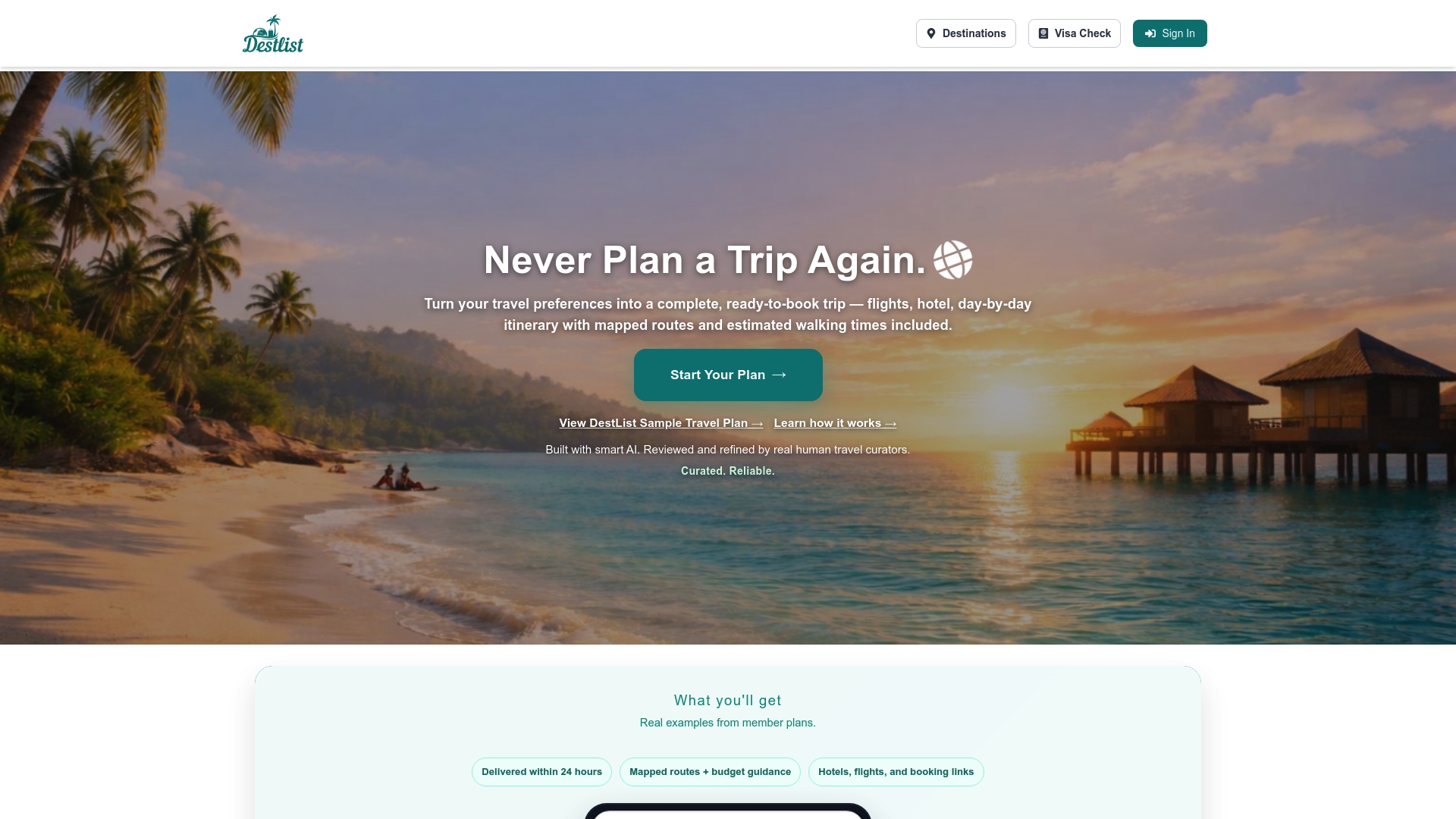
Whether you want a fully done-for-you travel planning experience or prefer to start with a custom travel itinerary tailored to your exact preferences, DestList handles the heavy lifting so you show up ready to enjoy, not scramble. Visit the DestList planner to start building your next trip in minutes, not hours.
Frequently asked questions
What is the first step in time-efficient travel planning?
Prioritize your core goals and lock in your major bookings, like flights and hotels, immediately to eliminate decision fatigue before it starts. Getting those anchors in place first gives you a solid structure to build everything else around.
Does AI really make trip planning faster?
Yes. AI-generated itineraries achieve 92% constraint satisfaction, meaning they match your preferences with high accuracy and cut planning time from several hours down to one or two. The speed gain is real and measurable.
How do I avoid travel planning burnout?
Combine automation, early batch decisions, and task delegation so you're not making 30 small choices over several weeks. Building in buffer times also absorbs unexpected changes without unraveling your whole itinerary.
What's the best tool for time-efficient travel planning?
Hybrid AI and human review platforms offer the best balance of speed, personalization, and reliability for busy professionals who need accuracy as well as efficiency. Platforms like DestList are specifically built for this combination.