
TL;DR:
- Travel preferences shape every aspect of trip planning, ensuring destinations, activities, and accommodations match individual priorities.
- AI acts as a collaborative partner by synthesizing travelers’ explicit needs and lifestyle values for a more personalized itinerary.
Your travel preferences are the single most powerful force in trip planning. They determine where you go, how you get there, what you eat, and how much you spend. The role of travel preferences in planning goes far beyond picking a destination. Preferences define the entire structure of a trip, from the pace of each day to the type of hotel you book. Research confirms that preference-weighted planning models produce a 90.5% superior ranking agreement compared to generic criteria. That number tells you something concrete: when planning reflects who you actually are, the results are dramatically better.
What role do travel preferences play in planning your trip?
Travel preferences function as the blueprint for every planning decision you make. They are not just wish lists. They are filters that eliminate options that do not fit and surface the ones that do. The industry term for this process is preference-weighted itinerary design, and it applies whether you are booking a solo backpacking trip or a family vacation to Bangkok.
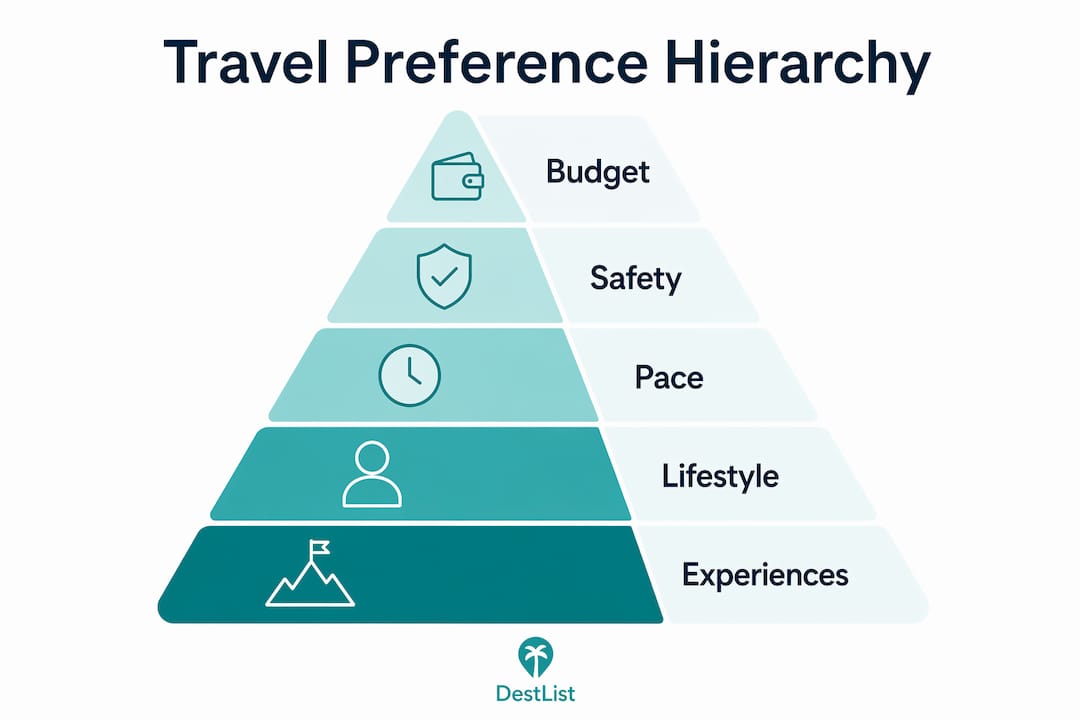
The most influential preference categories break down into five clear groups:
- Budget: How much you are willing to spend shapes every downstream decision, from airline class to neighborhood choice.
- Safety: Safety is the top priority for group and companion travel, cited by 69.2% of respondents in travel companion matching research. That makes it a non-negotiable filter, not a nice-to-have.
- Travel pace: Whether you prefer two activities per day or six changes the entire itinerary structure.
- Lifestyle values: Dietary habits, wellness routines, and cultural curiosity all shape which destinations and accommodations make the shortlist.
- Activity interests: Adventure, history, food, nightlife, and nature each pull planning in a different direction.
Pro Tip: Write your top three preferences before you open any booking site. Travelers who clarify priorities upfront spend less time second-guessing and more time planning trips they actually take.
The practical implication is that no two travelers should follow the same planning process. A traveler who prioritizes wellness and dietary alignment needs a completely different framework than one who prioritizes budget and adventure. Understanding how traveler personas shape planning decisions is the first step toward building a trip that actually delivers.

| Preference | Influence level | Primary planning impact |
|---|---|---|
| Budget | Very high | Destination range, accommodation tier, transport mode |
| Safety | Very high | Companion matching, destination shortlisting |
| Travel pace | High | Daily itinerary structure, activity volume |
| Dietary and wellness | Medium to high | Accommodation type, restaurant selection |
| Cultural immersion | Medium | Tour type, neighborhood choice, activity mix |
How do lifestyle preferences shape modern travel experiences?
Lifestyle preferences have moved from background consideration to primary planning driver. Dietary habits, wellness priorities, and work-life balance directly influence destination selection and the type of amenities travelers demand. A traveler who practices daily yoga and follows a plant-based diet will not be satisfied by a resort with no fitness center and a menu built around meat. That mismatch does not just create inconvenience. It undermines the entire trip.
The shift is visible in booking behavior. Travelers increasingly prioritize experiences tied to their personal values and social identities, which has driven a measurable decline in standard group tours and a corresponding rise in customized travel. Personalization is now the single most reliable driver of satisfaction. That is a significant structural change in how the travel industry must operate.
Lifestyle alignment in travel covers several distinct dimensions:
- Health and wellness: Travelers seek accommodations with gyms, spas, or access to outdoor activities that match their fitness routines.
- Dietary needs: Vegan, halal, kosher, and allergen-specific requirements filter destinations and restaurants before a single booking is made.
- Environmental values: Eco-conscious travelers prioritize low-impact transport, sustainable lodging, and destinations with strong conservation records.
- Work-life integration: Remote workers and digital nomads factor in reliable Wi-Fi, time zone compatibility, and co-working access as baseline requirements.
- Cultural depth: Travelers who value authentic local experiences actively avoid tourist traps and seek neighborhood restaurants, local guides, and community-based activities.
The tension between physical comfort and cultural immersion is real. A traveler who wants authentic street food experiences in Ho Chi Minh City may also want a comfortable, air-conditioned hotel. Balancing those two preferences requires deliberate planning, not just wishful thinking. Platforms that support itinerary personalization help travelers hold both priorities at once without sacrificing either.
Understanding guest experience design from the accommodation side reveals how much hosts and hotels now tailor their offerings to match specific traveler lifestyles. The best accommodations are not just places to sleep. They are extensions of the traveler's daily life.
What role does AI play in aligning planning with your preferences?
AI has shifted from a search tool to a genuine co-planner. Travelers now treat AI as a collaborative partner, using it to balance pragmatic needs like budget and schedule against hedonic desires like authenticity and enjoyment. That shift changes how planning conversations work. Instead of typing "hotels in Lisbon," travelers describe their lifestyle, pace, and priorities, and expect the AI to synthesize a coherent plan.
The way travelers prompt AI tools reflects their planning maturity. Research on large language models in travel planning shows that prompting strategies range from highly specific instructions to open-ended conversational exploration. Both approaches work, but they produce different outputs. Specific prompts generate tighter, more efficient itineraries. Exploratory prompts surface options the traveler had not considered.
Here is how to get the most from AI travel planning:
- State your non-negotiables first. Tell the AI your budget ceiling, travel dates, and any safety or dietary requirements before asking for suggestions.
- Describe your pace. Specify whether you want a relaxed trip with long lunches or a packed schedule with multiple daily activities.
- Name your lifestyle priorities. Mention wellness, cultural immersion, adventure, or family needs so the AI filters accordingly.
- Ask for trade-off explanations. Request that the AI explain why it chose one option over another. This reveals hidden assumptions and lets you correct them.
- Iterate, do not accept the first draft. The first AI output is a starting point. Refine it by pushing back on specific recommendations.
Pro Tip: Treat your first AI planning session as a preference interview, not a booking session. The goal is to surface what you actually want, not to lock in flights on day one.
AI tools improve decision confidence and reduce planning friction, particularly for group trips where multiple preferences must be reconciled. The practical tips for using AI in your itinerary process show how these tools cut planning time without cutting quality.
How do budget and safety weigh against experiential preferences?
Budget and safety consistently outrank experiential preferences in the early stages of planning. Travel pace, safety, and budget dominate group travel decisions, with safety at 69.2%, budget at 73.1%, and travel pace at 76.9% among the top cited factors. These three constraints form the outer boundary of any trip. Everything else, including cultural immersion and activity preferences, fits inside that boundary.
The practical tension shows up most clearly in accommodation choices. Availability and price override brand loyalty for 55% and 44% of global travelers respectively when booking. Travelers want personalized experiences, but they will not pay a premium for a brand name when a better-priced option meets their functional needs. That is a clear signal: functional fit beats aspirational branding.
Budget management does not mean reducing trips. 39% of travelers actively use cost-saving tactics like traveling off-season, choosing less expensive transport, and trading down on accommodation rather than canceling travel altogether. That behavior shows a clear hierarchy: the experience itself is protected, and the logistics absorb the cost pressure.
Balancing practical constraints with experiential goals requires a few deliberate choices:
- Set a firm budget ceiling before researching destinations, not after.
- Identify one or two non-negotiable experiences and protect their budget first.
- Use off-season timing to access premium destinations at lower cost.
- Trade accommodation tier for location quality when the two conflict.
- Review best practices for booking accommodations to find functional options that still align with your lifestyle preferences.
The travelers who report the highest satisfaction are not those who spent the most. They are the ones who matched their spending to their actual priorities rather than to a generic checklist.
Key Takeaways
Travel preferences are the primary determinants of trip quality, and aligning planning decisions with personal priorities in budget, safety, pace, and lifestyle produces measurably better outcomes than generic approaches.
| Point | Details |
|---|---|
| Preferences drive every decision | Budget, safety, and pace set the outer limits before any experiential preference applies. |
| Lifestyle alignment matters | Dietary, wellness, and cultural values must match destination and accommodation choices to avoid satisfaction gaps. |
| AI works best as a co-planner | Treat AI as a preference interview tool, not a booking engine, to get itineraries that reflect who you are. |
| Budget protects experience | Most travelers cut logistics costs rather than reduce trips, showing that the experience itself is the priority. |
| Personalization beats generic planning | Preference-weighted models produce a 90.5% superior ranking agreement over generic criteria. |
Why I think most travelers plan in the wrong order
Most travelers open a flight search engine before they have answered a single question about what they actually want. That is the wrong starting point. After years of watching how people plan trips, the pattern is consistent: travelers who start with logistics end up with efficient trips that feel hollow. Travelers who start with preferences end up with trips they talk about for years.
The shift from generic to personalized planning is not just a trend. It is a correction. For decades, the travel industry sold packages built around average preferences. The average traveler does not exist. What does exist is a person with specific dietary needs, a preferred pace, a safety threshold, and a set of experiences they have been wanting for years. Planning should start there.
The most common mistake I see is treating safety and budget as afterthoughts. They are not. They are the frame. Build the frame first, then fill it with the experiences you actually want. Travelers who skip this step spend the first two days of every trip renegotiating decisions they should have made at home.
AI tools have made this easier, but only if you use them correctly. The travelers who get the most from AI planning are the ones who treat the first session as a conversation about priorities, not a request for a finished itinerary. The output improves dramatically when the input is honest and specific.
— Helen
How Destlist builds trips around your actual preferences
Destlist combines AI-driven planning with human expert review to produce itineraries that reflect your real priorities, not a generic template.
Every plan starts with your preferences: budget, pace, lifestyle values, and the experiences you care most about. Destlist then builds a day-by-day itinerary with matched flights, hotels, mapped routes, and estimated walking times. A human curator reviews every plan before it reaches you. The result is a ready-to-book custom itinerary delivered within 24 hours. Whether you want curated travel plans for a specific destination or a fully custom trip built from scratch, Destlist handles the complexity so you can focus on the experience.
FAQ
What are the most influential travel preferences in planning?
Budget, safety, and travel pace consistently rank as the top three factors, with safety cited by 69.2% of travelers in group planning research. These three set the outer limits before any experiential preference applies.
How do lifestyle preferences affect destination choice?
Dietary habits, wellness routines, and environmental values filter destinations before a single booking is made. A traveler with specific dietary needs or fitness requirements will eliminate destinations that cannot meet those baseline requirements.
Can AI tools accurately reflect personal travel preferences?
AI travel assistants improve decision confidence and planning efficiency when travelers provide specific, honest inputs about their priorities. The quality of the output depends directly on the specificity of the preference information provided.
How do travelers balance budget constraints with experiential goals?
Most travelers protect the experience and absorb cost pressure through logistics. Common tactics include traveling off-season, choosing less expensive transport, and trading down on accommodation rather than reducing the trip itself.
Why does personalized planning produce better trips than generic planning?
Preference-weighted planning models show a 90.5% superior ranking agreement compared to generic criteria. That gap reflects the difference between a trip built for the average traveler and one built for you specifically.