
TL;DR:
- Most travelers now desire personalized trips but still rely on generic booking sites, leading to lower satisfaction. Custom itineraries, supported by AI and human expertise, offer significant time savings, higher satisfaction, and reduced travel stress, especially for busy or complex schedules. Combining technology with personalized service creates efficient, relevant, and memorable travel experiences tailored to individual preferences.
Three out of four travelers today say they want a personalized trip, yet most people still spend hours on generic booking sites, piecing together itineraries that sort of fit their life. The travel personalization market is growing at a 17.8% compound annual rate toward a $1 billion valuation by 2035, and custom itineraries already deliver 40% higher satisfaction than generic packages. This guide breaks down exactly how customization works, who benefits most, and how to use it as a practical time-saving tool rather than an indulgence reserved for premium travelers.
Table of Contents
- Why customization matters for travel in 2026
- How customization streamlines travel planning for busy people
- Balancing technology and the human touch in curated travel
- When is travel customization most impactful?
- Why the best travel plans are rarely one-size-fits-all
- Ready to simplify your next trip with expert customization?
- Frequently asked questions
Key Takeaways
| Point | Details |
|---|---|
| High satisfaction boost | Customized trips have been shown to deliver 40% higher traveler satisfaction versus generic packages. |
| Saves time and stress | Personalized itineraries streamline logistics, reduce planning stress, and save busy travelers valuable time. |
| Hybrid approach needed | Combining AI efficiency with human expertise ensures best results and avoids common pitfalls in planning. |
| Most valuable for complex plans | Travel customization is especially impactful for tight schedules, multi-stop trips, and professionals balancing work and leisure. |
| Customization is accessible | Modern solutions make tailored travel planning available and practical, not just a luxury extra. |
Why customization matters for travel in 2026
The travel industry has shifted. Travelers are no longer satisfied with cookie-cutter packages that lump together a hotel, a flight, and a bus tour of major landmarks. The data makes this clear: 74% of travelers now actively want personalized trips, and providers who deliver on that expectation see measurably higher retention and revenue. This is not a niche trend driven by ultra-wealthy travelers booking private jets. It spans budget-conscious weekend warriors, family groups coordinating school schedules, and executives fitting a conference trip around two precious vacation days.
What changed? Several things converged at once. Remote and hybrid work blurred the line between business and leisure travel, creating what the industry calls "bleisure" trips. At the same time, travelers became more experienced and more selective. They know what they like, and they're tired of paying for experiences that don't match their preferences. This is where customized travel itineraries enter the picture as a genuine efficiency tool, not just a marketing upgrade.
Here are the customization aspects that matter most to time-constrained travelers:
- Preference matching: Aligning accommodation style, cuisine preferences, and activity type to what you actually enjoy
- Schedule integration: Building an itinerary around your real calendar, including meetings, flights you've already booked, or family commitments
- Decision reduction: Pre-vetting restaurants, tours, and transport so you're not searching on the ground
- Stress buffering: Including buffer time, backup options, and weather contingencies so disruptions don't derail your trip
- Budget alignment: Filtering flights and hotels to your actual spend range rather than showing you options you'll reject
The numbers behind these benefits tell a compelling story:
| Customization benefit | Supporting data |
|---|---|
| Higher traveler satisfaction | 40% increase vs. generic itineraries |
| Market demand for personalization | 74% of global travelers prefer it |
| Industry growth rate | 17.8% CAGR through 2035 |
| Revenue impact for providers | Personalized experiences generate measurably higher booking value |
| Stress reduction | Rated top benefit by professionals using concierge-style planning |
Understanding travel customization trends helps you stay ahead of what the industry is building toward and make smarter choices about how you plan now.
How customization streamlines travel planning for busy people
Let's be direct about the core problem. Planning a trip well takes time. Researching flights, comparing hotels, reading reviews, mapping routes, and building a schedule that doesn't leave you exhausted by day two is easily a 10 to 15 hour project for a one-week vacation. For busy professionals, that time simply doesn't exist in comfortable blocks.
"Personalized travel services support executive performance by handling scheduling complexity, preference matching, and concierge logistics, directly reducing cognitive load and on-trip stress." CEO Times
Customization attacks this problem at the root. Instead of you doing all the research, a well-designed custom planning process works like this:
- Preference intake: You answer a structured set of questions about your travel style, budget, pace, must-have experiences, and dates. This typically takes 10 to 15 minutes and replaces hours of independent research.
- Smart itinerary building: An AI-assisted tool or human planner uses your answers to create a day-by-day schedule with logistics already solved, including mapped routes, estimated walking times, and activity sequencing that makes geographic sense.
- Schedule integration: Your existing commitments, such as a conference on day two or a late return flight, get factored in rather than treated as afterthoughts. The itinerary bends around your life, not the other way around.
- Review and confirm: You receive a ready-to-book plan and can approve or adjust it. Most custom services deliver this within 24 hours.
- Concierge support: Once you're traveling, you have access to real-time adjustments if a restaurant closes, a tour gets canceled, or the weather shifts unexpectedly.
The customization methods for professionals that work best aren't always the most tech-heavy. Often, the most effective approach combines a smart intake process with a human planner who can catch what an algorithm misses, like knowing that a particular museum is mobbed on Saturday mornings or that two neighborhoods you've requested are actually 45 minutes apart by transit.
Pro Tip: When using any travel customization service, be specific about what you want to avoid, not just what you want to include. Knowing you hate crowded tourist spots or need vegetarian options at every meal is just as valuable to a planner as knowing your dream destinations.
Saving time with personalization is real and measurable. But the deeper gain is mental. When you know your trip has been planned intelligently and someone has thought through the details, you can actually relax before you even board the plane.

Balancing technology and the human touch in curated travel
AI has transformed what's possible in travel planning. Algorithms can scan hundreds of flights in seconds, identify price patterns, cross-reference hotel ratings with your stated preferences, and generate itinerary drafts that would take a human planner hours. The efficiency gains are real and significant.
But AI in travel planning comes with well-documented limits. Research from MIT highlights that AI systems can produce what are called "hallucinations," meaning confidently stated but incorrect information about real-time conditions like current visa requirements, recently closed attractions, or disruptions that require human verification to resolve. Cold starts are another challenge: if a system has little data about you, early recommendations may miss the mark.
On the broader picture, personalization risks over-optimization when it leans too heavily on past behavior. If an algorithm only recommends what you've chosen before, you miss out on the spontaneous discovery that makes travel genuinely memorable. There are also real concerns about data privacy when platforms build detailed profiles of your travel habits.
Here's how AI-assisted planning compares to fully human-curated planning:
| Factor | AI-assisted planning | Human-curated planning |
|---|---|---|
| Speed | Very fast (minutes to hours) | Slower (hours to days) |
| Cost | Lower | Higher |
| Real-time accuracy | Can lag or hallucinate | High when experienced |
| Handling complex logistics | Good for standard cases | Better for exceptions |
| Personal nuance | Limited by data inputs | Strong with good communication |
| Spontaneity | Can over-optimize | Can build it in intentionally |
| Privacy | Requires data sharing | More controlled |
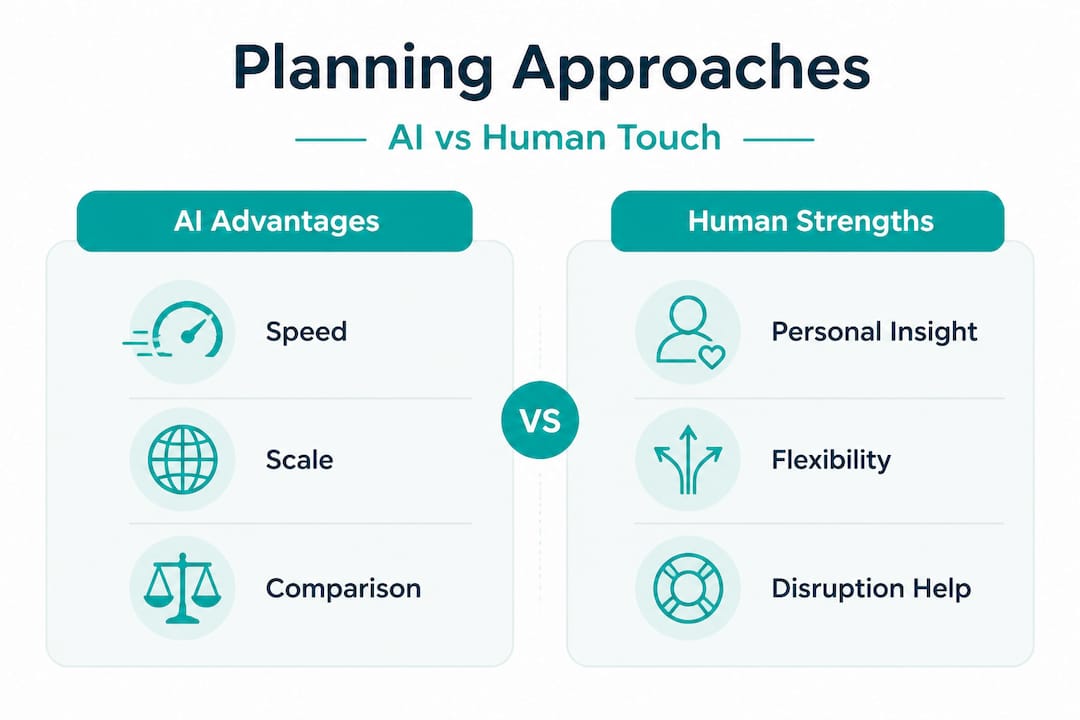
The most effective approach is a blend. You use AI to handle the heavy lifting of data, logistics, and initial drafting. You rely on human expertise to catch edge cases, apply local knowledge, and make judgment calls that an algorithm can't. Personalized trip plan examples consistently show that the best outcomes come from hybrid systems where technology accelerates the process and humans verify the results.
Pro Tip: When evaluating any travel planning service, ask specifically how they handle disruptions. A great custom plan means nothing if there's no human available to reroute you when a connection falls through at 11 p.m.
The pros and cons of each approach are worth understanding clearly:
AI strengths: Speed, scalability, price comparison, pattern recognition, 24/7 availability AI weaknesses: Real-time gaps, limited context for nuanced preferences, privacy risks, potential algorithmic bias Human strengths: Judgment, local knowledge, handling exceptions, empathy, flexibility Human weaknesses: Slower turnaround, higher cost, limited availability
When is travel customization most impactful?
Not every trip needs the same level of planning. A solo traveler spending a week at a beach resort with no agenda can get by with minimal customization. But for a large portion of today's travelers, especially those with time pressure or complex schedules, customization shifts from "nice to have" to genuinely essential.
The people who get the most value from customized planning include:
- Business executives and frequent flyers who need trips that fit around packed calendars without wasted time or poor hotel choices near the wrong part of town
- Families with multiple schedules juggling school breaks, different activity preferences across age groups, and accommodation needs that vary widely from solo travel
- Multi-city vacation planners who need routing logic, not just a list of places they want to see
- Short trip maximizers with only three to five days and a clear goal: see the most, experience the best, and come back genuinely refreshed rather than exhausted
- First-time visitors to complex destinations where language barriers, local transport nuances, or cultural considerations make generic planning risky
Tailoring trip itineraries to specific traveler profiles produces dramatically better outcomes in these scenarios. The satisfaction data for professionals using personalized concierge-style services points to improvements in both trip quality and on-trip productivity, because they're not spending vacation time fixing planning mistakes.
For multi-trip itinerary planning, the gains compound. A traveler who has multiple trips per year benefits from a planner who already knows their preferences, can anticipate their needs, and builds on prior trips rather than starting from scratch each time.
A quick self-check: ask yourself these questions to determine whether customization is worth investing in for your next trip.
- Do I have fewer than six hours to plan this trip properly?
- Am I traveling with others whose preferences differ from mine?
- Does this trip include multiple cities, countries, or transport types?
- Is this trip either very short (under five days) or very long (over two weeks)?
- Do I care significantly about quality of hotels, restaurants, or activities?
If you answered yes to two or more of those, you are a strong candidate for custom planning. The time you save and the experience you gain will return more value than the effort or cost of going custom.
Why the best travel plans are rarely one-size-fits-all
Here's an opinion that tends to make travel companies uncomfortable: the real cost of a generic trip isn't the money you spend. It's the restoration you don't get. When a vacation ends and you feel like you need another vacation to recover, that's a planning failure, not a you failure. You spent time and money on an experience that wasn't actually designed for you.
We've seen this pattern repeatedly. A traveler books a popular package to a top-rated destination, hits all the "must-see" spots recommended by every travel list, and comes back feeling vaguely dissatisfied. Not because the destination was bad, but because the itinerary was built for a statistical average traveler, not for them.
The 74% of travelers who want personalized trips aren't asking for more luxury. They're asking for more relevance. There's a meaningful difference. Relevance means a slower pace if that's what restores you. It means a food-focused itinerary if that's your primary travel motivation. It means having one spectacular dinner instead of four mediocre ones.
There's also a persistent myth that customization means micro-management, that someone is hovering over your schedule and eliminating any chance of spontaneous discovery. Good customization does the opposite. It handles the decisions that drain you, like where to sleep, how to get from point A to point B, and which restaurants are worth your time, so you have real mental bandwidth for spontaneity when you want it.
Real trip customization stories show that travelers who use personalized planning report more memorable moments, not fewer, precisely because they weren't spending that mental energy on logistics. Customization is a pragmatic tool. It gives you your vacation back.
Ready to simplify your next trip with expert customization?
If this resonates with you, the next step doesn't have to be complicated. DestList combines AI efficiency with human travel expertise to build fully personalized itineraries delivered within 24 hours. Every plan includes day-by-day schedules, mapped routes, flight and hotel options matched to your budget, weather alerts, and real support when things shift.
Whether you're planning a quick three-day escape or a multi-city international trip, a custom travel itinerary from DestList gives you a ready-to-book plan built around your actual preferences, not a template. If you'd rather hand the whole thing off, explore done-for-you travel planning and let our team handle every detail from start to finish. Your next trip should feel like a vacation from the moment you start planning it.
Frequently asked questions
Is travel customization only worth it for expensive or luxury trips?
No. The satisfaction data shows significant time savings and higher satisfaction across all budget levels, with busy professionals at mid-range budgets among the biggest beneficiaries.
What if I want some flexibility in a customized itinerary?
Well-designed custom plans intentionally build in free time and open-ended options, so you get structure where it helps and room to wander where you want it.
Can AI-based travel tools replace travel agents completely?
Not yet. AI handles speed and data well, but human verification remains essential for disruptions, complex logistics, and nuanced preferences that don't fit a standard pattern.
Is it possible to customize a trip if I only have a few days to travel?
Short trips benefit the most from customization. Efficient scheduling and preference matching ensure that every hour counts when your window is tight.
How does customization impact stress and decision fatigue?
Custom itineraries dramatically reduce the number of decisions you need to make on the ground. Pre-matched logistics and concierge support cut planning stress before you leave and problem-solving stress once you're there.