
TL;DR:
- Personalized AI trip planning combines speed with tailored itineraries that reflect individual preferences.
- Hybrid plans improve local nuance and adaptability through human expertise alongside AI automation.
- Combining AI efficiency with human insight creates the most memorable and relevant travel experiences.
Planning a vacation should feel exciting, not like a second job. Yet most travelers spend an average of 10 or more hours sifting through review sites, comparing flight prices, and stitching together a coherent itinerary from scattered blog posts and outdated travel guides. Generic plans rarely fit real life: your dietary needs, your toddler's nap schedule, your obsession with obscure street food markets. The good news is that personalized trip planning has evolved dramatically, and today's best solutions combine the speed of artificial intelligence with the warmth of genuine human expertise to deliver itineraries that actually work for you.
Table of Contents
- What makes an effective personalized trip plan?
- AI-powered itinerary builders: Fast, smart, and personal
- Hybrid and expert-reviewed plans: Balancing automation with human touch
- How do top personalized trip plans compare?
- Insider tips for choosing your perfect plan
- Why the best trip plans blend AI efficiency with human intuition
- Want a customized trip plan without the hassle?
- Frequently asked questions
Key Takeaways
| Point | Details |
|---|---|
| Personalization matters | Tailored itineraries save time and improve travel experiences compared to generic options. |
| AI boosts efficiency | AI-powered trip planners quickly generate accurate, optimized schedules with high satisfaction rates. |
| Human expertise refines plans | Combining AI planning with expert review adds local insight and adaptability for special interests. |
| Side-by-side comparison helps | A comparison of top plans clarifies which approach suits your specific needs best. |
What makes an effective personalized trip plan?
Now that you grasp why personalization matters, let's set the foundation for evaluating which trip plans actually deliver.
Not every "personalized" plan lives up to the label. Many services simply swap out a city name and call it custom. A genuinely effective plan does much more. Here's what to look for when evaluating any itinerary service:
- Relevance to your interests and group: A solo backpacker and a family of five need entirely different day structures, accommodation types, and activity pacing.
- Time and location efficiency: The best plans minimize backtracking. A good itinerary clusters nearby attractions and calculates realistic walking or transit times so you're not wasting hours commuting between sites.
- Adaptation for real constraints: Budget caps, dietary restrictions, mobility limitations, or a must-see concert on Thursday night should all be baked into the plan, not treated as afterthoughts.
- Integration of local events and seasonal highlights: A plan that doesn't know about the city's major food festival this weekend is already outdated before it starts.
- Responsiveness to last-minute changes: Life happens. Flight delays, sudden rain, or a restaurant closure should trigger fast adjustments, not a full rebuild from scratch.
The accuracy of modern systems is surprisingly strong. Research on AI itinerary planning confirms that 92% constraint satisfaction is achievable by large language model based systems generating day-by-day personalized itineraries. That means the system correctly honors nearly all of your stated requirements in a single pass.
Pro Tip: Before committing to any itinerary service, write down your top five non-negotiable constraints. If a tool can't clearly confirm how it handles each one, keep looking.
AI-powered itinerary builders: Fast, smart, and personal
Having established evaluation criteria, let's explore real AI solutions that bring these elements to life, starting with rapid-fire itinerary generators.
AI-powered trip planners work by analyzing your stated preferences (travel style, budget, interests, group composition), then cross-referencing millions of data points including hotel ratings, local transit schedules, real-time weather feeds, and crowd patterns. The result is a draft itinerary that would take a human researcher many hours to produce, delivered in minutes.
Here's how these tools create genuinely smart plans:
- Preference fusion: The system weighs multiple inputs simultaneously, balancing your love of museums against your partner's preference for outdoor hikes and your shared budget ceiling.
- Attraction anchoring: Rather than building from a blank slate, many tools anchor the plan around a specific hotel, landmark, or experience you've already committed to, then build outward logically.
- Dynamic constraint handling: Advanced engines enforce your requirements as hard rules, not suggestions, so a vegetarian traveler won't find a steakhouse lunch wedged into day two.
- Iterative refinement: Most modern AI builders let you adjust and regenerate specific sections without scrapping the whole plan.
One of the clearest real-world demonstrations of AI planning's impact comes from Tripadvisor. Their AI trip builder, which generates personalized itineraries anchored to specific attractions or hotels, produced a 4% increase in trip creation and a 10% increase in saved items among users. That's not a minor tweak. It signals that when a plan genuinely fits a traveler's context, they engage more deeply and follow through.
"The real breakthrough isn't just speed. It's relevance. When an AI plan feels like it was built for you specifically, the experience of planning itself becomes enjoyable rather than stressful."
These systems also dramatically cut down on decision fatigue. Instead of choosing from 200 hotel options, you get three that fit your exact budget, preferred neighborhood, and check-in timeline. You can learn how to save time with customized itineraries and see firsthand why this approach is becoming the default for experienced travelers.
For those managing multiple trips per year, whether for work, family visits, or leisure, AI builders are especially useful. Multi-trip planning across different destinations and group configurations used to require either a dedicated travel agent or an enormous personal time investment. AI tools now handle this complexity at scale, and the 92% constraint satisfaction rate holds even for complex, multi-leg itineraries.
Pro Tip: When testing an AI builder, give it an unusual constraint on purpose, like "no tourist traps" or "evenings free for spontaneous exploration." How it handles that vague input tells you a lot about its sophistication.
Hybrid and expert-reviewed plans: Balancing automation with human touch
While fully AI-based tools are powerful, sometimes the optimal plan blends smart automation with human insight. Let's examine what that looks like.
There's a ceiling to what purely algorithmic planning can achieve. AI is extraordinarily efficient at organizing known information, but it doesn't know that the most beloved tapas bar in Barcelona is down an unmarked alley that doesn't appear on Google Maps, or that a particular trail in Patagonia is impassable in early spring despite being listed as open.
This is where hybrid planning shines. The AI handles the heavy lifting: flights, hotel matching, major attractions, transit logistics, and budget tracking. Then a human expert steps in to:
- Adjust for local nuance that databases miss (which neighborhood to actually stay in, which market day is worth waking up early for)
- Reroute around real-time disruptions like sudden road closures or a pop-up festival that transformed a plaza into a pedestrian celebration
- Refine for bespoke interests that are hard to parameterize, such as a traveler who wants to focus exclusively on Art Deco architecture or fermented food traditions
"AI tools excel in personalization, but human-reviewed plans add nuance, especially around dynamic pricing and local events."
Research also shows that while AI performs exceptionally well in "cold start" scenarios (planning a destination you've never visited with no prior data), benchmarks confirm it may lack the local nuance that seasoned experts like Lonely Planet's editorial team bring. The combination of the two isn't a compromise. It's an upgrade.
Consider a traveler planning two weeks in Japan for the first time. An AI can instantly produce a day-by-day itinerary covering Tokyo, Kyoto, Osaka, and Hiroshima, complete with bullet train reservations and hotel recommendations within their $200-per-night budget. But a human expert might flag that cherry blossom season starts three days into the trip, and suggest rearranging the order of cities so the traveler arrives in Kyoto at peak bloom rather than a week too late. That single adjustment turns a good trip into an unforgettable one.

Services that offer custom travel planning or a fully done-for-you travel plan typically integrate both layers, using AI to draft and structure the plan while a human curator refines the details that matter most.
Pro Tip: When using a hybrid service, prepare a short list of "local experience" goals, such as attending a cooking class, finding a neighborhood coffee shop where locals go, or catching a traditional music performance. These are exactly the requests where human expertise outperforms algorithms.
How do top personalized trip plans compare?
To simplify selection even further, here's a direct comparison of the plans and methods we've examined.
| Method | Personalization | Speed | Downside | Best for |
|---|---|---|---|---|
| Pure AI builder | High (data-driven) | Very fast (minutes) | May miss local nuance | Solo travelers, frequent trips |
| Hybrid AI + expert | Very high | Fast (24 hours) | Costs more | Families, luxury, first-timers |
| Traditional travel agent | Moderate | Slow (days to weeks) | Expensive, less flexible | Complex group bookings |
| DIY planning | Fully custom | Very slow (hours/days) | Time-consuming, error-prone | Budget travelers with time |
Modern recommendation engines have made AI accuracy genuinely impressive. NCF models (Neural Collaborative Filtering, which learns your preferences from behavior patterns) outperform traditional collaborative filtering with an RMSE of 0.6688 versus 0.85, and achieve an 84% top-5 accuracy rate for activity selection. In plain language: the system correctly predicts which activities you'll enjoy 84% of the time in its top five suggestions.
For scheduling complex multi-day itineraries, TOPTW optimization with ANSA (a type of advanced scheduling algorithm) can handle mandatory visits and fully customized activities across large destination datasets, making it possible to produce highly optimized routes even for complex trips with many fixed time commitments.
Here's a quick breakdown of who should use which approach:
- Solo travelers: Pure AI tools offer speed and cost efficiency, perfect for spontaneous or frequent travel.
- Families with young children: Hybrid plans handle logistical complexity (stroller-friendly routes, nap-friendly scheduling) that AI alone often misses.
- Business travelers: AI tools excel here because preferences are consistent and constraints are well-defined.
- First-time visitors to a new region: Hybrid planning is worth the investment because local human expertise dramatically reduces costly mistakes.
Explore different trip planner types to get a clearer sense of which model fits your travel style before committing to a service.
Insider tips for choosing your perfect plan
You've seen the contenders. Here are practical tips to ensure you get the best fit for your specific needs.
- Test reliability with edge cases. Give any tool a logistically awkward scenario (tight layovers, unusual dietary needs, a city you've never researched) and see how cleanly it handles the challenge.
- Prioritize ease of adjustment. The ability to swap a restaurant, shift a museum visit to the morning, or add a half-day excursion without rebuilding everything is critical for real-world use.
- Check price transparency upfront. Hidden fees for changes, priority support, or premium features should be disclosed before you commit, not buried in fine print.
- Sample two or three tools before investing. Most platforms offer a free demo or a trial itinerary. Use it to evaluate the quality of suggestions, the interface, and the responsiveness of support.
- Request expert tweaks for special interests. If you have niche interests like wine tourism, street photography, or historical architecture, ask specifically whether the service can accommodate them. The answer will reveal how genuinely customizable the platform is.
Strong engagement data backs up the value of getting this choice right. Tripadvisor's personalized AI tool generated a 2% boost in member registration, a clear signal that travelers recognize and sign up for genuinely useful personalization. Good tools attract loyal users because they deliver.
For a broader framework on managing your planning process efficiently, the trip planning guide for busy travelers covers time-saving strategies that apply regardless of which tool you choose.
Why the best trip plans blend AI efficiency with human intuition
Here's an honest perspective you won't find in most guides.
Most articles on this topic treat AI planning as a feature checklist and human expertise as a premium add-on you can skip if budget is tight. We think that framing misses the point entirely.
AI is genuinely unbeatable at organizing complexity. Give it your departure dates, budget, group size, and a list of interests, and it will produce a logistically sound itinerary faster than any human ever could. What used to require hours of cross-referencing flights, neighborhoods, and opening hours now happens in seconds. That efficiency is real and it matters.
But here's what AI consistently gets wrong: the texture of a place. The reason you remember a trip years later is rarely the landmark you photographed. It's the tiny square where you stumbled into a neighborhood birthday party, or the elderly shopkeeper who insisted you try a regional candy you'd never heard of. Those moments don't come from an algorithm. They come from a plan with enough breathing room and local intelligence to let them happen.
The savvy traveler uses AI to build the skeleton: the flights, the hotel, the must-see attractions in logical order. Then they layer in human input, whether from a local expert, a seasoned travel curator, or a destination-specific resource, to find the moments the database doesn't know about.
We've seen this play out repeatedly. A traveler using an AI-generated plan for Lisbon had a perfectly efficient three-day itinerary. A quick human review added one change: swap a well-known miradouro (viewpoint) for a lesser-known one two blocks away, where locals go specifically because tourists haven't found it yet. That single adjustment, five minutes of human judgment applied to a machine-generated plan, became the traveler's favorite memory of the trip.
The goal isn't to choose between AI and human expertise. It's to understand that smart AI-powered planning works best as the foundation, with human intuition as the finishing layer that transforms a solid trip into an exceptional one.
Want a customized trip plan without the hassle?
Ready to put these insights to use? Here's how you can get a truly effortless personalized plan.
DestList combines AI-driven itinerary building with human expert review to deliver ready-to-book trip plans within 24 hours. Whether you're planning a solo city break, a family adventure, or a multi-destination journey, every plan is tailored to your exact preferences, budget, and timeline.
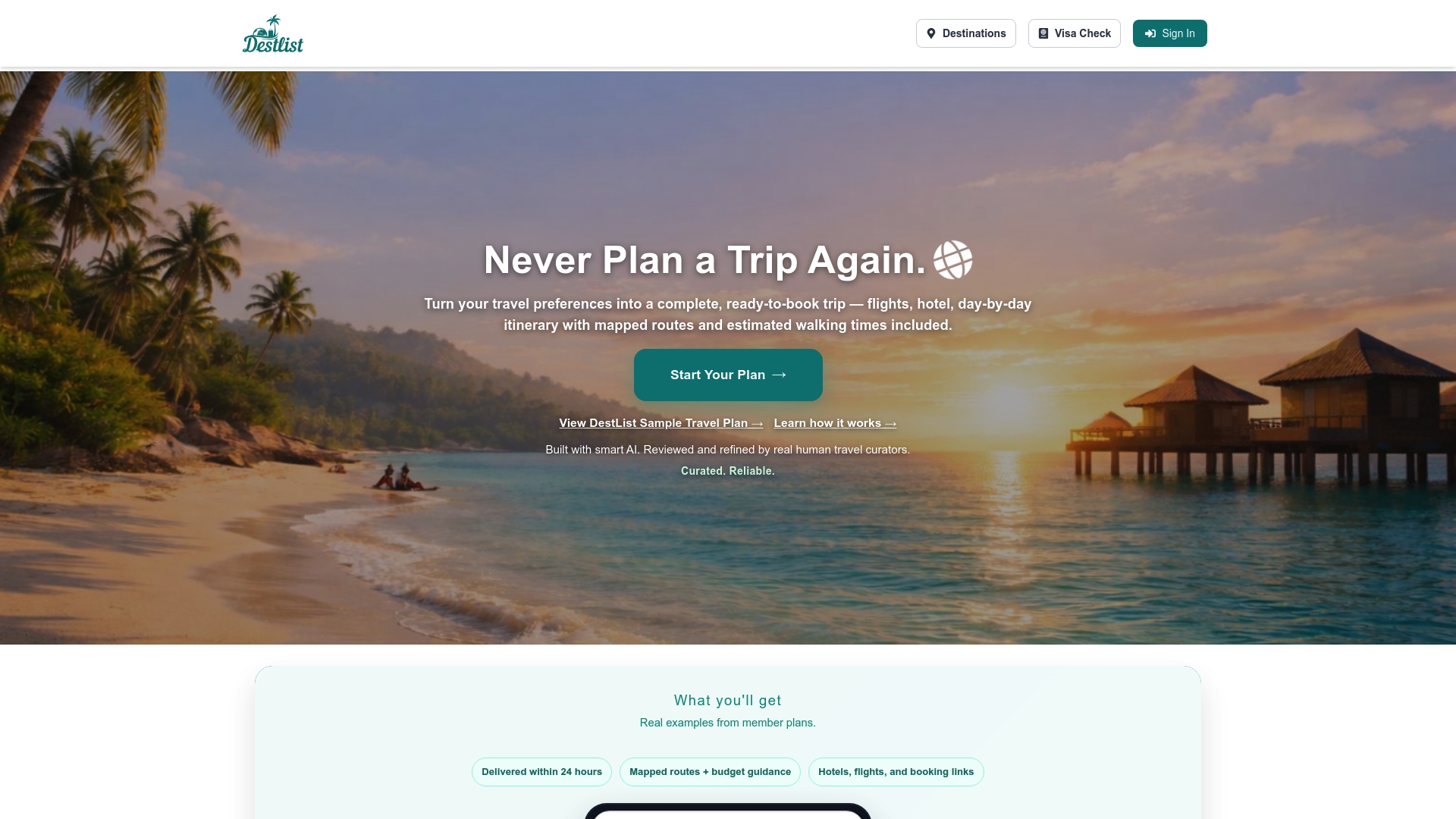
You can try custom travel itineraries built around your specific interests, or hand everything over with a fully done-for-you travel planning service that handles flights, hotels, day-by-day activities, mapped routes, and even packing lists. Not sure where to go yet? Explore adventure destinations to find your next trip based on your mood, budget, and available travel dates. DestList is built for travelers who value their time and want every vacation to feel effortless.
Frequently asked questions
What's the quickest way to get a personalized itinerary?
AI-powered tools like Tripadvisor's builder let you generate tailored plans in minutes by analyzing your preferences and available time, making them the fastest option for most travelers.
Can I combine expert advice with AI-generated trip plans?
Yes, many services now fuse AI's speed and data analysis with expert review for added local nuance, and research confirms that human-reviewed plans cover edge cases that pure AI misses.
How do AI-powered planners handle last-minute changes?
Advanced systems integrate real-time data fusion including live weather and local events, allowing you to adjust plans quickly without rebuilding the entire itinerary.
How accurate are personalized recommendations from AI trip planners?
AI-powered planners using NCF models reach 84% top-5 accuracy for activity selection with an RMSE of 0.6688, surpassing most traditional recommendation methods.
Recommended
- Save time and enjoy more with customized travel itineraries
- Best types of trip planners for effortless travel 2026
- Online Travel Planner for New York, San Francisco, Austin, Atlanta and Los Angeles | DestList
- DestList – Curated Travel Plans Built for You
- London Itineraries: Plan Your Perfect Trip | London Vacation Guide
- 7 Expert Tips for a Luxurious Family Vacation in Greece – Longevity Travel