
TL;DR:
- Traveler personas provide deep, structured profiles that improve trip planning efficiency and relevance.
- Properly integrated persona data enables AI systems to create feasible, customized itineraries aligned with individual travel styles.
- Continuous recalibration of personas during planning or the trip prevents misalignment and enhances overall travel satisfaction.
Most travelers assume that a "personalized" trip plan means picking their favorite cuisine and checking a box for beach versus mountain. That assumption costs hours. Generic planning tools collect surface preferences and spit out recommendations that half the internet has already seen. The real breakthrough in travel planning isn't about destinations at all. It's about knowing exactly who you are as a traveler before you book a single thing. Traveler personas, structured profiles that go far deeper than a preference checklist, are quietly transforming how the best itineraries get built, and understanding them changes everything about how efficiently you can plan.
Table of Contents
- What are traveler personas and why do they matter?
- How traveler personas drive automated and AI-powered planning
- From constraints to confidence: Making logistics-first planning work for you
- Persona drift: Why real trips require constant recalibration
- Business impact: How persona-driven planning boosts engagement and conversions
- A smarter way forward: Moving beyond the myth of the static traveler persona
- Where curated travel meets real-life alignment
- Frequently asked questions
Key Takeaways
| Point | Details |
|---|---|
| Personas boost efficiency | Well-built traveler personas drastically reduce irrelevant options and time spent planning. |
| AI relies on persona accuracy | Modern planning tools need dynamic, detailed personas to generate useful, personalized itineraries. |
| Adapt your profile | Update your persona for each trip stage and category to prevent generic recommendations. |
| Business uses prove value | Persona-driven planning dramatically increases engagement and satisfaction for brands and travelers alike. |
| Build robust plans | Encoding logistics and time constraints into your persona ensures reliable, enjoyable trips even under pressure. |
What are traveler personas and why do they matter?
To understand why most planning tools or templates fall short, let's start by clarifying what traveler personas actually are and what sets them apart from mere preference lists.
A traveler persona is a structured profile that captures far more than your favorite hotel star rating. It encodes your travel style, trip purpose, available time windows, energy pacing, spending comfort zones, and personal priorities. Think of it as the operating system for your trip. When a plan is built on top of a well-defined persona, every recommendation, from which neighborhood to stay in to how long to spend at a museum, fits the actual shape of your day. Research on personalized travel planning confirms that personas are evaluated for plan quality and alignment, specifically considering both constraints and preferences as equal inputs.
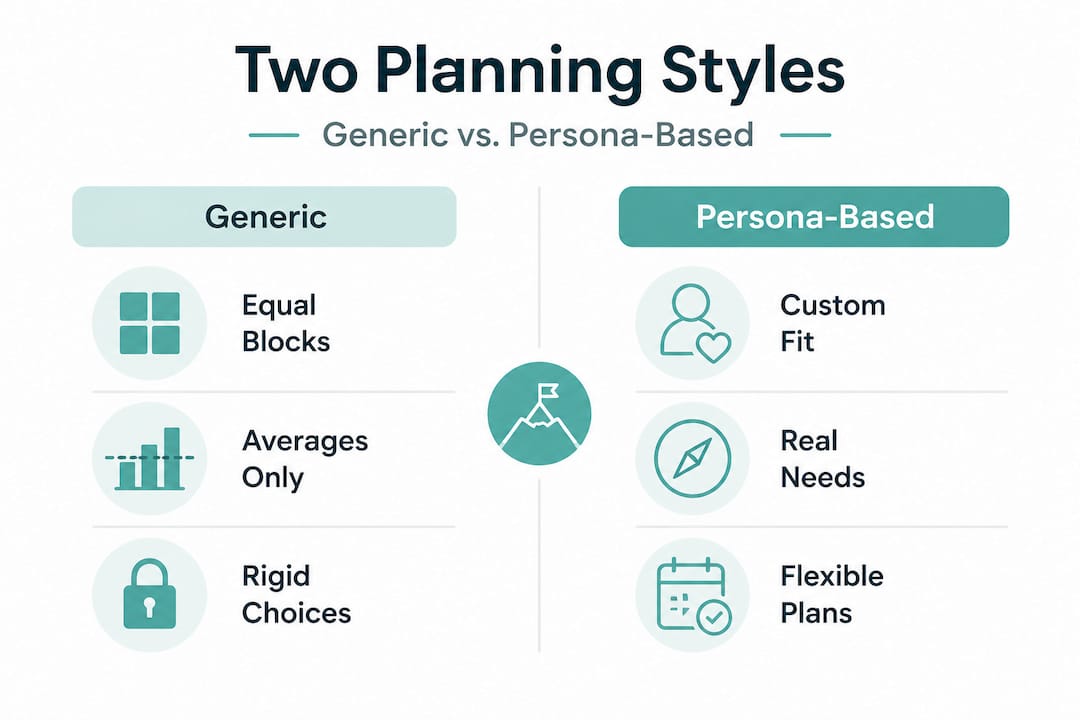
The difference between a generic itinerary and a persona-driven one is stark. Here's a side-by-side comparison:
| Planning dimension | Generic approach | Persona-based approach |
|---|---|---|
| Time allocation | Equal blocks per activity | Weighted by energy and transit time |
| Hotel selection | Star rating and price only | Location relative to priority activities |
| Activity sequencing | Alphabetical or by popularity | Optimized for pace, proximity, and interest depth |
| Dining | Highest-rated options | Filtered by dietary needs, budget, and timing |
| Flexibility | One fixed plan | Modular blocks that adapt to real-world delays |
The practical payoff is real. A well-defined persona shrinks your decision space dramatically. Instead of scrolling through 200 hotel options, your profile narrows it to 12 that genuinely match your constraints. That's the efficiency gain that customized travel itineraries deliver when they're built on solid persona foundations.
Core elements of a strong traveler persona:
- Travel type: solo, couple, family, group
- Trip purpose: leisure, adventure, cultural immersion, remote work
- Time rigidity: fixed departure and arrival constraints, meeting commitments
- Energy profile: high-intensity explorer versus slow-paced browser
- Budget framework: fixed total, daily cap, or splurge-and-save hybrid
- Location affinities: urban centers, coastal areas, rural retreats
- Non-negotiables: accessibility needs, dietary requirements, safety priorities
Pro Tip: Build a different persona for each category of trip you take. Your solo business travel persona and your family beach vacation persona are completely different operating systems. Blending them produces mediocre plans for both.
Using AI itinerary tips becomes far more effective once you lock in these persona layers before feeding any information into a planning tool.
How traveler personas drive automated and AI-powered planning
Now that you know the building blocks of traveler personas, let's see how they're used behind the scenes to automate and personalize your planning, especially with the rise of AI.
AI planning tools treat your persona as the primary input layer. Without it, the system defaults to statistical averages, which means popular attractions, mid-range hotels near city centers, and itineraries that look fine on paper but feel hollow in practice. When a strong persona is fed into the system, the model can filter, sequence, and pace recommendations in a way that actually mirrors how you move through a destination.

Here's a sample comparison of what AI-generated versus human-curated persona-aligned planning actually delivers on a single travel day:
| Planning element | AI-generated (no persona) | Human-curated (persona-aligned) |
|---|---|---|
| Morning activity | Top-rated museum (crowds peak at 10am) | Neighborhood market visit (matches "local immersion" goal, quieter timing) |
| Lunch | Highest-reviewed restaurant nearby | Low-key café within walking distance, within daily budget |
| Afternoon | Second top-rated attraction | Rest block (respects "low energy afternoon" preference) |
| Evening | Rooftop bar (generic recommendation) | Sunset viewpoint that fits "outdoor, budget-conscious" profile |
| Transit | Not factored | Walking times and transit options mapped between each stop |
The numbers behind AI planning quality are sobering. Fewer than 10% of LLM-generated itineraries reach human-level performance when evaluated on both feasibility and persona alignment. That gap is almost entirely explained by the absence of deep persona conditioning in the planning process.
"Fewer than 10% of the latest LLM-generated itineraries reach human-level performance, with evaluation including feasibility and persona alignment."
Here's how AI leverages persona details when the system is properly built:
- Constraint parsing: The system reads hard time blocks, budget caps, and non-negotiables as filters before any recommendations are generated.
- Style weighting: Activity types are ranked according to your stated travel style and past preference signals.
- Proximity optimization: Routes are sequenced to minimize backtracking based on your energy profile and the location of key commitments.
- Pace calibration: Rest blocks, meal durations, and transit allowances are inserted based on whether you're a high-intensity planner or a slow wanderer.
- Feasibility checks: The system tests whether the plan physically works within your time windows before presenting options.
Reviewing the best types of trip planners reveals that the most effective solutions combine AI efficiency with human editorial oversight, precisely because AI still struggles with nuanced persona alignment. Expert trip curation fills those gaps, and understanding travel curation terms helps you ask the right questions when evaluating any planning service.
From constraints to confidence: Making logistics-first planning work for you
Once you grasp the role of AI and personas, it's time to get practical: here's how to embed logistical reality into your planning for maximum confidence, not chaos.
Rushed plans fail for a predictable reason: they treat time as elastic. The traveler who lands at 2pm, books a museum visit at 3pm, and plans dinner at 6pm in a different neighborhood has ignored transit reality, jet lag, and the simple fact that airports take time to exit. Logistics-first persona encoding with hard-edged time windows, buffers, and modular energy-level blocks is what separates itineraries that hold up from ones that collapse by day two.
Core logistics to encode in your persona:
- Arrival and departure times, including realistic transit-to-accommodation estimates
- Fixed commitments: tours with set times, restaurant reservations, event tickets
- Energy rhythm: when you peak and when you fade (morning person versus night owl)
- Transit preferences: walking distance limits, comfort with public transit versus taxis
- Recovery needs: how much downtime between high-stimulation activities you need
- Weather sensitivity: how strongly adverse weather affects your activity choices
Pro Tip: Add a 60 to 90 minute buffer block every single day. This single habit absorbs delayed trains, longer-than-expected museum visits, spontaneous detours, and the general reality that things take longer when you're somewhere unfamiliar. Travelers who build in buffer time report significantly higher satisfaction and on-time performance throughout their trips.
Modular energy-level blocks are especially useful for longer vacations. A three-day weekend getaway can sustain high-intensity exploration from morning to night. A ten-day trip cannot. Building in low-energy afternoons or rest days on days four and seven isn't giving up on your vacation. It's what keeps the second half of your trip as enjoyable as the first.
If you want to save 10 or more hours on trip planning, encoding logistics into your persona before touching any planning tool is the single highest-leverage move. It eliminates the endless back-and-forth of checking whether a plan actually fits your day, because that question gets answered at the persona stage, not the booking stage. The payoff extends further when you save time with customized itineraries built around these pre-defined constraints.
Persona drift: Why real trips require constant recalibration
But what if your preferred travel style changes, or your priorities evolve while planning? Let's address a hidden trap in persona-based planning: drift and recalibration.
Persona drift is what happens when your priorities and constraints shift during the planning process or mid-trip, but your itinerary doesn't shift with them. A common example: you build your persona around boutique hotels and walkable neighborhoods, but by day three of planning, you've discovered a compelling villa rental outside the city. Suddenly your transit assumptions, morning activity windows, and dining radius are all wrong. Your plan is still running on the old operating system.
Persona drift within a planning process can cause generic recommendations to creep back in, undoing the specificity you worked to establish. The fix is deliberate re-parameterization, not a complete restart.
"Persona systems should support re-parameterization by category and moment."
Here's how to do it practically:
- Identify the trigger: Note which booking decision changed your assumptions. Was it accommodation, transport, or a new activity commitment?
- Isolate the affected category: Don't rebuild your entire persona. Only update the parameters tied to the changed element.
- Check downstream effects: Review how the update changes activity proximity, transit times, and energy pacing for each affected day.
- Rerun recommendations: Feed the updated persona back into your planning tool or brief your planner with the new constraints.
- Confirm feasibility: Walk through the updated day timeline to verify the plan still holds under real-world conditions.
Static personas are comfortable but dangerous. They feel definitive, which discourages the adjustments that keep a plan genuinely relevant. Streamlining multi-trip planning across different travel categories becomes far easier when you build the habit of checking your persona at each major booking milestone.
Business impact: How persona-driven planning boosts engagement and conversions
Adapting your persona is smart for individuals, but it's also proven in business: here's how leading travel companies use these insights for exponential gains in engagement and conversions.
Travel brands have been using persona-based communication for years, and the data is striking. A persona-aligned pre-trip email series achieved an 80.3% open rate and a 32.6% click-through rate by triggering planning content based on traveler type and trip stage. Compare that to industry-average email open rates around 20%, and the gap becomes obvious. Personalization at the persona level isn't a minor improvement. It's a category shift.
Here's how travel brands operationalize persona-based recommendations:
- Survey-driven segmentation to identify traveler type before pre-trip communications begin
- Must-see attraction modules customized to adventure, cultural, or family traveler profiles
- App modules that rearrange their interface based on declared travel purpose
- Modular itinerary blocks sent in sequence according to booking stage and traveler energy profile
- Restaurant and activity suggestions filtered to match budget tier and cuisine preferences declared at signup
The insight for individual travelers is this: the same mechanics that drive those engagement numbers can work for your personal planning. When you treat your trip like a brand treats its customers, filtering every recommendation through a clearly defined persona, you get the same efficiency gain. Fewer irrelevant options, faster decisions, and a final plan that actually fits. Personalized cultural trip planning is one area where this approach delivers especially strong results, since cultural experiences require tighter alignment between your interests, pace, and the depth of engagement you're seeking.
A smarter way forward: Moving beyond the myth of the static traveler persona
Here's the contrarian view that most planning guides won't tell you: a traveler persona isn't a label you earn once and apply forever. The entire productivity argument for personas collapses the moment you treat them as fixed identities rather than living tools.
Conventional planning wisdom says: define your traveler type, then let the system do the work. That framing is incomplete. Strong persona conditioning is necessary but not sufficient, and benchmarks that evaluate realistic constraints and direct persona alignment make that clear. The persona gets you to the starting line. Dynamic recalibration is what carries you across the finish.
The practical implication is uncomfortable for people who want planning to be a one-time task. It means checking your persona priorities before booking accommodation, again before finalizing activities, and once more before locking in dining reservations. Each category has different stakes, and your priorities genuinely shift between them. Your "accommodation self" cares deeply about location and quiet. Your "activity self" cares about timing and energy fit. Treating these as one uniform profile produces plans that partially satisfy everything and fully satisfy nothing.
Most AI tools and even human planners still optimize toward a single persona snapshot. Use their outputs as a starting point, not a finished product. The travelers who get the most out of persona-based planning are the ones who trust their on-the-ground read of the situation and adjust without guilt when the plan stops fitting reality. Stress-free trip curation works best when you bring that adaptability to the table, and adaptive multi-trip planning across multiple destinations becomes genuinely smooth when you treat each trip stage as its own persona moment.
Where curated travel meets real-life alignment
If you're ready to skip wasted hours and get plans perfectly matched to your travel style, see how curated solutions put these insights into action.
At DestList, we build every itinerary around the specific mechanics described in this article: structured persona inputs, logistics-first scheduling, energy pacing, and buffer time baked in from day one. Our planners don't just generate options. They test feasibility, check persona alignment, and refine until the plan actually mirrors how you travel.
Whether you need a custom travel itinerary planner built around your exact constraints or a fully done-for-you trip planning service that handles flights, hotels, and day-by-day flow, DestList delivers a ready-to-book plan within 24 hours. No template recycling, no generic top-ten lists. Just a plan designed around who you are as a traveler, not who the algorithm assumes you are.
Frequently asked questions
How does a traveler persona differ from a simple travel preference list?
A traveler persona is a structured, multi-factor profile that encodes style, constraints, and purpose, while a preference list usually covers only surface-level likes and dislikes without accounting for time limits, energy, or logistical realities.
What's the risk of not updating your persona when trip details change?
Failing to adjust leads to generic, misaligned recommendations that no longer fit your actual lodging situation, energy levels, or activity priorities, which is the core problem of persona drift.
Do AI-powered tools really personalize trips better using traveler personas?
AI tools improve itinerary relevance significantly with persona input, but LLM-generated itineraries still lag behind human planners on feasibility and deep persona alignment, which is why hybrid approaches work best.
How do I make my itinerary more robust under tight time constraints?
Use logistics-first structuring and modular energy blocks to absorb real-world delays: lock in fixed time commitments, categorize activities by energy level, and build a 60 to 90 minute buffer into each day.
Recommended
- Best types of trip planners for effortless travel 2026
- Trip planning guide: save 10+ hours on your next vacation
- Streamline your travel planning: expert guide, 8 steps
- Multi-trip planning: streamline your vacations in 2026
- Streamline your London sightseeing: efficient workflow guide - The London Journal | London Vacation Guide