
TL;DR:
- Decision fatigue can overwhelm travelers due to unlimited options and conflicting information.
- A goal-first approach using a structured framework helps clarify desires, evaluate destinations, and reduce stress.
You open a browser to plan a trip and two hours later you have 47 tabs open, three conflicting Reddit threads, and zero bookings. That experience has a name: decision fatigue. And it hits travelers harder than almost any other planning scenario because the options are genuinely unlimited. This travel decision-making guide cuts through that noise with a structured, goal-first approach. You will learn how to clarify what you actually want from a trip, evaluate destinations with a proven framework, budget around your real priorities, and build an itinerary that holds up without suffocating you.
Table of Contents
- Key Takeaways
- Your travel decision-making process starts here
- The 7-factor framework for destination evaluation
- Budgeting smartly without micromanaging
- Building an itinerary that actually works
- Common pitfalls that derail travel decisions
- My honest take on planning smarter trips
- Plan your next trip with Destlist
- FAQ
Key Takeaways
| Point | Details |
|---|---|
| Start with your "why" | Define your emotional travel goal before looking at destinations to avoid regret and wasted planning. |
| Use the 7-factor framework | Evaluate destinations by goal alignment, cost, time, experience density, risk, flexibility, and opportunity cost. |
| Budget around priorities | Protect your top two or three spending categories and stop micromanaging the rest. |
| Build in buffer time | Reserve at least 30% of your itinerary for unplanned moments to reduce stress during the trip. |
| Decide within 24 hours | Once you have shortlisted two or three destinations, commit within a day to avoid spiraling indecision. |
Your travel decision-making process starts here
Most people start planning a trip by picking a destination. That's actually the wrong move. Starting with a destination instead of defining your goals and real costs first is the single most common reason travelers end up disappointed with trips they spent weeks planning.
Before you type a single city into a search bar, ask yourself what you want to feel at the end of this trip. Rested? Challenged? Reconnected? Inspired? Emotional reasons like personal growth or a desire for awe should be driving your destination choice, not which beach photo got the most likes last week.
Common emotional travel goals fall into a few categories:
- Relaxation and restoration: You need to decompress. Slow-paced destinations, minimal logistics, and low stimulation are your friends.
- Adventure and challenge: You want physical effort, new environments, and a story to tell. You can handle complexity.
- Cultural immersion: You want to understand how other people live. Cities, local food, history, and language matter most.
- Connection: You are traveling with family, a partner, or friends. Shared experiences and group compatibility come before personal preference.
Alongside your emotional goal, honestly assessing your mental and physical capacity before you choose a trip can prevent wasted planning and match your trip style to your actual life stage right now. A solo traveler running on empty from a brutal work quarter does not need a 12-city European rail adventure. They need Lisbon for a week with three good restaurants already bookmarked.
Pro Tip: Write one sentence describing your ideal feeling on the last day of your trip. Use that sentence as a filter for every decision that follows.
The other trap to watch out for is social media influence. Algorithm-driven inspiration has effectively collapsed the traditional travel planning process, pushing people toward impulsive bookings based on aesthetics rather than fit. A destination that photographs beautifully might be completely misaligned with what you need. That mismatch is the root of most travel disappointment.
The 7-factor framework for destination evaluation
Once you know what you want from a trip, it is time to evaluate destinations with a structure that takes emotion out of the driver's seat without removing it entirely. A decision matrix simplifies complex trade-offs and lets you make confident choices faster.
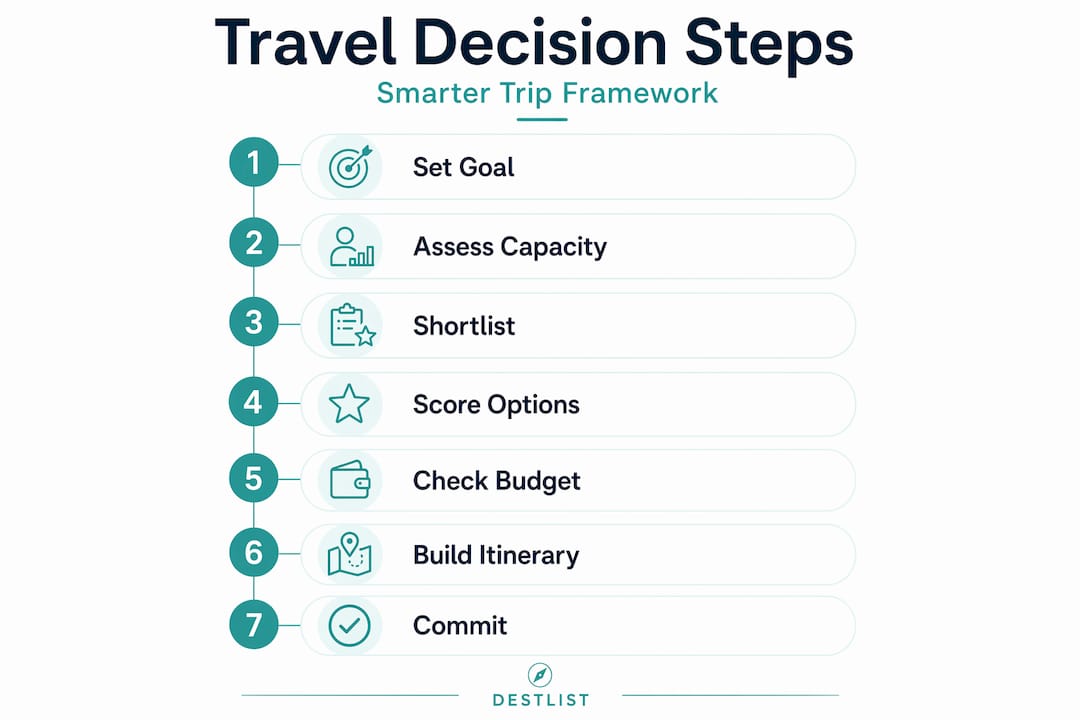
Here are the seven factors to rate each destination:
| Factor | What to evaluate |
|---|---|
| Goal alignment | Does this destination actually deliver the experience you defined? |
| Total cost | What is the realistic all-in cost including flights, lodging, food, and activities? |
| Time efficiency | How much of your trip is spent in transit versus actually experiencing the place? |
| Experience density | How many of your priority activities or interests exist in this destination? |
| Risk | Visa complexity, health advisories, political stability, weather season. |
| Flexibility | Can plans change easily? Are there refundable options and alternative activities? |
| Opportunity cost | What are you giving up by choosing this destination over your other shortlisted options? |
Here is how to apply this framework in practice:
- Write down two or three destinations you are genuinely considering. Not ten. Not fifteen. Limiting your shortlist to two or three options is critical to reducing overwhelm.
- Score each destination from one to five on every factor above.
- Weight the factors that matter most to you. If cost is your primary constraint, double its score. If time is your scarcest resource, weight time efficiency higher.
- Add the scores and compare. The highest score is your working first choice.
- Sleep on it for one night. If you wake up hoping a different destination won, go with that one. Gut check is a real signal.
Experts who study the trip decision-making process recommend making the final call within 24 hours after completing your shortlist evaluation. Extending the decision window rarely adds useful information. It mostly adds anxiety.
Pro Tip: When evaluating safety and transport costs, research shows that safety and travel cost rank as the two most significant factors in transport mode decisions. Weight both heavily in your matrix.
If two destinations score almost identically, pick the one that feels slightly more exciting, not slightly more practical. Trips need a spark.
Budgeting smartly without micromanaging
Budgeting for travel trips most people up because they think about it as a policing exercise. Track every dollar, cut every corner, feel guilty about every splurge. That approach does not lead to better trips. It leads to resentment.
A smarter framing: treat your budget as a tool to protect priorities, not police minor expenses. Identify your top two or three spending categories for this specific trip. Maybe it is accommodation quality, guided experiences, and one truly excellent meal. Those three categories get the budget. Everything else gets reasonable minimums.
Here is what tends to get forgotten when travelers build their first budget:
- Visa and entry fees: These can range from free to several hundred dollars depending on destination and citizenship.
- Travel insurance: Non-negotiable for international travel. Budget one to eight percent of your total trip cost.
- Airport and local transport: The cost of getting from airport to accommodation adds up fast, especially in cities where taxis are expensive.
- Tipping culture: In the US and some other countries, not budgeting for tips means constantly scrambling.
- Contingency fund: Add ten to fifteen percent on top of your projected total. Something always costs more than expected.
Mid-trip spending is where budgets collapse. A practical fix: check your running total every two to three days using a simple notes app or a dedicated travel budgeting tool. You do not need elaborate software. You need awareness. Surprises at the end of a trip feel worse than mid-trip adjustments.
Pro Tip: Do not obsess over small costs like snacks or cheap coffee. Spend that mental energy deciding whether the big-ticket items genuinely match your trip goals.
Building an itinerary that actually works
A good itinerary is not a schedule. It is a framework. There is a meaningful difference. A schedule tells you where to be at 9am. A framework tells you what kind of day today is and roughly what you want to accomplish, then lets reality fill in the gaps.
Start by choosing one or two experience headlines for your trip. An experience headline is your shorthand description of what makes this trip worth taking. For example: "Eating my way through Oaxaca's street food scene" or "Four days of serious hiking in Patagonia." Every activity you add to your itinerary should connect to those headlines. If it does not connect, cut it.
From there, build your days around this rhythm:
- Anchor activity: One significant planned experience per day, booked in advance where needed.
- Loose exploration: Two to three hours of unstructured time around the anchor. This is where the best memories usually happen.
- Buffer time: At least thirty percent of each day should be unscheduled. That sounds extreme until you miss a bus, discover an unexpected market, or simply need to sit for a while.
For lodging, staying central reduces decision fatigue during the trip itself. When your hotel is fifteen minutes from where you want to be, you spend less mental energy on logistics and more on experience. Vacation rental search tools can help you weigh proximity against cost, particularly in cities where neighborhoods vary dramatically.
For transport, default to the option that costs you the least time, not the least money. This shifts once your trip budget is genuinely tight, but for most leisure travelers, a thirty-minute taxi versus a ninety-minute transit commute is worth the price difference on limited travel days.

Common pitfalls that derail travel decisions
Even well-intentioned travelers fall into patterns that undermine their trips before they start. Here is what to watch for:
- Endless shortlisting: Adding destinations to your list without ever removing any is a stall tactic dressed as research. Cap your final shortlist at three options.
- Optimizing for cost at the expense of experience: Saving two hundred dollars on a flight that routes through two connections over twelve hours often destroys an entire first day. Calculate the real trade-off, not just the number.
- Ignoring seasonality: Many travelers pick destinations without checking whether their travel window aligns with the destination's best conditions. Weather and travel season matter more than most pre-trip research suggests.
- Not accounting for personal energy: A ten-day itinerary that would thrill you when rested might exhaust you during a stressful period at work. The destination is the same; your capacity is not.
- Failing to commit: Decision fatigue is real. Humans have a limited pool of mental energy, and too many options leads to choices that feel worse, not better.
The best trip is not the one with the most optimal destination. It's the one you actually booked with confidence and showed up for fully present.
Making travel choices easier ultimately comes down to knowing when to stop researching and start committing. Give yourself a hard deadline. The trip you book is always better than the trip you are still researching.
My honest take on planning smarter trips
I have spent years watching people agonize over travel decisions, and the pattern is almost always the same. They do not suffer from a lack of information. They suffer from a lack of clarity about what they actually want.
The moment I started treating travel planning as a goal-clarification exercise rather than a logistics problem, everything got faster and more enjoyable. I stopped comparing flights for three days straight. I stopped reading forty hotel reviews to decide between two nearly identical properties. I made a decision, and I moved on.
What I have also learned is that imperfect trips taken confidently beat perfect trips planned indefinitely. The framework I described in this article is not about finding the objectively best destination. It is about finding a destination that is genuinely good enough for your current needs, then committing fully to it.
The travelers I have seen get the most out of their trips are not the ones who planned the most carefully. They are the ones who planned with clear intentions, built in flexibility, and let the trip surprise them. Structure gives you the confidence to be spontaneous. That is the real value of a well-built planning process. If you take only one thing from this essential travel planning guide, let it be this: know why you are going before you decide where.
— Helen
Plan your next trip with Destlist

If the framework in this article makes sense but you would rather not spend hours executing it yourself, that is exactly what Destlist is built for. Destlist combines AI-powered planning with human expert review to deliver custom travel itineraries that are ready to book within 24 hours. You tell Destlist your travel goals, travel dates, and budget. It builds your complete day-by-day plan including flights, hotels, activities, and routes. You can also browse curated trip plans aligned to specific moods, budgets, and destinations if you want a starting point without the blank-page problem. Structured, goal-aligned travel planning, done for you.
FAQ
What is a travel decision-making guide?
A travel decision-making guide is a structured framework that helps you choose destinations, set budgets, and plan itineraries based on your personal travel goals rather than impulse or social media influence.
How do I shortlist travel destinations without getting overwhelmed?
Limit your list to two or three serious options, then score each one against factors like goal alignment, total cost, time efficiency, and experience density. Commit to a final choice within 24 hours of scoring.
How much buffer time should I leave in a travel itinerary?
Reserve at least 30% of each day as unscheduled time. This reduces post-booking stress and creates space for unexpected discoveries that often become the best parts of a trip.
What factors matter most in travel decision-making?
Goal alignment is the most important factor. Beyond that, safety and travel cost consistently rank as the top practical criteria, followed by time efficiency and experience density.
Why do travelers feel decision fatigue during trip planning?
Too many options deplete mental energy, making later decisions feel harder and less satisfying. The fix is setting deliberate constraints early: limit your shortlist, set a decision deadline, and stop adding new options once you have three solid candidates.