
TL;DR:
- Genuinely curated itineraries are personalized to your preferences, offering higher satisfaction and flexibility.
- Generic plans provide convenience and fixed pricing but often lack real customization and adaptability.
Most travelers assume that any travel itinerary is roughly equivalent to another. You pick a destination, someone hands you a schedule, and off you go. But the difference between curated and generic itineraries is far wider than the marketing suggests, and it shows up the moment something goes wrong, or more often, the moment nothing feels right. Curated itineraries are built around you. Generic ones are built for everyone. That distinction affects your satisfaction, your flexibility, and ultimately whether your trip feels like a vacation or a checklist.
Table of Contents
- Key takeaways
- The difference between curated and generic itineraries
- Benefits and trade-offs of each approach
- How your traveler profile changes everything
- The role of AI and human expertise in modern itinerary planning
- How to choose the right itinerary for your next trip
- My honest take on curated versus generic travel
- Plan your next trip with Destlist
- FAQ
Key takeaways
| Point | Details |
|---|---|
| Curated beats generic on satisfaction | Personalized plans deliver roughly 40% higher traveler satisfaction than standard packages. |
| "Curated" labels can mislead | Some itineraries marketed as curated simply bundle known attractions without adjusting pacing, timing, or access. |
| Your traveler profile matters most | Matching your personality type (planner, explorer, comfort seeker) to the right itinerary format prevents the most common trip frustrations. |
| Hybrid planning is often the smartest move | Booking complex logistics as a package while customizing daily activities balances convenience with personal freedom. |
| AI speeds planning but needs human review | AI-generated drafts miss emotional nuance and real-world feasibility without a human layer of oversight. |
The difference between curated and generic itineraries
Before you can choose between them, you need an honest definition of each. Not the brochure version.
A generic itinerary is pre-built for maximum audience appeal. Think of a 7-day Italy tour that hits Rome, Florence, and Venice with the same schedule every week, for every group. The Colosseum at 9 a.m., the Uffizi at 2 p.m., a gondola ride on day five. There is nothing wrong with it, but it was designed for a composite traveler who does not actually exist. Generic travel plans offer real convenience and fixed pricing, but they eliminate spontaneity by design. You trade control for ease.
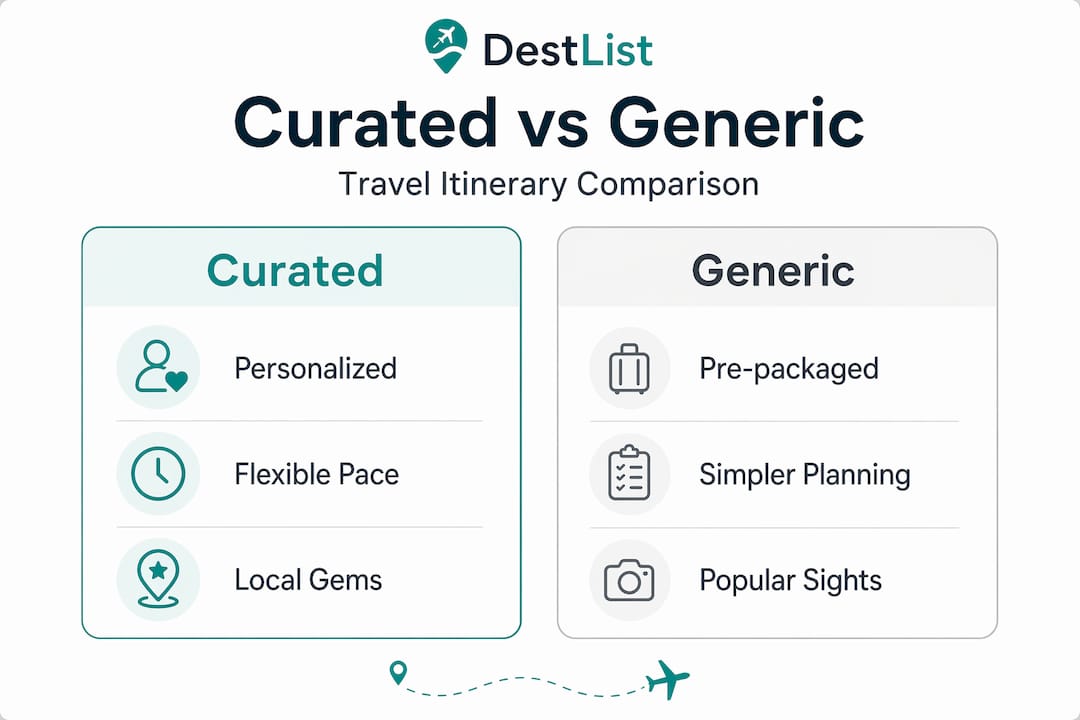
A curated itinerary, at its best, is built around your preferences, pace, and priorities. It accounts for whether you hate early starts, whether you travel with kids, whether you care more about food than museums, and whether you need a rest day built into a 10-day schedule. The best curated trips include transfers timed to avoid rush hour, restaurant reservations at places that are not on page one of Google, and a daily flow that does not leave you exhausted by Tuesday.
Here is where the confusion starts. Many itineraries are labeled "curated" when they are really just branded versions of generic plans. Delta Vacations offers curated itineraries that bundle flights, hotels, rides, and activities. That bundling is convenient, but bundling is not the same as personalization. The itineraries include public landmarks and third-party activities, which is fine, but they are sample plans with fixed structures. Whether that counts as curated depends on how deep the personalization actually goes.
Pro Tip: When evaluating any itinerary marketed as "curated," ask three specific questions: Does the pacing reflect your travel speed? Does it include any non-obvious or locally known experiences? And were the transfer times built around real logistics, or just approximated? Those answers reveal actual curation depth.
Key features that distinguish genuinely curated itineraries from generic ones:
- Timing and pacing adjusted to your stated preferences, not average group behavior
- Local or off-the-beaten-path recommendations beyond the top 10 attractions
- Flexibility built in, including optional days or swap-out activities
- Logistics that account for real travel times, not idealized ones
- A point of contact who knows your itinerary, not a call center
Benefits and trade-offs of each approach
The case for curated itineraries is strong. Custom plans deliver roughly 40% higher traveler satisfaction compared to standard package tours. That gap is not about luxury. It is about fit. When your trip matches your actual preferences rather than a statistical average, you enjoy it more.

But satisfaction comes with trade-offs. A genuinely personalized travel itinerary takes more effort to produce and typically costs more. It also puts more decision-making on you during the planning phase. The more you customize, the more you need to check, confirm, and coordinate.
Generic travel plans have a legitimate case too. They are simpler to book, easier to budget for, and logistically managed from start to finish. For a first-time visitor to a destination, a well-run generic tour can be genuinely excellent. You learn the lay of the land, cover the highlights, and let someone else handle the hotel check-ins and bus transfers.
| Factor | Curated itinerary | Generic itinerary |
|---|---|---|
| Personalization | High, built around your preferences | Low, built for broad appeal |
| Flexibility | Built-in options and adjustments | Fixed schedule, limited changes |
| Logistics burden | Handled by planner, specific to you | Fully managed, standardized |
| Cost | Higher, reflects customization work | Lower, spread across group |
| Spontaneity | Preserved or encouraged | Often removed by design |
| Best for | Repeat visitors, complex trips, families | First-timers, short trips, solo travelers |
Pro Tip: Trip length is a reliable guide. For trips of three days or fewer, a generic itinerary often works fine. For anything over five days, the compounding effect of mismatched pacing and wrong-fit activities makes curated planning worth the investment.
One often-overlooked cost of generic plans is the friction of small mismatches. A transfer that leaves 30 minutes after your tour ends sounds fine until the tour runs long. A hotel "near the action" that is actually a 20-minute walk kills your morning if you travel slowly. Curated travel solves these friction points specifically, not generically.
How your traveler profile changes everything
The right itinerary format depends heavily on who you are as a traveler. Traveler personality profiles fall into recognizable categories, and mismatching your profile to the wrong itinerary type is the root cause of most trip dissatisfaction.
Here is how common traveler profiles map to itinerary types:
-
The planner. You like knowing what happens every hour. You book restaurants months in advance and research neighborhoods before you land. A detailed curated itinerary suits you perfectly because it satisfies your need for structure while being built around your specific preferences, not a stranger's.
-
The explorer. You want a framework, not a schedule. You like knowing you have a hotel and a flight home, but the middle should be yours to figure out. A hybrid approach works best here. Book the logistics through a package, then leave the daily activities open for self-direction.
-
The comfort seeker. You travel to relax. You do not want to think about transfers, restaurant queues, or whether your hotel is in the right part of town. A high-quality generic package or a fully managed curated plan both work, as long as the service layer is strong and the accommodation is excellent.
-
The value hunter. Your main constraint is budget, not experience level. Generic group tours offer the best cost-per-experience ratio for you. Just verify that the "included" meals and activities are actually things you want, not just line items that look good in the brochure.
-
The adventure seeker. You want the unexpected. Rigid schedules frustrate you. For this profile, generic itineraries feel like a cage. A loosely structured curated plan with daily flexibility and local guide access will serve you far better.
Destination complexity also plays a role. Traveling in a country where you do not speak the language, where transport infrastructure is inconsistent, or where cultural norms require knowledge you do not have, those are conditions where curated planning pays off most. Hybrid approaches work especially well in these cases. You book the complex parts as a managed package and handle the simple parts yourself.
The role of AI and human expertise in modern itinerary planning
AI has genuinely changed how itineraries get built. A prompt can generate a full 10-day travel schedule in seconds, complete with neighborhoods, restaurant suggestions, and timing estimates. For first drafts and inspiration, that speed is useful.
The problem is accuracy and emotional fit. AI-generated itineraries require human review to verify feasibility and preserve authentic experience quality. An AI does not know that a particular restaurant closed six months ago, that the museum you scheduled on a Monday is shut, or that the walking route it suggested crosses a construction site. It also cannot account for the feeling of a neighborhood, the energy of a market at a specific time of day, or the subtle sense of pacing that separates an exhausting itinerary from a satisfying one.
"The shift from searching to asking with AI improves efficiency but can reduce transparency and surprise in travel." — AI in Tourism, 2026
That quote captures the tension precisely. AI is excellent at producing structured output quickly. It is poor at producing unexpected delight, local knowledge, or the kind of judgment that comes from having actually visited a place. Platforms that combine AI efficiency with human review get the best of both. The AI handles the scaffolding. The human expert checks whether it actually works.
The travelers who get burned by AI-only planning are usually the ones who needed more than a draft. They needed someone to catch the Monday museum, reroute the inefficient transit leg, and add the one restaurant that no algorithm would recommend because it is too new to have reviews yet.
How to choose the right itinerary for your next trip
Use this as your decision-making framework before you commit to any plan.
-
Identify your non-negotiables. Write down the two or three things that would make your trip feel worthwhile regardless of what else happens. If those things are on the itinerary, and paced well, you are in good shape.
-
Check the pacing honestly. Count the number of activities per day. More than three major activities in a single day is a red flag in most generic plans. A genuinely well-reviewed itinerary accounts for transit time, meal time, and the simple reality that people slow down in the afternoon.
-
Test the "curated" claim. Ask whether the itinerary includes anything you could not have found on the first page of a Google search. Ask whether the timing of each activity reflects real logistics. Ask who built it and whether they have been to the destination recently. Shallow curation is often worse than an honest generic plan because it creates false expectations.
-
Assess how much you want to decide on the ground. If making choices while tired and jetlagged sounds exhausting, lean toward a structured plan. If spontaneity is part of the point, build it in deliberately rather than discovering it by accident.
-
Consider a hybrid. Book your flights, hotels, and major transfers as a fixed package for cost and simplicity. Keep two or three days per week unscheduled so you can follow what actually interests you once you arrive.
Pro Tip: Before finalizing any itinerary, run a quick transit check. Map the route between your first and last stop of each day and check if the estimated travel times are realistic given local traffic, not theoretical best-case scenarios.
My honest take on curated versus generic travel
I spent years defaulting to package tours when I was newer to travel, and I understand the appeal completely. Someone else handles the hard parts, you show up, and things mostly work. But what I kept noticing was a specific kind of dissatisfaction. Not misery. Just a persistent sense that the trip was slightly off, like wearing shoes that almost fit.
The frustration with rigid generic packages is usually subtle. It is the group dinner at a tourist-trap restaurant because that is what the contract includes. It is the free afternoon that drops you in a neighborhood with nothing walkable nearby. It is the scheduled "leisure time" that falls during the one window when the local market is actually open.
What changed for me was recognizing my traveler profile honestly. I am a planner who also wants flexibility in the afternoon. Once I understood that, I stopped booking generic tours and started building plans that accounted for that specific combination. Curated trips that gave me a structured morning and an open evening became my baseline.
AI planning tools have genuinely helped with the research phase. But the one time I trusted a fully AI-generated plan without human review, I ended up with a museum visit on a public holiday. The itinerary looked perfect on paper. It just had not been checked by anyone who knew the destination.
The real value of a great curated itinerary is not the recommendations. It is the thinking behind the flow. That thinking requires a human, even if AI does the first draft.
— Helen
Plan your next trip with Destlist
If this article has clarified what you actually need from a travel plan, Destlist is built for exactly that moment of clarity.
Destlist combines AI-powered planning with human travel curators who review every itinerary for real-world accuracy before it reaches you. You get a personalized travel itinerary that includes flights, hotels, day-by-day activities, mapped routes, and realistic walking times, all matched to your budget and travel style. Premium plans are ready to book within 24 hours. Whether you are a structure-loving planner or a hybrid traveler who wants logistics handled and afternoons free, Destlist builds around you, not around a generic traveler profile. Explore curated travel plans and see what your next trip could actually look like.
FAQ
What is the main difference between curated and generic itineraries?
A curated itinerary is built around your specific preferences, pace, and priorities. A generic itinerary is pre-built for broad appeal and offers convenience over personalization.
Are curated itineraries worth the extra cost?
Research shows that custom plans deliver roughly 40% higher satisfaction than standard packages. For longer or more complex trips, the return on that investment is clear.
How can I tell if an itinerary is genuinely curated?
Check whether the timing reflects real logistics, whether the recommendations go beyond obvious attractions, and whether the pacing accounts for your stated preferences. Evaluating actual curation depth means looking past the marketing label.
When does a generic travel plan make the most sense?
Generic travel plans work well for short trips, first-time visitors to a destination, or travelers who prioritize simplicity and fixed pricing over personalized experiences.
Can AI create a truly curated itinerary?
AI can produce fast and detailed drafts, but human review is necessary to verify accuracy, catch logistical errors, and add the local knowledge that makes an itinerary genuinely useful rather than just structurally complete.