
TL;DR:
- A travel itinerary review helps identify logistical, pacing, and routing issues before booking, reducing stress and maximizing enjoyment. It ensures realistic pacing, better routing, and buffers for downtime, leading to higher trip satisfaction and spontaneous discoveries. Combining AI, forums, and professional services offers a tailored, efficient approach to stress-free, personalized trip planning.
You spent three weeks building what felt like the perfect Paris itinerary, only to realize on day two that you'd scheduled the Louvre and Musée d'Orsay on the same afternoon, on opposite sides of the Seine, with a dinner reservation sandwiched in between. Sound familiar? Most travelers discover their planning mistakes in the field, where fixing them costs money, energy, and precious time. A travel itinerary review catches those mistakes before you ever board the plane, turning a stressful trip into the vacation you actually imagined.
Table of Contents
- What is a travel itinerary review and who needs one?
- How itinerary reviews improve your trip: Core benefits
- Forum experts, AI, or professionals? Who does reviews best
- How to get and apply travel itinerary reviews
- What most people miss about itinerary reviews
- Try DestList for smarter, stress-free itinerary reviews
- Frequently asked questions
Key Takeaways
| Point | Details |
|---|---|
| Catches hidden trip flaws | Travel itinerary reviews help spot pacing and routing issues that most travelers miss. |
| Enhances travel enjoyment | Reviewed itineraries lead to smoother, more enjoyable, and less stressful trips. |
| Choose the right review source | Forums, AI, and professionals each offer unique strengths—often a hybrid approach is best. |
| Easy to get started | Busy travelers can request, interpret, and apply review feedback with minimal hassle. |
| Great for every trip | Even short getaways and experienced travelers benefit from a second set of expert eyes. |
What is a travel itinerary review and who needs one?
A travel itinerary review is a structured assessment of your trip plan, carried out by experienced travelers, travel professionals, or knowledgeable community members. The goal is to evaluate your logistics, pacing, routing, and activity load before you commit to bookings. Think of it the same way you'd think about having a second set of eyes on a business proposal: even when you've put real effort in, someone with fresh perspective almost always spots something you missed.
The most common mistakes these reviews catch include:
- Overpacked days: Booking three major museums, a cooking class, and a rooftop dinner in a single day sounds exciting in theory. In practice, it leads to rushing, mental fatigue, and no enjoyment.
- Poor routing: Visiting sites in geographical order that makes no sense, creating hours of backtracking across a city or between towns.
- Missing buffer time: Zero downtime between activities means any delay, from a long line to a late lunch, cascades into the rest of the day.
- Underestimating transit times: Travelers frequently assume a 20-minute gap is enough to travel across a major city during peak hours.
- Ignoring energy flow: Scheduling the most physically demanding activities at the end of a long travel day, when you're already worn out.
Busy professionals benefit the most from this process. When you have 10 days off a year, there's no room for a trip that falls short. Reviews of shared itineraries on forums like Rick Steves provide expert feedback on pacing, logistics, geographic logic, and energy flow, helping refine plans for people with limited time. Vacationers often overlook geographical realities entirely, assuming that because two attractions look close on a map, they're easy to combine in a single morning.
"A great itinerary isn't a list of things to do. It's a story that flows, with room to breathe and space to be surprised." — Experienced travel planner
You can learn to tailor trip itineraries around your actual preferences rather than generic recommendations, and expert trip curation removes the guesswork entirely for travelers who'd rather spend their energy elsewhere.
How itinerary reviews improve your trip: Core benefits
Once you understand what a review is, the real question becomes: what does it actually fix? The benefits run deeper than just correcting logistics.
Here are the top five ways a reviewed itinerary beats an unreviewed one:
- Realistic pacing: Reviews correct for real-world timelines. A reviewer who has stood in line at the Vatican knows it takes two hours minimum, not 45 minutes like the brochure suggests.
- Reduced backtracking: Organizing activities by geography rather than alphabetical or thematic order saves hours of travel time per day.
- Emotional rhythm: A good itinerary builds energy gradually, not burn-out by day three. Reviews adjust the emotional arc so you're not exhausted before the best part.
- Better decisions under pressure: When you arrive at a destination already confident in your plan, you make sharper decisions in the moment instead of scrambling.
- Unexpected discoveries: Forum reviews flag issues like backtracking and overpacked days and then open up time for the unscripted moments that often become the best memories.
Here's a side-by-side look at how reviewed and unreviewed itineraries compare in practice:
| Factor | Unreviewed itinerary | Reviewed itinerary |
|---|---|---|
| Daily activity load | Often 6 to 8+ items | Realistic 3 to 4 focused items |
| Routing logic | Random or theme-based | Geographically sequenced |
| Transit time accounted for | Rarely | Consistently built in |
| Buffer/rest time | Almost never | At least one per day |
| Post-trip satisfaction | Mixed to low | Consistently high |
| Stress level on the ground | High | Manageable |
Research backs this up. Online travel reviews influence intention via sensory, affective, behavioral, and intellectual combinations, meaning the quality and realism of your itinerary directly shapes how much you enjoy the experience, not just how efficiently you move through it.
The emotional dimension here is underrated. Travelers who feel in control of their itinerary report higher satisfaction. That sense of control comes directly from knowing your plan has been vetted and pressure-tested. You can save time with customized itineraries and create space for the kind of stress-free travel that actually feels like a vacation.

Pro Tip: Always leave at least one open, unscheduled slot per day. Call it your discovery hour. Reviewers consistently recommend this because it protects the entire day from unraveling the moment something runs long.
Forum experts, AI, or professionals? Who does reviews best
Not all reviews are created equal. Where you get your itinerary reviewed matters as much as whether you get it reviewed at all.
AI tools can generate an itinerary in seconds, and for simple trips, they're genuinely useful. But AI itineraries are fast but often generic or logically flawed. An AI might not know that a particular attraction closes on Tuesdays, that the ferry to that Greek island runs only three times a week in October, or that two "nearby" sites are separated by a steep climb that takes 40 minutes on foot. AI works well for drafts and inspiration, less well for final validation.
Travel forums like Reddit's r/travel or the Rick Steves community offer something AI can't: lived experience from real travelers. Forum reviewers have been to these places. They know the crowds, the hidden gems, the logistical quirks. The downside is time. Posting a detailed itinerary and waiting for quality responses can take days, and feedback quality varies widely.
Professional reviewers and travel services shine when your trip is complex. Think multi-country routes, island-hopping logistics, or trips involving young children or elderly travelers. Experts nuance reviews for specifics like Greek ferry schedules, energy stacking across long travel days, and light-sensitive sites, catching things that even experienced forum users might miss.
Here's a quick breakdown of how each option compares:
| Review method | Speed | Depth | Cost | Best use case |
|---|---|---|---|---|
| AI tools | Very fast | Moderate | Free to low | First drafts, quick inspiration |
| Travel forums | Slow (days) | High | Free | Crowdsourced local knowledge |
| Professional services | Fast (24 to 48 hrs) | Very high | Paid | Complex, high-stakes trips |
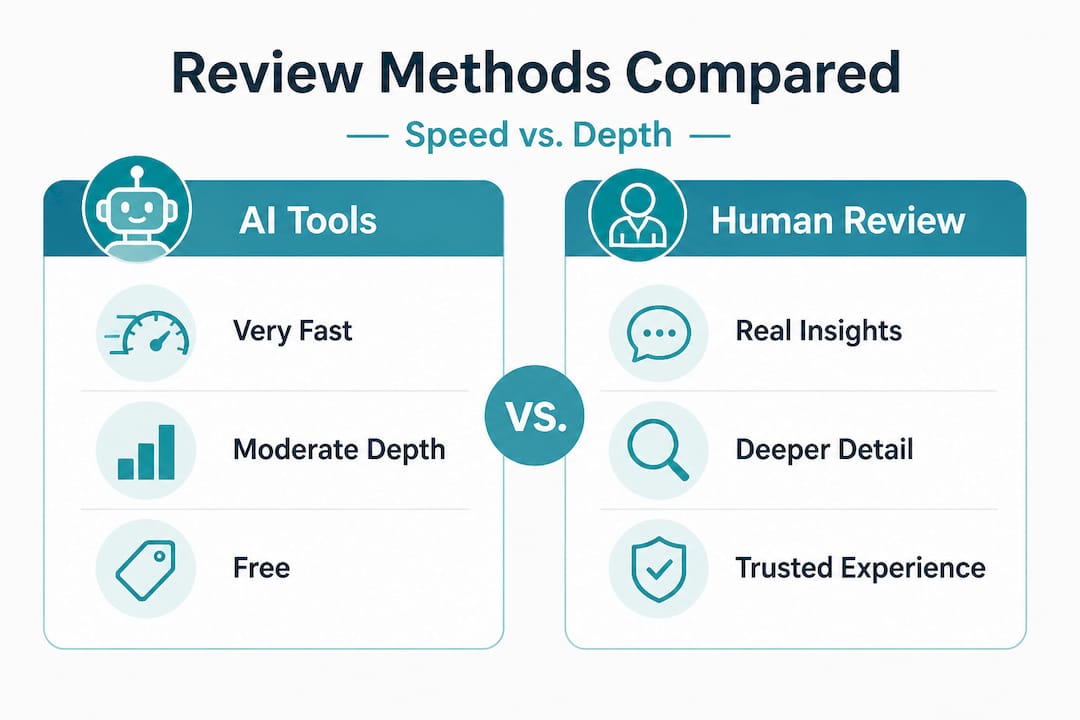
The smartest approach combines methods. Use AI tips for travel planning to build your initial framework quickly, take it to a forum or community for reality checks on specifics, and consider a professional service if the stakes are high or the route is complicated. Knowing the types of trip planners available helps you match your needs to the right tool at the right stage.
A hybrid model is almost always optimal. No single source gets everything right, but each fills gaps the others leave open.
How to get and apply travel itinerary reviews
Knowing a review helps is one thing. Actually doing it efficiently is another. Here's a practical process for getting the most out of any itinerary review:
- Write out your full itinerary first. Include day-by-day activities, estimated times, transit methods, and any bookings already made. Vague plans get vague feedback.
- Choose your review source based on trip complexity. A weekend in New York City? A forum works fine. A 14-day multi-city trip through Southeast Asia with connecting flights? Get a professional review.
- Submit with specific questions. Don't just ask "Does this look good?" Ask targeted questions: "Is Tuesday's schedule too full?" or "Is this routing logical?" Forum users flag mistakes and suggest one major activity per day with buffers, but they need enough context to give useful advice.
- Prioritize feedback based on your travel style. If you're a slow traveler who values depth over breadth, prioritize pacing notes. If you're efficiency-focused, focus on routing and transit feedback first.
- Test your revised itinerary using a planning tool. Map out the route visually. Check that the revised version actually flows before you commit.
- Book in the right order. Lock in the hard-to-change elements first, like flights and major tours, then fill in flexible activities around them.
Pro Tip: When submitting for review, ask reviewers to specifically identify your bottlenecks. Something like "Where are the points most likely to fall apart?" gets you actionable answers faster than open-ended requests. This is especially useful when you're working with forum reviewers who may not have time to read every line.
Once you receive feedback, resist the urge to defend your original plan. The whole point is to stress-test it. Changes that feel like losses on paper often result in far better days on the ground. You can customize trips efficiently without losing the personal vision that made you excited about the trip in the first place. For deeper guidance, an expert guide to travel planning walks through how to systematically build and refine a trip plan from scratch.
What most people miss about itinerary reviews
Here's something most travel advice gets wrong: itinerary reviews aren't just for big, elaborate trips. People tend to seek reviews when they're flying to Japan for two weeks or road-tripping through Europe. But some of the highest-impact reviews we've seen involve three-day weekend getaways, the trips where every hour genuinely counts and there's no recovery day if things go sideways.
The second thing people miss is that the biggest value of a review isn't error correction. It's permission. Permission to slow down, to spend an entire morning in one neighborhood, to skip the fourth "must-see" sight because the first three were already extraordinary. When a reviewer validates that a lighter schedule is actually better, travelers give themselves space to experience the destination instead of just moving through it.
There's a real tendency among motivated travelers to confuse activity density with quality. Checking off 12 attractions doesn't mean you experienced any of them fully. A great review challenges that mindset directly. It asks you to think about the emotional arc of your trip, not just the logistical sequence. What do you want to feel on day one versus day five? Where should the peak experience fall? These are the questions that separate a memorable trip from one you're glad is over.
The most valuable reviews, in our experience, are the ones that dare to question your priorities. Not just "this route is inefficient" but "why are you going here at all if this other place is what you actually care about?" That level of honesty is rare, but it's the kind that turns good trips into great ones.
Personalized trip plans reflect this philosophy. Customization isn't about loading more options. It's about building a trip that fits who you are as a traveler, and a good review is how you get there.
Try DestList for smarter, stress-free itinerary reviews
You've seen how much a well-executed review can change the outcome of a trip. The challenge for most busy professionals and vacationers isn't knowing reviews are valuable, it's finding the time and the right source to actually get one done.

DestList combines AI speed with genuine human expertise to give you the kind of itinerary review that produces results, not just suggestions. The platform's done-for-you travel planning service takes your preferences, budget, and travel dates and returns a fully reviewed, ready-to-book itinerary within 24 hours. No forum waiting. No generic AI outputs. If you're ready to stop guessing and start traveling with a plan you can trust, explore DestList's custom itinerary service and see how fast stress-free planning can actually be.
Frequently asked questions
What common mistakes do itinerary reviews catch?
They often catch overpacked days, poor routing, and unrealistic timelines. Reviews flag issues like backtracking and overpacking, such as scheduling three museums in a single day, and then recommend smarter pacing.
Do itinerary reviews help spontaneous travelers?
Yes. Reviews actually protect spontaneity by building buffer slots into your day, so you can follow an unexpected opportunity without throwing off everything else.
Are forum reviews or professional services better for trip planning?
Forum reviews work well for general crowdsourced feedback, while professional services are better for complex or high-stakes routes. Experts handle nuanced details that forums often miss, like ferry schedules and multi-destination logistics.
Do online reviews actually motivate people to travel?
Yes. Online travel reviews influence travel decisions by engaging readers on intellectual and emotional levels simultaneously, which affects both planning choices and destination selection.
How can I get my itinerary reviewed?
You can post on travel forums like Reddit or the Rick Steves community, run it through an AI tool for a quick logic check, or use a professional travel planning service for a thorough, personalized review.
Recommended
- Itinerary planning workflow: save 10+ hours per trip
- Save time and enjoy more with customized travel itineraries
- Why trip planning matters: save time, stress, and money
- Step-by-Step Trip Planning: Save Time & Travel Smarter
- Blog Posts - Morocco Tours
- Top 8 Alternativas a Intravel.net en 2026 para Viajeros Audaces - Desi Galli