
TL;DR:
- A structured itinerary workflow can save busy travelers over 10 hours of planning time.
- Effective plans include buffers, adaptable segments, and backup options to handle delays or disruptions.
- Prioritizing presence over perfection enhances travel enjoyment, making flexibility and spontaneity key.
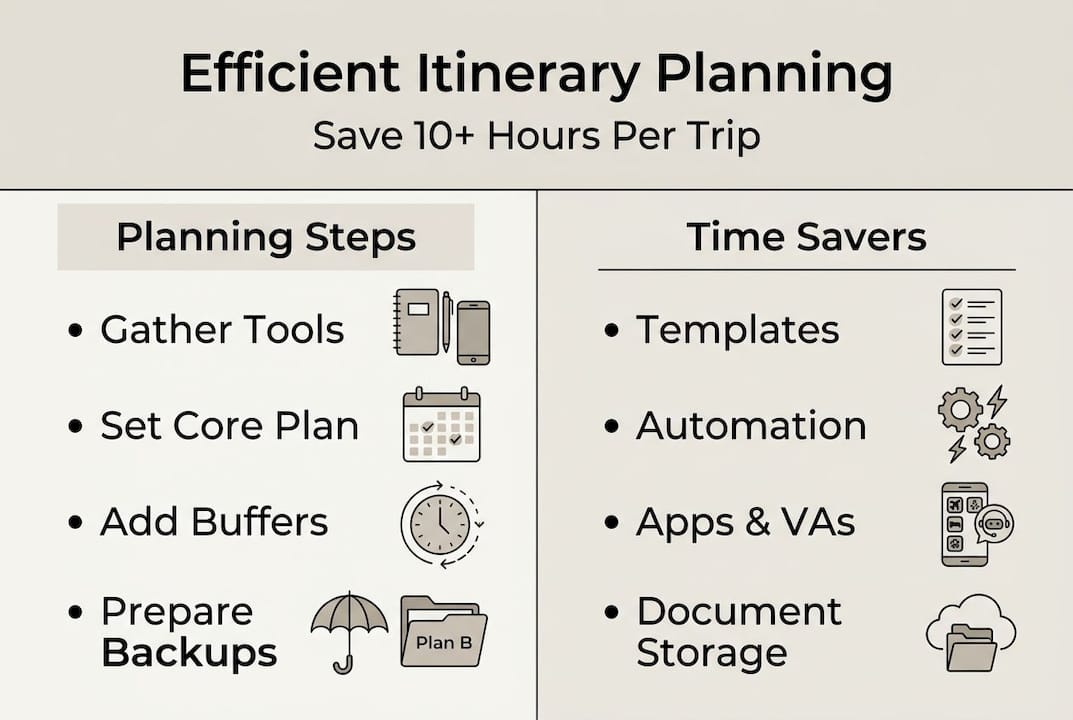
Planning a vacation should feel exciting, not like a second job. Yet the average traveler spends 16 hours researching and organizing a single trip, bouncing between countless tabs, apps, and booking sites. For busy professionals, that kind of time drain is simply not realistic. The good news is that a structured itinerary planning workflow can cut that effort dramatically, saving you 10 or more hours both in prep and on the ground. This guide walks you through every stage of that process, from gathering your tools to building a resilient, adaptable plan you can actually enjoy.
Table of Contents
- What you need before you start: Essential tools and information
- Step-by-step itinerary planning workflow for busy travelers
- Building adaptable, stress-free itineraries: Buffers, Plan B's, and avoiding overplanning
- Managing essential travel documents, contacts, and backup plans
- What most guides ignore: Perfection is the enemy of great travel
- Ready to make itinerary planning effortless?
- Frequently asked questions
Key Takeaways
| Point | Details |
|---|---|
| Preparation streamlines results | Gathering your tools and data first saves hours down the road. |
| Hybrid planning works best | Combining structured must-dos with flexible free time results in efficient and enjoyable travel. |
| Buffers and contingencies reduce stress | Always build in transit time and Plan B’s for a smoother trip. |
| Organize documents digitally | Keeping information handy and secure is critical for any busy traveler. |
What you need before you start: Essential tools and information
Efficient planning starts before you open a single booking site. Think of this phase as loading your toolbox. When everything you need is in one place, the actual planning moves fast.
Here is what to gather before you begin:
- Destination and travel dates (including flexibility windows if you have them)
- Budget range for flights, hotels, and daily spending
- Must-do activities and any non-negotiable experiences
- Traveler details such as passport expiration, loyalty program numbers, and dietary needs
- Preferred tools for organizing, whether that is a notes app, a spreadsheet, or a dedicated platform
Once you have that information collected, you need somewhere to put it. The table below compares three common approaches:
| Tool type | Best for | Time investment | Flexibility |
|---|---|---|---|
| Spreadsheet | DIY planners who want control | High | Medium |
| Travel app | On-the-go access and reminders | Medium | High |
| Virtual assistant or platform | Professionals with limited time | Low | High |
Virtual assistants, for example, can handle the full planning cycle, including researching options, comparing routes and pricing, building day-by-day schedules with buffers, mapping logistics, and organizing documents. That is a significant lift off your plate.
For a deeper look at how to set yourself up for success, the expert planning guide from DestList covers the full preparation phase in detail. You can also explore best trip planners to find the right fit for your style.
Pro Tip: Pre-built itinerary templates can shave hours off your planning time. Search for destination-specific templates or use a platform that generates a draft automatically based on your preferences.
Step-by-step itinerary planning workflow for busy travelers
With your tools in place, it is time to dive into the actual planning process. A clear sequence prevents the common trap of jumping between tasks and losing momentum.
Follow these six steps:
- Set your anchors. Identify 1-2 fixed commitments per day, such as a restaurant reservation or a guided tour. These become the backbone of each day.
- List your must-dos. Write out every activity or experience you want to include, then rank them by priority. Cut anything that does not make the top tier.
- Allocate transit buffers. Add 30 to 50% extra time around any transportation or transfers. Delays happen, and buffer time prevents a cascade of missed plans.
- Draft your core days. Assign anchors and top-priority activities to specific days, grouping activities by location to minimize unnecessary travel.
- Add contact details and logistics. Record hotel addresses, phone numbers, confirmation codes, and local emergency contacts directly in your itinerary document.
- Review for flow. Read through the full plan and check for back-to-back activities with no breathing room. Adjust until the pace feels natural.
Hybrid planning, which combines a structured core with intentional free time, is widely recognized as the most effective approach because it balances efficiency with spontaneity. You get the security of a plan without feeling trapped by it.
| Planning method | Time to build | Adaptability | Stress level |
|---|---|---|---|
| Fully manual | 10-16 hours | Low | High |
| Virtual assistant | 2-4 hours | Medium | Low |
| AI-powered platform | Under 1 hour | High | Very low |
For professionals who want to save 10+ hours planning, the platform-based approach consistently delivers the best results. You can also look into itinerary automation tools that handle the repetitive steps automatically.

Pro Tip: Reserve 30 to 40% of your daily schedule as open time. This is not wasted space. It is your buffer against delays, unexpected discoveries, and the mental fatigue that comes from a packed agenda.
Building adaptable, stress-free itineraries: Buffers, Plan B's, and avoiding overplanning
Once you have laid out your plan, perfecting it means making it adaptable. A beautiful itinerary that falls apart at the first delay is not a good itinerary.
The optimal structure for any travel day includes 1 to 2 anchor activities, 30 to 40% free time, and a Plan B that is often better than Plan A. That last point surprises most people, but it is true. When you are forced to pivot, you often stumble onto something far more memorable than what you originally planned.
A word of caution: The "death march" itinerary, where every hour is scheduled and every minute is accounted for, is one of the most common travel mistakes. It turns a vacation into a logistics operation and leaves you more exhausted than when you left.
Here are quick Plan B ideas for common travel hiccups:
- Attraction is closed or sold out: Identify one backup per anchor activity before you leave home
- Weather disruption: Keep a short list of indoor alternatives for each destination
- Flight delay or cancellation: Know the next available flight and have your airline app ready
- Restaurant fully booked: Research two nearby alternatives in advance and save them offline
- Transportation breakdown: Note local taxi or rideshare options and keep cash on hand
For stress-free planning tips that go beyond the basics, DestList's blog covers real-world scenarios that most generic guides skip entirely. The goal is a plan that holds up under pressure, not one that only works when everything goes perfectly.
Managing essential travel documents, contacts, and backup plans
Planning is only effective if you can access your key details when you need them. A well-organized document system is what separates a smooth trip from a stressful one.
A complete travel itinerary should include all of the following:
- Flight details: Confirmation numbers, terminal info, and check-in times
- Hotel confirmations: Address, phone number, check-in and check-out times
- Meeting or activity addresses with local contact names and phone numbers
- Time zone notes for international travel or multi-city trips
- Transit buffers of 30 to 50% around every transfer
- Emergency contacts: Local embassy, travel insurance hotline, and a trusted contact at home
- Contingency plans for your top three activities
These itinerary must-haves are especially critical for business travel, where missing a meeting address or contact number can have real professional consequences.
For storage, use a combination of cloud backup (Google Drive or Dropbox) and an offline copy saved to your phone. Never rely on a single access point. Email yourself a copy as a third backup.
Privacy matters too. Avoid sharing full itinerary documents in unsecured channels. Use password-protected files or a trusted travel app with encryption when sharing sensitive booking details.
For a full breakdown of how document organization reduces anxiety on the road, the itinerary stress reduction guide covers both the practical and psychological benefits of being prepared.
What most guides ignore: Perfection is the enemy of great travel
You have seen the step-by-step process. Here is a perspective you will not find in most planning guides.
Most travel content focuses on maximizing every minute of your trip. More activities, tighter schedules, better optimization. But that mindset is exactly what burns out busy professionals who finally get a few days off. The irony is that the harder you work to plan the perfect trip, the less present you are when you are actually on it.
Experienced travelers know this: the moments that stick with you are almost never the ones you planned. They are the side street you wandered down, the local you ended up talking to for an hour, the restaurant you found because your first choice was full. A rigid itinerary crowds those moments out.
Our take, shaped by working with travelers across dozens of destinations, is that the best itinerary is one you are willing to abandon. Build your anchors, protect your buffers, and then let go. For professionals juggling multi-trip planning approaches across a busy year, this mindset shift alone changes the quality of every trip.
Prioritize feeling present over staying on schedule. That is the real workflow upgrade.
Ready to make itinerary planning effortless?
If building a structured, adaptable itinerary still sounds like more work than you want to take on, that is exactly what DestList is built for. The workflow in this guide works well when you have time to follow it. When you do not, you need a better option.

DestList combines AI-powered planning with human expertise to deliver a custom travel itinerary tailored to your preferences, budget, and schedule, ready within 24 hours. If you want the full experience handled for you, the done-for-you planning service covers everything from flights to day-by-day activities. Start exploring your options at the DestList travel planner and see how fast a great trip comes together.
Frequently asked questions
How much time can an efficient itinerary planning workflow really save?
A well-organized workflow can save you 10 or more hours during your trip compared to traditional planning, by reducing time spent searching, reorganizing, and recovering from disruptions on the ground.
What is the best way to keep my travel plans flexible but structured?
Use a hybrid planning approach by anchoring 1 to 2 fixed activities per day and leaving 30 to 40% of your schedule open for spontaneous experiences or unexpected changes.
Do I need a virtual assistant or travel agent to streamline my itinerary?
Not always. While a VA handles the full cycle including research, routing, and document organization, many digital tools and AI-powered platforms let you automate and centralize the process yourself.
What are the must-have items for any travel itinerary?
Every itinerary should include detailed flights and hotels, local addresses and contact numbers, time zone notes, transit buffers, emergency contacts, and at least one contingency plan per major activity.