
TL;DR:
- Day-by-day trip planning creates a structured schedule that assigns specific destinations, activities, and logistics to each day, ensuring logistical clarity and stress reduction. It involves balancing fixed anchors, preferred activities, and backup options, leaving roughly 40% of each day open for spontaneous experiences. Using tools like Google Docs, Wanderlog, or Tripadvisor Trips, travelers can organize and adapt their itineraries for multi-city trips, prioritizing flexible planning and geographic clustering.
Day-by-day trip planning is a structured travel framework that defines each day's destinations, timing, accommodations, and activities so you always know exactly where you need to be and when. Unlike a loose list of places to visit, a proper daily travel itinerary assigns every element of your trip to a specific date, from your morning museum visit to your evening restaurant reservation. Tools like Google Docs, Wanderlog, and Tripadvisor Trips are the most common formats travelers use to build and share these plans. This article breaks down what goes into a solid day-by-day itinerary, how to organize one for complex trips, and how to keep it flexible enough to actually enjoy.
What is day-by-day trip planning?
Day-by-day trip planning is the practice of building a structured daily schedule that covers destinations, transport, accommodation, and activities for every single day of a trip. The industry term for the output is a travel itinerary, and the day-by-day format is simply the most detailed version of one. It includes flight and transport details, accommodation booking confirmations, the order of daily activities, restaurant reservations, and key contact numbers for each stop.

The core purpose is logistical clarity. When you know your Day 3 starts with a 9am cooking class in Chiang Mai and ends at a specific guesthouse, you stop making decisions under pressure. That mental load reduction is the real value of the format, not just having a pretty document to look at.
Named entities matter here. Wanderlog, Tripadvisor Trips, and Google Docs each serve different planning styles. Wanderlog maps your route automatically. Google Docs gives you total formatting control and offline access. Tripadvisor Trips pulls in reviews alongside your schedule. The right tool depends on how much structure you want before you leave home.
What are the essential components of a day-by-day itinerary?
A well-structured itinerary breaks each day into three time blocks: morning (roughly 8am to 1pm), afternoon, and evening. Each block serves a different planning purpose. Morning blocks hold your fixed anchor activities, the ones with tickets, reservations, or strict opening hours. Afternoon blocks carry preferred activities with some flexibility. Evening blocks work best as loosely planned, since energy levels and mood shift unpredictably after a full day.
Every day entry should contain the following elements:
- Day number and date so you never confuse Day 4 in Rome with Day 4 in Florence
- Accommodation details including check-in time, address, and confirmation number
- Anchor activity with approximate start time and booking reference
- Afternoon options listed as two or three alternatives, not a rigid schedule
- Dinner plan with a restaurant name and a backup option nearby
- Logistics note covering transport between locations, estimated travel time, and any tickets needed
Pro Tip: Build in roughly 25% extra time on every transit estimate. A train listed as 40 minutes often takes 50 once you account for platform changes and walking to the exit.
The logistics note is the component most travelers skip and later regret. Knowing that the Vatican Museums are a 20-minute walk from your hotel in Prati is the kind of detail that prevents a frantic morning cab ride.
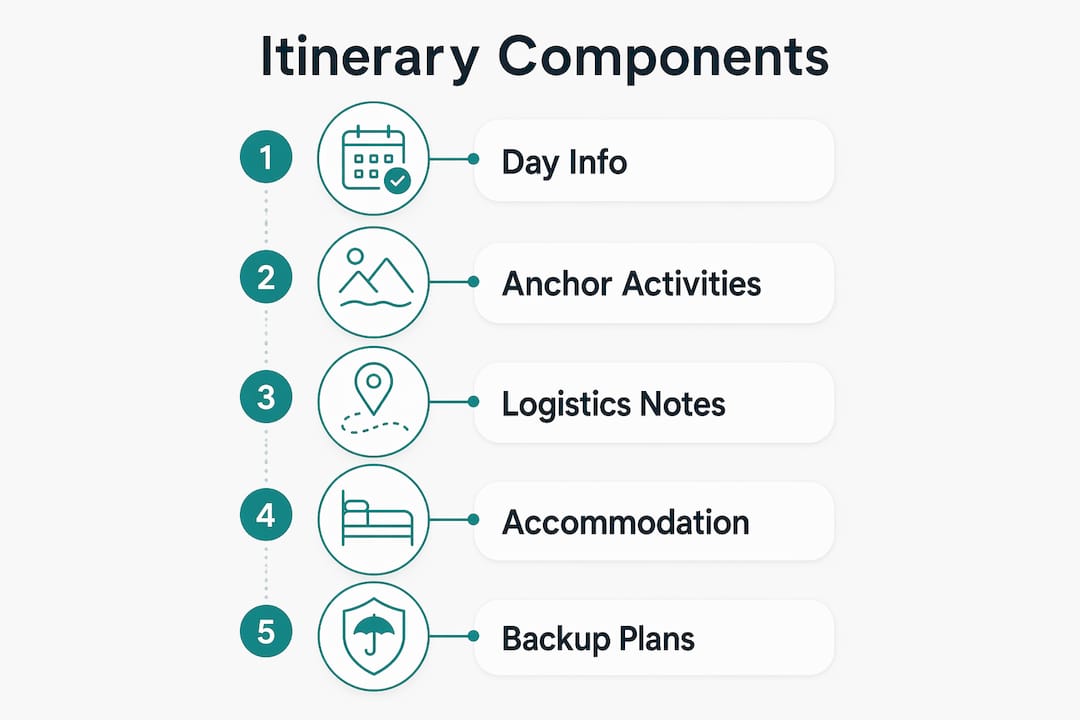
| Component | Purpose |
|---|---|
| Day number and date | Prevents scheduling confusion across multi-day trips |
| Accommodation details | Confirms where you sleep and when you can check in |
| Anchor activity | Fixes the non-negotiable commitment for the day |
| Afternoon options | Maintains flexibility without leaving the day unplanned |
| Logistics note | Covers transport connections and timing between locations |
How to balance detailed planning with flexibility in daily travel itineraries
The most common mistake in step-by-step trip planning is treating the itinerary as a minute-by-minute script. Good day-by-day planning intentionally leaves about 40% of each day open for rest, spontaneous exploration, or simply sitting in a piazza with an espresso. That open space is not wasted time. It is the part of the trip you will actually remember.
A tiered itinerary structure solves the tension between planning and flexibility. It works like this:
- Confirmed anchors. These are fixed commitments: flights, hotel check-ins, pre-paid tours, and timed entry tickets. They cannot move without financial or logistical consequences.
- Preferred activities. These are the things you genuinely want to do but have not booked. They go on the plan as intentions, not obligations. If the Uffizi queue is two hours long on Day 2, you push it to Day 4.
- Backup options. Every day should have one or two alternatives ready for when weather, fatigue, or a closed attraction derails the preferred plan. A nearby neighborhood walk, a café you wanted to try, or a museum with no wait time all qualify.
This three-tier approach means disruptions do not collapse your entire trip. Missing buffers and fallback plans are the single biggest reason day-by-day plans fail when real travel conditions hit.
Pro Tip: Plan your most physically demanding activities for mornings when energy is highest. Leave afternoons for lower-effort options like markets, cafés, or scenic walks. Your body will thank you by Day 5.
Over-scheduling is a specific trap for first-time visitors to cities like Paris, Tokyo, or New York. Travelers who try to hit six attractions in a single day often end up rushing through all of them and enjoying none. Two or three well-chosen experiences per day, with breathing room between them, consistently produce better trips than packed schedules.
How to organize a day-by-day itinerary for multi-city trips
Multi-city trips require a sequencing discipline that single-destination trips do not. The rule is simple: lock lodging and transport first, then assign one main anchor activity per full day, then fill in supporting options around it. Skipping that sequence and planning activities before confirming where you sleep on each night is how travelers end up with a beautiful Day 3 plan in Barcelona and no hotel room.
Counting usable days accurately is equally critical. A flight landing at 4pm means Day 1 is a partial day: airport arrival, transfer, check-in, and maybe a nearby dinner. That is the full realistic agenda. Treating it as a full sightseeing day creates immediate stress and a bad first impression of the destination.
Clustering activities by geography is the other organizing principle that separates good multi-city itineraries from exhausting ones. Grouping activities by neighborhood reduces transit time, cuts fatigue, and keeps the day's flow logical. If your anchor activity is the Sagrada Família in the Eixample district, your afternoon options should be other Eixample or Gràcia attractions, not something across the city in Barceloneta.
- Lock accommodation and transport for every night before planning any activities
- Assign one anchor activity per full day based on location and realistic energy levels
- Cluster all supporting activities within the same neighborhood or accessible area
- Write a logistics note for every travel day covering departure times, transit duration, and arrival logistics
- Treat arrival and departure days as partial days with limited activity capacity
A practical table helps when managing three or more cities:
| Day type | Planning priority |
|---|---|
| Arrival day | Transfer, check-in, light neighborhood dinner only |
| Full day | One anchor, two preferred options, one backup |
| Travel day | Departure logistics, arrival transfer, no major activities |
| Departure day | Morning activity only if checkout and transport allow |
Tools and methods for creating effective travel itineraries
The most practical tools for building a day-to-day travel guide are Google Docs, Wanderlog, and Tripadvisor Trips. Google Docs wins for travelers who want a fully customizable, shareable document that works offline. Wanderlog adds automatic map routing and collaboration features that work well for group trips. Tripadvisor Trips integrates directly with reviews and booking links, which speeds up research.
The choice of tool matters less than the workflow behind it. A reliable method for organizing trip itineraries follows this sequence: confirm transport and accommodation first, then place anchors on specific dates, then add preferred and backup options around them. Trying to plan activities before confirming logistics produces itineraries that look complete but fall apart on Day 1.
- Use Google Docs for offline access and easy sharing with travel companions
- Use Wanderlog for automatic route mapping and real-time collaboration
- Use Tripadvisor Trips when you want reviews and booking links in the same place
- Share the final itinerary with everyone traveling, including emergency contacts at home
- Keep a printed or downloaded copy for destinations with unreliable internet access
Pro Tip: Add a single "logistics master" tab or page to your itinerary document. List every confirmation number, address, and contact in one place. When something goes wrong at 11pm in a foreign city, you will not be searching through emails.
Updating the itinerary during the trip is just as important as building it beforehand. When a preferred activity gets skipped or a new discovery gets added, note it in the document. This keeps the plan accurate for the remaining days and gives you a useful record of the trip afterward.
Key takeaways
A day-by-day travel itinerary works best as a tiered framework with fixed anchors, preferred activities, and backup options, leaving roughly 40% of each day open for flexibility.
| Point | Details |
|---|---|
| Define anchors first | Lock flights, hotels, and pre-paid activities before planning anything else. |
| Use the three-tier structure | Separate confirmed, preferred, and backup activities to handle disruptions without stress. |
| Leave 40% of each day open | Unscheduled time absorbs delays and creates space for spontaneous experiences. |
| Cluster activities geographically | Group each day's options by neighborhood to cut transit time and reduce fatigue. |
| Count partial days accurately | Arrival and departure days have limited capacity. Plan them accordingly. |
Why over-planning is the real enemy of a good trip
I have reviewed hundreds of itineraries over the years, and the ones that fail share one pattern: they treat every hour as a slot to fill. The traveler who books a 9am museum, a 12pm food tour, a 3pm cooking class, and a 7pm rooftop dinner on Day 1 is not well-prepared. They are setting themselves up for a miserable first day and a trip that feels like a second job.
The counterintuitive truth is that the best travel experiences come from the gaps. The afternoon you wandered into a neighborhood market because the original plan fell through. The conversation with a local that turned into a two-hour lunch. None of that happens when every minute is spoken for.
My honest recommendation is to resist the urge to use every feature in Wanderlog or every column in your Google Doc. A stress-free trip plan is not the one with the most detail. It is the one with the right detail. Fix what cannot change, sketch what you hope to do, and leave the rest open. That structure gives you confidence without turning your vacation into a logistics exercise.
The travelers who come back saying "it was perfect" almost never had a perfect itinerary. They had a solid framework and the judgment to abandon it when something better appeared.
— Helen
Let Destlist build your day-by-day itinerary for you
Planning a trip day by day takes real time, especially when you are juggling flights, hotels, and activity logistics across multiple cities. Destlist removes that burden entirely.
Destlist combines AI and travel expertise to deliver custom travel itineraries built around your preferences, budget, and travel style. Every plan includes day-by-day activities with mapped routes, estimated walking times, flight and hotel matches, and weather alerts. Ready-to-book trips arrive within 24 hours. Whether you are planning 7 days in Bali or a multi-city trip across Southeast Asia, Destlist handles the structure so you can focus on the experience.
FAQ
What is a day-by-day itinerary?
A day-by-day itinerary is a structured travel plan that assigns specific destinations, activities, accommodations, and transport details to each individual day of a trip. It serves as the operational framework for the entire journey.
How much of each day should I plan in advance?
Plan roughly 60% of each day with confirmed or preferred activities, and leave the remaining 40% open. That open time absorbs delays, rest needs, and spontaneous discoveries without derailing the overall trip.
What should every day entry in a travel itinerary include?
Each day entry should include the date, accommodation details, one anchor activity with timing, afternoon options, a dinner plan, and a logistics note covering transport between locations.
What tools work best for building a travel itinerary?
Google Docs, Wanderlog, and Tripadvisor Trips are the most widely used tools. Google Docs works best for offline access and full customization. Wanderlog adds automatic route mapping. Tripadvisor Trips integrates reviews and booking links directly.
How do I plan a multi-city trip day by day?
Lock accommodation and transport for every night first, then assign one anchor activity per full day, then cluster supporting activities by neighborhood. Treat arrival and departure days as partial days with limited activity capacity.