
TL;DR:
- Most travelers prefer meaningful experiences over luxury amenities, signaling a shift toward experiential travel. Designing trips around active participation and local immersion creates deeper memories and higher satisfaction, especially in limited timeframes. Proper planning prioritizes purpose, allows buffer, and may involve advisors, resulting in more authentic and enjoyable Journeys.
Most travelers assume a packed itinerary equals a successful vacation. But 78% of travelers prefer meaningful experiences over luxury amenities, which signals a major shift in how people think about getting the most from their time away. Experiential travel planning flips the traditional approach on its head. Instead of racing through a checklist of famous sights, it asks a different question: How do you want to feel, and what do you want to walk away remembering? This guide breaks down what experiential travel planning actually means, why it consistently produces better trips, and how you can apply it even when your schedule is tight.
Table of Contents
- Defining experiential travel planning
- Why experiences matter more than ever
- A practical framework for time-constrained travelers
- Tools, logistics, and advisor insights
- A better trip: Why less might actually be more
- Ready to make your next trip truly unforgettable?
- Frequently asked questions
Key Takeaways
| Point | Details |
|---|---|
| Focus on doing, not just seeing | Experiential travel planning centers your trip around meaningful activities, not simply ticking off landmarks. |
| Choose key anchors early | Select your top one or two must-do experiences before building the rest of your itinerary. |
| Leave room for spontaneity | Balance your schedule with buffer time to enjoy unexpected moments and reduce stress. |
| Efficiency tools save time | Itinerary platforms and travel advisors help streamline logistics for a smoother, richer trip. |
Defining experiential travel planning
Traditional trip planning is easy to recognize. You search for the top ten things to do in a city, book them all, and spend your days rushing between stops with barely enough time to absorb where you are. Experiential travel planning is something fundamentally different.
Experiential travel planning is designing a trip around meaningful, hands-on experiences, focusing on active participation and local immersion rather than optimizing mainly for sightseeing. Think learning to make pasta from a home cook in Bologna, joining a traditional tea ceremony in Kyoto, or helping a family harvest olives in rural Greece. The activity itself is not the goal. The connection, the story, and the feeling you take home are what matter.
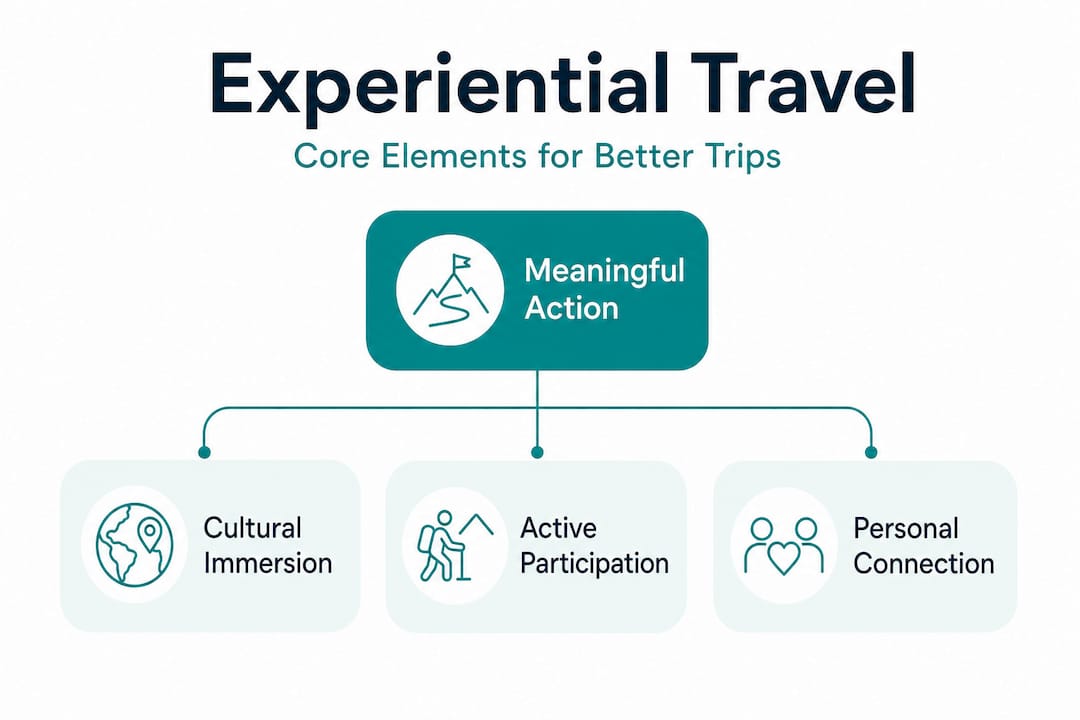
It is worth noting that experiential travel overlaps with but differs from labels like "experiential tourism" and "transformative travel." Experiential tourism is a marketing term used loosely across the industry. Transformative travel goes a step further, focusing specifically on personal growth and life change. Experiential travel planning sits comfortably in the middle: it prioritizes depth and engagement without requiring a life-altering journey.
One of the biggest sources of confusion in the marketplace is that nearly every tour operator or booking platform now uses the word "experience" to describe anything from a walking tour to a helicopter ride. Not all of those fit the definition. The real indicator is whether an activity involves genuine participation, local context, and a level of engagement that passive sightseeing simply cannot replicate.
Here are some classic experiential trip types that fit the real definition:
- Cultural immersion trips: Staying with local families, attending community events, or participating in traditional ceremonies
- Culinary journeys: Cooking classes, market tours with a local chef, farm-to-table experiences
- Volunteer travel: Contributing to conservation projects, building programs, or community development
- Skill-based travel: Pottery workshops in Japan, surfing retreats in Portugal, weaving classes in Peru
- Nature immersion: Guided wildlife tracking, foraging trips, or working on an organic farm
"The goal of experiential travel is not to collect passport stamps. It is to collect moments that genuinely change how you see the world and yourself."
If you want to explore the full range of options available, browsing types of travel experiences can help you identify which category best matches your interests. You can also look at real-world experiential trip examples to see how the concept works in practice across different trip styles.
Why experiences matter more than ever
Understanding the definition is one thing. Understanding why this approach produces better results is what convinces travelers to change how they plan.
The data is clear. 65% say experiences directly influence their destination choice, meaning where people decide to travel is increasingly driven by what they can do there, not just what they can see. That is a massive behavioral shift compared to even a decade ago, when iconic landmarks and hotel star ratings were the dominant decision factors.
The reason experiences create more lasting memories comes down to how the brain actually works. Passive observation, standing in front of a famous building and taking a photo, activates a relatively shallow level of engagement. Hands-on participation, especially when it involves learning, social connection, or mild challenge, triggers deeper encoding in memory. You remember what you did far longer than what you saw.

Here is a look at how the numbers break down across key traveler trends:
| Traveler preference | Statistic | What it means for planning |
|---|---|---|
| Experiences over luxury amenities | 78% prefer experiences | Prioritize activities over hotel upgrades |
| Destination choice driven by experience | 65% factor experiences in | Choose destinations with activity depth |
| Millennials willing to spend more on experiences | Growing year on year | Budget allocation is shifting toward doing |
| Post-trip satisfaction tied to immersion | Higher ratings for participatory trips | Active trips outperform passive ones in reviews |
This trend is not limited to one age group or traveler type. Millennials and Gen Z travelers are leading the shift, but data consistently shows that older travelers, including baby boomers, report higher trip satisfaction when at least part of their itinerary involves meaningful participation rather than pure observation.
The destination choice effect is especially important for busy travelers. If 65% of travelers choose where to go based on what they can experience there, it means a well-curated activity list is not just a nice add-on. It is the actual reason you chose that destination. Skipping or rushing through those activities defeats the entire purpose of the trip.
Browsing unique travel experiences is a useful way to start building a list of anchor activities before you ever commit to a destination. And for specific inspiration on how experience-based design translates into real itineraries, exploring types of experiential experiences gives concrete starting points across different trip categories.
A practical framework for time-constrained travelers
Knowing what experiential travel is and why it matters does not automatically solve the challenge most travelers face: limited time. A two-week trip is easy to fill with depth and immersion. A five-day trip requires a much more disciplined approach.
Here is a step-by-step framework designed specifically for busy travelers who want more meaning without more chaos:
- Start with feeling, not logistics. Before you book anything, ask yourself how you want to feel on this trip. Energized? Grounded? Inspired? Creative? That emotional anchor shapes every decision that follows.
- Identify one to two non-negotiable anchor experiences per day. These are the hands-on, immersive activities that are the reason you took the trip. Everything else is secondary.
- Book anchors first, then fill around them. Most travelers do the opposite. They book flights and hotels, then try to squeeze in experiences. Reverse that order entirely.
- Build in buffer time deliberately. A planning framework recommends keeping your schedule 60 to 70% structured with 30 to 40% buffer. This is not wasted time. It is where the best unplanned moments happen.
- Account for transition time realistically. Moving between locations takes longer than Google Maps suggests. Add 25% extra time to every transit estimate for a city you do not know well.
- Protect your energy for the experiences that matter most. Do not schedule your most meaningful anchor on day one after a long-haul flight. Give yourself a landing day.
Pro Tip: Limit yourself to no more than two anchor experiences per day. Three or more and you will spend your trip rushing between activities rather than actually being present for any of them.
Here is a comparison of how the two approaches stack up in practice:
| Planning style | How it works | Typical result |
|---|---|---|
| Checklist-based planning | Fill every hour with sights and activities | Exhausted traveler, shallow memories |
| Experiential-based planning | Anchor around one to two meaningful activities, allow buffer | Rested traveler, vivid and lasting memories |
| Luxury itinerary only | Focus on hotel quality and restaurant reservations | Comfortable trip, limited engagement with place |
| Immersion-first planning | Prioritize doing and connecting over seeing and eating | High satisfaction, strong sense of place |
The example daily template for a well-balanced experiential day looks like this: morning arrival or transit, one anchor experience of two to three hours, a relaxed local lunch with no agenda, free buffer time for wandering or spontaneous discovery, an optional lighter second activity in the late afternoon, and an early evening to recharge. That structure gives you depth without burnout.
If you want to see how top-rated trip planners structure this kind of itinerary, looking at best trip planners gives a useful comparison. For travelers who specifically want someone else to build the experience-first structure for them, stress-free travel curation explains how that process works. And for a look at how customized experience frameworks translate into high-impact group itineraries, the principles apply equally to solo and couple travel.
Tools, logistics, and advisor insights
Having a great framework means nothing if the logistics fall apart. Here is where the execution layer of experiential planning becomes critical.
The biggest logistical traps for experience-focused trips are these:
- Reservation lead times: The best cultural workshops, chef dinners, and local guides book up weeks or months in advance, especially in peak season
- Transport between experiences: Relying on ride-share apps in unfamiliar cities can cost you anchor time if surge pricing or availability becomes a problem
- Document and access management: Some immersive experiences require permits, vaccinations, or local guide licenses that take time to arrange
- Language and communication gaps: Hands-on experiences often involve local hosts who may not speak your language, making pre-trip communication logistics important
Travel advisors and agencies improve efficiency by relying on existing supplier networks and itinerary tools, converting proposals into client-facing apps. That means the best advisors are not just booking flights and hotels. They are stitching together a network of local contacts, pre-negotiated access, and digital tools that a solo planner would spend weeks trying to replicate.
Pro Tip: Use an itinerary app that syncs your documents, tickets, and booking confirmations in one place. Switching between email, PDF attachments, and separate apps during a trip is a small frustration that compounds quickly when you are trying to get somewhere on time.
The decision between DIY planning and working with a travel advisor comes down to two factors: time and complexity. For a straightforward long weekend, DIY is entirely manageable with the right tools. For a multi-destination trip with specific immersive experiences woven throughout, the return on outsourcing is significant.
Understanding when to outsource is a skill in itself. A good overview of done-for-you travel planning explains the situations where handing off the logistics is the smarter move. For a deeper look at which itinerary-building apps handle the complexity of experience-first trips best, comparing options before you commit saves real time. And hospitality logistics best practices from the high-end event world offer surprising lessons that apply to everyday travel planning.
A better trip: Why less might actually be more
Here is the editorial truth that most travel content avoids saying directly: the biggest threat to a great trip is not a bad hotel or a missed flight. It is an over-planned schedule that leaves no room for the trip to actually happen.
We have seen it consistently across hundreds of custom itineraries. Travelers who request the most packed schedules often come back with the least satisfying memories. They visited twelve places. They remember two. And they are too tired to feel good about either one.
Checklist travel is seductive because it feels productive. You can show people a list of things you did. You have photos at all the right landmarks. But somewhere between site number four and site number seven, the actual experience of being in a place evaporates. You are going through motions, not making memories.
The counterintuitive truth is that intentional downtime is not wasted time on a trip. It is the container for the moments you will actually remember. The conversation with a stranger at a neighborhood cafe. The unexpected street market you wandered into. The sunset you caught because you were not rushing to the next reservation.
We changed our own planning approach after seeing this pattern repeat. The travelers who came back with the best stories were almost never the ones who saw the most. They were the ones who went deep on a few things and let the rest unfold. This is the insight behind expert trip curation: it is not about packing in more, it is about choosing better and protecting the space for experiences to breathe.
The most frequent travel regret is not "I wish I had seen more." It is "I wish I had slowed down."
Ready to make your next trip truly unforgettable?
You now have the framework, the data, and the mindset shift to plan a trip built around genuine experience rather than a racing checklist. But knowing the approach and executing it efficiently are two very different challenges, especially when your time is limited.
DestList combines AI-powered planning with real human expertise to build itineraries that put your most meaningful experiences first. Every plan includes curated day-by-day activities with smooth logical flow, budget-matched flights and hotels, weather alerts, and mapped routes with estimated travel times. All of it is delivered within 24 hours, ready to book. If you want a trip designed around what actually matters to you, start with a custom travel itinerary service built for exactly this kind of experience-first planning. Or explore curated destination plans to see what a well-designed, immersive itinerary looks like in practice.
Frequently asked questions
What are examples of experiential travel activities?
Examples of experience types include hands-on cooking classes with locals, cultural rituals, community volunteering, skill-based workshops, and immersive nature adventures that involve genuine participation rather than passive observation.
Is experiential travel only for luxury or long vacations?
No. Experiential travel planning works for short weekend getaways, budget-friendly itineraries, or high-end trips alike. You simply identify and prioritize your must-have experiences first, then build everything else around them.
How do you avoid travel overwhelm when planning experiences?
Limit yourself to one or two anchor activities per day and build in deliberate buffer time. A planning framework recommends keeping 60 to 70% of your schedule structured while leaving 30 to 40% open for spontaneous discovery.
Do I need a travel advisor for experiential trips?
Not necessarily. Travel advisors and agencies can make the process faster and more efficient through supplier networks and digital tools, but with the right framework and apps, confident solo planning is entirely achievable.