
TL;DR:
- Effective trip timeline management involves phased planning, geographic clustering, and building flexible daily plans to maximize enjoyment and reduce stress. Travelers should book flights and accommodations three to six months in advance, then refine daily schedules four to six weeks prior, leaving room for spontaneous exploration during the trip. Using tiered itineraries, validation of AI-generated plans, and tools like spreadsheets helps maintain flexibility and achieve a more satisfying travel experience.
Trip timeline management is the strategic process of sequencing travel bookings and daily plans into phases that maximize convenience, cost-efficiency, and flexibility. Most travelers treat planning as a single event rather than a staged process, which leads to overbooked days, missed savings, and decision fatigue mid-trip. Explaining trip timeline management properly means covering three distinct phases: early commitments, mid-planning, and on-the-ground decisions. Tools like TripIt Pro, resources from MAKJournal, and booking platforms like Google Flights each play a defined role in this process. When you treat your trip timeline as a living structure rather than a fixed schedule, you travel better.
What are the essential phases of trip timeline management?
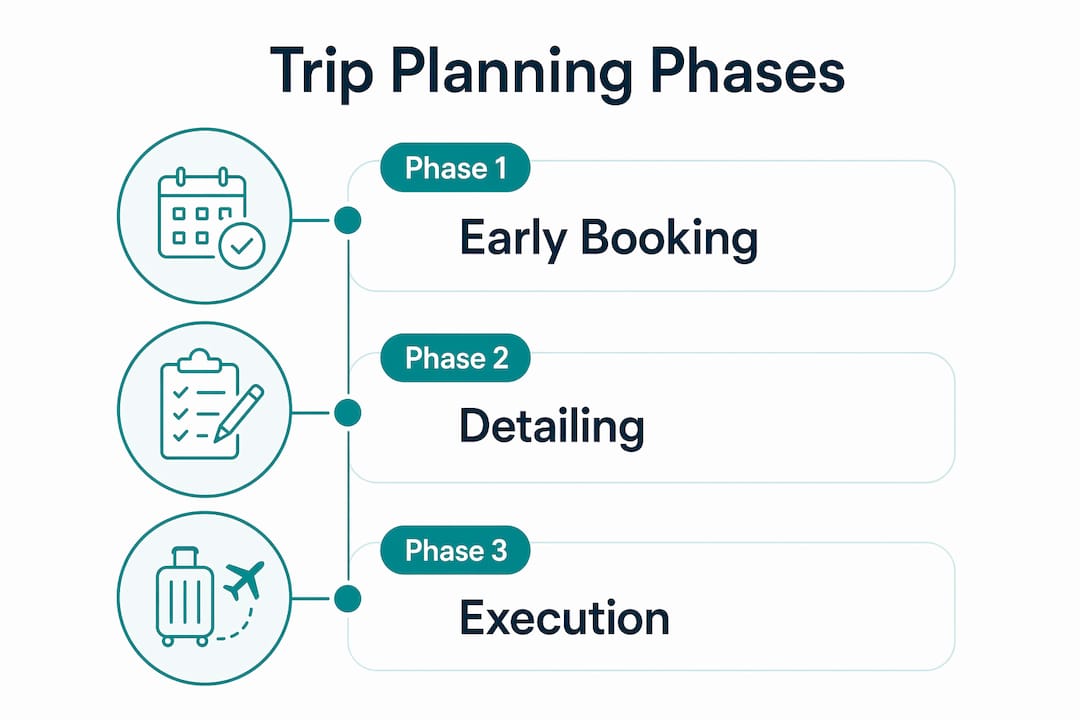
Trip timeline management follows a three-phase structure that prevents the most common planning mistakes: booking too late, scheduling too much, and leaving nothing flexible.

The first phase covers the period three to six months before departure. This is when you lock in flights and key experiences to secure the best availability and pricing. For international travel, this window is non-negotiable. Popular tours in destinations like Kyoto, Machu Picchu, and Cinque Terre sell out months in advance. Booking accommodations in this phase also gives you the widest selection before peak inventory disappears.
The second phase runs four to six weeks before your trip. This is when detailed daily scheduling takes shape, including restaurant reservations, museum timed entries, and local transport bookings. Trying to build a day-by-day schedule at the six-month mark is counterproductive because local event calendars, restaurant openings, and seasonal schedules are not yet confirmed. Waiting until this window gives you accurate, current information.
The third phase happens during the trip itself. Many activities, including neighborhood markets, street food tours, and spontaneous day trips, are best decided on the ground. Leaving these decisions open prevents the "booking paralysis" that comes from trying to pre-plan every hour. It also lets you respond to weather, energy levels, and local recommendations in real time.
| Phase | Timing | Key actions |
|---|---|---|
| Early commitments | 3 to 6 months out | Book flights, accommodations, major experiences |
| Mid-planning | 4 to 6 weeks out | Daily schedules, restaurant reservations, local transport |
| On-the-ground decisions | During the trip | Spontaneous activities, market visits, flexible day trips |
Pro Tip: Set a calendar reminder for the four-week mark before every trip. That is your signal to shift from macro planning to daily scheduling, when local information is most accurate.
How to optimize your daily itinerary by geographic and energy grouping
The single most efficient change you can make to a daily itinerary is geographic clustering. Grouping attractions by neighborhood reduces daily commute time by 30% to 50%, which translates directly into more time at actual destinations. A traveler in Rome who visits the Colosseum, Palatine Hill, and Circus Maximus in one morning loses almost no transit time. The same traveler who pairs the Colosseum with the Vatican in a single day spends a significant portion of that day on buses or taxis.
Beyond geography, daily energy load determines how much you actually enjoy what you planned. The framework that works consistently is this: schedule high-effort activities in the morning when energy peaks, use the early afternoon for lighter experiences like cafes, markets, or scenic walks, and keep evenings flexible for dining and social experiences. Travel fatigue builds quickly after consecutive heavy days, so building in recovery time is not laziness. It is trip management.
The most practical daily structure comes from the "3-activity rule": one anchor activity, one secondary activity, and one optional activity per day. Experts at MAKJournal recommend capping daily priorities at three to prevent burnout and maintain genuine enjoyment. The anchor is your non-negotiable (the Uffizi Gallery, a cooking class, a specific hike). The secondary fills the remaining energy. The optional gets dropped without guilt if the day runs long.
Here is how a well-structured day in Lisbon might look using this framework:
- Anchor: Morning visit to the Jerónimos Monastery in Belém (high effort, timed entry booked in advance)
- Secondary: Afternoon pastéis de nata tasting and walk through the Belém waterfront (light, no booking required)
- Optional: Evening fado show in Alfama (drop if tired, easy to reschedule)
Pro Tip: Build your daily itinerary structure around the anchor first, then fill backward. Never start with a full list and try to cut down. Start with one non-negotiable and add only what genuinely fits.
What booking strategies maximize flexibility and savings?
The booking sequence matters as much as the booking timing. Confirm flights and accommodations first, then schedule tours and activities closer to departure. This order protects your flexibility because activity bookings are far easier to adjust than flights or hotels. Locking in a tour six months out only to find your flight changed by two hours creates unnecessary rebooking stress.
For flights, booking one to six months in advance secures the strongest pricing window for most routes. Price alert tools like Hopper track fare movements and notify you when a target price is reached, removing the need to manually check routes daily. Flexible date searches on Google Flights show fare grids across an entire month, which often reveals savings of $100 to $300 on international routes by shifting departure by one or two days.
Accommodation strategy deserves the same attention. Following a step-by-step booking workflow for stays reduces both cost and last-minute scrambling. Travel rewards programs from Chase Sapphire, American Express, and airline loyalty programs like Delta SkyMiles or United MileagePlus can offset accommodation costs significantly when points are applied strategically.
The most common mistake in trip planning is overplanning every hour. Leaving 20% to 30% of your daily schedule unplanned is not a gap. It is the space where the best travel memories happen. A conversation with a local, a detour through an unexpected market, or simply sitting at a café longer than planned all require unscheduled time.
- Book flights and accommodations in the three-to-six-month window
- Use Hopper or Google Flights fare alerts to track price movements
- Confirm restaurant reservations and timed museum entries four to six weeks out
- Leave activity slots open during the trip for spontaneous decisions
- Apply travel rewards points to hotels before booking at full price
How to maintain itinerary flexibility and manage disruptions on the go
Disruptions are not exceptions in travel. They are built-in features of the experience. The travelers who handle them best operate with a tiered itinerary structure rather than a single rigid plan. Experienced travelers maintain three layers: fixed anchors (pre-paid, non-refundable commitments), preferred activities (planned but adjustable), and backup options (ready to deploy if something falls through).
When a disruption hits, the recovery process follows three steps. First, assess what is actually affected. A delayed flight changes your arrival time, not necessarily your entire itinerary. Second, drop the lowest-priority items from that day's preferred list rather than trying to compress everything into less time. Third, re-anchor around the next fixed commitment and rebuild from there. This approach prevents the cascade of stress that comes from treating every disruption as a full-plan failure.
Real-time monitoring tools reduce the surprise factor significantly. TripIt Pro and FlightAware track delays, gate changes, and connection risks in real time, giving you a window to act before a situation becomes a crisis. Elite travel coordinators use exactly this approach: proactive monitoring with pre-built contingency plans rather than reactive scrambling.
- Build your itinerary in three layers: fixed, preferred, and backup
- Store your itinerary in both a cloud app and a downloaded offline copy
- When disruption hits, assess scope before reacting
- Drop lowest-priority preferred items first to recover time
- Re-anchor around the next fixed commitment and rebuild forward
Pro Tip: Never rely solely on an AI-generated itinerary without validating against live local data. AI drafts must be checked against current museum hours, local holidays, and seasonal closures before you commit to a schedule.
What tools and techniques help with trip timeline management?
The right tool depends on how you plan, not on which app has the most features. AI itinerary planners like Trip Planner AI and Layla.ai generate structured day-by-day plans quickly, factoring in transport times and attraction proximity. AI creates useful drafts, but the output requires validation against real-time local data before it becomes a reliable travel document. Opening hours change, seasonal closures happen, and AI tools do not always reflect current conditions.
Spreadsheets remain the most reliable tool for travelers who want full control. Spreadsheet itinerary management offers offline accessibility and instant customization without sync risks or app dependency. A well-structured Google Sheets or Excel template with tabs for flights, accommodations, daily plans, and budget tracking gives you a single source of truth that works with or without internet access. This matters most in destinations with unreliable connectivity.
The most effective planning workflow starts with trip vision, not logistics. Before opening any booking platform, define your priorities: Are you optimizing for relaxation, cultural depth, adventure, or food? That answer determines your anchor activities, which then shape your geographic clusters, which then determine your daily structure. Jumping straight to flight searches without this foundation produces itineraries that look complete but feel misaligned once you are actually traveling.
- Trip Planner AI / Layla.ai: Fast draft generation, requires local validation
- TripIt Pro: Itinerary consolidation and real-time flight monitoring
- Google Flights: Flexible date fare grids and price tracking
- Hopper: Predictive fare alerts for flights and hotels
- Google Sheets / Excel: Offline-reliable, fully customizable itinerary management
- Destlist: AI-assisted, human-reviewed itinerary building with day-by-day structure
Pro Tip: Use the itinerary planning workflow that starts with vision and priorities before touching any booking tool. Travelers who skip this step consistently report feeling like their trip was busy but not satisfying.
Key takeaways
Effective trip timeline management requires phased planning, geographic clustering, and a tiered itinerary structure that keeps fixed commitments protected while leaving room for spontaneous decisions.
| Point | Details |
|---|---|
| Phase your planning | Book flights and hotels three to six months out; build daily schedules four to six weeks before departure. |
| Cluster geographically | Group attractions by neighborhood to cut daily commute time by 30% to 50%. |
| Apply the 3-activity rule | Limit each day to one anchor, one secondary, and one optional activity to prevent burnout. |
| Use a tiered itinerary | Separate fixed anchors, preferred activities, and backup options to handle disruptions without stress. |
| Validate AI-generated plans | Always check AI itinerary drafts against current local data before committing to a schedule. |
Why most travelers plan too much and enjoy too little
I have reviewed hundreds of travel itineraries, and the pattern is consistent: the more tightly packed the schedule, the more disappointed the traveler. Not because the destinations failed them, but because they never had a moment to actually be somewhere. They were always moving to the next thing on the list.
The phased planning approach changed how I think about trip timelines entirely. Booking flights and key experiences early removes the anxiety of availability. Building the daily structure four to six weeks out, when local information is current, removes the guesswork. And leaving genuine open space during the trip removes the pressure that turns travel into a checklist exercise.
The 3-activity rule sounds restrictive until you try it. On a recent trip to Lisbon, I planned one anchor per day and left the rest loose. I ended up spending three hours in a bookshop I had never heard of, eating the best meal of the trip at a place a stranger recommended, and watching a sunset from a viewpoint that was not in any guide. None of that was on a schedule.
The travelers who get the most from their trips are not the ones with the most detailed itineraries. They are the ones with the most deliberate ones. Keeping a "would love to do" list separate from a "must do" list, as Practical Wanderlust recommends for flexible planning, is one of the most underrated practices in travel. It gives you permission to adapt without feeling like you failed your own plan.
Structure your timeline. Then trust it enough to let it breathe.
— Helen
Plan your next trip with Destlist
Managing a trip timeline well takes time you may not have. Destlist builds that structure for you, combining AI-assisted planning with human travel expertise to produce custom travel itineraries that are ready to book within 24 hours.
Every Destlist plan includes day-by-day activity sequencing, geographic clustering, flight and hotel matching within your budget, and estimated walking times between stops. The phased planning logic described in this article is built directly into how Destlist structures each trip. You get the efficiency of a well-managed timeline without spending hours building it yourself. Whether you are planning a week in Bali or a long weekend in New York, Destlist delivers a trip plan that is organized, flexible, and ready to go.
FAQ
What is trip timeline management?
Trip timeline management is the process of organizing travel bookings and daily activities into sequential phases to optimize cost, flexibility, and experience. It covers everything from early flight bookings to on-the-ground spontaneous decisions.
How far in advance should I book flights and hotels?
Industry standards recommend booking flights three to six months before departure for international travel to secure the best pricing and availability. Hotels in high-demand destinations should be confirmed in the same window.
How many activities should I plan per day?
Travel experts recommend capping each day at three priority activities: one anchor, one secondary, and one optional. This prevents travel fatigue and leaves room for the unplanned moments that often define a trip.
What is the best tool for managing a travel itinerary?
TripIt Pro works well for consolidating bookings and monitoring real-time flight changes. Google Sheets or Excel provides the most flexible and offline-reliable option for building and updating detailed day-by-day plans.
Should I use AI to plan my trip itinerary?
AI tools like Trip Planner AI and Layla.ai generate useful draft itineraries quickly, but AI plans require validation against current local data including museum hours, seasonal closures, and public holidays before you rely on them.