
TL;DR:
- Effective short-trip travel relies on early preparation, strategic planning, and flexible itineraries to maximize enjoyment. Using curated tools like Destlist can significantly reduce planning time and help create personalized, day-by-day plans that center on key experiences. Prioritizing location, packing carry-on only, and managing jet lag through scheduled adjustments ensure travelers arrive energized and ready to explore.
Short trips often leave you exhausted and feeling like you missed out. You crammed too much in, lost hours to transit, fought jet lag on a two-day window, and came home needing a vacation from your vacation. This guide to managing short-term travel fixes that. Whether you have a long weekend in Chicago or four days in Lisbon, the difference between a trip that energizes you and one that drains you comes down to preparation, smart itinerary design, and knowing which rules to bend. Every section below gives you something you can use today.
Table of Contents
- Key takeaways
- Your guide to managing short-term travel: pre-trip prep
- Building a smart itinerary for short trips
- Managing jet lag on short trips
- Travel day tactics that actually save time
- Tools that simplify trip management
- My honest take on short-term travel
- Plan your next short trip with Destlist
- FAQ
Key takeaways
| Point | Details |
|---|---|
| Prepare documents early | Check passport validity and visa needs well before departure to avoid denial at the border. |
| Use the 3-2-1 rule | Plan 3 must-sees, 2 nice-to-haves, and 1 open slot per day to stay flexible without losing focus. |
| Fight jet lag proactively | Start shifting your sleep schedule 2-3 days before you fly to land ready, not wrecked. |
| Pack carry-on only | Staying within standard carry-on dimensions saves money, time, and the risk of lost bags. |
| Use curated planning tools | AI-assisted itinerary services cut prep time dramatically on short trips where every hour counts. |
Your guide to managing short-term travel: pre-trip prep
Before you pack a single shirt, get your paperwork in order. Many countries require passports valid for at least 6 months beyond your travel date. Booking a flight and then discovering your passport expires in four months is the kind of mistake that kills a trip before it starts. Check it now, not the week before you leave.
Packing within carry-on limits
Standard U.S. airline carry-on limits are 22 x 14 x 9 inches, and automated sizers at gates are enforcing this more aggressively than ever. Fees for oversized bags can top $100. For short trips, carry-on only is almost always the right call. You save time at baggage claim, eliminate lost luggage risk, and move faster through airports and transit.
Here is how to make carry-on only work:
- Build a capsule wardrobe. Stick to two or three colors that mix and match. Three bottoms, four tops, one layer. That covers most long weekends.
- Use packing cubes. They compress clothing, keep categories separate, and make unpacking at the hotel take under two minutes.
- Prepare an offline resource kit. Store itinerary PDFs, emergency contacts, and pinned maps in both your phone and a printed backup. Connectivity drops at the worst times.
- Download maps offline before you leave. Pin your hotel, transit hubs, pharmacies, and key spots in advance. Simply downloading the map is not enough if you haven't marked where you're actually going.
Pro Tip: Pack your personal item bag (usually under 18 x 14 x 8 inches) with everything you'll need during the flight and at security: laptop, medications, documents, snacks, and a change of clothes. If your overhead bag gets gate-checked, you lose nothing critical.
The 3-2-1 itinerary rule
Before you even look at flights, use the 3-2-1 planning rule to pressure-test your schedule. Three must-sees per day, two nice-to-haves, and one empty slot. The empty slot is not laziness. It is what saves your trip when the museum line is two hours or you stumble onto a street market worth an afternoon.
Building a smart itinerary for short trips
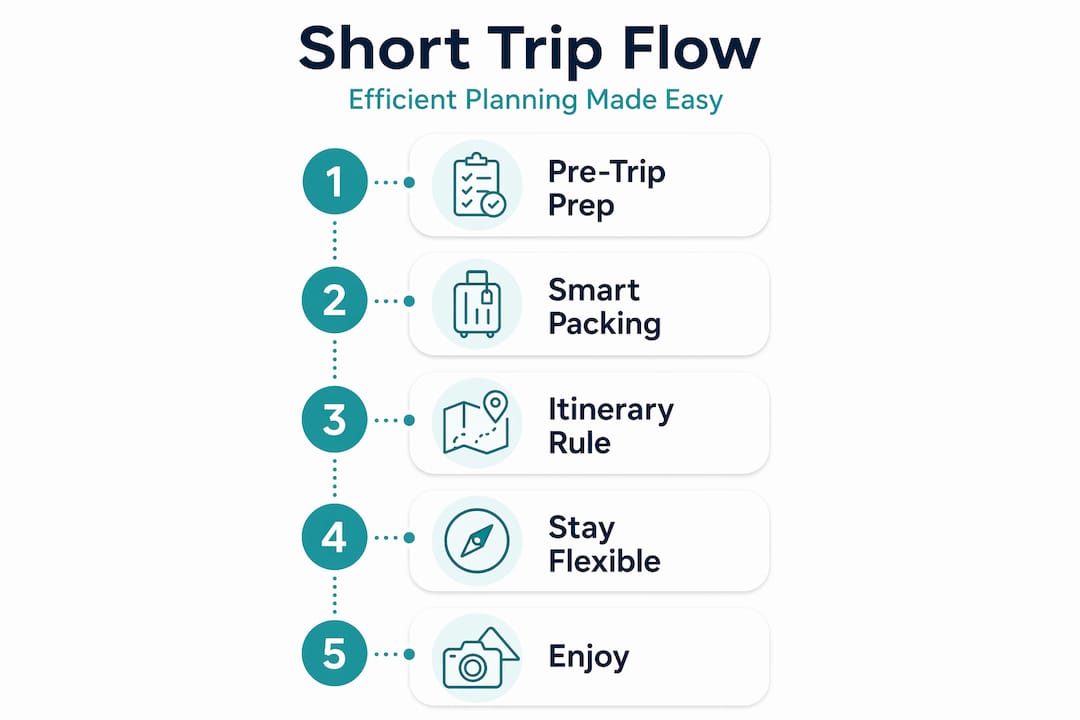
The most common short-term travel mistake is not bad luck. It's ambition. You want to see everything, so you schedule everything, and you end up rushing through all of it without actually experiencing any of it. Short trips benefit from depth over breadth: pick a few signature experiences per day and commit to them fully.

Two or three real activities per day is enough. That's not a limitation. It's a design choice that lets you eat lunch without watching the clock, take a detour when something looks interesting, and end each day feeling satisfied rather than frantic.
Accommodation location matters more than price
Where you stay on a short trip determines how much of it you actually enjoy. A cheaper hotel 40 minutes from the city center costs you 80 minutes of round trips every time you go out, plus transit money and energy. Centrally located accommodations reduce transit burnout and give you back hours you'd otherwise spend in cabs or on the subway.
Here is what a well-structured short-trip day looks like:
- Morning: one major activity (museum, landmark, neighborhood walk)
- Midday: a slow lunch somewhere locals actually eat
- Afternoon: one secondary experience from your nice-to-have list
- Evening: flexible, based on energy and what the city offers
Pro Tip: Book your first-day activities in advance and leave days two and three partially open. You'll know more about what you actually want after arriving than you do sitting at home with a browser tab open.
If you want to cut itinerary-building time significantly, check out these travel planning hacks that work especially well when your window is tight.
Managing jet lag on short trips
Jet lag is the quiet saboteur of short-term travel. Cross three or more time zones on a two-day trip and you can spend both days feeling foggy, craving sleep at noon and wired at midnight. The good news: you can minimize it significantly with the right pre-trip strategy.
Most people cannot shift their biological clock by more than 1 hour per day. That means if you're crossing four time zones, starting your adjustment two to three days before you fly is not optional. It's the only approach that actually works.
Here is the protocol that makes a real difference:
- Shift your sleep gradually. Move bedtime and wake time by one hour per day for two to three days before departure. Go earlier for eastward flights, later for westward.
- Use light exposure strategically. Get morning sunlight after arriving on eastward flights. For westward travel, get afternoon light. Light and routine help reset your clock faster than any supplement.
- Consider low-dose melatonin. Doses of 0.5 to 1 mg taken roughly 90 minutes before your target bedtime are effective for circadian reset without the grogginess of higher doses.
- Avoid long naps on arrival. Short naps of 20 to 30 minutes early in the day are fine. Anything longer pushes your adjustment backward.
- Eat on local time immediately. Meal timing signals your gut clock. Acting like a local on arrival — eating, moving, and getting daylight — resets your body faster than trying to tough it out.
If your trip is 48 hours or less and you're crossing only two time zones, staying on home time can actually be the smarter call. You avoid the adjustment entirely, and you leave before the disruption catches up with you.
Travel day tactics that actually save time
Travel day is where short trips get wrecked before they begin. A two-hour delay at security, a gate-checked bag, a missed connection. None of these are inevitable with the right habits.
Follow this sequence to protect your day:
- Wear your bulkiest items. Heaviest clothing worn on travel day can free up a third of your bag. Your hiking boots, heaviest jacket, and thickest sweater belong on your body, not in your suitcase.
- Pack documents and medications in your personal item, always. If your carry-on gets gate-checked, you still have what matters.
- Know the current TSA rules before you fly. REAL ID enforcement for domestic U.S. travel is now active. Power banks must travel in carry-on, not checked bags. Liquids still follow the 3-1-1 rule. Confirming these before security saves you the embarrassment of pulling everything out at the conveyor.
- Load your bag strategically. Place items you need at security (laptop, liquids bag) at the top or in an external pocket. Pack your hotel essentials at the bottom since you won't need them until you arrive.
- Arrive with buffer time, not just enough time. Short-term travel planning falls apart when one delay cascades into missed connections. Give yourself a real margin, especially at busy hubs.
Pro Tip: If you're flying through a smaller regional airport, look into airport-specific strategies before you go. Smaller airports have their own rhythms, parking quirks, and security flows that can save or cost you time.
Tools that simplify trip management
Planning a short trip manually takes longer than most people expect. You're coordinating flights, accommodations, day-by-day activities, opening hours, transit times, and contingency options. If you're doing that from scratch for a long weekend, you may spend more time planning than you spend on the trip itself.
That's where purpose-built tools and services change the math. Here's what to look for:
- Offline itinerary access. Any planning tool worth using should let you export or save your itinerary as a PDF. Connectivity in transit zones, older buildings, and international destinations is unreliable.
- Day-by-day flow with transit accounted for. A list of activities is not an itinerary. A real plan sequences activities by proximity, includes estimated walking or transit time, and flags potential conflicts.
- Integrated booking support. The best tools don't just plan. They help you move from plan to booked within the same workflow.
- Weather awareness. Short trips have no recovery days. A rain day can reshape your entire schedule. Tools that flag weather ahead of time let you front-load outdoor activities when the forecast is clear.
| Feature | DIY planning | Curated service |
|---|---|---|
| Time investment | 5 to 15 hours | Under 1 hour |
| Local expertise | Limited | Built-in |
| Booking coordination | Manual | Assisted or automatic |
| Offline access | Requires extra steps | Often included |
| Flexibility to adjust | Fully flexible | Depends on platform |
Personalized travel planning tools and curated itineraries measurably reduce travel stress on short trips, where every misaligned hour costs more than it would on a two-week vacation. Destlist, for example, combines AI planning with human editorial review to produce ready-to-book itineraries tailored to your preferences, budget, and travel style. If you want to see how a flexible planning approach changes the experience, it's worth exploring before your next trip.
My honest take on short-term travel
I've taken enough short trips to know what actually separates a good one from a great one. And it's almost never the destination.
What I've learned is that the travelers who get the most from two or three days are the ones who make deliberate decisions before they leave, then stay loose once they arrive. The mistake I made early on was building airtight itineraries and then defending them against reality. A closed museum, a long lunch that turned into two hours of conversation with strangers, an unexpected festival on a side street. Rigid plans treat those moments as problems. They're not. They're the point.
I've also been humbled by jet lag more times than I'd like to admit. I used to think I could power through it. Three espressos and willpower. What actually works is less exciting: adjust your schedule a few days out, get outside in the right light window on arrival, and don't nap for three hours when you feel wrecked at 2 p.m. Simple, boring, effective.
My real advice? Do the prep work honestly, then hold your plans with an open hand. Use tools like Destlist to handle the logistics so your mental energy goes toward actually being present. That's the trade that makes short trips feel longer in the best way.
— Helen
Plan your next short trip with Destlist
Short trips deserve planning as sharp as the trips themselves. Destlist was built for travelers who want to show up ready, not still researching at the gate.
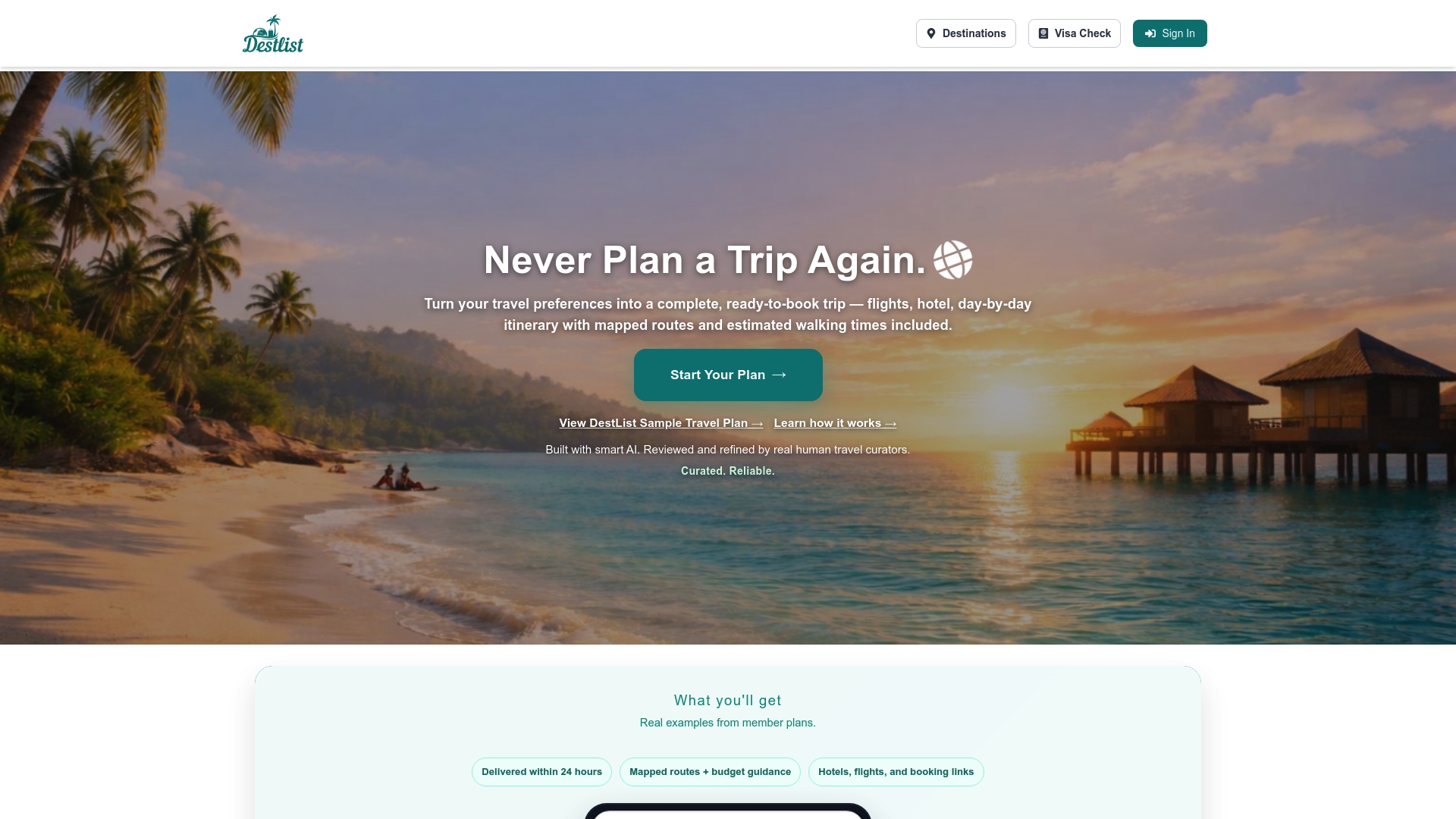
Destlist's custom travel itineraries are built by AI and refined by human travel curators who know how to sequence a short trip without wasting an hour. You get day-by-day plans, mapped routes, walking time estimates, and weather awareness, all ready to book within 24 hours. Whether you're planning a long weekend in a major city or a quick international escape, Destlist's curated travel plans match your budget, travel style, and pace. Stop spending your Sunday nights building spreadsheets and start actually looking forward to where you're going.
FAQ
How many activities should you plan per day on a short trip?
Two to three focused activities per day is the right target for short trips. The 3-2-1 rule (three must-sees, two nice-to-haves, one open slot) helps you stay realistic while leaving room for flexibility.
What are the standard carry-on dimensions for U.S. airlines?
Most U.S. airlines enforce a 22 x 14 x 9 inch limit for carry-on bags. Exceeding those dimensions at the gate can result in fees over $100, so measure your bag before you fly.
How do you reduce jet lag on a short trip?
Start shifting your sleep schedule one hour per day for two to three days before departure. Get strategic light exposure on arrival and avoid long naps. Low-dose melatonin taken 90 minutes before your target bedtime also helps reset your circadian rhythm faster.
Do I need to check passport validity before a short international trip?
Yes. Many countries require your passport to be valid for at least 6 months beyond your travel date. An expiring passport can result in denial of entry at the border regardless of your visa status.
What is the fastest way to build an itinerary for a short trip?
Using a curated planning service like Destlist cuts research time from hours to minutes. You get a ready-to-book plan with flights, hotels, day-by-day activities, and transit times built in, so you can focus on the trip rather than building a spreadsheet.