
The fastest way to handle last-minute trip changes
When your flight gets canceled at 6 AM or your hotel calls to say they're overbooked, the instinct is to panic-book the first alternative you find. That instinct costs you money and options. The fastest, most effective response follows a clear sequence: pause, triage, then act.
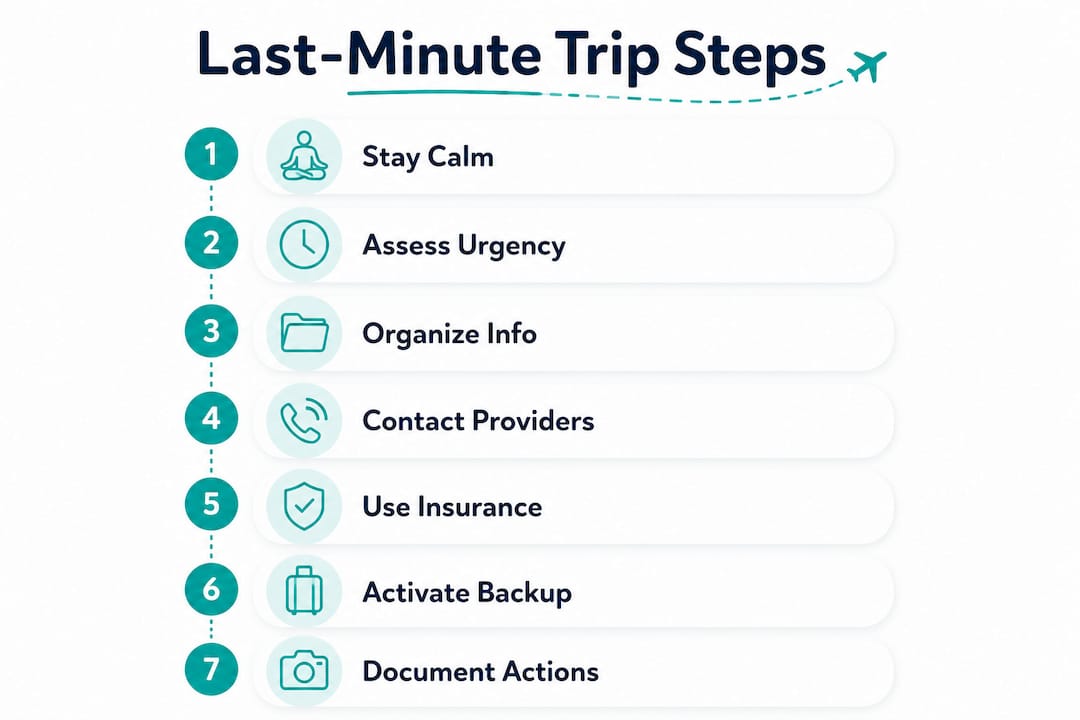
Here's the blueprint:
- Pause for 60 seconds. Resist the urge to rebook immediately. A calm mind spots cheaper, better options.
- Identify what's critical. Safety and shelter come first. A missed cooking class does not carry the same weight as a missed connecting flight.
- Contact providers in order of urgency. Airlines first (seats fill fast), then car rentals, then hotels (which have more flexibility).
- Check your cancellation windows. Many bookings carry a short free cancellation window that closes quickly. Use it before it closes.
- Pull up your insurance policy. Know what's covered before you commit to out-of-pocket expenses.
- Document everything. Screenshot confirmations, note agent names, and save reference numbers.
- Use your apps. Airline apps, TripIt, and Google Travel push real-time alerts faster than any call center.
Pro Tip: Before any trip, photograph every booking confirmation and save it to a cloud folder you can access offline. When chaos hits, you'll have every reference number in one place without digging through your inbox.
Table of Contents
- Stay calm and assess the situation when plans change suddenly
- How to keep all your travel information organized and accessible
- How to communicate clearly and proactively with travel providers
- How to use flexible booking policies and travel insurance to your advantage
- Why backup plans make last-minute adjustments far less stressful
- Which technology tools actually help when your trip goes sideways
- Expert advice on avoiding the most common mistakes mid-trip
- When a well-built itinerary makes all the difference
- Key Takeaways
Stay calm and assess the situation when plans change suddenly
Panic leads to costly, suboptimal choices; staying calm is what lets you evaluate your actual options. That's not a platitude. Travelers who take even a few minutes to breathe before rebooking consistently find lower-cost solutions and avoid the double-booking mistakes that come from frantic clicking.
Start with a quick mental checklist:
- Am I safe? If there's a physical safety concern, that overrides everything else.
- Do I have my essentials? Passport, wallet, phone, medication. If any of these are missing, that's your first call.
- What's the actual urgency level? A delayed departure is urgent. A canceled optional tour is not. Treat them differently.
- What are my real options? List them before committing to any one.
The key distinction is between urgent changes and inconvenient ones. A missed connection that strands you overnight is urgent. A restaurant that's fully booked is an inconvenience. Conflating the two leads to overreaction and wasted energy. Once you've separated the two categories, your next steps become obvious rather than overwhelming.

How to keep all your travel information organized and accessible
The travelers who recover fastest from disruptions are almost always the ones who can pull up a booking number in under 30 seconds. Organization is not a nice-to-have here. It's a practical advantage.
Centralize everything before you leave home:
- Use a single itinerary app. TripIt automatically parses confirmation emails and builds a master itinerary. Google Travel does the same with Gmail integration.
- Save offline copies. Download PDFs of every confirmation. Airports and foreign hotels are not reliable for Wi-Fi.
- Keep a notes file with key contacts. Airline customer service numbers, hotel front desk lines, car rental emergency contacts. Don't rely on finding these mid-crisis.
- Screenshot everything. Boarding passes, hotel check-in details, car rental agreements. Screenshots survive app crashes.
- Store documents in two places. Cloud storage (Google Drive, iCloud) plus your phone's local storage.
Building a flexible travel planning system before departure means you spend your energy on decisions, not on hunting for a booking reference while standing in an airport line. The five minutes it takes to organize this at home is worth an hour of stress later.
How to communicate clearly and proactively with travel providers
The way you communicate with airlines, hotels, and rental companies directly affects what you get. Polite, specific, and prompt beats frustrated and vague every time.
Practical communication tips:
- Call early. Phone lines are shortest in the first hour after a disruption is announced. Waiting costs you options.
- Be specific about what you need. "I need to rebook on the next available flight to Denver" is more productive than "I don't know what to do."
- Ask for a supervisor if the frontline agent can't help. Do it politely: "I understand this isn't your decision. Could you connect me with someone who has authority to make exceptions?"
- Use multiple communication channels. Call and simultaneously use the airline's app or live chat. Whichever gets through first wins.
- Log every interaction. Note the agent's name, the time, and any reference number. This documentation becomes leverage if you need to escalate or file a claim.
- Get everything in writing. If an agent verbally waives a fee, ask for written confirmation. Oral promises are frequently not honored without a paper trail.
Airlines are required to offer specific remedies during significant delays, including meal vouchers and, in some cases, hotel accommodations. Knowing your rights during delays before you travel puts you in a stronger negotiating position at the gate.

How to use flexible booking policies and travel insurance to your advantage
Most travelers treat travel insurance as a last resort. The ones who get the most out of it treat it as a strategic tool they understand before they need it.
Key tactics:
- Use the free cancellation window immediately. The 24–48 hour window is your cleanest exit. Once it closes, every change gets more expensive.
- Read the exclusions, not just the coverage summary. Chained events and exclusions are where most claims get denied. A missed connection that causes a missed tour may not be covered if the policy treats them as separate incidents.
- Notify providers proactively. Calling before a deadline, rather than after, dramatically increases the chance of a waived penalty.
- Know the difference between "cancel for any reason" and standard policies. Standard policies cover specific named perils. "Cancel for any reason" costs more but gives you genuine flexibility.
- Use your credit card's travel protection. Many premium travel cards include trip interruption and delay coverage that activates automatically when you pay with the card.
Pro Tip: When you buy travel insurance, read the fine print for "chained event" language. If your policy requires each disruption to independently qualify as a covered event, a single delay that cascades into multiple missed bookings may only pay out once. Look for policies that cover the full downstream impact.
Bundled travel packages, which include flights, hotels, and transfers under one booking, can also simplify last-minute changes by giving you a single point of contact rather than three separate providers to negotiate with simultaneously.
Why backup plans make last-minute adjustments far less stressful
Flexibility is travelers' most powerful tool during disruptions. The practical version of that insight is building contingency options before you need them.
Backup planning strategies that actually work:
- Save alternative hotels as draft bookings. Most booking platforms let you hold a reservation without charging your card. Keep one or two alternatives queued up, especially in cities where you're staying only one night.
- Build buffer time into your itinerary. A day with three activities has room to absorb a two-hour delay. A day with seven back-to-back bookings does not.
- Know your ground transport options. When flights are disrupted, buses and trains often have same-day availability at a fraction of the cost. High-frequency routes like New York to Philadelphia or Los Angeles to San Diego are particularly reliable for last-minute ground travel.
- Drop lower-value activities first. If you need to cut something, cut the optional extras before the experiences you planned the trip around.
- Check hotel rates in the late afternoon. Hotels often discount rooms late in the day to avoid empty inventory, making last-minute accommodation deals more accessible than most travelers expect.
For tips on securing last-minute hotel deals, booking directly with the property often surfaces rates that don't appear on third-party platforms, particularly when rooms are sitting empty close to check-in time.
Which technology tools actually help when your trip goes sideways
The right apps don't just track your itinerary. They push alerts before you'd otherwise know something is wrong, which gives you a head start on every other traveler scrambling for the same alternatives.
Tools worth having on your phone before you travel:
- Your airline's app. This is the fastest channel for rebooking and gate change alerts. Most airlines now allow full rebooking through the app without waiting on hold.
- TripIt or TripIt Pro. Aggregates all your bookings into one timeline and sends proactive alerts about delays and gate changes. The Pro version monitors flight prices and alternative routes.
- Google Travel. Pulls reservation data from Gmail automatically and displays everything in a clean itinerary view, accessible offline.
- FlightAware or Flightradar24. Real-time flight tracking that shows you exactly where your plane is before the airline updates the board.
- HotelTonight. Specializes in discounted same-day hotel bookings, useful when you need accommodation on short notice.
- Your bank's app. Notify your bank of travel disruptions to avoid fraud flags on emergency purchases in unexpected locations.
Enable push notifications for all travel apps before departure. Turning them on mid-crisis, when you're already at the airport, wastes time you don't have. Offline access for documents is equally critical. Download boarding passes, hotel confirmations, and maps to your device before you leave the terminal.
For travelers who want a stress-free trip planning foundation that's already built for flexibility, starting with a well-structured itinerary reduces the number of moving parts you have to manage when something goes wrong.
Expert advice on avoiding the most common mistakes mid-trip
The most expensive travel mistakes aren't the ones caused by disruptions. They're the ones caused by the response to disruptions.
The sunk cost trap. Travelers who've paid for a non-refundable activity often force their way to it even when circumstances have changed, spending more money and energy than the activity is worth. Cut it and move on.
Panic rebooking. Booking the first available alternative without checking alternatives is how you end up paying three times the going rate for a hotel room. Take five minutes to compare before you commit.
Ignoring the triage hierarchy. The right order is: safety first, then essential logistics (where you're sleeping tonight), then financial recovery. Trying to sort out a refund before you have a place to stay inverts the priorities and adds stress without solving the immediate problem.
Failing to document. Every call, every chat, every email exchange should be logged. Agent name, timestamp, reference number. This record is what turns a verbal promise into a successful insurance claim or refund.
Pro Tip: When a disruption hits, give yourself a hard five-minute rule before making any booking decision. Set a timer. Use those five minutes to list your top two or three options and their costs. The option that looks obvious in the first 30 seconds of panic rarely looks as good after five minutes of clear thinking.
Mental resilience matters here too. The travelers who handle disruptions best are the ones who've mentally separated from the original plan. The itinerary you built was a starting point, not a contract. Treating it that way makes every adjustment feel like a decision rather than a loss.
When a well-built itinerary makes all the difference

The best defense against last-minute chaos is a trip that was built with flexibility from the start. Destlist creates personalized travel itineraries that include weather alerts, flexible booking options, and day-by-day plans with enough breathing room to absorb the unexpected. Whether you're planning a week in Bali, Istanbul, or Bangkok, the platform delivers a ready-to-book itinerary within 24 hours, built by a combination of AI and human travel curators who know which bookings to hold loosely and which to lock in early.
If you're starting from scratch or rebuilding after a disruption, Destlist's custom travel itinerary service adapts to your preferences, budget, and timeline, so the next trip starts on solid ground.
Key Takeaways
Handling last-minute trip changes comes down to one discipline: triage first, then act, and document everything along the way.
| Point | Details |
|---|---|
| Triage before rebooking | Prioritize safety, then essential logistics, then financial recovery before making any new bookings. |
| Use cancellation windows fast | The 24–48 hour free cancellation window closes quickly; contact providers before it expires to avoid fees. |
| Document every interaction | Log agent names, timestamps, and reference numbers; written confirmation is your best leverage for refunds. |
| Flexibility beats a fixed schedule | Dropping lower-value activities and building buffer time into your itinerary absorbs disruptions with far less stress. |
| Technology gives you a head start | Airline apps, TripIt, and real-time flight trackers push alerts before the departure board updates, giving you more options. |