
TL;DR:
- Quick trip planning involves organizing short getaways of three to five days to maximize refreshment and minimize stress. It emphasizes a deliberate decision sequence, focusing on booking flights first, selecting central accommodations, and clustering attractions geographically. To succeed, travelers should set a budget, choose one main experience per day, and keep their plans flexible for spontaneity.
Quick trip planning is the practice of organizing a short vacation, typically 3–5 days, to maximize refreshment with minimal preparation time and travel stress. Unlike full vacation planning, which can take weeks, rapid trip organization compresses the entire process into a focused sequence of decisions. Platforms like Destlist, tools like Kiwi.com, and booking services like Traveloka have each built workflows around this exact need. The goal is simple: get you somewhere worth going, fast, without burning your weekend on logistics.
What is quick trip planning and why does it work?
Quick trip planning is defined as a structured, time-compressed approach to organizing short getaways that prioritize efficiency over exhaustive preparation. The industry term for this category of travel is the microvacation, and AARP reports microvacations are ideal at 3–5 days. That length is long enough to break your routine but short enough to avoid the planning fatigue that comes with longer trips.

The core insight is counterintuitive: shorter trips require more deliberate planning, not less. When you only have four days, every poor decision costs you proportionally more than it would on a two-week trip. Choosing the wrong neighborhood for your hotel, for example, can eat two hours of transit per day. That is why the methodology behind fast trip planning strategies matters as much as the destination itself.
Efficient travel planning works because it forces prioritization. You cannot do everything in four days, so you stop trying. That constraint, rather than limiting your experience, actually improves it.
What are the ideal characteristics of a quick trip?
The best quick trips share four defining traits: manageable length, short travel time, a central base, and a focused daily agenda. Get these right and the trip almost plans itself.
- Trip length of 3–5 days. AARP's microvacation guidance confirms this range as the sweet spot. Fewer than three days rarely justifies the cost of flights and hotel checkout logistics. More than five days starts to feel like a full vacation with full vacation planning demands.
- Travel time under 3–4 hours each way. Kiwi.com recommends keeping each-way travel time short to protect your time at the destination. A six-hour flight to a four-day trip means you lose an entire day to transit.
- A central accommodation location. Staying near the main attractions lets you start exploring immediately rather than spending your first morning on a subway or rideshare. Central hotels cost more but save time, which is your scarcest resource on a short trip.
- One main planned activity per day. AARP travel experts recommend one anchor experience daily, with the rest of the day left loose. This prevents the burnout that comes from overscheduling a short trip.
- A clear trip purpose. Are you going for food, hiking, culture, or rest? Defining this upfront filters every subsequent decision, from destination to restaurant choices.
Pro Tip: Pick your accommodation zone before you pick your hotel. A well-located budget hotel beats a luxury property in the wrong part of town every time on a short trip.
What is an efficient workflow for planning a quick trip?
The fastest planning workflow follows a fixed decision sequence. VoyagerNest's 30-minute itinerary method uses exactly this approach, and it works because it eliminates the back-and-forth that wastes most planning sessions.
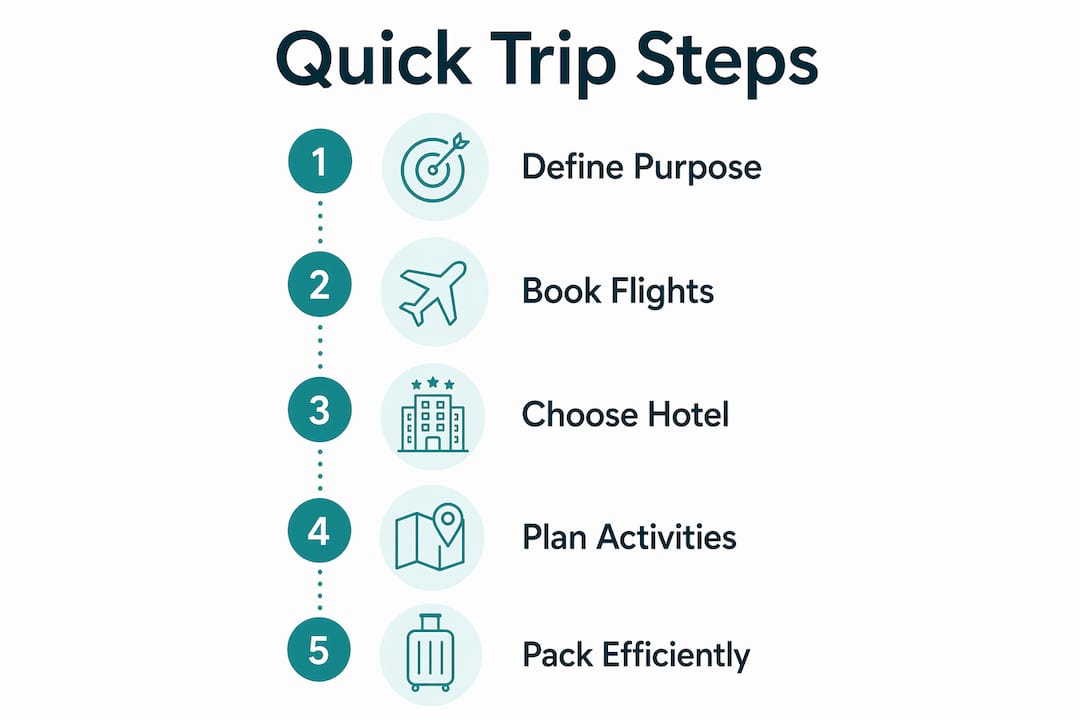
- Define your trip purpose and three must-do experiences. Write these down before opening any booking site. Three anchors give your itinerary structure without locking every hour.
- Book flights first. Flight availability and price drive your dates more than anything else. Lock the flights, then build everything else around them.
- Choose your accommodation zone. Identify which neighborhood puts you closest to your three anchors. Book a hotel there, not the cheapest option across town.
- Group remaining attractions geographically. VoyagerNest advises geographic clustering as the single most effective way to cut commuting time. Assign each cluster to a day based on proximity to your hotel.
- Build a lightweight daily framework. Morning anchor, afternoon activity, evening meal. Leave gaps. Gaps are not wasted time; they are where the best travel moments happen.
This sequence works because it treats planning as a funnel. Each decision narrows the next one, so you never face a blank page.
| Planning step | Time required | Key decision |
|---|---|---|
| Define purpose and anchors | 5 minutes | What are the three must-dos? |
| Book flights | 10 minutes | Which dates work with prices? |
| Choose accommodation zone | 5 minutes | Which neighborhood is most central? |
| Geographic clustering | 5 minutes | Which attractions share a zone? |
| Build daily framework | 5 minutes | Morning, afternoon, evening slots |
Pro Tip: Use a trip planning workflow that assigns each attraction to a map zone before scheduling it. You will cut transit time by more than you expect.
How do you manage budget and flexibility for last-minute quick trips?
Budget discipline is the most underrated fast trip planning strategy. Without a spending ceiling, destination research becomes infinite. Traveloka advises setting a firm budget first, then narrowing destination options by what fits within that range. This single step cuts wasted search time dramatically.
Destination flexibility is the second lever. Travelers who commit to one city before checking prices consistently pay more than those who search by region or travel time radius. If you are open to Portland, Denver, or Nashville, you will find a better deal than if you have already decided on one of them.
Flight timing matters more than most travelers realize. Going.com explains that flights booked 21 or more days in advance are generally cheaper than those booked 7–14 days out. Last-minute flights are typically more expensive and less flexible. That means spontaneous travel planning works best when you plan the spontaneity slightly in advance.
"Lock your budget and stay flexible on destination. That combination gives you the most options and the best prices for any short trip." — Traveloka travel planning guidance
A few specific tactics that protect your budget on quick trips:
- Book flights before hotels. Flight inventory and prices move faster than hotel rates.
- Search by travel time, not destination name. Tools that filter by flight duration from your home airport surface options you would not otherwise consider.
- Use refundable hotel rates when booking close to departure. The small premium is worth the flexibility if plans shift.
- Avoid peak travel weekends. Shifting a trip by one week can cut flight costs significantly without changing the experience.
What practical tips make the quick trip experience better?
Execution matters as much as planning. A well-planned trip can still feel rushed if you pack wrong, arrive late, or schedule too tightly. These tips apply from the night before departure through your last day at the destination.
- Pack carry-on only. Kiwi.com emphasizes packing light and managing bookings digitally as two of the highest-impact habits for short trips. Checked bags add 30–45 minutes at each end of the trip. On a four-day getaway, that is a meaningful chunk of time.
- Arrive early in the day, depart late. A morning arrival gives you an extra half-day at the destination. An evening departure means you do not lose your last day to airport waiting.
- Keep your itinerary loose. A framework of one anchor per day with open time around it outperforms a minute-by-minute schedule. AARP's experts recommend one planned event daily with buffer time built in.
- Organize all bookings digitally. Store flight confirmations, hotel details, and activity tickets in one app or folder. TripIt and Google Travel both work well for this. Fumbling through emails at a check-in desk wastes time and creates stress.
- Prioritize quality over quantity. Two great meals beat five average ones. One museum you actually care about beats four you feel obligated to visit. Short trips reward focus.
Pairing a flexible travel planning approach with these execution habits is what separates a genuinely refreshing quick trip from one that leaves you needing a vacation from your vacation.
Key takeaways
Quick trip planning works best when you treat time as your primary resource and every decision as a filter that protects it.
| Point | Details |
|---|---|
| Ideal trip length | Plan for 3–5 days to break routine without triggering full vacation planning demands. |
| Keep travel time short | Limit each-way transit to under 3–4 hours to protect usable time at the destination. |
| Use a decision sequence | Book flights first, then choose an accommodation zone, then cluster attractions geographically. |
| Book flights early | Flights booked 21 or more days out are generally cheaper and more flexible than last-minute fares. |
| One anchor per day | Plan one main experience daily and leave the rest loose to avoid burnout and allow spontaneity. |
Why quick trips changed how I think about travel
The most common mistake I see travelers make is treating a short trip like a compressed version of a long one. They try to see everything, eat everywhere, and check every landmark. The result is exhaustion, not refreshment.
The mindset shift that actually works is this: a quick trip is not a smaller vacation. It is a different kind of trip entirely. Its value comes from depth, not breadth. One neighborhood explored well beats five neighborhoods skimmed. One long lunch at a place the locals actually go to beats three tourist-trap meals rushed between attractions.
The planning pitfall I see most often is over-researching. Travelers spend more time reading reviews than they spend at the destination. The VoyagerNest 30-minute method exists precisely because decision sequence discipline cuts that spiral. Set your anchors, book your flights, stop researching.
Spontaneity and structure are not opposites in quick trip planning. Structure is what makes spontaneity possible. When your mornings are anchored and your hotel is central, your afternoons are genuinely free. That is when the best travel happens.
— Helen
How Destlist makes quick trip planning faster
Planning a short trip efficiently is exactly what Destlist was built for. The platform combines AI with human travel expertise to deliver ready-to-book itineraries within 24 hours, including flights, hotels, day-by-day activities, and mapped routes with walking times.

Travelers who use Destlist skip the research spiral entirely. You share your preferences, budget, and travel dates, and Destlist returns a complete, curated plan built around your priorities. For anyone who wants a custom travel itinerary without spending a weekend building one, Destlist delivers exactly that. The platform also includes a free destination discovery tool that matches your mood and budget to the right trip, which is the ideal starting point for any spontaneous travel planning session. Browse curated destinations to find your next quick getaway.
FAQ
What is a quick trip in travel terms?
A quick trip is a short vacation typically lasting 3–5 days, designed to refresh without the planning demands of a longer trip. AARP defines this format as a microvacation.
How far in advance should I book a quick trip?
Book flights at least 21 days before departure for the best prices. Going.com notes that last-minute flights are generally more expensive and offer less flexibility.
How do I plan a trip quickly without missing key experiences?
Define three must-do anchors first, book flights, then choose a centrally located hotel. VoyagerNest's 30-minute planning sequence uses this exact order to build a working itinerary fast.
Should I book flights or hotels first for a last-minute trip?
Book flights first. Traveloka advises that flight inventory and prices shift faster than hotel rates, so locking flights before hotels protects both your dates and your budget.
What is the biggest mistake people make on short trips?
Overscheduling. AARP travel experts recommend one planned activity per day with unstructured time built in, which prevents burnout and leaves room for the best unplanned moments.