
TL;DR:
- Planning a multi-city trip involves creating an efficient route based on geographic flow and avoiding backtracking.
- Proper pacing assigns more nights to major cities and fewer to small towns, optimizing travel experience and budget.
A multi-city trip is defined as any journey that connects three or more destinations under a single coordinated itinerary, and knowing how to plan multi-city trips correctly is what separates a smooth, memorable experience from a chaotic series of missed connections. The difference between the two comes down to route logic, smart pacing, and booking discipline. This guide covers all three, with specific strategies for transportation choices, itinerary management, and the most common mistakes travelers make before they ever leave home.
How do you design a logical route for multi-city trips?
Route logic before attraction lists is the single most important principle in multi-city planning. Most travelers start by listing cities they want to visit, then try to connect them. That approach almost always creates backtracking, which burns both time and money.
Start with a map. Plot every city you want to visit and look for a natural geographic flow. Four route structures work well for most multi-destination trips:
- Linear route: Travel from Point A to Point B in a straight geographic line. Best for one-directional trips like a coast-to-coast journey across Europe or a north-to-south run through Southeast Asia.
- Loop route: Return to your starting point. Works well when you want to use the same international gateway for arrival and departure.
- Hub-and-spoke route: Base yourself in one central city and take day trips or overnight trips to surrounding destinations. Ideal for regions with strong rail networks, like Japan or France.
- Split-region route: Divide your trip into two geographic clusters with a single connecting flight between them. Useful for combining, say, northern and southern Italy without retracing your steps.
Open-jaw flights are the booking tool that makes linear and split-region routes affordable. Flying into one city and out of another can save $200–$500 compared to a round-trip ticket that forces you to backtrack. Reversing the direction of your circuit can also lower fares by 10–25%, so always check both directions before booking.
Pro Tip: Before you research hotels or activities, drop every city on Google Maps and draw the route. If the line zigzags, reorder your stops until it flows in one direction.
How should you pace your stays across different cities?
Pacing is where most multi-city itineraries fall apart. Travelers assign the same number of nights to every stop regardless of the city's size or their own interests, which leads to either rushed sightseeing or wasted days sitting in a city with nothing left to do.
The 2026 standard for optimal pacing breaks down like this:
- Major capitals and large cities (Paris, Tokyo, New York, Istanbul): 3–5 nights minimum. These cities have enough depth to fill a week, and rushing them means skipping the neighborhoods, food scenes, and day trips that make them worth visiting.
- Mid-size cities (Bologna, Chiang Mai, Porto): 2–3 nights. Enough time to see the highlights and eat well without overstaying.
- Small towns and transit stops (Cinque Terre villages, Hallstatt, Luang Prabang): 1–2 nights. These are often best as overnight stops rather than multi-day bases.
Budget allocation follows the same logic. For trips covering 3–7 destinations, plan to spend 50–60% of your total budget on lodging and 15–20% on transit. The remaining portion covers food, activities, and contingencies. Longer stays in expensive cities eat into that lodging budget fast, so pacing and budget planning must happen together.
Pro Tip: Build at least one "slow day" into every major city stop. No tours, no museums. Just walk, eat, and absorb. These days consistently rank as the most memorable parts of any trip.
What are the best transportation options between cities?
Choosing between trains, flights, and car rentals is not just a cost question. It is a time question. Door-to-door travel time includes airport transfers, check-in, security, boarding, and baggage claim on the other end. For distances under 500 miles, trains are frequently faster in total elapsed time than short-haul flights, and they drop you in city centers rather than airports 30 miles out.

| Mode | Best for | Booking window | Key trade-off |
|---|---|---|---|
| Train | Under 500 miles, city-center routes | 60–90 days out | Slower max speed, but no airport hassle |
| Flight | Over 500 miles or island hops | 45–90 days out | Faster in air, slower door-to-door |
| Car rental | Rural areas, national parks, road trips | 30–60 days out | Flexibility, but adds parking and fuel costs |
Pre-book inter-city transit 60–90 days in advance to secure the best fares on both rail and air. Waiting until two weeks out often doubles the cost, especially on popular European rail corridors like Paris to Amsterdam or Rome to Florence.
A few additional rules for booking transit on multi-city trips:
- Book flights and lodging first. Lock in your framework before adding ground transportation.
- Use flight search tools with flexible date options to find the cheapest travel days between cities.
- Book all flight legs on a single ticket whenever possible. A single ticket means the airline is responsible for rebooking you if a delay causes a missed connection. Separate one-way tickets leave you on your own.
- Airline multi-city booking tools support through-checked baggage across all legs, which removes the hassle of reclaiming and re-checking bags at every stop.
How do you manage a multi-city itinerary without losing track?
The organizational challenge of a multi-city trip is real. You are tracking flights, trains, hotels, and activities across multiple cities, time zones, and booking platforms. Managing everything in one place is not a convenience. It is a necessity.
Scattered tabs and email confirmations are the enemy. A single itinerary document or app that consolidates every confirmation, time, and address gives you a clear picture of your trip at any moment. Destlist builds this structure automatically, generating day-by-day itineraries with mapped routes and estimated travel times so you are never guessing what comes next.
Key rules for itinerary management on multi-city trips:
- Set a minimum connection time of 90 minutes for international flights. Connection windows under 90 minutes on international routes carry a high risk of missed connections and lost baggage, especially when you factor in immigration and customs.
- Review your itinerary every time you add a booking. A new hotel check-in time might conflict with a train departure you booked two weeks earlier.
- Save offline copies of all confirmations. Airport Wi-Fi is unreliable, and you do not want to be searching your inbox for a hotel address when you land in a new city at midnight.
- Build buffer time between cities. A half-day buffer on arrival days lets you recover from delays without derailing the rest of your schedule.
For travelers who want a ready-built system, the itinerary planning workflow at Destlist handles the organizational layer automatically, saving most users more than 10 hours of planning time per trip.
Pro Tip: Screenshot every confirmation and save it to a dedicated album on your phone. No app required, no Wi-Fi needed, and everything is in one place when you need it fast.
What are the most common multi-city booking mistakes?
Even experienced travelers make predictable errors on multi-city trips. Knowing them in advance is the fastest way to avoid them.
- Booking separate one-way tickets to save money. This often costs more in the end and leaves you without protection if a delay causes a missed connection. Single-ticket bookings provide delay protection and baggage transfer benefits that separate tickets do not.
- Underestimating transit time between city center and airport. A 6:00 AM flight out of Charles de Gaulle means a 3:30 AM wake-up if you are staying in central Paris. Factor this into your pacing.
- Ignoring visa requirements per city. A multi-city trip through Southeast Asia or the Middle East may require multiple visas. Check entry requirements for every country on your route before you book anything.
- Skipping price checks in both route directions. Reversing your circuit direction can reduce fares by 10–25%. Always price both directions.
- Failing to set up price alerts. Google Flights price alerts capture fare drops that can save hundreds of dollars on multi-city routes. Set them the moment you identify your destinations.
The biggest planning mistake is treating a multi-city trip like a series of separate vacations. It is one trip with one budget, one route, and one schedule. Plan it that way from the start.
Key takeaways
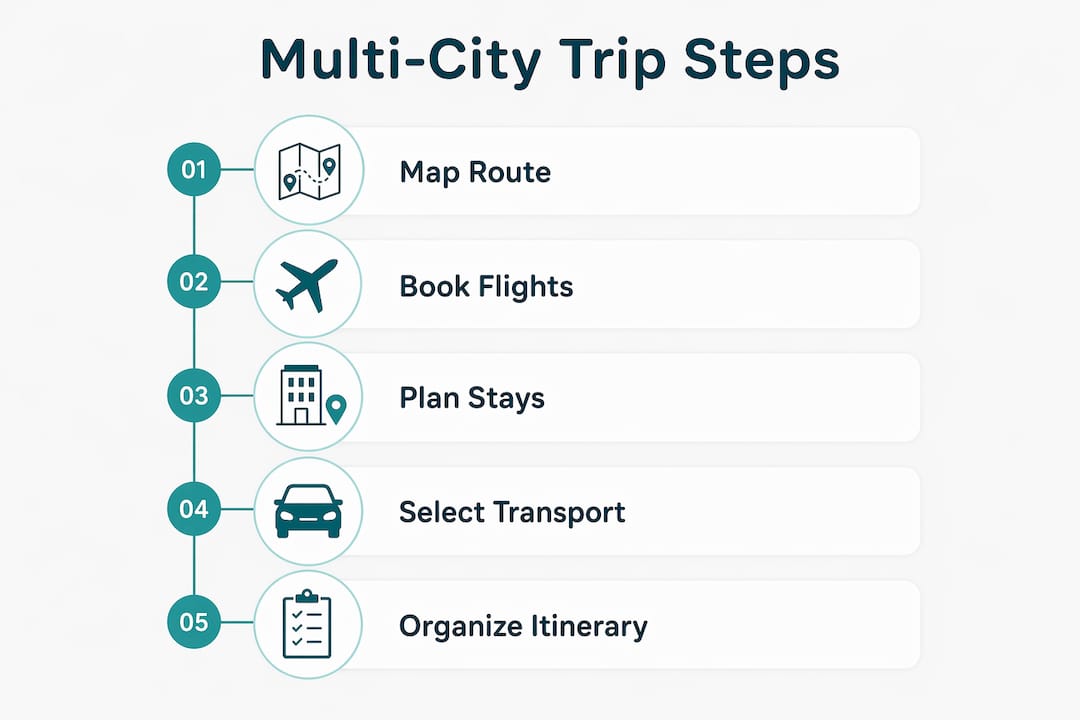
Efficient multi-city trip planning requires route logic first, then pacing, then transportation, then itinerary management, in that exact order.
| Point | Details |
|---|---|
| Route logic comes first | Map your cities geographically before researching hotels or activities to eliminate backtracking. |
| Match nights to city size | Allocate 3–5 nights for major capitals and 1–2 nights for smaller towns to avoid rushed or wasted days. |
| Book transit early | Pre-book rail and flights 60–90 days out and always use a single ticket for full delay protection. |
| Use one itinerary source | Consolidate all confirmations, times, and addresses in one place to prevent scheduling errors. |
| Check both route directions | Reversing your circuit direction can cut airfare by 10–25%, so always price it both ways. |
What I've learned from planning multi-city trips the hard way
I used to plan trips the way most people do: pick the cities I wanted to see, find flights between them, and figure out the rest later. That approach cost me two wasted travel days on a trip through Central Europe because I routed myself from Prague to Vienna and then back north to Berlin. The geography was obvious on a map. I just never looked at one before booking.
The shift that changed everything was treating route logic as the foundation of the entire plan. Once I stopped asking "what do I want to see?" and started asking "what is the most efficient path through these cities?", every other decision got easier. Pacing followed naturally. Transportation choices became obvious. The budget fell into place.
I also stopped being precious about buffer days. A free afternoon in a city you did not plan for is not wasted time. It is the day you find the restaurant that becomes your favorite meal of the trip. Build them in deliberately, especially after long travel days.
The tools matter too. I have tried managing multi-city trips across spreadsheets, email folders, and notes apps. None of them work as well as a single platform that holds everything. The mental load of remembering where your confirmation numbers live is real, and it compounds across a 10-day trip with four cities. Eliminate it early.
For travelers who want a structured starting point, Destlist's multi-trip planning guide is worth reading before you book anything.
— Helen
Let Destlist build your multi-city itinerary for you
Planning a multi-city trip well takes hours of research, route mapping, and booking coordination. Destlist cuts that time down dramatically. The platform combines AI-generated itineraries with human travel curation to produce day-by-day plans that include mapped routes, estimated travel times, flight and hotel matches, and activity suggestions, all delivered within 24 hours.

Whether you are planning a two-week loop through Southeast Asia or a long weekend across three European capitals, Destlist builds the framework so you can focus on the experience. Browse curated multi-city travel plans or start from scratch with a custom travel itinerary tailored to your dates, budget, and travel style.
FAQ
How many cities should you visit in one trip?
Three to five cities is the practical range for most two-week trips. More than five cities in two weeks leaves too little time per stop and too much time in transit.
Is it cheaper to book multi-city flights or separate one-ways?
It depends on the route, but single multi-city tickets often match or beat separate one-ways while adding delay protection and through-checked baggage benefits.
How far in advance should you book a multi-city trip?
Book flights and lodging 45–90 days out for the best rates. Rail tickets on popular European routes sell out faster and should be booked at the 60–90 day mark.
What is an open-jaw flight and why does it matter?
An open-jaw flight lets you fly into one city and out of another, which eliminates backtracking on linear routes and can save $200–$500 compared to a standard round-trip ticket.
What is the minimum connection time for international flights?
Allow at least 90 minutes for international connections. Windows under 90 minutes carry a high risk of missed flights and lost baggage, particularly when customs or immigration is involved.