
TL;DR:
- Careful budget travel planning increases trip frequency and overall satisfaction.
- Focus on intentional spending on meaningful experiences rather than minimum costs.
- Use practical tools, strategies, and emergency buffers to maximize travel value and reduce stress.
Budget travelers who plan carefully tend to take more trips, spend less overall, and return home more satisfied than those who wing it. That counterintuitive truth sits at the heart of smart travel. Many people assume that planning a tight budget means accepting discomfort, skipping the highlights, or grinding through every dollar. The reality is the opposite. Intentional travel planning prevents financial regret and makes frequent, meaningful trips possible by focusing your money on what actually matters to you. This article covers the essential frameworks, practical tools, common pitfalls, and mindset shifts that turn budget planning from a chore into your biggest travel advantage.
Table of Contents
- Why budget travel planning matters more than ever
- The key steps to effective budget travel planning
- Tools, hacks, and strategies to stretch your travel dollar
- Avoiding travel budget pitfalls and navigating exceptions
- Why intentionality—not frugality—drives travel satisfaction
- Plan memorable trips the smart way—with DestList
- Frequently asked questions
Key Takeaways
| Point | Details |
|---|---|
| Planning unlocks more travel | Setting a clear budget empowers you to travel farther and more often without financial regret. |
| Frameworks make budgeting simple | Following step-by-step planning removes stress and ensures all costs, including hidden ones, are covered. |
| Smart tools save money | Using apps, fare alerts, and sharing economy hacks helps you get more from every travel dollar. |
| Buffer for the unexpected | A 10-20% emergency cushion keeps you covered when surprises happen on the road. |
| Intentionality drives satisfaction | Aligning your budget with your real travel priorities brings more joy than chasing the lowest price. |
Why budget travel planning matters more than ever
Let's clear something up immediately. Budget travel is not about suffering through red-eye flights on no sleep, eating sad vending machine sandwiches, or skipping the experiences you actually came to see. It's about directing your money toward what creates real memories and cutting what doesn't.
The value of budget travel planning is showing up more and more as travel costs rise. Flights, hotels, and dining have all become more expensive since 2020, and that pressure isn't easing. In 2026, travelers who go in without a plan are far more likely to overspend, feel stressed, and return home wondering where the money went.
Here's what the data actually shows:
- Travelers with clear budgets take more trips per year on average
- 32% of travelers are cutting spending while still prioritizing value and immersive experiences over flashy extras
- Hacks, destination swaps, and intentional spending habits enable rich travel without requiring wealth
- Budget planning leads to higher overall satisfaction, not lower enjoyment
Think about it this way. If you blow your entire travel fund on one chaotic, unplanned trip, you might not travel again for two years. But if you plan carefully, you could easily take three or four meaningful trips in the same time frame.
"Intentional travel is not about spending the least. It's about spending on what matters most to you and eliminating everything else."
The step-by-step budget travel planning process is learnable by anyone. You don't need a finance degree or a spreadsheet obsession. You just need a clear starting point and the willingness to think ahead.
The key steps to effective budget travel planning
Effective budget planning follows a repeatable process. Whether you're heading to Southeast Asia or road-tripping across national parks, the same framework applies. Here's how to build it:
- Define your priorities. What must you experience on this trip? Decide before you book anything. This prevents impulse spending later.
- Estimate the big four costs. Flights, lodging, food, and activities are your core budget categories. Research realistic numbers for each.
- Add hidden costs. Fees, tips, travel insurance, visas, airport transfers, and local transport all add up. Budget for them explicitly.
- Build a buffer. A 10 to 20% emergency buffer protects you from surprise costs without derailing the whole trip.
- Choose a tracking method. Use an app, a notes file, or a simple spreadsheet. What matters is checking it daily.
- Book strategically. Off-peak travel, midweek flights, and fare alerts consistently beat last-minute prices.
- Adjust daily. Treat your budget like a living document. If you overspend on day two, scale back on day three.
Pro Tip: Set a daily spending limit and check your total every evening. This small habit prevents the "I'll figure it out later" trap that blows budgets fast.
Here's a sample breakdown for a 7-day international trip to help you visualize the budget:
| Budget category | Estimated cost (USD) |
|---|---|
| Flights (round trip) | $400–$700 |
| Accommodation (7 nights) | $175–$490 |
| Food (7 days at $20–$40/day) | $140–$280 |
| Activities and entry fees | $75–$150 |
| Local transport | $50–$100 |
| Emergency buffer (15%) | $125–$270 |
| Estimated total | $965–$1,990 |
The understanding travel budgeting systems approach helps you figure out which method fits your style. Some travelers prefer envelope budgeting, others use rolling daily averages. The method is less important than the consistency.

One common mistake: forgetting that exchange rates move. A currency that looks strong when you book may look different when you land. Factor in a small exchange rate cushion, especially for longer trips. Also check whether your credit card charges foreign transaction fees before you travel.
Tools, hacks, and strategies to stretch your travel dollar
Once your framework is set, the right tools make execution genuinely enjoyable. This is where smart travelers create real separation from the crowd.
Here's a quick comparison of what actually works versus common booking traps:
| Smart strategies | Common traps to avoid |
|---|---|
| Google Flights + fare alerts | Booking the first result without comparing |
| Incognito mode or VPN for price checks | Searching repeatedly from the same browser |
| No-fee travel credit cards | Cards with high foreign transaction fees |
| Local food markets and street food | Tourist-center restaurants near attractions |
| Airalo eSIM for data abroad | Roaming charges from your home carrier |
| Free walking tours and public transport | Paid tourist shuttles and guided buses |
| Destination dupes (affordable alternatives) | Defaulting to the most-hyped destinations |
Practical tools worth knowing:
- Google Flights for price tracking and flexible date searches
- Airalo for cheap international eSIM data plans
- Hostelworld or Booking.com for flexible, affordable accommodation
- Too Good To Go for discounted meals from local restaurants
- Workaway or Trusted Housesitters for free or low-cost stays in exchange for light work
Pro Tip: Set a fare alert for your destination six to twelve weeks before your target travel dates. Prices typically drop and spike unpredictably, and alerts let you catch the dips without obsessively checking.
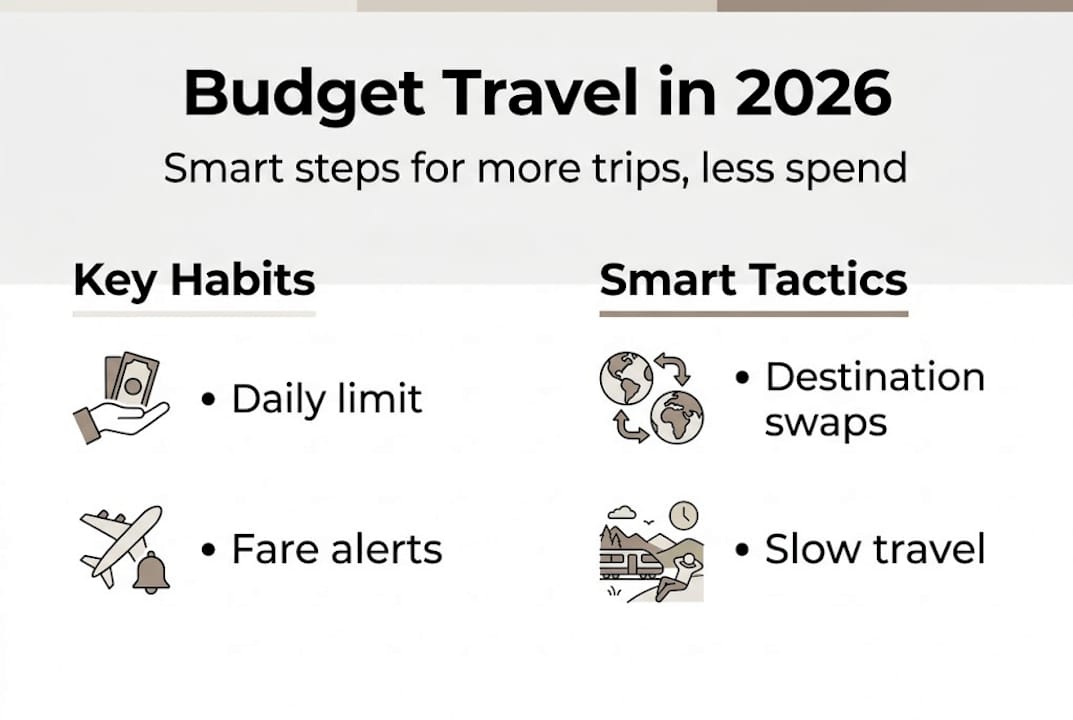
Destination swaps, sometimes called "dupes," are one of the most underused strategies. Instead of Paris in peak summer, consider Lyon or Porto. Instead of Bali during festival season, look at Lombok or Chiang Mai. Budget travel globally is viable at $50 to $130 per day across most regions, and destination choice is the single biggest lever you have.
Slow travel is another major win. Spending two weeks in one country instead of hopping across four cuts transportation costs sharply and gives you a richer, more immersive experience. Fewer flights, fewer packing sessions, more actual connection to where you are.
For optimizing trip planning, layering these tools and habits together compounds your savings. It's not one magic trick. It's five smaller smart moves that add up.
Avoiding travel budget pitfalls and navigating exceptions
Even well-planned budgets hit walls. Knowing the most common failure points lets you build defenses before you need them.
The biggest pitfalls most travelers face:
- Dynamic pricing. Hotel and flight prices can jump sharply around events, holidays, or sudden demand spikes. Always check what's happening locally during your travel dates.
- Budget airline fee traps. A $49 base fare can become $180 with seat selection, carry-on fees, and check-in charges. Always calculate the real total cost before booking.
- Group travel mismatches. When traveling with friends or family, spending styles vary wildly. Set ground rules early and have an honest group budget conversation before the trip begins.
- Foreign transaction and ATM fees. These quietly bleed money throughout the trip if you're not prepared.
- No emergency fund. Getting sick abroad, losing a passport, or missing a connection can cost hundreds of dollars without warning.
Travel emergencies and equity challenges hit harder for travelers with lower income, disabilities, or complex itineraries. Dynamic pricing, sudden disruptions, and hidden costs create unequal burdens. Planning carefully is not just a financial strategy. For many people, it's what makes travel accessible at all.
For stress-free trip planning, build the following protections into every trip:
- A 15% emergency buffer in a separate account or card
- Travel insurance for trips over a week or involving flights
- Offline copies of all booking confirmations and emergency contacts
- A fallback plan for accommodation if something falls through
"Budget travel done right isn't deprivation. It's the discipline that creates freedom. The travelers who plan for problems are the ones who actually relax on vacation."
When group dynamics complicate budgeting, assign one person to track shared expenses and use a tool like Splitwise to divide costs fairly. Addressing money openly before the trip saves friendships during it. Handling emergencies in travel budgets is a skill, and like all skills, it improves with practice.
Why intentionality—not frugality—drives travel satisfaction
Here's what most budget travel articles miss. The goal was never to spend as little as possible. That framing leads to miserable trade-offs and exhausting math at every meal. The real goal is alignment: matching where your money goes with what actually makes you happy when you travel.
Some travelers are happiest splurging on one incredible meal and sleeping in a modest hostel. Others would rather skip the restaurant entirely and spend that money on a guided hike or a local cooking class. Neither choice is wrong. Both are intentional.
Common travel myths suggest that budget travel is only for young backpackers, that expensive always means better, or that spontaneous travel is more authentic. None of that holds up. Intentional spending works at any age, any income level, and any travel style.
Slow travel, destination swaps, and spending on experiences over things are the real levers of satisfaction. Ask yourself before every booking: "Does this expense match what I actually came here to feel?" That one question, asked consistently, is worth more than any savings app.
For intentional travel to feel natural, it needs to start before you book. Clarity on your values turns budget planning from restriction into freedom.
Plan memorable trips the smart way—with DestList
All of this planning knowledge means more when it translates directly into action. That's exactly where DestList steps in.
DestList combines AI-powered research with human travel expertise to turn your preferences into a complete, ready-to-book itinerary within 24 hours. Every plan includes flight and hotel matching aligned to your budget, day-by-day activity flow, mapped routes, and estimated walking times. Explore done-for-you travel planning if you want a full trip handed to you, or build a custom travel itinerary around your specific priorities. You can also browse curated travel plans for inspiration across dozens of destinations. Smart planning starts here.
Frequently asked questions
How much money should I budget for travel?
Budget travel is viable at $50–$130 per day across most global destinations, though adding a 10–20% buffer for unexpected costs is strongly recommended.
What is the biggest mistake people make in budget travel planning?
Skipping the emergency fund and ignoring hidden costs like fees and local transportation are the top reasons travelers go over budget.
Are budget trips only suitable for young travelers?
Not at all. Budget travel myths incorrectly tie this style to age. Intentional, value-focused travel works at any life stage.
How can I avoid dynamic pricing when booking?
Use fare alerts and incognito mode or a VPN when searching, and compare prices flexibly across multiple travel dates before committing.
What if I have special needs or travel with a group?
Group travel mismatches and accessibility gaps are real but manageable with early, honest planning conversations and a flexible shared budget structure.