
TL;DR:
- A proper travel budget boosts confidence and allows more spontaneous trips.
- Four main systems suit different travelers: zero-based, envelope, 50/30/20, and daily allowance.
- Using a combination of tools and tracking habits ensures a stress-free and controlled travel experience.
Most travelers assume a budget kills the fun. It doesn't. The right budgeting system is actually what lets you say yes more often, because you already know exactly what you can afford. Instead of guessing at the airport or sweating over your credit card bill when you get home, you're making confident choices before you even pack. This article breaks down the top travel budgeting systems, compares how they work in real life, and gives you a step-by-step path to picking the one that fits your travel style. Less stress, more adventure.
Table of Contents
- Why travel budgeting matters more in 2026
- The core travel budgeting systems explained
- Step-by-step travel budgeting: Mechanics that work
- Apps, automation, and common pitfalls in travel budgeting
- The truth about finding your best travel budgeting fit
- Plan smarter: Take the stress out of trip budgeting
- Frequently asked questions
Key Takeaways
| Point | Details |
|---|---|
| Budgeting prevents overspending | Using a travel budgeting system gives you more freedom and less regret on your trip. |
| System choice matters | Pick a budgeting approach that matches your travel style and comfort with tracking money. |
| Use automation tools | Apps and digital systems make staying on track easier, with fewer manual errors. |
| Always add a buffer | Setting aside 10 to 25 percent for unexpected costs can prevent financial surprises. |
| Track and adjust often | Review your budget during your trip to make smart, stress-free spending choices. |
Why travel budgeting matters more in 2026
Travel costs aren't what they were five years ago. Inflation has risen 17% since 2020, and that number shows up everywhere from hotel rates to airport sandwiches. If you're planning trips without a system, you're essentially guessing, and guessing usually costs more.
Here's what the numbers actually look like for American travelers right now:
| Destination | Comfortable daily spend |
|---|---|
| United States (mid-range) | $140–$280/day |
| Europe | $75–$155/day |
| Southeast Asia | $50–$100/day |
The average annual leisure budget for US travelers in 2026 is $6,453 across four trips. That's a meaningful chunk of income, and most people have no formal plan for how it gets spent.
What happens when you skip the planning? A few things, none of them good:
- You overspend on the first half of the trip and cut corners on the second half
- You miss experiences you actually wanted because you feel uncertain about money
- You come home with post-trip regret and a credit card balance that lingers for months
"Travelers who track spending during a trip report significantly higher satisfaction than those who don't, regardless of how much they actually spent." — Voyanor spend report
The fix isn't to spend less. It's to spend intentionally. Understanding why trip planning matters goes beyond logistics. It directly affects how much you enjoy the money you do spend. A system gives you a framework so every dollar has a job before you leave home.
The good news is that budgeting for travel doesn't require a finance degree. It requires picking the right method for how your brain works and how you travel. That's exactly what the next section covers.
The core travel budgeting systems explained
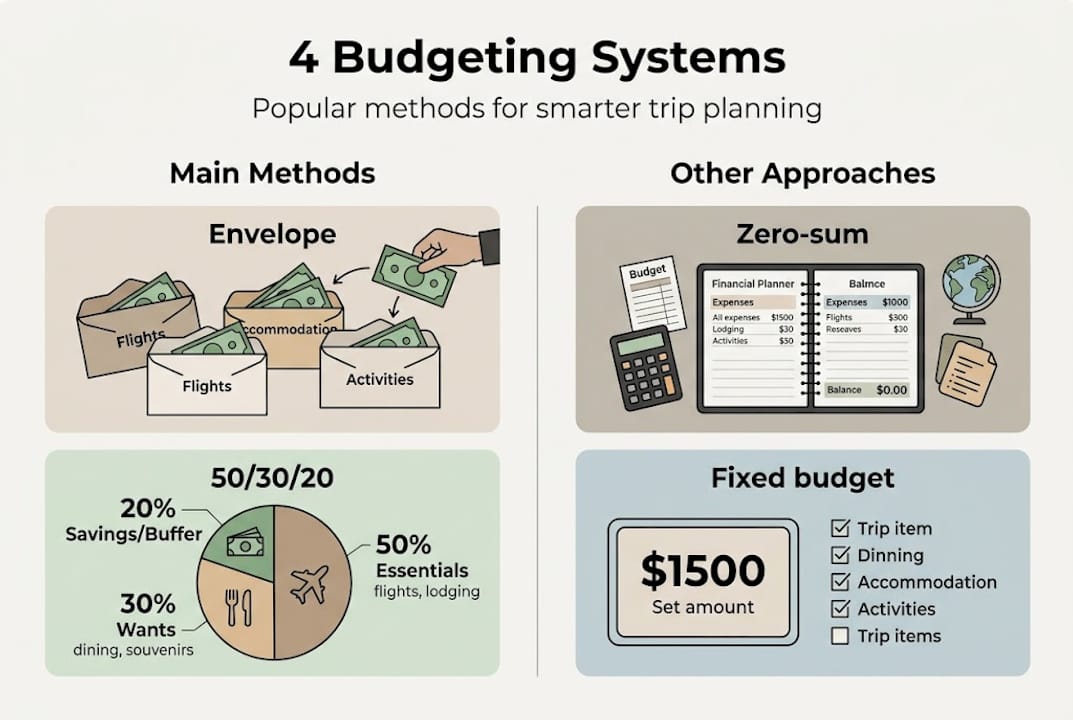
There are four main systems travelers use, and each one has a different personality. The best one for you depends on how much control you want, how much time you're willing to invest, and whether you're traveling solo, as a couple, or with a family.
Here's how they compare:
| System | Control level | Time investment | Best for |
|---|---|---|---|
| Zero-based | Very high | High | Detail-oriented solo travelers or couples paying off debt |
| Envelope | High | Medium | Families or group trips with shared categories |
| 50/30/20 | Medium | Low | First-time budgeters or casual travelers |
| Daily allowance | Medium | Low | On-trip tracking and spontaneous travelers |
According to key budgeting methodologies adapted for travel, each system has a distinct logic:
- Zero-based budgeting assigns every dollar a purpose before the trip starts. You account for flights, hotels, food, activities, and even souvenirs until the balance hits zero. It's the most precise method and works well when you're trying to stay strict.
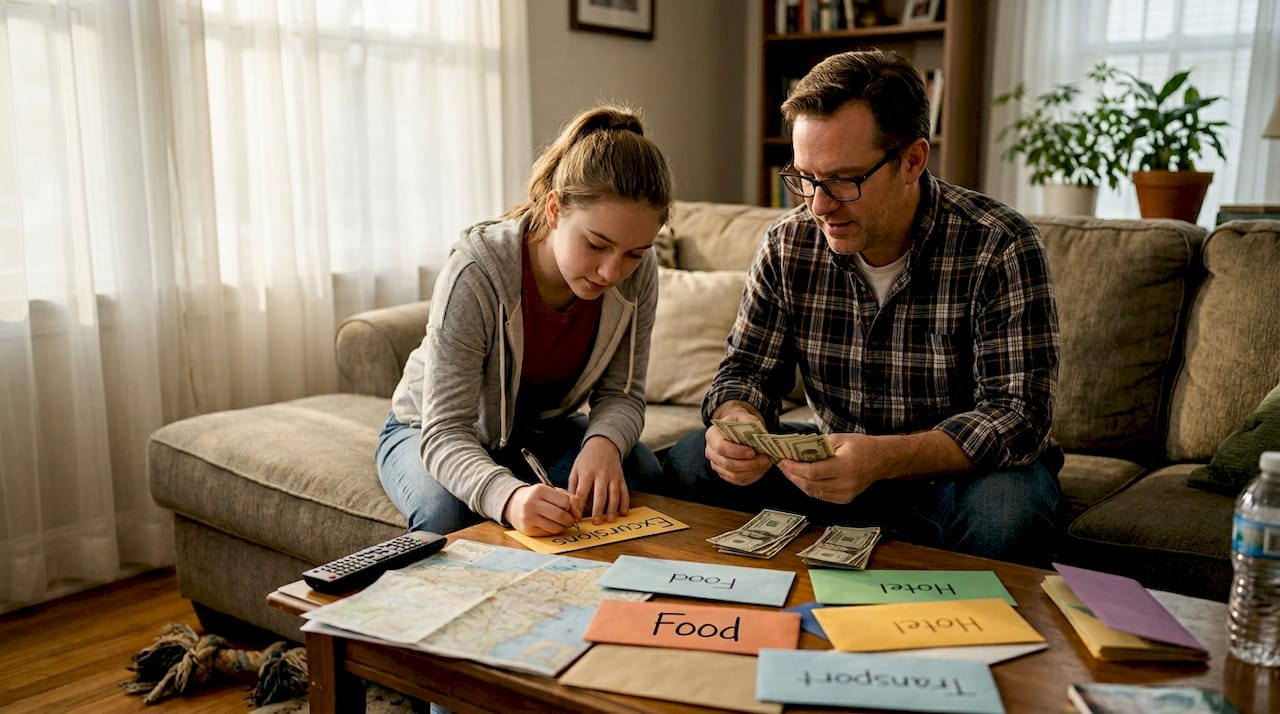
- Envelope budgeting sets a spending limit per category, either physically with cash or digitally with separate accounts or app folders. Once the envelope is empty, you stop spending in that category.
- The 50/30/20 rule splits your travel fund into needs (50%), wants (30%), and savings or contingency (20%). It's the easiest to start with and works well for travelers who don't want to track every line item.
- Daily allowance gives you a fixed amount to spend each day. It's flexible and easy to monitor on the go, making it popular with backpackers and spontaneous travelers.
Pro Tip: If you're traveling as a couple or family, envelope budgeting tends to reduce arguments about money because everyone can see the limits clearly before anyone spends.
For deeper guidance on choosing your budget type before your next trip, or if you want to see how these systems apply to real budget travel itineraries, both are worth a read before you commit to a method. Sites like Budgets and Travel also offer real-world examples of each system in action.
Step-by-step travel budgeting: Mechanics that work
Knowing the system is one thing. Building your actual budget is another. Here's how to do it without overcomplicating it.
- Define your priorities first. What matters most on this trip? A great hotel? Restaurants? Activities? Your priorities tell you where to put the most money before you assign anything else.
- Set a total budget cap. Work top-down (start with what you can afford) or bottom-up (add up real costs and see if they fit). Either way, you need a hard ceiling.
- Research real prices. Use Google Flights, Numbeo, and Booking.com to get actual numbers. Don't guess. Real price research is the step most people skip, and it's why budgets fall apart.
- Estimate daily spend by category. Break it into food, transport, activities, and miscellaneous. Multiply by the number of days.
- Add a contingency buffer. The Big Four categories (flights, accommodation, food, and activities) typically eat up 70–80% of your total budget. The remaining 20–30% should include a buffer of 10–25% for surprises.
- Track as you go. Do a quick daily review. It takes two minutes and keeps you from waking up on day five with no money left for the thing you actually came to do.
Statistic to know: A 10–25% contingency buffer is the standard recommendation from travel finance experts. Most travelers who skip it overspend by at least that amount anyway.
Pro Tip: Automate tracking wherever you can. Apps like Trail Wallet or TravelSpend log expenses instantly. The less friction between spending and recording, the more likely you are to actually do it.
If you want a more detailed walkthrough, the step-by-step travel planning guide covers this process from scratch. For travelers short on time, trip planning time-savers shows you how to cut the research phase significantly.
Apps, automation, and common pitfalls in travel budgeting
Once you have a system, the next question is how to maintain it without it feeling like a second job. This is where tools make a real difference.
Digital tools worth using:
- Trail Wallet for simple daily allowance tracking
- TravelSpend for multi-currency trips
- Google Sheets for custom zero-based budgets you can share with a travel partner
- Splitwise for group trips where costs need to be divided fairly
The debate between paper envelope methods and digital apps comes down to personality. Physical envelopes are tangible and harder to cheat, but they don't work well across multiple currencies. Apps offer real-time automation and instant alerts, but they require consistent input to stay accurate.
"The most effective approach isn't always the most sophisticated one. It's the one you'll actually use every day of your trip."
Many experienced travelers combine both. They use envelopes (or digital equivalents) for big fixed categories like accommodation and tours, then use an app for daily variable spending like food and transport. This hybrid approach gives you structure where you need it and flexibility where you want it.
Common pitfalls to avoid:
- Underestimating food costs, especially in cities where eating out is the norm
- Forgetting travel insurance as a budget line item (it's not optional)
- Ignoring exchange rate fluctuations on longer trips
- Failing to adjust the budget mid-trip when something unexpected happens
For more on streamlining travel planning so your system runs smoothly from day one, or if you want to look at efficient itinerary formatting that keeps budget and schedule aligned, both resources can save you real time.
The truth about finding your best travel budgeting fit
Here's what most budgeting guides won't tell you: the system matters less than your willingness to actually use it. We've seen travelers with color-coded spreadsheets blow their budget by day three, and others with a simple daily cash limit come home under budget every time.
The real variable is self-awareness. What's your relationship with money when you're excited and on vacation? Are you a spender who needs hard limits, or a natural tracker who just needs a framework? Your life stage matters too. A solo traveler in their twenties has different priorities than a family of four or a couple saving for a house.
Hybrid systems tend to work best in practice. Use envelopes or fixed accounts for your biggest spending categories, then let an app handle the daily granular stuff. It's the structure of zero-based with the ease of daily allowance tracking.
The uncomfortable truth is that no system saves you if you don't check in with it. Tracking and adapting beats picking the perfect method every single time. Start simple, build the habit, and adjust as you learn how you actually spend when you travel. For a calmer, more stress-free trip planning experience, the system you stick to is always the right one.
Plan smarter: Take the stress out of trip budgeting
You now have the framework. The next step is putting it into action without spending weeks doing research on your own.
DestList combines AI-powered planning with real human expertise to build custom travel itineraries that already account for your budget. Every trip includes flight and hotel options matched to your price range, day-by-day activities with estimated costs, and a smooth itinerary flow that removes the guesswork. If you want a completely done-for-you planning experience, DestList delivers a ready-to-book trip within 24 hours. Stop spending your planning time on spreadsheets and start spending it looking forward to your trip. Visit DestList to get started.
Frequently asked questions
What is the simplest travel budgeting system for beginners?
The 50/30/20 rule is the easiest starting point: put 50% toward needs like flights and hotels, 30% toward experiences and dining, and keep 20% as savings or a safety buffer.
How much should I add to my travel budget as a safety buffer?
Most travel finance experts recommend a 10–25% contingency on top of your estimated total. The exact amount depends on how unpredictable your destination or travel style tends to be.
Are travel budgeting apps more effective than manual methods?
Apps win on automation and real-time tracking, while manual methods give you more tactile control. Most experienced travelers get the best results by combining both approaches.
What are common travel budget mistakes?
The biggest ones are underestimating daily food costs, leaving out travel insurance, and not revisiting the budget mid-trip when plans change unexpectedly.
How much do Americans typically spend on travel each year?
In 2026, the average annual travel spend for American leisure travelers is $6,453, typically spread across four separate trips.