
A paid travel planner using AI-assisted routing and human review is the fastest way to synchronize a multi-stop trip into a ready-to-book itinerary. It's the right call for most leisure travelers and busy professionals juggling more than two or three destinations. Doing this yourself is possible. It's also the reason so many multi-city trips end up with a missed train connection at 6 a.m. or a hotel check-in that doesn't line up with a flight landing at midnight.
Any itinerary that actually holds together across multiple stops needs three things, regardless of who builds it:
- Coordinated flights and transfers that account for real connection windows, not just "looks fine on the map" timing.
- Accommodation and check-in logistics matched to arrival times, so you're not standing outside a locked hotel lobby at 2 a.m.
- Day-by-day timing with transit buffers, including full entries for travel days themselves, not just the destinations on either end.
Trusted benchmarks make this concrete: a well-built itinerary follows a standard day-by-day format that includes anchor activities, flexible backups, dinner plans, and explicit transit logistics. Services built around this standard, including Destlist's 24-hour premium delivery option, pair AI-generated drafts with human verification to catch the kind of local-knowledge gaps that automated routing tools routinely miss.
Key Takeaways
A paid, AI-assisted and human-verified planner synchronizes multi-stop trips faster and more reliably than manual DIY planning for anyone juggling three or more destinations.
| Point | Details |
|---|---|
| Book in the right order | Lock flights first, accommodation second, activities third to avoid date conflicts. |
| Treat transit days as full entries | Build explicit buffers between legs instead of leaving transfer time implicit. |
| Prepare dates, budget, and must-sees first | Clean upfront input shortens turnaround and cuts down on revision rounds. |
| Match the trip to the route | DIY works for simple trips; hybrid or paid planning fits 3+ stops or multi-country routes. |
| Destlist delivers ready-to-book plans in 24 hours | Its AI-plus-human workflow produces sequenced bookings, transit maps, and a clear revision window. |
Table of Contents
- How Does a Planner Actually Synchronize a Multi-Stop Itinerary?
- What Does a Ready-to-Book Multi-Stop Itinerary Actually Include?
- What Should You Prepare Before Hiring a Planner?
- What Do Turnaround Times and Pricing Typically Look Like?
- What Goes Wrong in Multi-Stop Trips, and How Do Planners Prevent It?
- How Does Destlist Specifically Synchronize a Multi-Stop Trip?
- Should You Hire a Planner or Do It Yourself?
- What I've Learned Watching Multi-Stop Trips Fall Apart (and Come Together)
- How Destlist Turns Your Preferences Into a Bookable Trip
- Sources
How Does a Planner Actually Synchronize a Multi-Stop Itinerary?
The process is more mechanical than most people expect, and that's exactly why it works. Here's the sequence a planner follows, whether they're mapping a three-city European trip or a work-plus-leisure swing through Southeast Asia.
- Intake. The planner collects your dates, budget, must-see items, pace preference, and any fixed commitments (a wedding, a conference, a flight you already booked).
- Route sequencing. Stops get ordered to form a line or loop rather than a zigzag, since backtracking between distant cities burns both time and money. This step usually settles nights-per-city, too, with several nights as a common default with additional buffer nights added around long transfers.
- Booking sequencing. Flights get locked first, accommodation second, activities third. Reversing this order is a common structural mistake that leads to date mismatches later.
- Buffer and transfer planning. The planner checks connection windows, train schedules, local transit frequency, and luggage-transfer logistics between each leg.
- Verification and handoff. A human reviewer checks the AI-generated draft against real-world conditions, then the final itinerary gets formatted for delivery.
At each step, the planner is checking things a map app won't tell you: whether a "45-minute connection" at an airport actually means changing terminals, whether the regional train you're counting on only runs hourly, and whether your hotel's check-in time leaves you standing on a sidewalk with luggage for three hours.
Typical service level agreements break into three milestones: an initial draft (often within 24 hours for premium tiers), one or two revision rounds, and final delivery with booking links attached. You supply the constraints; the planner supplies the sequencing logic.
Pro Tip: Ask any planner how they handle "hidden" transit changes, like a train that requires a platform switch mid-route or a ferry terminal that's a 20-minute taxi ride from the train station. The good ones already build in a buffer for exactly this, because it's the single most common cause of missed connections on multi-stop trips.
Planners who treat transit days as full itinerary entries, rather than blank space between destinations, meaningfully reduce missed-connection risk compared to itineraries that leave transfer logistics implicit.
What Does a Ready-to-Book Multi-Stop Itinerary Actually Include?
A finished itinerary isn't a list of cities with vague notes attached. It's a working document you can hand to a check-in agent or open on your phone at a train platform.
Each day typically includes an anchor activity or two (with confirmation numbers once booked), a short menu of flexible backup options, a dinner suggestion, your confirmed lodging details, and explicit transit logistics for that day. This matches the standard itinerary format that experienced planners default to, and it's the difference between a document you glance at once and one you actually use for six straight days.
On top of the day-by-day layer, a complete deliverable includes:
- An overview map showing the full route, plus the transit method and estimated door-to-door time for each leg, including a recommended buffer window.
- Booking links in the correct sequence, flights first, accommodation second, must-do activities third, so you're not booking a nonrefundable hotel before your flight dates are locked.
- A packing list adjusted for your destinations and season.
- Weather alerts tied to your actual travel window.
- Visa and entry notes flagged per stop, plus contingency suggestions for the legs most likely to go sideways.
| Deliverable | Format |
|---|---|
| Day-by-day schedule | Digital document with editable and printable versions |
| Route and transit map | Interactive map plus offline-ready PDF |
| Booking links | Sequenced list (flights, hotels, activities) |
| Packing and weather layer | Checklist with destination-specific weather alerts |
Multiple deliverable formats matter more than they sound. Good planners provide a shareable editable document alongside a printable PDF and recommend keeping an offline copy of confirmations, since airport Wi-Fi and rural cell coverage have a way of disappearing exactly when you need a booking reference.
What Should You Prepare Before Hiring a Planner?
The faster you hand over clean information, the faster you get an accurate draft back. Planners aren't guessing when they ask for specifics upfront; they're trying to avoid three rounds of revisions that a five-minute intake form could have prevented.
Essential items to have ready:
- Travel dates and any hard constraints (a return flight already booked, a conference you can't miss).
- Budget range, ideally as a total figure rather than a per-night guess.
- Must-see items ranked by priority, not just listed.
- Your pace preference: two activities a day, or six.
- Loyalty programs and any pre-existing bookings that need to be worked around.
Optional but genuinely useful:
- Preferred hotel neighborhoods or proximity to specific landmarks.
- Dietary restrictions and mobility constraints.
- Passport and visa details, especially for multi-country routes with mixed entry requirements.
- Preferred airlines, alliances, or seat classes.
Most services accept this information through a structured intake form, though email or even a shared calendar invite with notes works if you're moving fast. Destlist's customization workflow is built around exactly this kind of quick-input approach for readers who don't have an afternoon to spare on a lengthy questionnaire.
Pro Tip: If you're short on time, prioritize dates, budget, and your top three must-sees over everything else. A planner can infer pace and neighborhood preferences from those three inputs, but they can't guess your budget ceiling or your one non-negotiable activity.
What Do Turnaround Times and Pricing Typically Look Like?
Pricing for synchronized multi-stop itineraries usually falls into one of three shapes: a flat one-off fee for a single trip, tiered service levels based on complexity or turnaround speed, or a subscription for travelers planning trips regularly throughout the year. Add-ons commonly include full booking service (someone actually clicks "confirm" on your behalf), last-minute change support, and concierge-style extras like restaurant reservations.
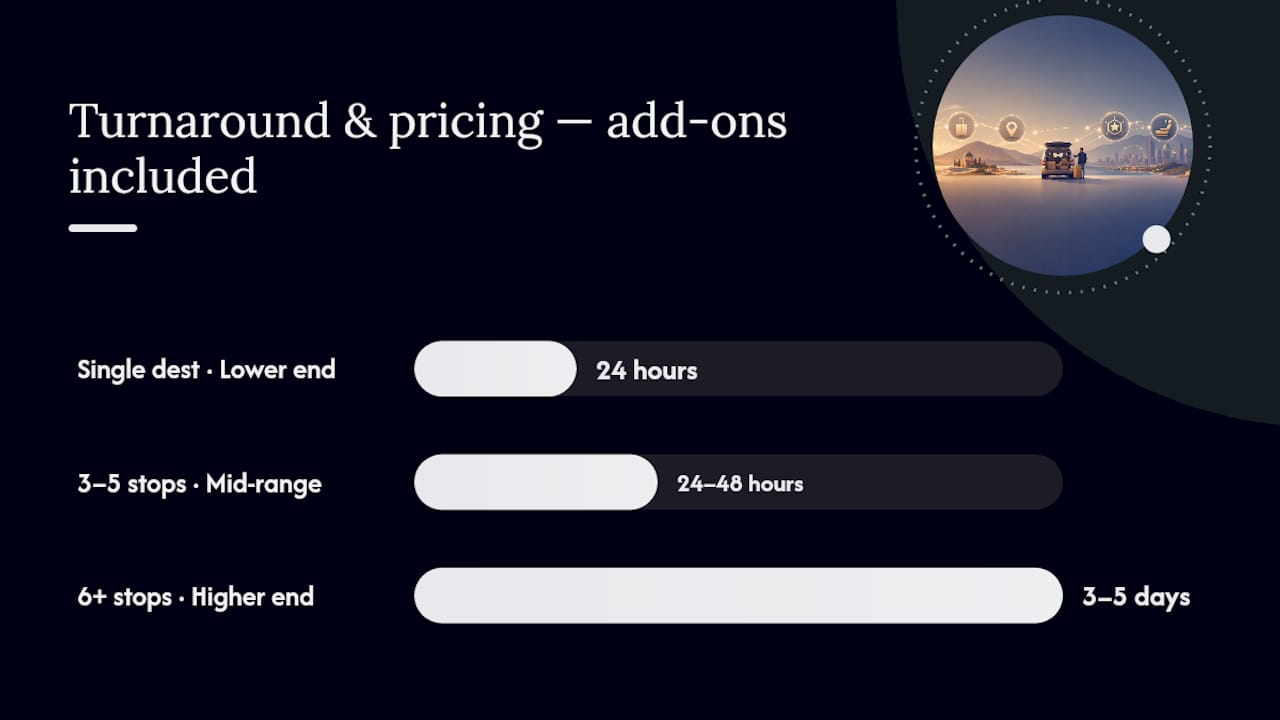
Turnaround depends heavily on complexity and how complete your intake information is:
| Trip complexity | Typical turnaround | Approximate price range |
|---|---|---|
| Single destination, simple pace | 24 hours (premium tier) | Lower end of service pricing |
| 3 to 5 stops, moderate complexity | 24 to 48 hours | Mid-range |
| 6+ stops or multi-country with visas | 3 to 5 business days | Higher end |
Revision policies typically include one or two free rounds within a defined change window, usually 48 to 72 hours after delivery. Changes beyond that, or requests that involve rebuilding the route entirely rather than swapping one activity, often trigger an added fee. This is standard across the industry and reflects the real work involved: a full re-sequencing isn't the same as moving dinner from Tuesday to Wednesday.
What Goes Wrong in Multi-Stop Trips, and How Do Planners Prevent It?
Most multi-stop trip failures trace back to a small handful of repeat offenders. Knowing them in advance is half the battle.
- Missed connections, usually from underestimating how long "45 minutes" actually takes at an unfamiliar airport or station. Planners counter this with fixed buffer rules, often padding connection windows well beyond the legal minimum.
- Unrealistic pacing, cramming six cities into eight days because it looked fine on a map. Planners fix this by grouping geographically close stops and recommending 2 to 4 nights per city rather than one-night stands across an entire continent.
- Conflicting check-in times, arriving at 11 p.m. to a hotel with a midnight check-in cutoff. Planners flag this during the accommodation-booking step, before it becomes a 90-minute sidewalk standoff.
- Time zone fatigue, back-to-back overnight flights with no recovery day. Planners build a buffer day after long-haul legs when the schedule allows it.
- Baggage transfer issues and single-airline assumptions, especially on itineraries that mix budget carriers with no interline agreements. Planners flag these routes and suggest backup connections.
A late-night arrival paired with an early-morning train is one of the most common self-inflicted wounds in DIY multi-stop planning. A planner who catches this during the buffer-planning stage will either shift the arrival flight, add a buffer night, or swap the train for a later departure, whatever keeps the traveler from sprinting through a station at 6 a.m. on two hours of sleep.
Hidden transfer costs deserve attention too. Baggage fees, taxi fares between train stations and airports, and luggage storage while you squeeze in a few extra hours in a city all add up, and experienced planners factor these into the budget rather than treating them as afterthoughts. Where clients should expect flexibility: activity order within a day, restaurant picks, minor timing shifts. Where they shouldn't: the core route sequence and booked flight or hotel dates, since unwinding those usually costs real money.
How Does Destlist Specifically Synchronize a Multi-Stop Trip?
Destlist's workflow runs on a hybrid model: AI handles the first pass, humans catch what AI can't see. Preference intake feeds an AI system that drafts route sequencing and rough timing across every stop. A human curator then reviews that draft for the details that require actual local knowledge, things no algorithm reliably gets right on its own.

Human reviewers specifically check local transit frequency (does that regional train really run every 20 minutes, or is that an off-peak schedule), visa and entry requirements per stop, current opening hours for anchor activities, walking times between points that look closer on a map than they are on foot, and basic neighborhood safety considerations for evening plans.
This is where technology tools matter most: cross-checking map-based distance impressions against real schedules and platform frequencies is standard practice among planners who take timing seriously, and it's the step that separates a workable itinerary from one that looks fine until you're standing at the wrong platform.
A few trust signals worth knowing before you commit:
- 24-hour premium delivery for travelers who need a fast turnaround.
- A human verification step layered on top of the AI draft, not instead of it.
- Sample itineraries available for browsing before you buy, including trips like a Bali escape and an Istanbul multi-day route.
- A clear revision policy with a defined change window rather than open-ended back-and-forth.
Deliverables arrive as a shareable digital document, a printable PDF, and an offline-ready folder, with calendar export and direct booking links included so you're not copying dates by hand into your phone.
Should You Hire a Planner or Do It Yourself?
The honest answer depends on three things: how many stops you're juggling, how much spare time you actually have, and how much a wasted afternoon of your time is worth to you.
| Trip type | Time available | Recommended route |
|---|---|---|
| Weekend, single or two cities, simple pace | Several hours to spare | DIY |
| 3 to 5 stops, moderate complexity | Limited time, some flexibility | Hybrid (planner for sequencing, DIY for simple bookings) |
| 6+ stops, multi-country, or work-plus-leisure combo | Little to no spare time | Paid planner |
Three quick examples make this concrete. A weekend multi-city hop between two nearby cities is manageable solo, since the margin for error is small and the stakes are low. A two-week multi-country trip through several visa zones is exactly where a travel advisor earns their fee, because the coordination overhead multiplies with every border crossing. A combined work-and-leisure trip, where a conference schedule has to mesh with personal sightseeing days, benefits from a planner who can build the leisure days around fixed professional commitments without you losing an evening to spreadsheet math.
The one-minute checklist: if your trip has more than three stops, involves more than one country, or you have fewer than two free evenings to plan it, hire a planner. Hybrid approaches that keep DIY control over simple bookings while handing complex sequencing to a professional often capture the best of both.
What I've Learned Watching Multi-Stop Trips Fall Apart (and Come Together)
The timing traps in multi-stop travel are remarkably consistent. It's almost always the same handful of mistakes: a connection window that looked fine on paper, a hotel check-in time nobody checked against the arrival flight, a route that zigzags because the cities "looked close" on a map that flattens actual travel time into nothing.
What surprises people most is that the fix usually isn't more research. It's better sequencing logic applied earlier in the process, before flights get booked and the whole route locks into place. That's the real value a planner brings: not more information, but a workflow that catches the interaction between decisions before those decisions become expensive to undo.
For more on the mechanics behind this, Destlist's blog covers how to plan multi-city trips and the common pitfalls that trip up even experienced travelers.
How Destlist Turns Your Preferences Into a Bookable Trip
Destlist is the alternative to weeks of tab-hopping between flight search engines, hotel sites, and train timetables. Instead of manually cross-checking every connection yourself, you fill out your preferences once and get a synchronized, ready-to-book itinerary back, often within 24 hours on the premium tier.
The custom travel itinerary service includes a day-by-day plan with anchor activities and backups, a full transit layer with buffer recommendations, sequenced booking links, and a packing list adjusted to your season and destinations. The done-for-you planning option adds the full AI-plus-human workflow described above, with local curators checking transit frequency, visa flags, and opening hours before anything gets delivered. Common add-ons include full booking service, last-minute change support, and partner perks like eSIM and travel insurance links.
If you're weighing convenience against cost for your next trip, it's worth reading how convenience factors into business travel decisions before you commit to a route. When you're ready, head to the custom itinerary page, enter your dates and must-sees, and expect a first draft with clear revision terms attached.
Sources
- Travel Itinerary Format: Full 2026 Guide — TravelBuzzy
- How to Crush Multiple Destinations Planning (2026)
- DIY Travel Planning vs Travel Agent: Which Option Saves More Time, Money, and Stress? - The Travel Home
- The Pros & Cons of Using a Travel Agent - U.S. News