
TL;DR:
- Eco-friendly travel planning involves making deliberate choices that reduce ecological impacts and support local communities. It emphasizes selecting sustainable transportation, verified accommodations, and designing slow, region-focused itineraries that prioritize community benefit and environmental responsibility. Small behavioral changes and proper preparation can bridge the intention-action gap, leading to more meaningful and greener travel experiences.
Eco-friendly travel planning is the practice of making deliberate travel choices that minimize ecological footprints and maximize positive outcomes for destinations and communities. Known in the industry as sustainable tourism planning, this approach covers every stage of a trip: how you get there, where you sleep, what you eat, and how you spend your time on the ground. The role of eco-friendly travel planning has never been more pressing. A Booking.com 2025 study found that 76% of travelers want sustainable options, yet only 23% actually choose lower-impact travel when booking. Closing that gap starts with a plan.
What is the role of eco-friendly travel planning?
Sustainable tourism planning works by converting good intentions into specific decisions before you ever leave home. It means choosing a train over a flight when the route allows, booking a Green Key certified hotel instead of a generic chain, and designing an itinerary that spends more time in fewer places. These choices compound. A single traveler who applies all three strategies on one trip can cut their travel carbon footprint by a measurable margin while spending money that stays in the local economy.
The distinction between eco-tourism, sustainable tourism, and conscious travel matters here. Understanding these differences allows you to make more accurate, intentional choices rather than defaulting to vague "green" marketing. Eco-tourism refers specifically to nature-based travel with conservation goals. Sustainable tourism is the broader framework covering environmental, social, and economic responsibility across all trip types. Conscious travel is the personal mindset that drives both.
How do transportation choices shape your travel's environmental impact?
Transportation accounts for roughly 14% of global greenhouse gas emissions, making it the single largest lever in your travel footprint. The mode you choose matters more than almost any other decision. Flying economy from New York to London generates roughly 0.5 metric tons of CO2 per passenger. Taking the Eurostar from London to Paris generates about 0.006 metric tons for the same distance. The gap is not marginal. It is structural.

| Travel mode | Relative CO2 per km | Best use case |
|---|---|---|
| Long-haul flight | Very high | Intercontinental only |
| Short-haul flight | High | Avoidable in most regions |
| High-speed rail | Low | Europe, Japan, select US corridors |
| Bus/coach | Very low | Regional and domestic travel |
| Electric vehicle rental | Low to moderate | Road trips with charging access |
When flying is unavoidable, carbon calculators like ICAO and Atmosfair give you reliable emissions estimates and offset options before you book. These tools let you compare routing scenarios, so you can see whether a layover in Frankfurt adds more emissions than a direct flight from a different hub. The answer is often yes. Direct flights almost always produce fewer emissions than connecting itineraries because takeoff and landing burn disproportionately more fuel.
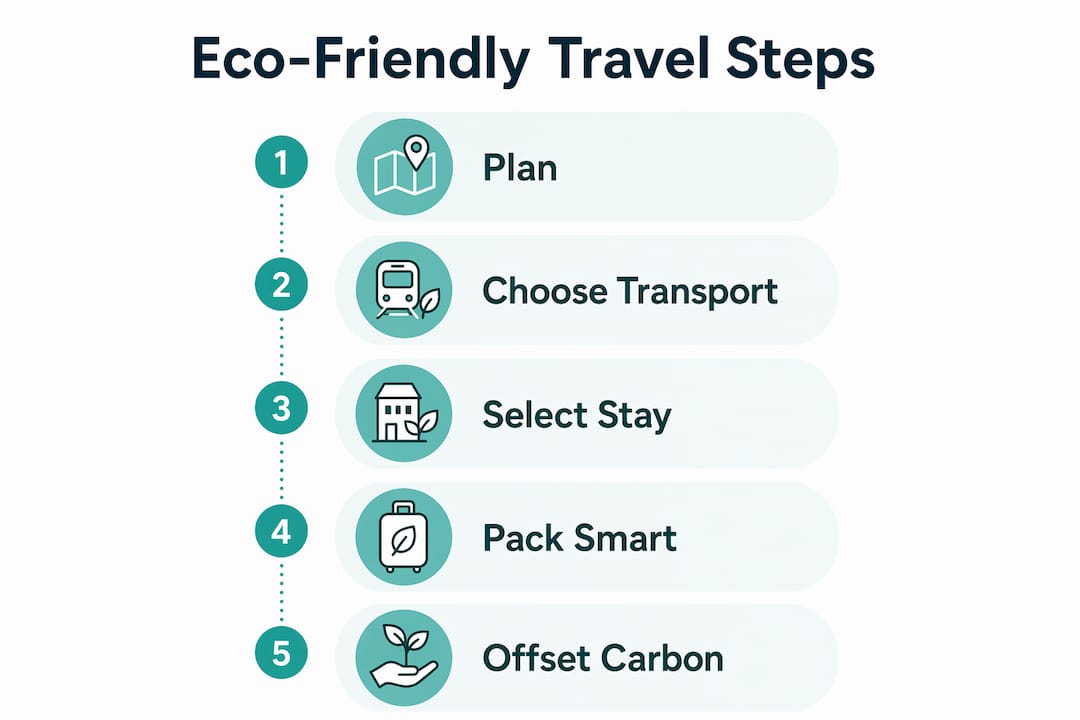
On the ground, careful trip routing combined with modal shifts to rail and bus is the most effective emission reduction strategy available to individual travelers. Renting an electric vehicle through services like Hertz EV or Enterprise Electric makes sense for road trips in regions with strong charging infrastructure, such as Norway, California, or the Netherlands.
Pro Tip: When booking multi-city trips, prioritize itineraries with the fewest total flight legs. Each takeoff and landing cycle burns more fuel per kilometer than cruising altitude. Two direct flights beat four connecting flights every time.
How do you choose accommodations and activities with real sustainability standards?
Certification bodies like Green Key, EarthCheck, and the Global Sustainable Tourism Council (GSTC) provide third-party verification that a property meets defined environmental and social standards. These are not self-declared labels. Green Key, for example, requires annual audits covering energy use, water consumption, waste management, and staff training. EarthCheck applies to resorts and large hospitality operators across Asia-Pacific and the Caribbean.
Less than 30% of travelers correctly distinguish credible certifications from self-declared "eco-friendly" claims. This matters because greenwashing is widespread. A hotel that installs a towel reuse sign is not the same as one that has reduced its water consumption by 40% and sources 80% of its food locally. When researching stays, look for the certification logo and verify it on the issuing body's official registry.
Community-based tourism takes the economic argument further. Revenue returned to local communities reaches 60 to 95% in community-based models, compared to just 10 to 20% in conventional tourism. That gap represents the difference between a destination that thrives from tourism and one that is hollowed out by it. Booking a homestay in Oaxaca, Mexico, or a community-run lodge in Rwanda's Volcanoes National Park puts money directly into the hands of local families rather than international hotel chains.
Here is a practical checklist for evaluating any accommodation or activity:
- Verify the property holds a recognized third-party certification (Green Key, EarthCheck, or GSTC).
- Check whether the business employs local staff and sources food from regional producers.
- Look for transparent reporting on energy, water, and waste practices on the property's website.
- For tours and activities, confirm the guide is locally based and the operator supports conservation programs.
- Avoid wildlife experiences that involve captive animals or direct human contact with wild species.
For a deeper look at how sustainable surf tourism operators build these standards into their business models, the surf industry offers a useful case study in community-led certification.
How to craft an eco-friendly itinerary that balances impact and experience
An eco-friendly itinerary is one designed around depth rather than distance. Slow travel itineraries focused on fewer destinations with longer stays reduce emissions by up to 30 to 50% compared to high-mileage sprint trips. Spending two weeks in Tuscany instead of five cities in five countries is not a compromise. It is a fundamentally different and often richer travel experience.
Building a green trip itinerary follows a clear sequence:
- Choose a region, not a checklist. Pick one geographic area and commit to exploring it thoroughly rather than ticking off landmarks across multiple countries.
- Book slower transport between stops. Use regional trains, ferries, or buses instead of budget airlines for internal legs.
- Schedule unplanned time. Downtime within itineraries reduces travel stress and prevents the excessive emissions that come from cramming too many activities into short windows.
- Prioritize active transport on the ground. Walking and cycling tours generate zero emissions and connect you to neighborhoods that bus tours skip entirely.
- Eat and shop locally. Choosing restaurants that source from local farms and markets keeps spending in the community and reduces the carbon cost of imported food supply chains.
Technology helps here. Apps like ToursByLocals connect you with vetted local guides in over 160 countries. Google Maps' eco-friendly routing feature now defaults to lower-emission directions in many cities. Destlist's customized travel planning tools let you build itineraries that account for travel flow, walking distances, and local experience options in one place.
Practical packing and daily habits that reduce your travel footprint
Zero-waste travel starts before you pack. Packing light and minimizing single-use items significantly reduces both luggage weight (which affects flight fuel burn) and plastic waste at the destination. The goal is a kit that covers every need without disposables.
Core items for an eco-friendly travel checklist:
- A reusable water bottle with a built-in filter (LifeStraw or Grayl work in most global destinations).
- Solid toiletries: shampoo bars, conditioner bars, and solid sunscreen eliminate plastic bottles entirely.
- Reef-safe mineral sunscreen, specifically if your trip includes coral reef destinations like the Maldives, Hawaii, or the Great Barrier Reef.
- A lightweight tote bag for markets and shopping to avoid single-use plastic bags.
- A reusable cutlery set and a collapsible coffee cup for street food and café stops.
Pro Tip: Before you travel, research the destination's recycling and waste infrastructure. Zero-waste success depends on knowing local systems. In some cities, like Kamikatsu, Japan, there are 45 waste categories. In others, recycling infrastructure barely exists. Adjust your kit accordingly.
Behavior matters as much as gear. Follow Leave No Trace principles on any nature excursion: pack out everything you pack in, stay on marked trails, and never feed wildlife. Respect local tipping customs, dress codes, and cultural practices. These behaviors signal respect and support the social dimension of sustainable travel, which is just as important as the environmental one.
Key takeaways
Eco-friendly travel planning reduces environmental harm and increases community benefit by applying deliberate choices to transportation, accommodation, itinerary design, and daily behavior.
| Point | Details |
|---|---|
| Transportation is the biggest lever | Choosing rail over short-haul flights and using carbon calculators like ICAO cuts the most emissions. |
| Certifications beat self-declared labels | Verify Green Key, EarthCheck, or GSTC credentials before booking any accommodation. |
| Community-based tourism multiplies impact | Local stays and guides return 60 to 95% of revenue to communities versus 10 to 20% in conventional tourism. |
| Slow travel cuts emissions and improves experience | Fewer destinations with longer stays reduce trip emissions by up to 30 to 50%. |
| Packing and behavior complete the picture | A reusable kit and Leave No Trace habits address the daily waste and cultural respect dimensions of sustainable travel. |
Why the intention-action gap is the real problem to solve
I have used ICAO's carbon calculator before booking every flight for the past three years, and the single most useful thing it does is make the abstract concrete. Seeing that a direct flight from Chicago to Lisbon generates roughly half the emissions of a connecting itinerary through three hubs changed how I route every trip. Numbers do what principles cannot: they force a decision.
The Booking.com data showing that 76% of travelers want sustainable options but only 23% follow through does not surprise me. The gap is not a values problem. It is a friction problem. Sustainable choices are often harder to find, harder to verify, and harder to compare than conventional ones. The traveler who wants to book a certified eco-lodge in Costa Rica has to cross-reference three different certification registries, read between the lines of hotel marketing copy, and often pay a booking fee to a platform that does not filter by certification at all.
The fix is not to lecture travelers about caring more. It is to reduce the friction at the point of decision. That means using tools that surface certified options, building itineraries that default to lower-impact transport, and treating slow travel not as a sacrifice but as the better product. Every trip I have taken that centered on one region rather than five cities has been more memorable, less exhausting, and cheaper. Intentional travel choices that hire local guides and deepen community interactions are not just ethical. They are better travel.
Start with one change per trip. Use Atmosfair before your next flight booking. Verify one hotel's Green Key status. Add one rest day to your next itinerary. Incremental progress compounds faster than most travelers expect.
— Helen
Plan your next trip with Destlist's eco-conscious itinerary tools
Knowing what sustainable travel requires is one thing. Building a trip that actually delivers on it is another, and that is where most travelers lose time.

Destlist combines AI-powered planning with human expertise to create custom travel itineraries that account for your sustainability preferences alongside your budget, travel style, and schedule. You can specify lower-emission transport options, request locally focused accommodation, and receive a day-by-day plan with mapped routes and walking times, all delivered within 24 hours. For travelers who want to explore eco-friendly destinations without spending hours cross-referencing certification registries and carbon calculators, Destlist does the research so you can focus on the trip itself.
FAQ
What is eco-friendly travel planning?
Eco-friendly travel planning, also called sustainable tourism planning, is the process of making deliberate pre-trip and in-trip decisions that reduce environmental harm and increase positive social and economic outcomes for destinations. It covers transportation choices, accommodation selection, itinerary design, and daily behavior.
How do I reduce my carbon footprint when traveling?
Choose rail over short-haul flights wherever possible, book direct flights when flying is unavoidable, and use carbon calculators like ICAO or Atmosfair to compare routing emissions before you book. On the ground, prioritize walking, cycling, and public transit over private car hire.
How do I spot greenwashing in hotels and tour operators?
Look for third-party certifications from recognized bodies like Green Key, EarthCheck, or the GSTC, and verify the credential on the issuing organization's official registry. Self-declared labels like "eco-friendly" or "green" without external verification are not reliable indicators of genuine sustainability practice.
Is sustainable travel more expensive?
Sustainable travel costs are often comparable to or lower than conventional travel when you choose local dining, community stays, and regional transport over global chains and budget airlines. Slow travel with longer stays in one region also reduces the cumulative cost of constant transit.
What should I include in an eco-friendly travel checklist?
A practical checklist covers a filtered reusable water bottle, solid toiletries, reef-safe mineral sunscreen, a reusable tote, and a collapsible cup. Beyond gear, include pre-trip research on the destination's waste infrastructure and a review of any certified accommodations or local guides you plan to book.