
TL;DR:
- A travel day planner combines daily activities with detailed logistics, serving as an on-the-ground command center. It includes hotel details, transit notes, confirmation codes, packing reminders, and emergency contacts to facilitate seamless execution of travel plans. Using a structured planner prevents last-minute confusion, updates easily, and adapts to real-time changes, making trip management more efficient.
A travel day planner is a structured, day-by-day document that combines your scheduled activities with the logistical details needed to execute each travel day without friction. Unlike a simple list of places to visit, it functions as your on-the-ground command center, holding hotel addresses, transit notes, confirmation codes, packing reminders, and emergency contacts alongside your daily agenda. Think of it as the difference between knowing where you want to go and actually knowing how to get there, check in, and make the most of every hour. For anyone serious about how to plan a trip efficiently, this tool is non-negotiable.
What is a travel day planner and why does it matter?
A travel day planner is the operational layer of your trip. The broader industry term for this concept is a daily travel itinerary, but a true travel day planner goes further by embedding execution-ready details directly into each day's schedule. Where a standard itinerary might say "Visit the Colosseum," a travel day planner adds the address, the nearest metro stop, your ticket confirmation number, and the check-in time at your next hotel.

Execution-ready details embedded next to each activity dramatically speed up decision-making when you are tired, jet-lagged, or navigating an unfamiliar city. That single design principle separates a planner that genuinely helps from one that just looks organized on paper.
The value compounds on multi-day trips. When you move between cities or countries, the cognitive load of tracking flights, accommodation changes, and local transit simultaneously is significant. A well-built travel day planner absorbs that load so your brain stays free for the actual experience.
What key components make up a travel day planner?
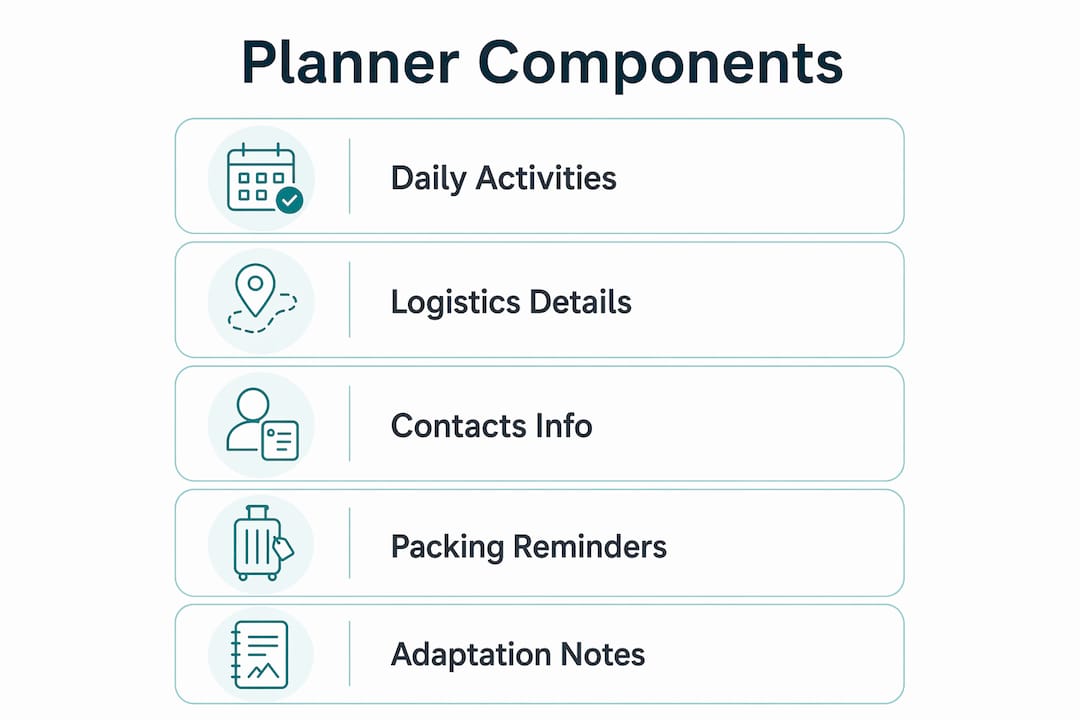
The most effective travel day planners share a consistent structure. Each section serves a specific function, and leaving any of them out creates gaps that tend to surface at the worst possible moments.
The core components are:
- Daily activity blocks. Organize each day into morning, afternoon, and evening segments. Include at least one confirmed "anchor" booking per block, such as a museum ticket or restaurant reservation, alongside flexible secondary options.
- Accommodation details. Hotel name, full address, check-in and check-out times, confirmation number, and a direct phone number. This information should appear on the day you arrive, not buried in a separate document.
- Transit and transfer notes. Flight numbers, train departure times, platform or terminal details, and estimated travel durations between locations. Transit details prevent the most common itinerary failures, particularly when connections are tight.
- Packing and departure reminders. Templates emphasize packing checklists and document notes alongside day schedules, which means your planner should flag what to pack the night before a departure day, not just what to do after you arrive.
- Essential documents section. Passport numbers, visa details, travel insurance policy numbers, and digital or printed copies of all confirmations. The U.S. State Department's International Travel Checklist specifically recommends keeping insurance and STEP enrollment details accessible at all times.
- Emergency and contact information. Local embassy numbers, your insurer's emergency line, and the contact details of anyone who needs to reach you. This section is the one you hope never to use and the one you will be most grateful for if you do.
Pro Tip: Create a "Day Zero" page in your planner covering the 24 hours before departure. List every item to pack, every document to print, and every confirmation to screenshot. Travelers who do this report far fewer last-minute panics at the airport.
How does a travel day planner differ from a general itinerary or checklist?
These three tools serve different phases of the same trip, and conflating them is one of the most common travel planning mistakes.
| Tool | Primary focus | When you use it | What it does NOT cover |
|---|---|---|---|
| Pre-trip checklist | Preparation and compliance | Weeks before departure | Day-of logistics or activity sequencing |
| Travel itinerary | Activity framework, day by day | During trip planning | Packing reminders, contact info, confirmations |
| Travel day planner | Execution of each travel day | On the ground, in real time | Long-range planning or pre-departure tasks |
A pre-trip checklist, like the kind recommended by the U.S. State Department, covers documents, vaccinations, customs requirements, and safety registrations. It is a preparation tool. A travel itinerary gives you the sequence of destinations and activities across your trip. A travel day planner is what you actually open at 7 a.m. in a foreign city to know exactly what happens next.
The distinction matters because official guidance for international travelers stresses pre-trip checklists for safety and legal compliance. Those checklists complement a travel day planner. They do not replace it. Treating your itinerary as your planner means you will constantly be hunting through separate documents for a hotel address or a bus schedule when you should be focused on enjoying the trip.
The travel day planner also handles something neither of the other tools does well: spontaneous adaptation. When a museum is closed or a restaurant is full, your planner's flexible secondary options give you an immediate alternative without requiring you to rebuild your entire day from scratch.
What formats and tools are available for travel day planners?
The format you choose should match your travel style, your comfort with technology, and your need for offline access. There is no single best format, but there are clear trade-offs between the main options.
Printable PDF templates are the most tactile option. Services like EasyDigitalDIY offer free travel planner templates that include annual calendars, packing lists, budget trackers, and daily schedule pages in one downloadable file. The advantage is zero battery dependency and easy annotation with a pen. The disadvantage is that updates require reprinting.
Mobile apps and AI trip planners combine itinerary building, budgeting, and packing in a single interface. Destlist, for example, uses AI to generate day-by-day itineraries with mapped routes and estimated walking times, then allows you to customize each day before your trip. The key question with any app is whether it works offline, since roaming data is unreliable in many destinations.
Digital documents using Google Docs or Notion give you maximum flexibility. You can build a custom template, share it with travel companions, and update it in real time. The trade-off is that building a good template from scratch takes time, and formatting can become unwieldy on a phone screen.
- Google Docs: free, shareable, accessible on any device with a browser
- Notion: powerful for linking databases of bookings and contacts, steeper learning curve
- Printable PDFs: best for travelers who prefer paper or have limited phone storage
- AI platforms like Destlist: best for travelers who want a ready-built structure with expert curation
Pro Tip: Whatever format you choose, always save an offline copy. Screenshot your hotel confirmations, download your PDF, or enable offline mode in your app before you leave your home country's Wi-Fi. Losing access to your planner at an international airport is a genuinely stressful experience.
How to create a practical travel day planner that adapts on the go
Building a planner that holds up under real travel conditions requires a specific approach. Here is a process that works for trips of any length.
- Anchor your fixed commitments first. Enter every flight, train, and confirmed hotel booking before you add a single activity. These are non-negotiable time blocks that define the shape of each day. Everything else fits around them.
- Group activities geographically. Assign activities to days based on location, not just interest. Crossing a city twice in one day to visit two attractions wastes two to three hours of travel time that could be spent at a third attraction nearby.
- Apply the three-activity rule per day. Cap each travel day to three priority activities: one anchor booking, one secondary option, and one optional activity you can drop if time runs short. This structure prevents exhaustion and keeps the day recoverable when things run late.
- Build in buffer days. On trips longer than five days, schedule at least one slow day with no anchor bookings. Transport and check-in times extend travel days well beyond their apparent duration, and a buffer day absorbs delays without cascading into the rest of your trip.
- Embed execution details at the point of use. Do not create a separate "documents" section at the back of your planner. Place the hotel address on the day you check in. Place the flight number on the morning of departure. Consolidating this information at the moment of need prevents the frantic document search that derails otherwise well-planned days.
- Update your planner on the ground. A travel day planner is a living document. When a restaurant closes or a tour gets canceled, cross it out and write in your backup option. Travelers who treat their planner as fixed tend to lose time debating alternatives in the moment. Travelers who treat it as a flexible guide adapt in seconds.
For travelers managing complex logistics like group airport arrivals, an airport pickup coordination guide can help you build the transfer section of your planner with precision, especially when multiple people are arriving on different flights.
Pro Tip: Link your packing list essentials directly to your departure day entries. When your planner reminds you to check out at 11 a.m., it should also remind you to pack your charger, adapter, and any items you used that morning.
Key takeaways
A travel day planner works because it combines your activity schedule with execution-ready logistics, giving you a single document that handles both planning and real-time decision-making on the ground.
| Point | Details |
|---|---|
| Definition is specific | A travel day planner includes logistics, contacts, and confirmations alongside daily activities. |
| Three tools, three roles | Pre-trip checklists, itineraries, and day planners each serve a distinct phase of travel. |
| Three activities per day | Cap each day at one anchor, one secondary, and one optional activity to prevent exhaustion. |
| Format follows travel style | Choose printable PDFs, apps, or digital docs based on offline needs and tech comfort. |
| Update on the ground | Treat your planner as a living document and revise it as conditions change during the trip. |
Why I think most travelers are using the wrong tool at the wrong time
I have planned trips across four continents using everything from handwritten notebooks to AI-generated itineraries, and the single most consistent mistake I see is travelers confusing a beautiful itinerary with an operational plan. They spend hours building a color-coded Google Sheet of activities and then arrive at their hotel with no idea what the check-in time is or where the nearest pharmacy is.
The mental relief that comes from a single, well-structured travel day planner is real and measurable. When I started embedding hotel addresses, transit notes, and confirmation codes directly into each day's entry rather than keeping them in a separate email thread, my travel experience changed noticeably. I stopped losing time to document hunting. I made faster decisions when plans changed. I actually enjoyed the trip more because the cognitive overhead was gone.
I am also a firm believer that flexible travel planning beats rigid hourly scheduling every time. The travelers I know who over-plan every hour end up frustrated when reality does not cooperate, and it never does perfectly. The three-activity framework described above is not a limitation. It is a permission structure that lets you say yes to the unexpected without losing the day.
My honest recommendation: build your planner in whatever format you will actually open at 7 a.m. in a foreign city. If that is a printed PDF in your jacket pocket, use that. If it is a Notion page on your phone, use that. The best travel day planner is the one you trust enough to rely on when you are tired and the train leaves in 20 minutes.
— Helen
Plan smarter trips with Destlist
Destlist takes the work of building a travel day planner and does it for you. Using AI combined with expert curation, Destlist generates custom travel itineraries that include day-by-day activity plans, mapped routes, estimated walking times, hotel and flight matching, and packing list tools, all in one place. You get a ready-to-use plan delivered within 24 hours, built around your budget, travel style, and destination preferences. Whether you are planning a solo city break or a multi-country family trip, Destlist gives you a structured, flexible plan you can trust from departure day to the last night. Start planning at destlist.com.
FAQ
What does a travel day planner include?
A travel day planner includes daily activity blocks, accommodation details, transit notes, confirmation codes, packing reminders, and emergency contact information. It is designed to give you everything you need to execute each travel day without searching through multiple documents.
How is a travel day planner different from a travel itinerary?
A travel itinerary outlines your activities day by day, while a travel day planner adds the logistical execution details, such as hotel addresses, check-in times, and transit instructions, that you need to actually carry out those activities on the ground.
What is the best format for a travel day planner?
The best format depends on your travel style. Printable PDF templates work well for travelers who prefer paper and offline access. Mobile apps and platforms like Destlist suit travelers who want AI-assisted planning with real-time updates. Google Docs and Notion work best for travelers who want full customization.
How many activities should I plan per travel day?
Cap each travel day at three activities: one confirmed anchor booking, one secondary option, and one optional activity. This prevents exhaustion and keeps your day manageable when transit or check-in logistics take longer than expected.
Do I need a separate checklist if I have a travel day planner?
Yes. A pre-trip checklist covers preparation tasks like document verification, visa applications, and travel insurance, while a travel day planner handles on-the-ground execution. The U.S. State Department recommends using both tools together for international travel.