
TL;DR:
- Hybrid travel planning combines AI tools with local and community insights to create efficient, personalized itineraries that adapt to real-world conditions. It involves generating a structured AI draft, verifying it with recent reviews and local contacts, and adjusting plans in real time for accuracy and authenticity. This approach maximizes efficiency, personalization, and flexibility while mitigating potential logistical errors.
Hybrid travel planning is the process of combining AI-powered digital tools with traditional human insights to craft flexible, personalized travel itineraries that adapt to real-world conditions. Also called blended travel planning in some professional contexts, this approach uses AI itinerary generators like those built into platforms such as Destlist alongside local guides, community forums, and real-time data to produce trips that are both efficient and authentic. The result is a planning method that outperforms purely automated or purely manual approaches by capturing the speed of technology and the nuance of lived experience. With per capita holiday spending projected to decline 18 to 20% in 2025 and 2026, travelers need every efficiency advantage available.
What is hybrid travel planning and how does it work?
Hybrid travel planning is defined by three interlocking layers: AI for speed and logic, local human insight for nuance, and community knowledge for accuracy and real-time updates. Each layer compensates for the weaknesses of the others. AI can generate a 10-day itinerary in seconds but cannot tell you that the best ramen shop in Osaka moved locations last month. A local guide knows that detail but cannot instantly cross-reference 200 flight combinations against your budget window.

The synthesis is what makes hybrid planning genuinely powerful. You feed your preferences, dates, and budget into an AI tool to get a structured skeleton. You then run that skeleton past recent traveler reviews on platforms like Reddit's r/travel or TripAdvisor, consult a local contact or tour operator, and adjust based on what you learn. The final itinerary reflects both computational efficiency and human judgment. This is not a new concept in principle, but the quality of AI tools available in 2026 makes it far more practical and precise than it was even three years ago.
How does hybrid planning compare to traditional or fully digital methods?
Traditional travel planning relies entirely on human expertise: travel agents, guidebooks, personal recommendations, and phone calls to hotels. It produces deeply personalized results but is slow, expensive, and limited by the planner's network. Fully digital planning uses AI tools exclusively, which is fast and cost-effective but prone to outdated information, generic suggestions, and what researchers call over-optimization without human judgment, where the itinerary looks perfect on paper but fails in practice.
Hybrid planning sits between these two poles and draws from both. The table below shows where each method wins and where it falls short.
| Approach | Speed | Personalization | Real-world accuracy | Cost |
|---|---|---|---|---|
| Traditional (human-only) | Slow | High | High | High |
| Digital (AI-only) | Fast | Moderate | Variable | Low |
| Hybrid (AI + human) | Fast | High | High | Moderate |
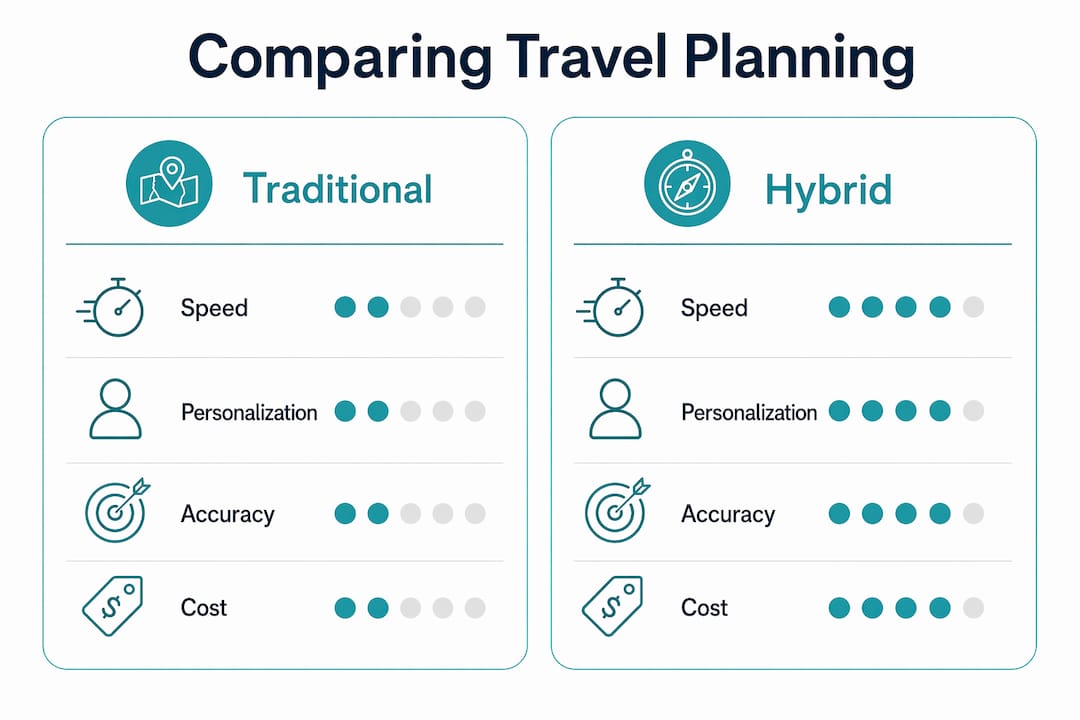
The hybrid model's main structural advantage is verification. An AI tool might schedule three museums in a single afternoon without accounting for walking distance, queue times, or a local festival that closes one venue. A human check catches all three problems before you board the plane.
Pro Tip: When using an AI tool to draft your itinerary, always ask it to flag assumptions it made about opening hours, transit times, or seasonal availability. Those flagged items become your human-verification checklist.
What are the key steps in an effective hybrid travel planning workflow?
A practical hybrid workflow follows a clear sequence. Skipping steps, especially the verification stage, is the most common reason hybrid plans underperform.
-
Define your parameters. Set your destination, travel dates, budget range, and non-negotiables before touching any tool. AI performs best when given precise inputs, not vague preferences.
-
Generate an AI skeleton. Use an AI itinerary tool to produce a day-by-day draft. This gives you a logical structure covering transport, accommodation zones, and activity clusters. Tools like Destlist's AI planner produce detailed itinerary drafts that include mapped routes and estimated walking times.
-
Verify with community input. Cross-reference the AI draft against recent posts on travel forums, destination-specific Facebook groups, and review platforms. Focus on anything time-sensitive: restaurant closures, construction near your hotel, seasonal transport changes.
-
Consult a local or specialist source. For trips longer than five days or to unfamiliar destinations, one conversation with a local guide, a destination-specialist travel agent, or a reputable tour operator adds disproportionate value. This step catches the details no algorithm surfaces.
-
Build in backup options. A resilient hybrid itinerary includes contingency plans based on local conditions such as weather forecasts and transit alerts, reviewed daily before departure. Assign one alternative activity per day for weather-dependent plans.
-
Adapt in real time. Hybrid planning does not end when you leave home. Use apps like Google Maps, local transit apps, and weather services to adjust on the ground. The itinerary is a framework, not a contract.
Pro Tip: Keep your verified itinerary in a shared Google Doc or Notion page with a notes column. Update it each evening with what changed and why. This creates a living document that improves as the trip progresses.
What are the benefits and challenges of hybrid travel planning?
The benefits of hybrid travel planning are concrete and measurable, but the method also introduces coordination complexity that purely automated planning avoids.
Key benefits:
- Efficiency. AI handles the time-consuming research phase in minutes. You spend your planning hours on judgment calls, not data gathering.
- Personalization. Itinerary personalization improves significantly when AI-generated structures are refined with your specific preferences and local knowledge.
- Real-time adaptability. Hybrid plans are designed to flex. When a train is canceled or a restaurant is closed, you already have a verified alternative.
- Cost-effective prioritization. With holiday budgets under pressure, AI helps identify where to spend and where to save, while human input confirms which splurges are actually worth it.
- Authentic experiences. Local verification steers you away from tourist traps and toward the places residents actually recommend.
Common challenges:
- Source coordination. Managing inputs from AI tools, forums, local contacts, and booking platforms simultaneously requires discipline. Without a clear system, information conflicts and creates confusion.
- Over-reliance on AI. Travelers who skip the human verification step often arrive with itineraries that are logistically flawed. AI confidence does not equal accuracy.
- Time investment. Hybrid planning is faster than traditional planning but slower than simply booking a package tour. It rewards travelers who invest a few focused hours upfront.
For bleisure travelers specifically, intentional time-blocking to separate work hours from leisure is the single most important discipline. Without it, neither the work nor the travel delivers its full value.
How can hybrid planning be customized for different traveler types?
Hybrid travel strategies are not one-size-fits-all. The workflow adapts significantly depending on who is traveling and what they want from the trip.
Solo travelers prioritize flexibility and safety. AI tools excel at generating solo-friendly itineraries with realistic pacing, while community forums like solo travel subreddits provide current safety and logistics intel that no algorithm reliably captures.
Families need buffer time and age-appropriate activity sequencing. AI can generate family itineraries quickly, but human verification is critical for confirming stroller accessibility, child admission policies, and realistic travel times with young children.
Bleisure travelers benefit from a specific structural rule: book the core work period first to lock in schedule reliability, then optimize leisure extensions separately to control marginal costs. This prevents the leisure tail from disrupting professional commitments. Remote work has made longer stays financially viable, and flexible productivity is now a core driver of bleisure travel growth in 2026.
Luxury travelers combining premium experiences with slower modes of transport, such as cruise and rail combinations, face a specific planning trap. The biggest mistake in hybrid luxury trips is booking premium hotels before planning the route. Plan the route first, then place high-comfort stays strategically at recovery points. Luxury multi-center itineraries combining rail and cruise segments start around £2,499 per person for 13-night trips, according to current European rail and cruise operators.
Budget travelers use AI to rank experiences by cost-to-value ratio and identify free or low-cost alternatives to paid attractions. Pairing this with smart budget travel planning tools helps stretch limited funds without sacrificing quality.
| Traveler type | AI role | Human input focus |
|---|---|---|
| Solo | Pacing and safety routing | Community safety intel |
| Family | Activity sequencing | Accessibility and age suitability |
| Bleisure | Work-leisure scheduling | Local coworking and dining options |
| Luxury | Route optimization | Premium experience curation |
| Budget | Cost-value ranking | Local free and low-cost alternatives |
Key takeaways
Hybrid travel planning works because it combines AI speed with human verification, producing itineraries that are both efficient and grounded in real-world conditions.
| Point | Details |
|---|---|
| Core definition | Hybrid planning blends AI tools with local and community knowledge for accurate, personalized itineraries. |
| Workflow sequence | Start with an AI skeleton, verify with community input, consult local sources, then adapt in real time. |
| Primary benefit | The method delivers personalization and efficiency simultaneously, which neither AI-only nor human-only planning achieves alone. |
| Biggest risk | Skipping human verification produces logistically flawed itineraries despite AI-generated confidence. |
| Traveler customization | The hybrid workflow adapts for solo, family, bleisure, luxury, and budget travelers with distinct priorities at each stage. |
Why I think most travelers are using hybrid planning wrong
Most people who describe themselves as hybrid planners are actually just using AI to generate an itinerary and then booking it without verification. That is not hybrid planning. That is AI planning with extra steps. The human layer is not optional decoration. It is the part that makes the plan work.
I have seen this pattern repeatedly. A traveler uses a well-known AI tool to build a Tokyo itinerary, books everything, and arrives to find that two of the restaurants no longer exist and one museum is closed for renovation. The AI had no way of knowing. A 20-minute scan of recent posts on a Japan travel forum would have caught all three issues before departure.
The other mistake I see is treating the itinerary as fixed once it is built. Hybrid planning is iterative by design. The future of travel blends premium and value services dynamically, and the best travelers treat their plans the same way. They hold the structure loosely and update it as conditions change. That flexibility is not a sign of poor planning. It is the point.
My honest recommendation: spend 60% of your planning time on AI-generated structure and 40% on human verification and real-time adaptation. Most people invert that ratio and then wonder why the trip did not match the plan.
— Helen
Plan your next trip with Destlist's hybrid approach
Destlist combines AI-driven itinerary generation with human curation to deliver exactly what hybrid planning promises: speed, personalization, and real-world accuracy in a single platform.
Every itinerary Destlist produces includes day-by-day activities, mapped routes, estimated walking times, weather alerts, and budget-matched flight and hotel options. The done-for-you travel planning service delivers a ready-to-book trip within 24 hours, built around your preferences and refined by travel experts. If you want to explore options before committing, Destlist's curated itinerary library covers 50 seven-day plans across cities and travel styles. For travelers who want a fully tailored plan, the custom itinerary service integrates your specific priorities from the first input.
FAQ
What is hybrid travel planning in simple terms?
Hybrid travel planning is the practice of using AI tools to generate an initial itinerary structure, then refining and verifying it with local knowledge, community input, and real-time data. The goal is a plan that is both fast to build and accurate in practice.
How is hybrid planning different from using a travel app?
A travel app provides AI-generated suggestions without the human verification layer. Hybrid planning adds deliberate community and local input to catch outdated information, logistical errors, and missed opportunities that no app surfaces on its own.
What tools do hybrid travel planners typically use?
Hybrid planners combine AI itinerary platforms like Destlist with community forums such as Reddit travel communities, local tour operators, and real-time apps like Google Maps and weather services. The combination of these sources is what defines the hybrid approach.
Is hybrid travel planning worth it for short trips?
Yes, even for weekend trips. A two-hour hybrid planning session, split between AI itinerary generation and a quick community verification check, consistently produces better results than booking based on AI output alone, particularly for restaurant and activity recommendations.
What is bleisure travel and how does it relate to hybrid planning?
Bleisure travel combines business and leisure within a single trip, and hybrid planning is the most practical method for managing both. Booking the work segment first, then optimizing the leisure extension separately, keeps costs controlled and schedules reliable.