
TL;DR:
- Premium trip planning offers personalized itineraries with expert support, reducing decision fatigue and enhancing overall travel experience. It includes curated choices, exclusive perks, and real-time advocacy, often at cost-neutral prices. This service is especially valuable for complex trips or first-time destinations, saving time and increasing trip satisfaction.
Premium trip planning is the deliberate choice to hand complex travel decisions to experts who deliver personalized, ready-to-book itineraries and real support throughout your trip. The benefits of premium trip planning go far beyond convenience. Travelers who use services like Destlist or work with certified advisors through networks like Virtuoso gain curated itineraries, exclusive perks, and a human advocate when things go sideways. If you've ever spent three weekends researching flights only to feel less certain than when you started, you already understand why choosing premium trip planning makes sense.
Why does premium trip planning reduce decision fatigue?
Decision fatigue is the mental exhaustion that sets in after making too many choices. Psychologist Barry Schwartz demonstrated that more options cause worse decisions, not better ones. Travel is one of the worst offenders. A single trip to Europe can involve comparing dozens of flight combinations, hundreds of hotels, and thousands of activity reviews before you book a single thing.
Premium planning cuts that process down to a manageable set of curated choices. An expert reviews your preferences, budget, and travel style, then presents two or three strong options instead of fifty mediocre ones. That shift alone changes how you feel about the trip before it even starts.
Unstructured planning also leads to costly last-minute decisions. When travelers skip the early planning stages, they end up booking rushed flights and overpriced hotels under pressure. A structured, sequenced approach resolves each planning stage in order, which removes the financial and logistical surprises that derail DIY trips.
The advantages of personalized travel planning show up in the details:
- Narrowed options: You receive a shortlist, not a search result page with 1,200 hotels.
- Sequenced decisions: Flights first, then hotels, then activities. No jumping between tabs.
- Budget clarity: Costs are mapped before you commit, not discovered at checkout.
- Pacing built in: Rest days and travel time are factored into the itinerary from the start.
Pro Tip: Ask your planner to flag one "splurge" option and one "value" option in each category. That single comparison is far easier to decide than an open-ended search.
What exclusive benefits do premium planning services offer?
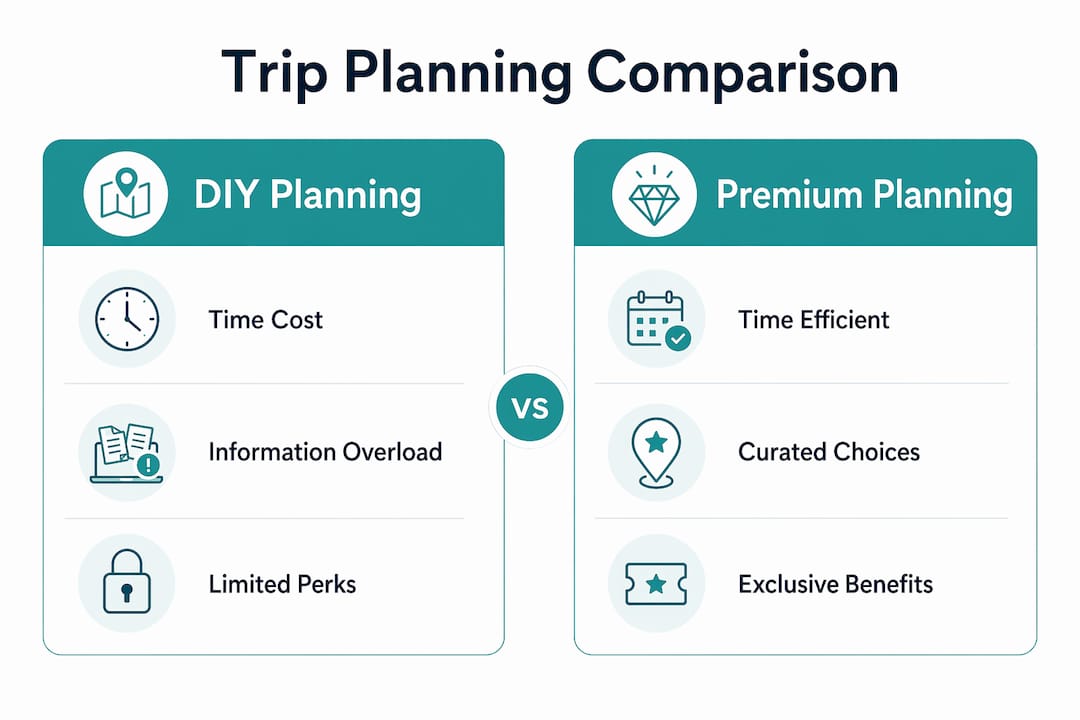
Premium planning services deliver perks that most travelers cannot access on their own. Virtuoso network advisors, for example, secure complimentary upgrades, daily breakfast, and spa credits at participating hotels, often at the same rate as a direct booking. That means you pay the same price and receive hundreds of dollars in added value.
The human element is equally important. One-third of ASTA travel advisors' clients are new customers, many of them citing the need for help with flight disruptions and hotel problems. That stat reflects a real shift. Travelers who once booked everything themselves are returning to advisors after experiencing the chaos of airline cancellations with no one to call.
The core benefits of working with a premium planning service include:
- Real-time advocacy: When a flight cancels, your advisor calls the airline on your behalf while you're still at the gate.
- Exclusive room categories: Advisors often access inventory not listed on public booking sites.
- Vetted recommendations: Every hotel, tour, and restaurant has been reviewed by someone who has been there, not just aggregated from user reviews.
- Weather and logistics alerts: Platforms like Destlist include weather alerts and mapped routes so you're never caught off guard.
Travel advisors' commissions typically come from the hotels and airlines they book, not from the traveler. That structure means premium planning is often cost-neutral. You pay the same rate you'd find online and receive a better room, a free breakfast, and a person to call if anything goes wrong.
How does premium planning improve the overall travel experience?
Well-paced, personalized itineraries produce measurably better trips. Research on mental health in contemporary tourism shows that reducing decision stress during travel increases enjoyment and emotional balance. That finding matters because most travelers underestimate how much cognitive load they carry into a vacation.

A premium itinerary does not just list where to go. It accounts for travel time between sites, energy levels across the day, and the difference between a packed schedule and a satisfying one. Advisors who create balanced agendas based on client priorities produce trips with better flow and higher satisfaction than self-built schedules.
Here is how a premium itinerary improves the experience in practice:
- Morning activities are matched to energy. Physically demanding tours are scheduled early, not after a long dinner.
- Transit time is visible. You know the walk from your hotel to the museum takes 18 minutes, so you leave on time.
- Alternatives are pre-selected. If a site is closed or crowded, your plan already includes a backup.
- Rest is built in. A good itinerary includes downtime, which prevents the burnout that turns a dream trip into an exhausting one.
Pro Tip: Tell your planner your energy pattern. If you're slow in the mornings, say so. A plan built around your rhythm will feel effortless instead of like a race.
Lowering cognitive load through personalized support is not a luxury add-on. It is the mechanism that turns a technically correct itinerary into a trip you actually enjoy. Destlist builds this logic into every plan, including estimated walking times and day-by-day activity flow.
DIY trip planning vs. premium services: which is better?
DIY planning works well for short, simple trips where the stakes are low. A weekend in a city you know, a road trip with flexible dates, or a repeat visit to a familiar destination. For anything more complex, the time cost and error rate of DIY planning outweigh the savings.
Expert travel advisors filter information overload into feasible, personalized itineraries that online search engines cannot replicate. Google can show you 400 hotels in Bangkok. It cannot tell you which one is a 10-minute walk from the floating market and has a rooftop pool worth the price difference.
| Factor | DIY planning | Premium planning |
|---|---|---|
| Time investment | 20+ hours of research | 1–2 hours of input |
| Option volume | Hundreds of unfiltered results | Curated shortlist |
| Error recovery | You handle cancellations alone | Advisor handles it for you |
| Exclusive perks | Rarely available | Upgrades, credits, breakfast |
| Itinerary pacing | Self-managed, often uneven | Professionally balanced |
| Cost vs. value | Visible cost, hidden gaps | Same or lower cost, more value |
Premium planning is most valuable when the trip involves multiple destinations, complex logistics, a special occasion, or a destination you have never visited. For customized travel itineraries that cover all of those variables, the time savings alone justify the choice. A trip to Bali, Istanbul, or Bangkok involves visa requirements, local transport, seasonal weather, and neighborhood-level hotel decisions that take real expertise to get right.
Key Takeaways
Premium trip planning consistently outperforms DIY planning on time savings, trip quality, and traveler satisfaction because expert curation removes decision fatigue, adds exclusive perks, and provides human support when problems arise.
| Point | Details |
|---|---|
| Decision fatigue is real | Too many options reduce choice quality; premium planners narrow the field to a curated shortlist. |
| Exclusive perks add real value | Virtuoso-style benefits include free breakfast, upgrades, and credits at no extra cost over direct booking. |
| Human support changes outcomes | Advisors handle cancellations and disruptions in real time, so you don't have to. |
| Pacing improves satisfaction | Professionally balanced itineraries reduce burnout and increase enjoyment throughout the trip. |
| Cost is often neutral | Advisor commissions come from suppliers, not travelers, making premium planning cost-neutral or better. |
What I've learned after years of watching travelers plan their own trips
The travelers who regret their vacations most are rarely the ones who overspent. They're the ones who spent 40 hours planning and still felt like they missed the best parts. I've seen it repeatedly. Someone builds a technically complete itinerary, books every hotel themselves, and arrives exhausted from the planning before the trip even starts.
The real value of premium planning is not the upgrades or the curated restaurant list, though those matter. It's the mental space you reclaim. When someone else has already solved the logistics, you show up to your trip present instead of anxious. That shift in mindset produces a fundamentally different experience.
For stress-free travel planning, the question is not whether you can plan a trip yourself. You probably can. The question is whether the hours you spend doing it are worth more than the cost of having an expert do it better. For most busy travelers, the answer is obvious once they've tried both.
— Helen
Destlist builds your trip so you can focus on taking it
Destlist combines AI-assisted planning with human expert review to deliver ready-to-book itineraries within 24 hours. Every plan includes day-by-day activities, mapped routes, estimated walking times, flight and hotel matching, and weather alerts.
Travelers who want a custom travel itinerary reviewed by real curators can submit their preferences and receive a complete plan without spending a weekend on research. Destlist also offers pre-built itineraries for destinations like Bali, Istanbul, and Bangkok for travelers who want a proven plan fast. The platform is built for people who value their time and want their vacation to actually feel like one.
FAQ
What is premium trip planning?
Premium trip planning is the practice of delegating travel research and itinerary creation to expert planners or AI-assisted platforms that deliver personalized, ready-to-book trips. The result is a curated plan tailored to your preferences, budget, and travel style.
Does premium trip planning cost more than booking yourself?
Not necessarily. Travel advisors typically earn commissions from hotels and airlines, so advisor fees are often absorbed by suppliers rather than charged to the traveler. You frequently pay the same rate and receive added perks like upgrades and free breakfast.
How does premium planning reduce travel stress?
Research shows that reducing decision stress during travel increases enjoyment and emotional balance. Premium planners remove the cognitive load of comparing hundreds of options by delivering a curated shortlist and a professionally paced itinerary.
When is premium trip planning worth it?
Premium planning delivers the most value for multi-destination trips, first-time visits to unfamiliar regions, special occasions, or any trip where logistics are complex. For simple weekend trips to familiar cities, DIY planning is usually sufficient.
Can AI replace human travel advisors?
AI tools accelerate research and itinerary building, but human advisors provide clarity and support that automated systems cannot replicate, especially during disruptions. Platforms like Destlist combine both: AI builds the plan, and human curators review and refine it.