
TL;DR:
- Structured itineraries save travelers time and reduce decision fatigue by clustering activities geographically.
- Balancing 60-70% planned time with buffers and non-negotiables enhances enjoyment and prevents burnout.
- Using AI tools improves itinerary accuracy and confidence, creating personalized trips that maximize experience.
Most travelers assume that skipping the plan means more freedom. For busy professionals with two weeks of vacation and a full inbox waiting on return, that assumption can quietly ruin a trip. Wasted hours stuck in traffic between poorly clustered attractions, paralyzed by too many restaurant choices, and falling into bed exhausted without actually having relaxed. Structure is not the enemy of adventure. It is the engine that makes real adventure possible, and this article breaks down exactly how to use it.
Table of Contents
- The efficiency advantage: How structure saves your time
- Finding balance: Avoiding burnout and building in flexibility
- Smarter planning: How technology and algorithms elevate itinerary accuracy
- Beyond logistics: How structure boosts focus, enjoyment, and debriefs
- The uncomfortable truth most travelers miss about itinerary structure
- Ready to travel smarter? Get a custom itinerary built for you
- Frequently asked questions
Key Takeaways
| Point | Details |
|---|---|
| Structure saves time | Grouping activities and planning logistics maximizes your actual travel experiences. |
| Balance prevents burnout | Including 30-40% free time leaves room for rest, delays, and spontaneous fun. |
| Technology enhances planning | Algorithm-driven tools personalize and streamline itineraries for optimal results. |
| Order boosts focus | A strategic sequence in your itinerary keeps you energized and engaged. |
| Personalization is key | Adapting your itinerary to your own interests and pace delivers the best travel memories. |
The efficiency advantage: How structure saves your time
With the misconception about spontaneity addressed, let's look at how structured itineraries translate into tangible time savings and genuine stress reduction.
Time is the one thing you cannot buy more of on vacation. Every minute spent backtracking across a city, debating where to eat lunch, or standing in the wrong line is a minute you will never get back. Clustered, geographic planning is the single most powerful antidote to this problem. When your morning museum, afternoon market, and evening restaurant all sit within the same district, you spend your day experiencing things instead of navigating between them.
Structured itineraries maximize efficiency by clustering activities geographically, keeping transit time at 30% or less of the day and leaving a full 70% available for actual experiences. That ratio changes everything. A traveler spending 70% of a 10-hour day doing things they love gets 7 hours of real experience. Their unstructured counterpart, constantly figuring out logistics, may net only 4.
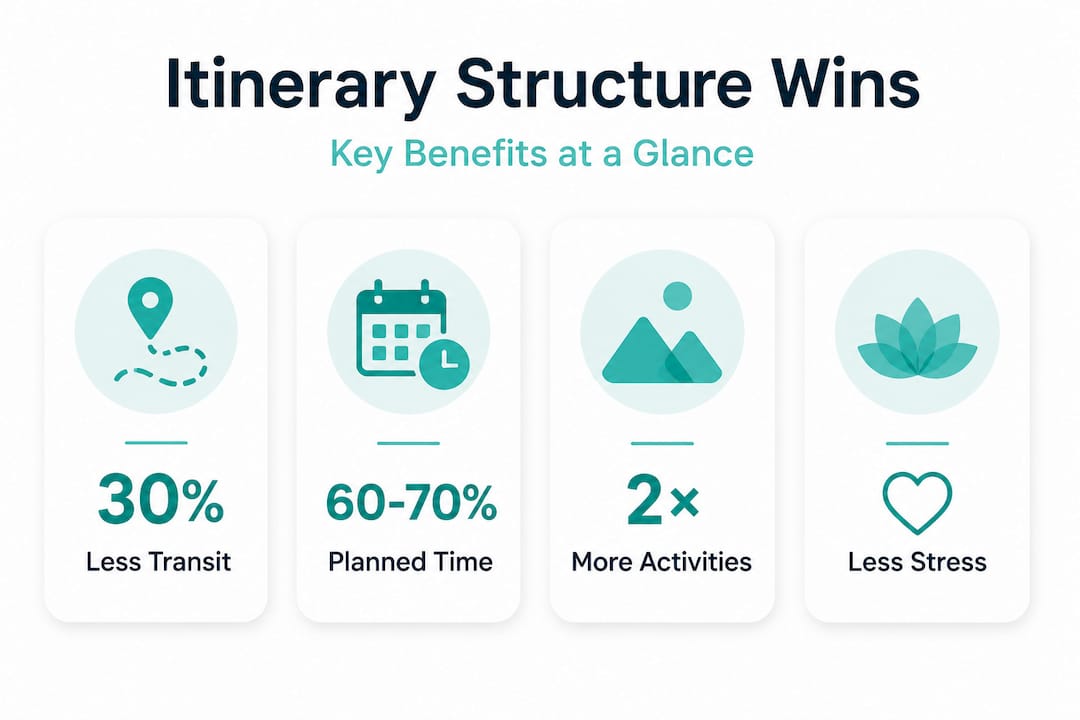
Here is what a typical travel day looks like when you compare the two approaches:
| Time block | Unstructured traveler | Structured traveler |
|---|---|---|
| 8:00 AM | Deciding where to eat breakfast | Breakfast at pre-selected café near first site |
| 9:30 AM | Researching nearby attractions | Entering first museum at opening |
| 11:00 AM | Transit across town (wrong direction) | Walking 8 minutes to second site |
| 1:00 PM | Still debating lunch spots | Seated at lunch reservation |
| 3:00 PM | Finally at first major attraction | Third activity of the day underway |
| 6:00 PM | Exhausted, heading back early | Leisurely dinner in same neighborhood |
| Total experiences | 2 activities | 5 activities |
The gap is not exaggerated. Decision fatigue, which is the mental depletion caused by making too many choices, compounds every hour you spend without a plan. Structured itineraries for busy professionals reduce decision fatigue and cognitive load by pre-resolving logistics, including buffers and fallbacks before you even board the plane.
"Pre-resolving decisions before the trip begins is one of the most underrated productivity strategies a traveler can use. Every choice you eliminate in advance is mental energy available for enjoyment." — Silk Harbor Travel
Staying near your planned activities also multiplies this benefit. Choosing accommodation close to your itinerary reduces daily transit dramatically. The math is simple: fewer miles per day equals more hours doing what you came to do.
The top time-wasters for unstructured travelers include:
- Browsing review apps for 20 to 30 minutes before each meal
- Backtracking between poorly sequenced attractions
- Waiting for sold-out tickets to experiences that required advance booking
- Losing time to analysis paralysis on "what to do next"
- Unexpected long transit routes between scattered activities
Pro Tip: Build one or two fallback options into each day, a nearby café, a park, or a secondary attraction. When something closes unexpectedly or the queue is longer than expected, you pivot immediately instead of standing still. This alone can reclaim 45 minutes on a disrupted day.
Good stress-free trip planning starts with treating your schedule as a tool, not a constraint. The structure serves you, not the other way around.
Finding balance: Avoiding burnout and building in flexibility
Having seen the time benefits, it is critical to understand why too much structure can sometimes backfire and how you can strike the right balance.

Here is the trap many organized travelers fall into: they over-correct. They schedule every hour, book every restaurant in advance, and turn what should be a restorative trip into a second job. Overpacked itineraries cause decision fatigue and reduce enjoyment. The recommended approach is 60 to 70% structured time with 30 to 40% slack for delays and spontaneity.
Understanding the difference between a rigid plan and a balanced one is easier with a direct comparison:
| Factor | Rigid itinerary | Balanced (with buffer) itinerary |
|---|---|---|
| Activity density | Every hour filled | 60-70% booked, rest open |
| Response to delays | Cascade of missed plans | Single adjustment, day intact |
| Energy at day's end | Often depleted | Usually refreshed |
| Memorable surprises | Rare (no room for them) | Frequent (space to follow them) |
| Enjoyment rating | Lower due to pressure | Higher due to breathing room |
Professionals deal with rigid schedules all week. Bringing that same structure to vacation without modification creates a different kind of stress, not less of it. The goal is structured freedom: a skeleton that holds the day together without crushing the life out of it.
Research from travel psychology confirms that overplanning creates burnout by removing the sense of agency travelers need to feel genuinely relaxed. When every hour is accounted for, there is no room to linger over a second coffee, wander a market stall, or simply sit and watch a city wake up.
"The best travel experiences often happen in the spaces between plans. Structure creates the frame; the best moments fill the gaps." — The Travel Psychologist
Here is how to build that balance deliberately:
- Anchor your day with two to three fixed points. A morning activity, a midday plan, and an evening booking are enough. Everything else can be fluid.
- Schedule buffer time explicitly. Block 30 to 45 minutes between activities instead of stacking them back to back. Treat that buffer as part of the plan, not wasted time.
- Identify one "wild card" slot per day. Leave one afternoon or morning intentionally unscheduled. This is when the best unplanned experiences tend to appear.
- Rate your non-negotiables before you go. Before the trip, rank your planned activities by priority. If the day gets compressed, you already know what stays and what goes.
- Pre-book only the hard-to-get items. Save advance reservations for high-demand attractions and popular restaurants. Leave casual activities open for the flow of the day.
Pro Tip: Use the 60 to 70% structure rule as your planning ceiling. If you find yourself filling more than two thirds of each day with fixed plans, cut something. Your future self, wandering a beautiful side street you never would have found on a packed schedule, will thank you. Build this habit into your flexible travel planning from day one.
Smarter planning: How technology and algorithms elevate itinerary accuracy
Once you understand how to balance structure and flexibility, using the latest tools makes both significantly easier and more precise.
Manual planning has a ceiling. You can cluster activities, read reviews, and estimate transit times, but you are still working with incomplete information and personal blind spots. Algorithmic tools do not have those limits. Time-aware planning models, including models like ANSA, improve itinerary accuracy by 5.5 to 8.2% over standard benchmarks by simultaneously optimizing for time windows, actual transit times between specific locations, and individual traveler preferences.
That 8.2% improvement might sound modest. But translated into a 7-day trip, it can mean the difference between a well-sequenced week and two days of suboptimal routing, missed openings, and exhausting backtracking.
Modern itinerary tools bring a set of capabilities that manual planning simply cannot match:
- Preference matching: Inputs like food preferences, interest categories, and physical activity levels shape every recommendation
- Real-time route minimization: Tools calculate optimal sequences across multiple stops using live traffic and transit data
- Time slot optimization: Opening hours, crowd patterns, and seasonal data inform when to visit each attraction
- Budget alignment: Accommodation and activity costs are balanced automatically against stated budgets
- Weather sensitivity: Outdoor activities are sequenced for optimal weather windows within the trip period
The most common travel planning mistakes, booking the wrong neighborhoods, missing sold-out experiences, misestimating transit times, are exactly the problems that AI itinerary planning addresses most effectively. These tools cross-reference thousands of data points that no individual traveler could process in the same planning window.
The real-world benefit is not just efficiency. It is confidence. When your logistics are optimized by a system trained on millions of travel patterns, you board every train and enter every restaurant knowing that the plan has been stress-tested. There is no second-guessing, no "should we have gone there first?" You can explore the custom itinerary benefits yourself when you see how much mental energy it frees up on arrival.
Looking at examples of personalized trip plans also reveals something important: the best ones do not feel like spreadsheets. They feel like your trip, built around what you actually love.
Beyond logistics: How structure boosts focus, enjoyment, and debriefs
Efficient planning with technology is just one piece. True mastery comes from understanding all the ways structure enhances your overall journey, including some benefits that most travelers never consider.
For professionals specifically, an itinerary does more than organize activities. It acts as a cognitive anchor. A well-ordered business travel itinerary functions as a strategic tool that maximizes focus, with the order of activities mattering for transitions and post-trip debriefs to prevent reactive, stressful decision-making.
That insight applies directly to leisure travel too. When you know what the day holds, your brain is not running a background process called "what are we doing next?" That freed-up bandwidth goes toward actually noticing where you are. You see more, absorb more, and remember more.
Consider the downstream benefits that a structured trip creates:
- Sharper focus during each activity because logistics are already resolved
- Better memory formation because you are present instead of preoccupied
- Easier post-trip reflection because the sequence of events is documented and clear
- Reduced arguments between travel companions because decisions are already made
- Faster recovery from disruptions because the plan has buffers and alternatives built in
"Order is not the opposite of experience. It is the container that makes experience possible. When travelers know what comes next, they can be fully where they are." — Booking.com Business Travel Resources
There is also genuine value in closing the loop after a trip. Documenting what worked, which restaurants over-delivered, which attractions were skippable, and which neighborhoods surprised you creates a personal travel database. That record makes your next trip faster to plan and more precisely matched to what you actually enjoy.
This is where itinerary planning workflows prove their value long after the trip ends. A documented plan is not just a schedule. It is a record of your travel identity, refined with each journey.
The uncomfortable truth most travelers miss about itinerary structure
So, what do all these insights mean for your next trip? Here is what most travel guides never actually say.
The uncomfortable reality is that even a perfectly structured itinerary fails when it does not account for your personal energy patterns. Most plans are built around time, not the person living inside that time. You might book a dense morning knowing logically it makes sense, while ignoring the fact that you are not a morning person and never have been. That mismatch between plan and person is where burnout begins.
Copy-pasting itineraries from the internet is particularly dangerous. Those plans were built for someone else's preferences, stamina, and travel style. Following them to the letter does not give you their experience. It gives you FOMO and exhaustion, two things you can get at home for free.
The professionals who travel most successfully share one habit: they identify one non-negotiable per day and let everything else flow around it. Not five non-negotiables. One. The single thing they would genuinely regret missing. Everything else gets organized in service of that anchor. This approach preserves the integrity of the trip without turning every day into an obligation.
"Structure should serve your experience, not replace it. The moment your itinerary becomes the point of the trip, you have already lost the plot."
That is the real lesson. Structure is a means. The experience is the end. When you confuse the two, a packed itinerary starts feeling like a second job instead of a vacation.
The best thing you can do before your next trip is get honest about your own patterns. Are you a slow-start morning person? Build that in. Do you need a two-hour lunch to feel human? Schedule it. Do you hit a wall at 4 PM? Do not put your most demanding activity there. Stress-free planning steps always start with self-knowledge before logistics.
Ready to travel smarter? Get a custom itinerary built for you
If reading this made you realize how much time and energy slips away on unstructured trips, you are already ahead of most travelers. The harder part is putting the right structure in place without spending 15 hours on research and spreadsheets.
That is exactly what DestList was built to solve. DestList combines AI-powered route optimization with human travel expertise to build custom travel itineraries that are geographically clustered, budget-matched, and fully personalized to your interests and travel pace. You share your preferences and your constraints. DestList delivers a ready-to-book trip within 24 hours, complete with flights, hotels, day-by-day plans, mapped routes, and estimated walking times. No spreadsheets. No second-guessing. Just a plan that works.
Start planning at destlist.com and see how much more enjoyable travel becomes when the structure is already built for you.
Frequently asked questions
How much time should be structured in a travel itinerary?
Aim for 60 to 70% structured time with the rest kept open for flexibility, unexpected opportunities, and recovery from delays.
Can technology really optimize my travel itinerary better than manual planning?
Yes. Algorithmic tools improve itinerary accuracy by up to 8.2% over manual benchmarks by simultaneously accounting for timing, preferences, and real transit data.
What's the biggest mistake in travel itinerary structure?
Overpacking activities. Overcrowded itineraries cause decision fatigue and reduce how much you actually enjoy each experience.
Why does itinerary order matter for professionals?
A well-ordered plan acts as a strategic cognitive tool, saving mental energy and keeping professionals focused rather than reactive throughout the day.
How can I personalize my travel itinerary efficiently?
Use AI-driven platforms that match your interests and habits to build plans around you. Personalized trip plans consistently outperform generic itineraries in both enjoyment and logistics.