
TL;DR:
- Contextual trip suggestions personalize travel itineraries based on real-time data, preferences, and situational factors. They outperform traditional methods by delivering more accurate, diverse, and adaptive recommendations that reflect travelers' unique circumstances. Choosing platforms that capture multiple context dimensions and offer transparency ensures smarter, more satisfying travel experiences.
Contextual trip suggestions are personalized travel recommendations that adapt to your interests, past experiences, budget, and real-time situational factors to produce itineraries that actually fit your life. The travel industry now calls this approach context-aware recommendation, and it represents a fundamental shift from generic "top 10 lists" to plans built around who you are and what you need right now. Advanced AI models like Deep Route Recommendation (DRR) and time-aware adversarial learning systems have made this precision possible at scale. Understanding why contextual trip suggestions outperform traditional planning methods helps you choose smarter tools and get more from every trip.
Why contextual trip suggestions beat generic planning
Context-aware travel recommendations work by combining multiple layers of personal and situational data into a single, coherent itinerary. Traditional planning tools rely on collaborative filtering, which groups you with travelers who clicked similar things, or rule-based systems that apply fixed logic regardless of your situation. Neither approach knows that you are traveling with a toddler in july, have a tight budget, and hate crowds.
Modern systems replace that blunt logic with embedding-based architectures. These models capture multi-dimensional travel preferences including booking window, party composition, and price sensitivity, enabling genuine discovery rather than revenue-optimized suggestions. The difference is meaningful. A rule-based system recommends the Louvre because you visited Paris. An embedding model recommends a private guided tour of Sainte-Chapelle on a tuesday morning because your profile signals a preference for art, small groups, and off-peak timing.
How dynamic context changes every recommendation
Dynamic contextual data is the engine behind truly personalized itineraries. The signals that feed these systems include your current location, time of day, weather forecasts, local events, emotional state, and even how long you have been walking. Emotion and affect integration into recommendation systems improves adaptability to user moods, reduces cold-start problems, and enhances satisfaction at the top-K recommendation level. Cold-start problems occur when a system has little data on a new user. Emotional signals fill that gap faster than behavioral history alone.

Multi-agent AI pipelines take this further by automating complex planning tasks as discrete, coordinated jobs. One agent checks your budget. Another scans weather forecasts. A third pulls live event data. The result is a feasible, end-to-end itinerary that no single algorithm could produce alone. This architecture vastly reduces the manual effort travelers spend reconciling flights, hotels, and daily activities.
Pro Tip: When evaluating any travel planning tool, ask whether it captures at least four context dimensions: time, budget, party size, and real-time conditions. Tools that capture fewer tend to recycle the same popular recommendations regardless of your situation.
Do context-aware models actually perform better?
The performance data on context-aware systems is clear and specific. The DRR model achieves 82.4% Recall, 79.6% Precision, and 81.2% Diversity, representing gains of 12.3%, 11.7%, and 10.8% respectively over traditional baselines. Higher diversity matters because it means the system surfaces genuinely varied options rather than clustering around the same popular spots.
Time-aware itinerary planning using adversarial learning delivers 5.5% accuracy, 8.2% recall, and 7.3% F1 improvements over standard large language model planners. These gains were validated across four major cities, confirming that the improvements hold in real-world conditions, not just controlled tests. Adversarial learning forces the model to generate itineraries that are hard to distinguish from those a knowledgeable local would create.
| Model Type | Recall | Precision | Diversity |
|---|---|---|---|
| Traditional baseline | ~70.1% | ~67.9% | ~70.4% |
| Deep Route Recommendation (DRR) | 82.4% | 79.6% | 81.2% |
| Time-aware adversarial learning | +8.2% vs. LLM baseline | +5.5% vs. LLM baseline | Validated across 4 cities |
| World knowledge-augmented generative | +12.4% vs. competitive baseline | Verified on 3 real-world datasets | Seasonal and event data integrated |
World knowledge-augmented generative models improve next point-of-interest recommendations by up to 12.4% compared to competitive baselines by incorporating real-world seasonal trends and live events. That 12.4% gain translates directly into fewer wasted hours at closed attractions or overcrowded plazas.
"Advanced travel recommendation systems now employ agentic architectures that integrate external knowledge of events, cultural trends, and weather into user behavioral patterns for real-time contextual narratives." — Research on world knowledge and real-time context in travel planning AI
The practical implication is straightforward. A system that knows a major festival is happening in your destination this weekend will route you differently than one working from static popularity scores. Context-aware travel plans do not just personalize. They stay accurate as conditions change.
What practical benefits do travelers actually get?
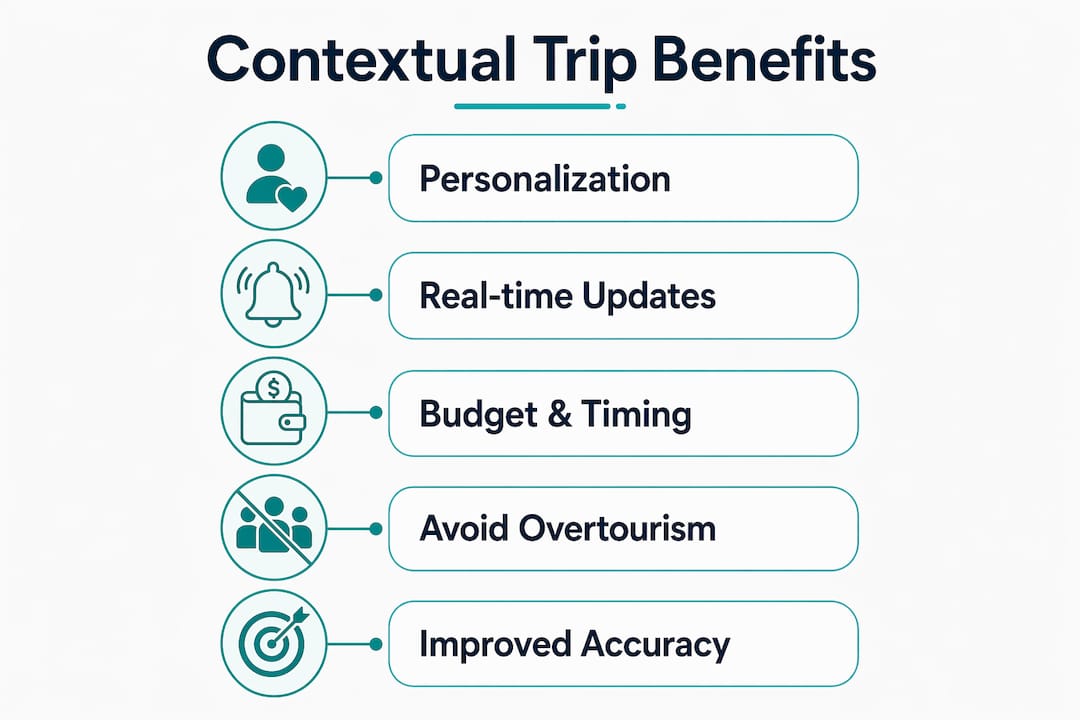
The benefits of context-aware trip suggestions extend well beyond better restaurant picks. Here are the core advantages travelers experience:
- Genuine personalization. Recommendations reflect your actual interests and travel history, not the average preferences of a demographic bucket.
- Adaptive itineraries. Real-time updates adjust your plan when weather shifts, a venue closes, or you decide to spend an extra hour somewhere.
- Reduced decision fatigue. Fewer irrelevant options mean faster, more confident choices at every stage of the trip.
- Overtourism mitigation. Context-aware platforms redistribute tourist flows spatially and temporally, guiding you toward less crowded areas or off-peak times. This benefits both you and the local community.
- Smarter budget use. Systems that capture price sensitivity and booking windows surface deals that match your actual constraints, not just the cheapest or most expensive options.
The overtourism benefit deserves more attention than it typically gets. Platforms like TOEP integrate sustainability scores and real-time local event data to guide visitors away from saturated hotspots. You get a less crowded, more authentic experience. Local economies benefit from distributed visitor spending. Both outcomes come from the same contextual logic.
Pro Tip: Before your next trip, spend five minutes filling out every preference field a planning tool offers. The more context you provide upfront, including travel pace, dietary needs, and activity intensity, the more accurate the recommendations become from day one.
One underappreciated challenge is that POI APIs lack travel-shaped context like administrative boundaries and thematic circuits, which are critical for realistic itinerary logic. This is why generic map-based tools often produce itineraries that look logical on paper but require impractical travel between stops. Context-aware systems built for travel solve this by layering thematic and geographic logic on top of raw location data. The result is a personalized trip plan that flows naturally from morning to evening without backtracking across the city.
How do you choose a platform with real context-awareness?
Not every tool that claims to be "AI-powered" captures meaningful context. Evaluating platforms requires looking at specific features, not marketing language.
Features that signal genuine context-awareness
Real context-aware platforms capture at least four dimensions of your situation simultaneously. Look for real-time data integration covering weather, local events, and crowd levels. Check whether the platform explains why it made a recommendation. Transparency in AI suggestions builds trust and helps you correct the system when it misreads your preferences.
| Platform Approach | Strengths | Limitations |
|---|---|---|
| Rule-based systems | Predictable, fast | Rigid, ignores personal nuance |
| Collaborative filtering | Leverages crowd wisdom | Averages out individual preferences |
| Embedding-based models | Captures multi-dimensional context | Requires sufficient user data |
| Hybrid AI + human curation | Balances scale with judgment | Higher cost, slower iteration |
User control is a non-negotiable feature. The best platforms let you override recommendations, adjust context inputs mid-trip, and see the reasoning behind suggestions. Systems that treat you as a passive recipient of recommendations rather than an active participant tend to produce itineraries that feel generic after the first day.
Emerging experimentation platforms like TOEP are also worth watching. They test context-aware and sustainability-focused recommendations in live tourism environments, which means the research validating these approaches is grounded in real traveler behavior, not just lab conditions. For travelers who want to understand itinerary personalization methods in depth, the distinction between embedding-based and hybrid approaches matters when choosing a tool that will serve you across multiple trips.
Key takeaways
Context-aware travel recommendations outperform traditional planning because they process multiple real-time signals simultaneously, producing itineraries that are accurate, personal, and adaptable.
| Point | Details |
|---|---|
| Context-aware models outperform baselines | DRR achieves 12.3% higher Recall and 10.8% higher Diversity than traditional methods. |
| Multi-agent pipelines reduce planning effort | Coordinated AI agents handle budget, weather, and feasibility checks automatically. |
| Emotional signals improve accuracy | Integrating mood and affect data reduces cold-start problems and improves top-K recommendation precision. |
| Overtourism is a solvable problem | Platforms using sustainability scores redirect travelers to less crowded spots and off-peak times. |
| Platform choice determines quality | Hybrid AI and human curation approaches balance personalization scale with real-world judgment. |
The shift i think most travelers are missing
I have spent years watching travelers spend more time planning a one-week trip than they spend on the trip itself. The problem is not a lack of information. The problem is that most planning tools still treat context as optional metadata rather than the core input.
The transition from static to dynamic recommendation systems is real and measurable. But most travelers have not updated their mental model of what a planning tool can do. They still open a browser, search "best things to do in Lisbon," and manually stitch together a dozen blog posts written for a generic audience. That process ignores everything that makes their trip unique: their pace, their interests, who they are traveling with, and what is actually happening in Lisbon that week.
What I find genuinely interesting about the current generation of context-aware systems is how they handle the sustainability dimension. Recommending the less-visited neighborhood is not just a nice ethical gesture. It produces a better trip. Fewer crowds, more authentic interactions, lower prices, and the satisfaction of discovering something most visitors miss. The data-driven approach to trip ideas makes this outcome repeatable, not accidental.
The one caution I would offer: context-aware tools are only as good as the context you give them. Travelers who rush through preference settings and skip the onboarding questions get generic results from sophisticated systems. The technology has caught up. The bottleneck is now the traveler's willingness to invest two minutes in telling the system who they actually are.
— Helen
How Destlist builds context into every itinerary
Destlist combines AI-driven recommendation logic with human travel expertise to produce itineraries that reflect your actual situation, not a template. Every plan accounts for your budget, travel dates, party composition, and activity preferences before a single destination is suggested.
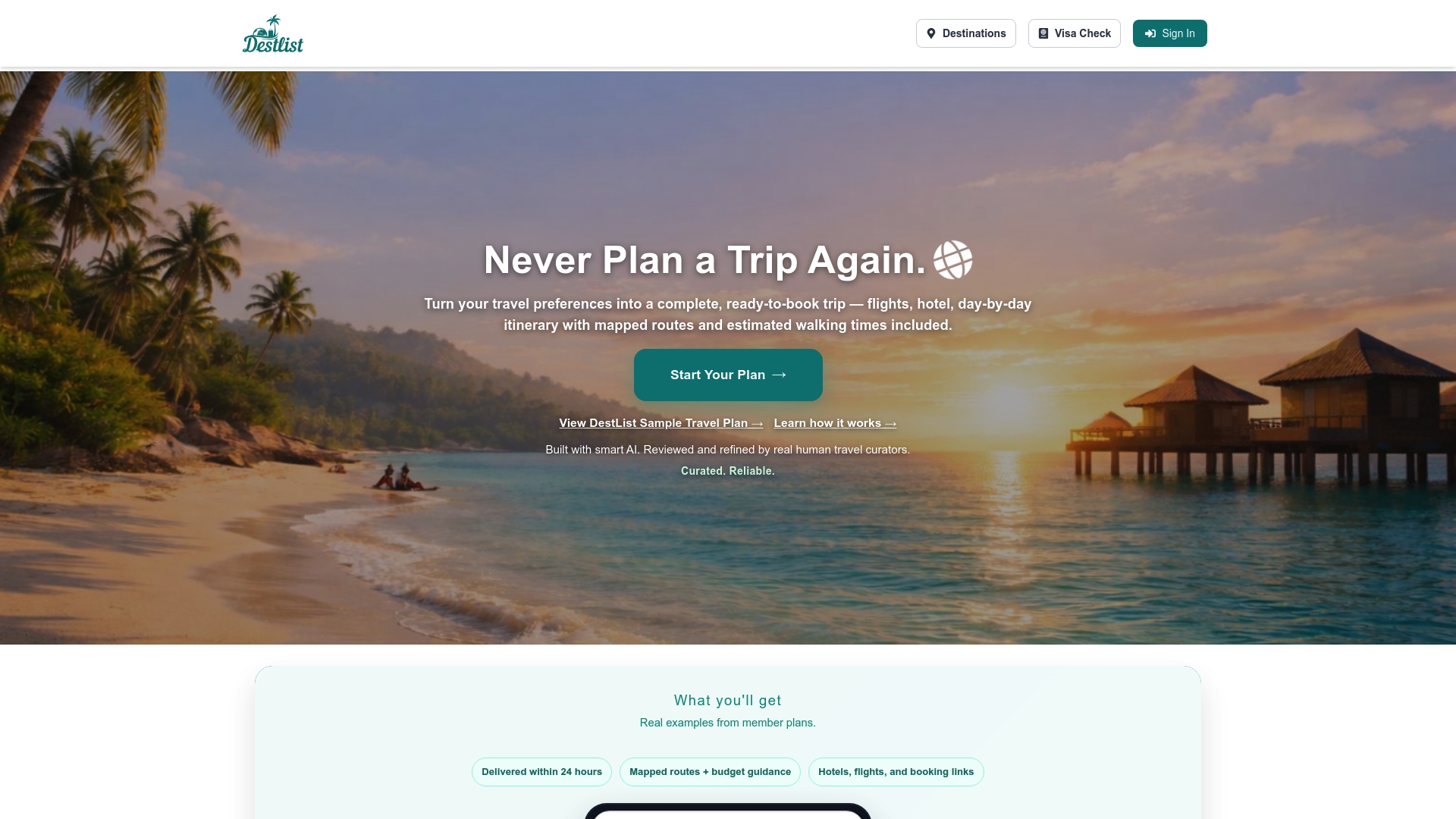
Destlist delivers ready-to-book custom itineraries within 24 hours, complete with day-by-day activities, mapped routes, estimated walking times, and weather alerts. The platform also includes a free destination decision tool that matches your mood and budget to the right trip before you commit to planning. Whether you are looking at 7 days in Bali or a city break in Istanbul, Destlist applies the same contextual logic to every recommendation. Explore curated travel plans built around your context and start planning a trip that actually fits you.
FAQ
What are context-aware travel suggestions?
Context-aware travel suggestions are recommendations generated by AI systems that factor in your personal preferences, real-time conditions, budget, party composition, and emotional state to produce itineraries tailored to your specific situation rather than a generic traveler profile.
Why do contextual trip suggestions outperform standard travel planning?
The Deep Route Recommendation model shows 12.3% higher Recall and 10.8% higher Diversity compared to traditional baselines, meaning context-aware systems surface more relevant and varied options than rule-based or collaborative filtering approaches.
How does real-time data improve travel recommendations?
World knowledge-augmented generative models improve point-of-interest accuracy by up to 12.4% by incorporating live seasonal trends and local events, so your itinerary reflects what is actually happening at your destination during your visit.
Can context-aware travel tools help with overtourism?
Yes. Platforms that integrate sustainability scores and real-time crowd data redistribute tourist flows toward less-visited areas and off-peak times, producing a better experience for travelers and reducing pressure on overcrowded destinations.
What should i look for when choosing a context-aware travel planner?
Look for platforms that capture at least four context dimensions simultaneously, offer real-time updates, explain their recommendations, and allow you to adjust inputs mid-trip. Hybrid systems combining AI with human curation tend to produce the most reliable results.