
TL;DR:
- Data-driven travel personalization utilizes AI analysis of behavioral data, booking patterns, and real-time information to create precise, customized trip recommendations. This approach enhances accuracy, efficiency, and local experience discovery by integrating human oversight, dynamic updates, and seamless booking across platforms; however, challenges like data freshness, bias, and privacy remain. Travelers can maximize benefits by providing detailed preferences, reviewing recent data, and combining AI tools with human judgment for more authentic and coherent travel plans.
Data-driven trip ideas are personalized travel recommendations generated by analyzing behavioral data, booking patterns, real-time conditions, and user preferences through AI and analytics platforms. The travel industry now calls this practice predictive travel personalization, and its role in modern trip planning is to replace guesswork with precision. Platforms like Expedia, MakeMyTrip, and AI-powered tools including ChatGPT have made this approach mainstream. 58% of U.S. millennials have already used AI for trip planning, compared to just 11% of baby boomers. That gap tells you everything about where travel planning is heading and who is leading the shift.
How the role of data-driven trip ideas reshapes personalization
The core mechanism behind data-driven travel personalization is continuous data ingestion. Platforms pull from booking histories, search behavior, social media activity, real-time pricing feeds, and even weather forecasts to build a picture of what you actually want, not what a generic travel guide assumes you want.
MakeMyTrip achieved sub-50ms personalization latency using Databricks, resulting in a 7% uplift in user click-through rates. That number matters because it proves personalization at speed is not just technically possible. It directly changes traveler behavior and booking decisions.
Modern AI trip planning apps go further than standard points-of-interest databases. They use BERT deep learning models to extract sentiment and regional slang from user-generated content, which surfaces hidden gems that no guidebook would ever include. A traveler asking for "authentic street food in Lisbon" gets results shaped by thousands of real visitor reviews, not a curated list from a tourism board.

Decision analytics transforms fragmented travel data into a compass for smarter decisions, shifting planning from reactive fixes to proactive strategies. For travelers, this means your itinerary adjusts before a disruption ruins your day, not after.
Here is what data analytics actually changes for your trip:
- Dynamic pricing awareness: Real-time fare data lets platforms flag the optimal booking window for flights and hotels, saving you money without manual research.
- Itinerary flow optimization: AI sequences activities by geography, opening hours, and crowd data so your day makes logical sense rather than sending you across a city twice.
- Immersive experience matching: Platforms match you to experiences aligned with your past behavior, whether that is adventure travel, culinary tourism, or slow travel.
- Disruption response: Near-real-time data means rebooking suggestions appear before you even realize your flight is delayed.
Pro Tip: Before using any AI trip planning tool, input your past trips, not just your wishlist. Platforms that learn from your actual travel history produce far more accurate suggestions than those working only from stated preferences.
Traditional planning vs. data-driven approaches
The contrast between traditional and data-driven travel planning is not subtle. Traditional planning relies on static guidebooks, travel blogs written months before your trip, and manual cross-referencing of review sites. It is time-consuming, prone to outdated information, and produces the same Eiffel Tower itinerary everyone else gets.
Data-driven approaches use near-real-time data refreshed 10 to 30 minutes before departure, improving itinerary prediction accuracy by 21.7%. That is the difference between a hotel recommendation that accounts for a local festival driving up prices and one that does not.
| Feature | Traditional planning | Data-driven planning |
|---|---|---|
| Information freshness | Static, weeks or months old | Real-time or near-real-time updates |
| Personalization depth | Generic, based on destination type | Behavioral, based on your specific history |
| Booking efficiency | Multiple platforms, manual comparison | Single-platform, multi-component booking |
| Disruption handling | Reactive, manual rebooking | Proactive alerts and automatic alternatives |
| Hidden gem discovery | Limited to popular review sites | Deep learning analysis of social and local data |
| Time investment | High, 5 to 20 hours per trip | Low, minutes to hours depending on complexity |
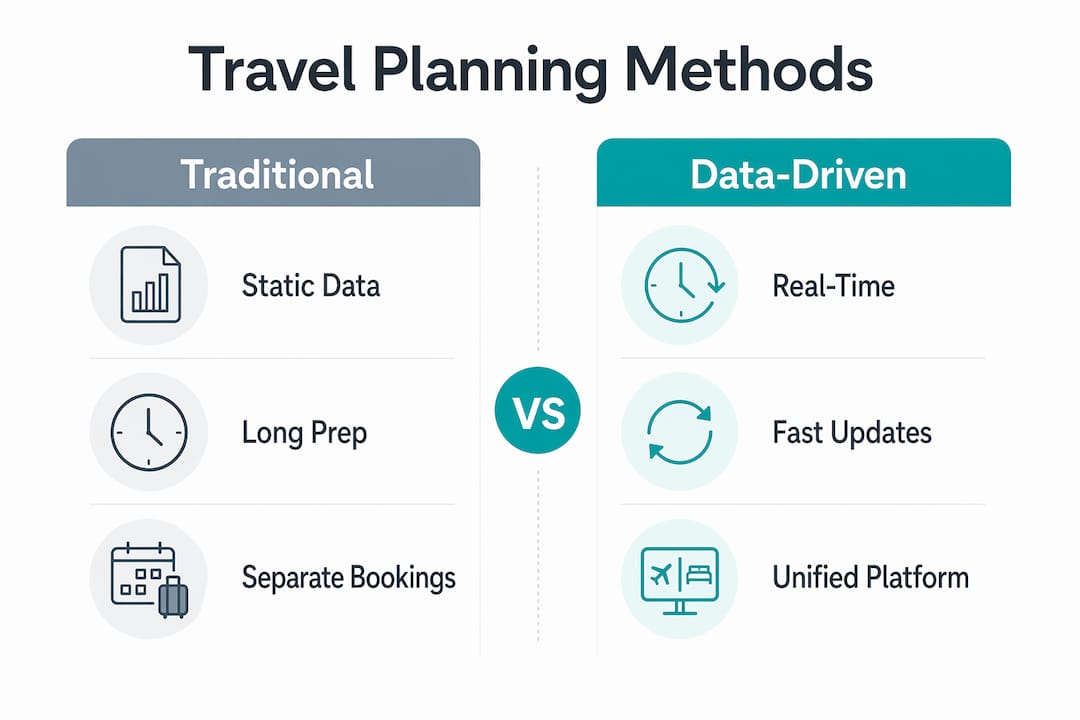
The single-platform advantage is significant. 77% of travelers are likely to book multiple trip components on the same platform, and that figure rises to 83% among Gen Z. Platforms that offer integrated travel planning capture loyalty precisely because they eliminate the friction of managing flights, hotels, and activities across five different tabs.
What are the real benefits and challenges of data-driven travel?
The benefits of data-driven travel are concrete and measurable. You save time, spend more accurately, and arrive at destinations with itineraries that reflect your actual preferences rather than a travel agent's assumptions.
Key benefits include:
- Time efficiency: AI platforms compress 10 to 20 hours of manual research into a ready-to-book plan delivered in under 24 hours.
- Budget precision: Real-time pricing data and fare tracking align your bookings with your actual budget rather than estimates.
- Personalized itineraries: Behavioral data produces trip structures that match your travel style, pace, and interests at a level no static template can replicate.
- Integrated booking: Multi-component booking on one platform reduces coordination errors and last-minute surprises.
- Smarter discovery: Deep learning analysis of social content surfaces local experiences that standard recommendation engines miss entirely.
The challenges are real too. Data freshness is the most underappreciated risk. An AI recommendation built on stale data can send you to a restaurant that closed six months ago or a hotel undergoing renovation. 39% of travelers want formal training to build trust in AI booking tools, which signals that adoption is not automatic even when the technology works well.
AI bias is a structural problem. Models trained predominantly on Western travel patterns underserve travelers seeking experiences in Southeast Asia, West Africa, or Central America. Human oversight corrects for this, which is why the strongest platforms combine algorithmic recommendations with expert curation.
Pro Tip: Always cross-check AI-generated restaurant and activity suggestions against a source updated within the last 30 days. Google Maps reviews with recent timestamps and local travel forums are your best verification tools.
Privacy is the third challenge. Personalization requires data, and that data includes your location history, spending behavior, and travel patterns. Before connecting a new platform to your accounts, review what data it retains and whether it shares with third parties.
Practical applications and future trends shaping data-driven travel
The most advanced current application is real-time itinerary adjustment. Platforms integrated with live flight data, weather APIs, and local event feeds can reroute your day automatically when conditions change. This is not a future feature. It exists now in platforms built on unified data pipelines.
AI travel apps already analyze unstructured social data using deep learning to identify emerging neighborhoods, seasonal events, and local favorites before they appear on mainstream travel sites. For travelers who want to avoid overtourism hotspots, this capability is genuinely useful.
Looking ahead to the next two to three years, three trends will define data-driven travel planning. First, agentic AI will handle end-to-end booking autonomously. You set parameters, the agent books flights, hotels, transfers, and activities without you touching a single confirmation screen. Second, half a billion smartphone users are projected to hold digital identity wallets by 2026, enabling verified, frictionless payments across multiple suppliers in a single transaction. Third, sustainability analytics will become a standard filter, letting you optimize your trip for carbon footprint alongside cost and convenience.
Neural rendering and 3D digital twins of destinations are moving from concept to pilot. Imagine previewing the exact view from your hotel room or walking a museum's layout before you book. These tools reduce post-booking disappointment and increase traveler confidence in unfamiliar destinations.
How to maximize data-driven tools for your next trip
Getting the most from data-driven travel recommendations requires more than downloading an app. The quality of your output depends directly on the quality of your input.
- Build a detailed preference profile. Platforms like Destlist produce better itineraries when you specify travel pace, accommodation style, dietary needs, and activity intensity. Vague inputs produce generic outputs.
- Use behavioral history, not just stated preferences. Connect platforms to your past booking data where privacy terms allow. Your actual travel history is more accurate than what you think you prefer.
- Prioritize platforms with human curation layers. Pure algorithmic recommendations miss context. The best personalized trip plans combine AI efficiency with expert review to catch errors and add local nuance.
- Engage with authentic social data. Gen Z travelers in particular trust peer voices over algorithmic suggestions. Cross-referencing AI recommendations with recent social content from real travelers in your destination adds a layer of authenticity no algorithm fully replicates.
- Verify data freshness before booking. Check when a recommendation was last updated. A 21.7% improvement in accuracy from near-real-time data means freshness is not a minor detail. It is the difference between a smooth trip and a frustrating one.
Expedia's research confirms that travelers who book multiple components on one platform report higher satisfaction and fewer coordination problems. Platforms that connect flights, hotels, transfers, and activities in a single data environment give you a coherent trip rather than a collection of separate reservations.
Key takeaways
Data-driven trip planning works because it combines real-time behavioral data, AI personalization, and human curation to produce itineraries that are faster, more accurate, and more relevant than any manual research process.
| Point | Details |
|---|---|
| Personalization requires real data | Input your actual travel history, not just a wishlist, for accurate AI recommendations. |
| Data freshness determines accuracy | Near-real-time data improves itinerary prediction by 21.7%, making freshness a critical quality factor. |
| Integrated booking drives loyalty | 77% of travelers prefer booking all trip components on one platform for convenience and fewer errors. |
| Human curation corrects AI bias | Algorithmic recommendations alone miss cultural nuance; expert oversight produces more trustworthy results. |
| Agentic AI is the near-term future | Digital identity wallets and autonomous booking agents will make end-to-end trip planning nearly hands-free by 2026. |
Why I think most travelers are still underusing data-driven tools
I have spent years watching travelers spend 15 hours planning a one-week trip, cross-referencing outdated blog posts and review sites that were last updated before a pandemic reshaped entire destination economies. The tools to do this better exist right now, and most people are not using them correctly.
The mistake I see most often is treating AI trip planning as a search engine upgrade. You type in "best things to do in Tokyo" and expect a smarter Google result. That is not how these platforms work at their best. The real power comes from feeding them context: your budget, your travel pace, who you are traveling with, what bored you on your last trip, and what surprised you in a good way.
The other underappreciated factor is the human layer. I am genuinely skeptical of fully automated itineraries for complex, multi-city trips. Algorithms are excellent at optimization within defined parameters. They are poor at recognizing that a traveler who loved a slow food tour in Bologna probably does not want a packed 12-stop day in Kyoto, even if the data says those two preferences correlate. That judgment call requires a person.
What I find most promising is the combination: AI handles the logistics, pricing, and sequencing while a human curator reviews the output for coherence and authenticity. Platforms that build this hybrid model produce trips that feel designed, not generated. That distinction matters more than any latency metric.
The travelers who will get the most from data-driven tools in 2026 are the ones who treat them as a starting point for a conversation, not a final answer. Engage with the output, push back on suggestions that do not fit, and use the time you save on logistics to think harder about what you actually want from a trip.
— Helen
Plan your next trip with Destlist's AI-curated itineraries
If the data and frameworks in this article resonate with how you want to plan your next trip, Destlist puts them into practice for you.
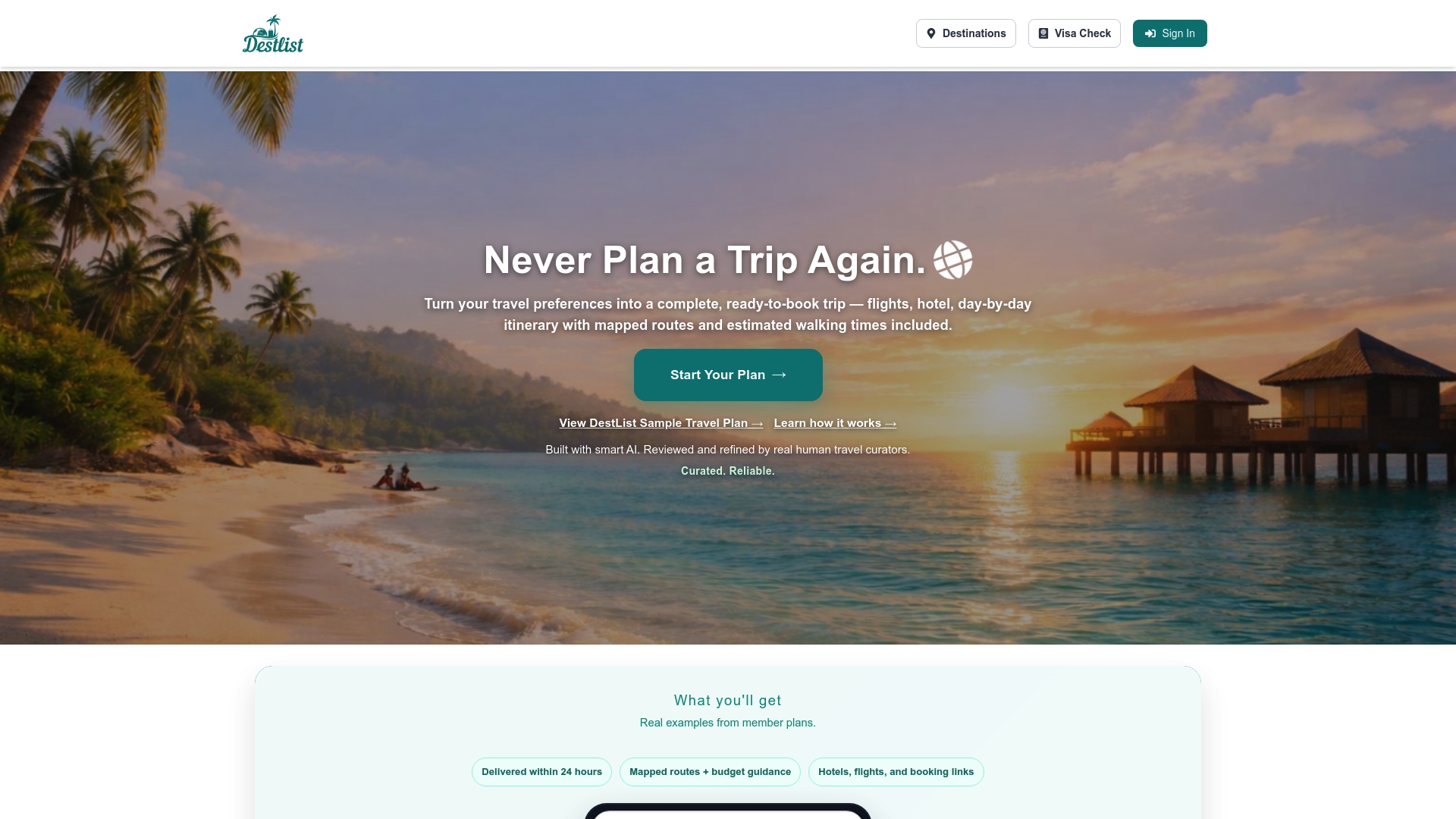
Destlist combines AI-powered trip building with human expert curation to deliver ready-to-book itineraries within 24 hours. Every plan includes day-by-day activities, mapped routes, flight and hotel matching within your budget, and weather alerts. You specify your preferences and travel style. Destlist handles the research, sequencing, and booking logistics. Explore curated travel plans built around your specific preferences, or start with a custom travel itinerary if you have a specific destination in mind. For travelers who want the benefits of data-driven planning without the hours of research, this is the direct path.
FAQ
What are data-driven trip ideas?
Data-driven trip ideas are personalized travel recommendations generated by analyzing your booking history, search behavior, real-time pricing, and preferences through AI and analytics platforms. The industry term for this practice is predictive travel personalization.
How does data improve travel planning accuracy?
Near-real-time data refreshed 10 to 30 minutes before departure improves itinerary prediction accuracy by 21.7%, according to research on AI trip planning apps. Stale data is the primary cause of inaccurate recommendations.
Which travelers use AI trip planning tools most?
Millennials lead AI adoption in travel planning, with 58% having used AI tools for trip planning, compared to 45% of Gen Z and 11% of baby boomers, based on Phocuswright's 2026 travel research.
What is the biggest challenge with AI travel recommendations?
Data freshness and AI bias are the two most significant challenges. Models trained on limited geographic data underserve travelers exploring less-documented destinations, and recommendations built on outdated information produce poor real-world results.
How do I get better results from AI trip planning platforms?
Input your actual travel history and specific preferences rather than generic destination requests. Platforms that combine AI recommendations with human curation, like Destlist, produce more coherent and trustworthy itineraries than fully automated tools alone.