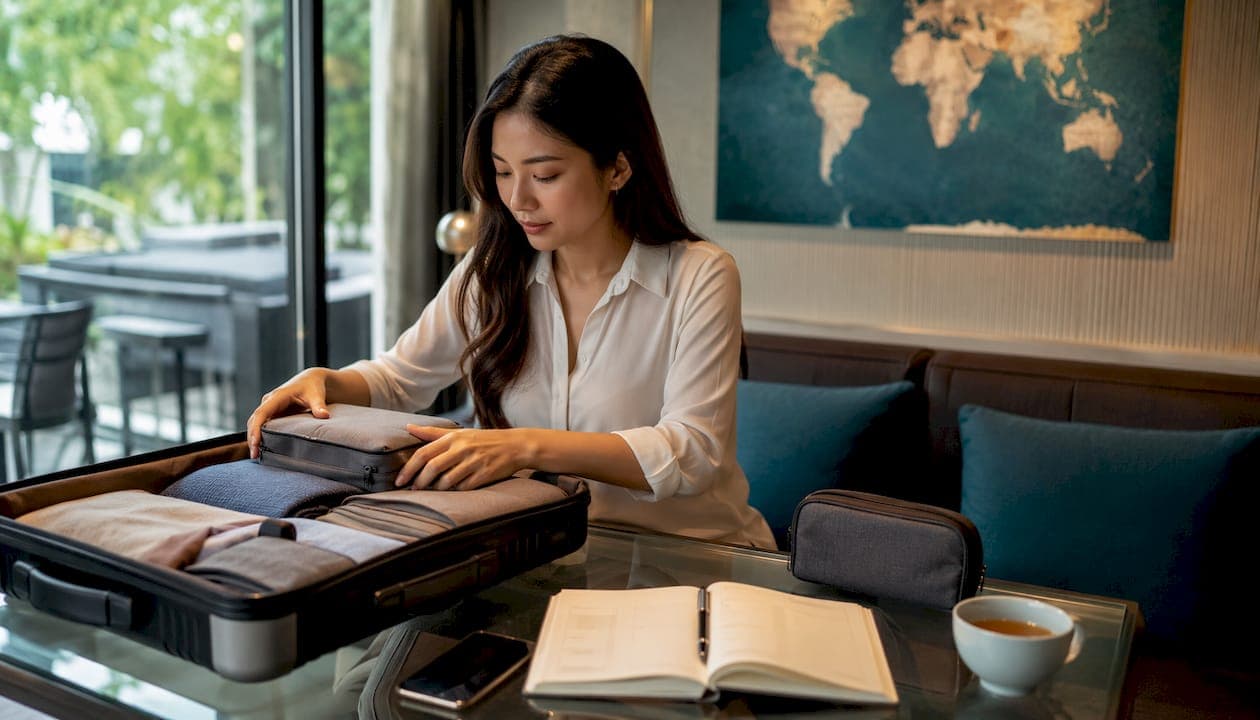
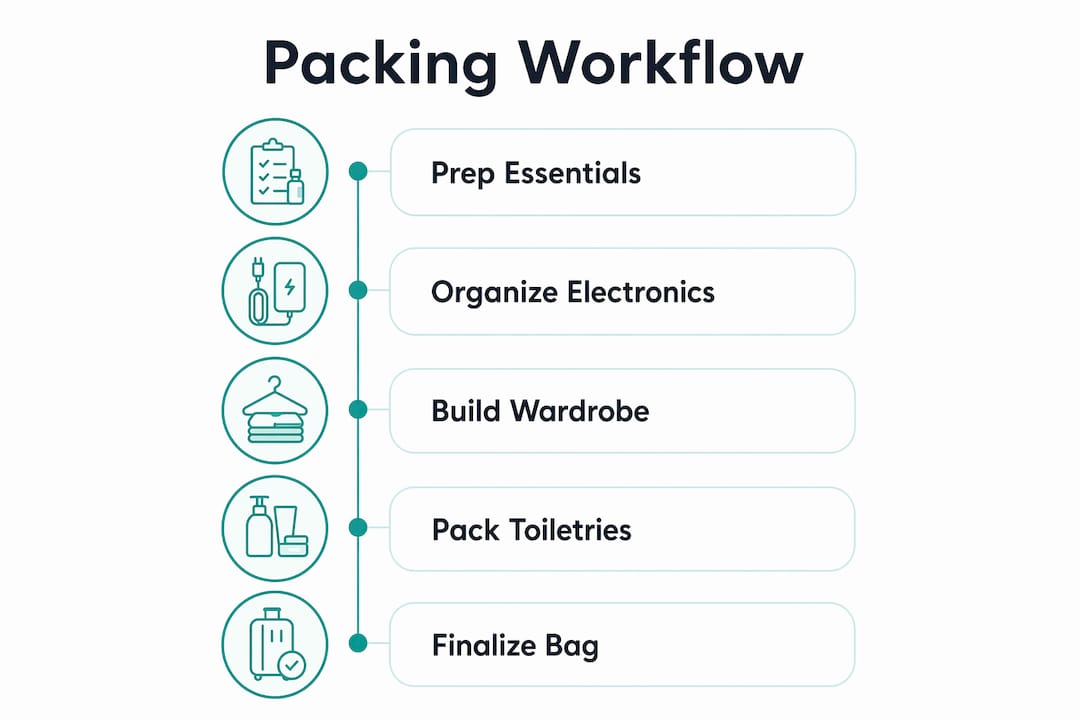
The most effective workflow for packing for business travel follows five sequential steps: categorize your essentials, tailor quantities to trip length and meeting type, organize by zone inside your carry-on, apply space-saving techniques, and maintain a pre-packed core kit between trips. That's the whole system. Everything else is execution.
Here's what a solid business packing workflow covers at a glance:
- Documents and personal items: ID, boarding passes, wallet, backup payment, pen
- Electronics: laptop, phone, power bank under 27,000mAh, chargers, adapters, tech pouch
- Clothing: neutral-palette modular outfits scaled to trip nights, wrinkle-resistant fabrics
- Toiletries: TSA-compliant travel kit, medication, stain remover pen
- Additional supplies: packing cubes, business cards, luggage tracker, backup outfit in personal item
The difference between a frantic pack-the-night-before scramble and a calm, repeatable system is structure. Your luggage affects your schedule, your appearance, and your margin for error on a work trip. Overpacking creates friction. Disorganization creates stress at the exact moments you need clarity.
Table of Contents
- What documents and personal items should you always pack first?
- How to manage electronics and power for productivity on the go
- How to build a travel wardrobe that works for every meeting
- What goes in your toiletry kit for a business trip?
- Additional supplies and special considerations worth packing
- Expert workflow tips that make packing a repeatable system
- Key Takeaways
What documents and personal items should you always pack first?
Documents are the one category where forgetting anything stops your trip cold. Pack these before a single piece of clothing goes in.
- Government-issued ID or passport with at least six months of validity for international travel (check current entry requirements at travel.state.gov)
- Boarding passes (digital or printed backup)
- Work badge or conference credentials if your destination requires them
- Visa documentation where applicable
- Wallet with your primary card, a backup card stored separately, and a small amount of cash in small bills
- Insurance cards (health and travel)
- Small notebook and pen — landing cards, customs forms, and last-minute meeting notes still require handwriting
Store documents in the top compartment or a dedicated sleeve in your personal item, not buried in your main bag. Speed through security and immigration depends on instant access. A printed itinerary with confirmation numbers is worth the extra sheet of paper, especially when your phone battery dies at the gate.
How to manage electronics and power for productivity on the go
Your carry-on functions as a mobile office. Every tech decision should serve that premise.
- Laptop and charger (primary productivity tool; test that it works before you leave)
- Smartphone and a compact backup cable
- Airline-compliant power bank under 27,000mAh to keep devices charged through long flights and back-to-back meetings
- Universal travel adapter covering EU, UK, US, and Australia outlets, with USB-A and USB-C ports
- Noise-canceling headphones for focus in transit and sensitive calls in busy terminals
- Portable mouse and presentation adapter (HDMI or USB-C to HDMI for client presentations)
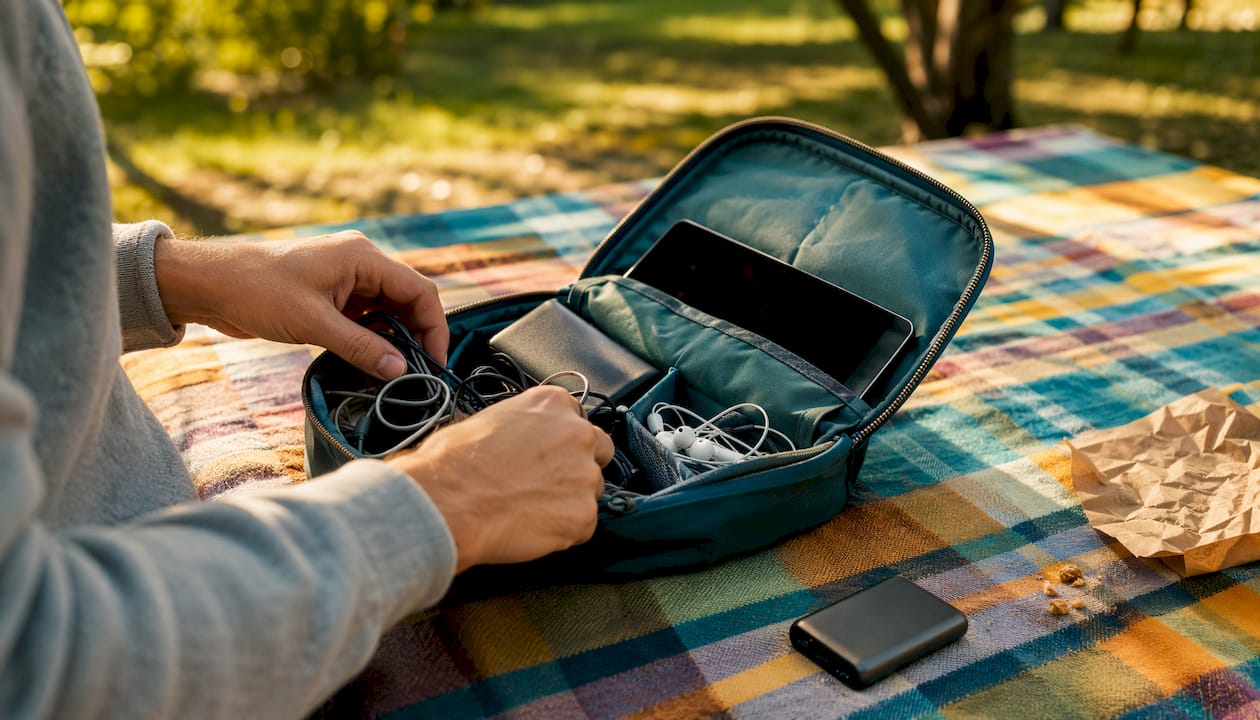
- Dedicated tech pouch consolidating all cables, adapters, and backup storage
A dedicated tech pouch does more than keep cables untangled. It prevents the airport security chaos of unpacking a disorganized bag and eliminates the hotel-room moment where you realize you left your adapter on the desk.
Pro Tip: Skip airport charging stations entirely. They are slow, often occupied, and carry real security risks for your devices. A charged power bank from home is faster and safer every time.
How to build a travel wardrobe that works for every meeting
Business clothing must operate in combinations, not as individual outfits. The goal is maximum coverage from minimum pieces.
Build around a neutral palette
Black, navy, charcoal, and white reduce outfit fragmentation. Every top works with every bottom, which means three shirts and two pairs of trousers produce more distinct looks than five random pieces at twice the volume.
Scale quantities to trip nights, not days
Use nights as your driver. Laundry access changes everything — without it, plan one outfit per meeting day plus one contingency.
Scale quantities to trip nights, using enough outfits and garments to cover your meetings and any contingencies, adjusting based on access to laundry services.
Fabric and packing method matter
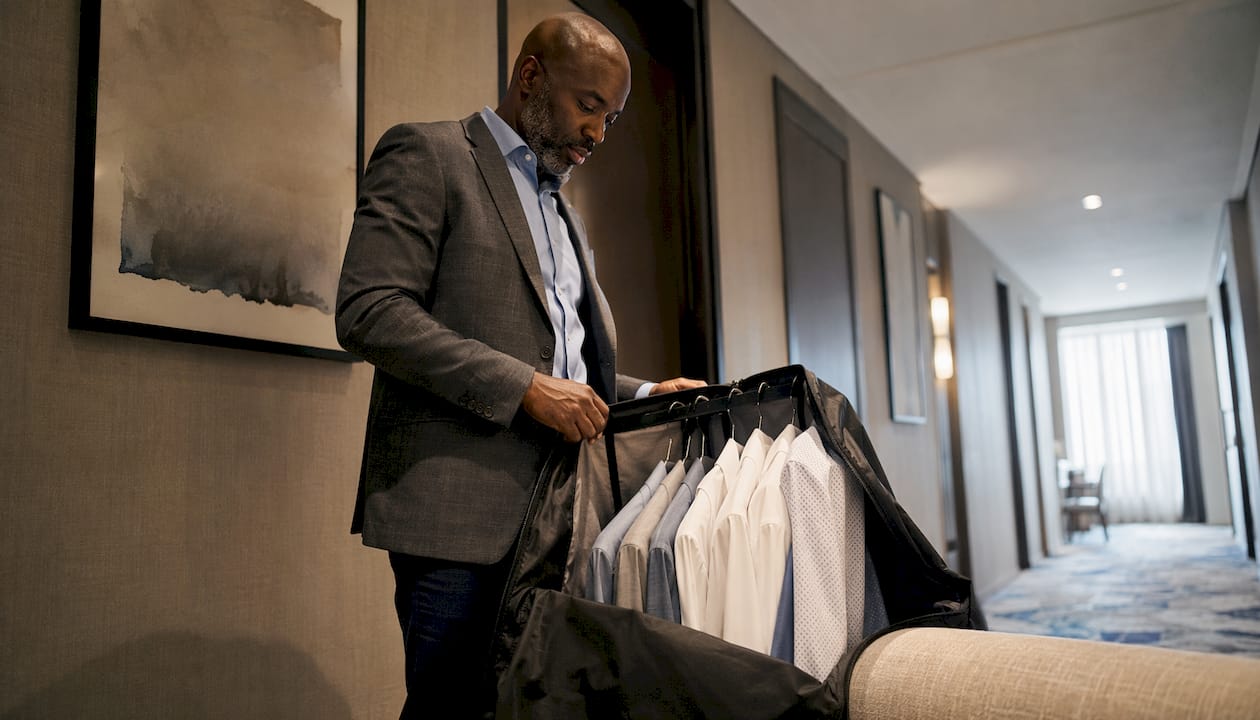
Synthetic or performance-blend fabrics resist wrinkles and dry quickly, which makes mid-trip laundry practical even in a hotel sink. Use a garment folder or packing folder for blazers and dress shirts. Roll casual items tightly. Wear your bulkiest pieces on transit day — your blazer and structured shoes go on your body, not in your bag.
Shoe strategy
Limit to one primary professional shoe and one compact comfort option for long venue days. Two similar dress shoes is one of the most common and wasteful packing mistakes in business travel.
What goes in your toiletry kit for a business trip?
A minimalist, TSA-compliant kit covers everything you need without adding bulk. The key is keeping it semi-permanent so you are not rebuilding it from scratch before every trip.
- Toothbrush and toothpaste (travel size)
- Deodorant
- Face wash and basic skincare
- Razor and shaving supplies
- Hair product and comb
- All liquids in containers of 3.4 oz (100ml) or less, together in one clear quart-sized bag
- Daily medications with a small backup supply in your carry-on, not your checked bag
- Stain remover pen — a wrinkled shirt is recoverable; a stained one before a client meeting is not
Keep a dedicated toiletry bag that stays partially packed between trips. Refill travel-size containers rather than buying new ones each time. This single habit cuts your pre-trip prep time considerably and eliminates the "did I pack deodorant?" question at 11 PM.
Additional supplies and special considerations worth packing
These items sit outside the core categories but consistently prevent the small failures that derail business trips.
- Backup professional outfit in your personal item. If your carry-on gets gate-checked or delayed, you can still walk into a 9 AM meeting looking prepared. This single habit has saved countless professionals from genuine disasters.
- Packing cubes to divide your carry-on into zones. One cube for tops, one for bottoms, one for undergarments and socks. They compress clothing and turn your bag into something you can actually find things in at 6 AM.
- Light layer for cold conference rooms. Many destinations run warm outdoors and freezing indoors. A lightweight blazer or cardigan handles both without adding weight.
- Business cards. Still relevant, especially at conferences and client dinners where exchanging contact details on a phone feels awkward.
- Nutrition snacks for schedule gaps. Conference days rarely follow the agenda, and a protein bar in your bag beats hunting for food between sessions.
- Luggage tracker (Apple AirTag or Tile) for peace of mind, even with a carry-on. The momentary separation of your bag during boarding is enough reason to know exactly where it is.
- Climate check before you pack. Review the forecast for your destination and adjust layers accordingly. Packing for the trip you imagine instead of the one you are actually taking is how you end up with the wrong clothes.
For professionals who travel frequently, understanding what hotel amenities support business travelers can also inform what you skip packing entirely — some properties provide quality toiletries, ironing boards, and tech accessories that make your kit lighter.
Expert workflow tips that make packing a repeatable system
The most common packing mistake is not forgetting an item. It is failing to pack for environmental friction — airport stress, late arrivals, cramped spaces, and schedule changes that leave no recovery time. A system solves for all of that. A one-off checklist does not.
Maintain a pre-packed core kit
Keep a set of recurring essentials pre-packed and ready to go between trips: toiletry bag, tech pouch, travel adapter, and any medications. You are not starting from zero each time. You are only adding trip-specific clothing and documents.
Think in nights, not days
Packing by days leads to overpacking. Packing by nights, with an honest assessment of laundry access, leads to a carry-on that actually closes. A five-night trip with hotel laundry available needs far less than five nights without it.
Commit to carry-on only for trips under five days
Carry-on travel eliminates the single largest variable in airport friction: lost luggage risk. It also cuts your airport exit time, simplifies ground transportation, and forces disciplined packing decisions that make every subsequent trip easier. For longer trips, wrinkle-resistant performance fabrics and a mid-trip laundry plan make carry-on viable well past five days.
Organize your bag into three zones
Divide your carry-on into dedicated zones rather than packing by category and hoping for the best:
- Zone 1 (immediate access): laptop, documents, travel wallet
- Zone 2 (clothing core): garments compressed with packing cubes
- Zone 3 (personal items): toiletry pouch, backup essentials
Organizing into designated zones transforms packing from a frantic task into something predictable. You stop repacking at security. You stop digging through your bag in hotel rooms.
Pack one full meeting outfit in your personal item
This is the single highest-leverage habit in business travel. Your personal item (laptop bag, backpack, or tote) should always contain one complete, meeting-ready outfit. If your carry-on is gate-checked, delayed, or sent to the wrong city, you arrive prepared regardless.
Pro Tip: Shift your mindset from "packing for this trip" to "running a repeatable system." The first time takes effort. By the third trip, you are packed in under 20 minutes with nothing forgotten.
A well-built packing workflow also pairs with a well-built trip plan. Destlist's custom travel itinerary service handles flights, hotels, and day-by-day logistics so you can focus on the work, not the logistics around it.
Key Takeaways
A disciplined workflow for packing business trips, built around carry-on optimization, modular clothing, and pre-packed core kits, consistently reduces friction and protects professional readiness.
| Point | Details |
|---|---|
| Documents come first | Pack ID, boarding passes, backup payment, and a pen before anything else. |
| Power bank within airline-compliant power limits | Keep an airline-compliant power bank charged to stay operational through delays and meetings. |
| Scale clothing to nights | Use trip nights and laundry access, not days, to determine how many outfits to pack. |
| Three-zone bag organization | Divide your carry-on into immediate access, clothing core, and personal items zones. |
| Pre-packed core kit | Keep toiletries, tech pouch, and adapter ready between trips to cut prep time to under 20 minutes. |