
TL;DR:
- Travel personas are distinct motivational profiles that influence destination choices, planning habits, and spending. Recognizing your travel personality helps tailor trips for increased satisfaction, efficiency, and memorable experiences.
Travel personas are defined as the distinct motivational profiles that shape how travelers choose destinations, plan itineraries, and spend their time abroad. Recognizing your travel personality type is not a personality quiz gimmick. It is a practical planning tool. Selecting destinations popular with a different persona leads directly to burnout rather than enjoyment. The travel industry, platforms like Destlist, and behavioral research models all recognize that matching your trip to your core traveler archetype produces more satisfying, efficient, and memorable experiences.

1. What are the main types of travel personas?
The most widely recognized travel personas in 2026 fall into ten core archetypes. Each one reflects a distinct set of motivations, preferences, and planning habits. Understanding which one fits you, or which combination fits a specific trip, is the fastest way to cut through decision fatigue and plan with confidence.
2. The adventure seeker
The Adventure Seeker prioritizes physical challenge, remote locations, and high-stimulus experiences over comfort or convenience. Adventure travelers visit 40% more unique countries annually than other traveler types. They spend less on accommodation and more on experiences like trekking permits, guided climbs, or whitewater rafting. Trips typically run 2–4 weeks, and destinations like Patagonia, Nepal, and Iceland dominate their bucket lists.
Pro Tip: If you identify as an Adventure Seeker, book experiences first and accommodation second. The best guides and permits sell out months before the best hotels.
3. The cultural explorer
The Cultural Explorer travels to understand people, history, and local life. Museums, local markets, historical sites, and authentic food experiences define their itinerary. This traveler reads about a destination before arriving and often learns basic phrases in the local language. Cities like Kyoto, Istanbul, and Oaxaca consistently attract this persona because they offer layered, accessible cultural depth.
4. The relaxation lover
The Relaxation Lover measures a trip's success by how rested they feel at the end of it. Beach resorts, spa retreats, and slow-paced destinations are the default choice. This traveler actively avoids over-scheduled itineraries. The Maldives, Bali, and the Amalfi Coast rank as top destinations because they deliver beauty without demanding effort. Luxury trip planning often overlaps with this persona, since comfort and quality are non-negotiable.
5. The nature enthusiast
The Nature Enthusiast seeks out wildlife, landscapes, and ecological experiences. National parks, safari destinations, and coastal ecosystems are their preferred settings. Unlike the Adventure Seeker, this traveler does not need an adrenaline rush. They want proximity to nature, whether that means watching the Northern Lights in Norway or birdwatching in Costa Rica. Sustainability is often a core value, and they tend to choose eco-lodges and low-impact tour operators.
6. The organized planner
The Organized Planner treats trip research as part of the enjoyment. Spreadsheets, pre-booked restaurants, and day-by-day itineraries are standard practice. This traveler books flights and hotels months in advance and rarely leaves anything to chance. The upside is maximum value and zero wasted time. The downside is that rigid schedules can create stress when things go sideways. Customized travel itineraries built by expert curators give this persona the structure they want without the hours of research.
7. The spontaneous traveler
The Spontaneous Traveler treats flexibility as a feature, not a flaw. Last-minute flights, unplanned detours, and open-ended itineraries define their style. Budget and solo travelers book 1–4 weeks in advance, and the Spontaneous Traveler often falls within that window. This persona thrives in destinations with strong public transit and dense activity options, like Bangkok, Lisbon, or New York, where pivoting plans costs nothing.
8. The luxury traveler
The Luxury Traveler prioritizes quality, exclusivity, and service above all else. Business-class flights, five-star hotels, private transfers, and curated dining experiences are baseline expectations. Luxury travelers book 2–6 months ahead to secure the best suites and private experiences. This persona is also one of the most likely to use professional travel planning services because their time is worth more than the hours saved on research.
9. The family traveler
The Family Traveler plans around the needs of children, which means safety, accessibility, and entertainment take priority over novelty or adventure. Theme parks, beach resorts with kids' clubs, and cities with strong public infrastructure are top choices. Families book 2–6 months ahead for stays of 3–7 nights on average. The family travel personality also demands flexibility within structure, since children's needs change daily.
Pro Tip: Family travelers benefit most from itineraries with built-in buffer time. A packed schedule with young children almost always runs late. Plan for 70% of what you think you can do.
10. The solo traveler
The Solo Traveler values independence, self-discovery, and the freedom to change plans without negotiation. Safety, social infrastructure, and ease of navigation matter more than luxury or novelty. Destinations like Japan, Portugal, and New Zealand consistently rank as top solo travel choices because they combine safety with rich independent experiences. Personality frameworks like MBTI show that solo travelers range from introverted types seeking solitude to extroverted types using solo travel to meet new people. The planning approach differs significantly between those two subtypes.
11. The budget traveler
The Budget Traveler treats cost efficiency as a core travel value, not a constraint. Hostels, local transit, free attractions, and street food are deliberate choices, not compromises. This persona often travels longer than other types because lower daily costs extend the trip. Southeast Asia, Eastern Europe, and Central America offer the highest value for this traveler style. The budget travel style also overlaps frequently with the Spontaneous Traveler, since flexibility allows for last-minute deals.
How traveler personas shape booking behavior
Traveler type directly determines when, how, and where people book. Standard industry models categorize these patterns by demographics and behavior, and the differences are significant.
| Persona | Booking window | Typical stay length | Top priority |
|---|---|---|---|
| Family traveler | 2–6 months ahead | 3–7 nights | Safety, kids' amenities |
| Luxury traveler | 2–6 months ahead | 5–10 nights | Service quality, exclusivity |
| Adventure seeker | 1–3 months ahead | 2–4 weeks | Experiences, access |
| Cultural explorer | 1–3 months ahead | 7–14 nights | Location, local access |
| Solo traveler | 1–4 weeks ahead | 3–10 nights | Safety, flexibility |
| Budget traveler | 1–4 weeks ahead | Varies widely | Cost per night |
| Spontaneous traveler | Days to 2 weeks | Short to medium | Availability, price |
Hotels use these traveler types to design targeted packages and prioritize amenities, which improves both guest satisfaction and operational efficiency. Recognizing your natural booking window also gives you a practical advantage. Booking within your persona's natural timeframe helps secure better deals and availability without forcing behavior that feels unnatural.
Pro Tip: If you are a Luxury or Family traveler, set calendar reminders 6 months before your target travel dates. The best properties and private experiences fill up faster than most travelers expect.
Why most travelers are actually hybrid personas
Travel personas are fluid. A luxury traveler on one trip may behave as a budget adventurer on another. A business traveler extending a work trip into a weekend getaway often adopts relaxation or cultural explorer traits. This is not inconsistency. It is a rational response to different trip goals.
"The most useful thing about knowing your travel persona is not the label itself. It is understanding which specific needs matter most for a given trip. Do you need fast Wi-Fi? Gear storage? A quiet room? Those functional requirements tell you more about what to book than any personality category."
Practical planning benefits come from understanding specific travel needs rather than defending a fixed identity. A traveler who identifies primarily as a Cultural Explorer may still want a luxury hotel in Paris because comfort enhances the experience. Embracing that nuance produces better trips. The friend group vacation test from Destlist is one practical tool for identifying how different personas within a group can align on a shared trip without conflict.
Matching your persona to a curated planning approach
AI-powered travel platforms use traveler personas to match travelers with curated tours and itineraries, reducing choice overload and saving research time. The practical benefit is significant. Instead of sorting through hundreds of hotels and activities, you receive options pre-filtered for your travel style.
Destlist applies this approach directly. Its AI-driven planning system takes your traveler preferences and builds day-by-day itineraries with matched flights, hotels, mapped routes, and walking times. The result is a ready-to-book trip that fits your persona rather than a generic template. Traveler personas reduce decision fatigue by providing curated recommendations, which is especially useful for busy travelers who want efficient planning.
The table below shows how planning approach aligns with persona category:
| Persona category | Best planning approach | Key benefit |
|---|---|---|
| Organized planner, Luxury | Expert-curated itinerary | Structure, quality assurance |
| Family, Relaxation lover | Curated with flexibility built in | Stress reduction, kid-friendly options |
| Adventure seeker, Nature enthusiast | Specialist tour operator or AI-curated | Access to niche experiences |
| Budget, Spontaneous | DIY with flexible booking tools | Cost control, last-minute availability |
| Solo, Cultural explorer | Hybrid: curated base, flexible additions | Independence with a safety net |
How traveler personas make planning faster is not theoretical. Travelers who start with a clear persona spend less time researching and more time enjoying the trip they actually wanted. Digital travel solutions for nomads also show how persona-aware tools, from connectivity options to accommodation filters, make the difference between a trip that works and one that just happens.
Key Takeaways
Knowing your travel persona is the single most effective way to cut planning time and increase trip satisfaction.
| Point | Details |
|---|---|
| Ten core archetypes exist | Adventure Seeker, Cultural Explorer, Relaxation Lover, Nature Enthusiast, Organized Planner, Spontaneous, Luxury, Family, Solo, and Budget each require different planning approaches. |
| Booking windows vary by persona | Families and luxury travelers book 2–6 months ahead; solo and budget travelers book 1–4 weeks ahead. |
| Personas are fluid, not fixed | Most travelers exhibit hybrid traits across different trips, and planning for specific needs beats defending a fixed label. |
| Persona matching reduces decision fatigue | AI-curated platforms use traveler personas to filter options and deliver relevant itineraries faster. |
| Functional needs matter most | Specific requirements like Wi-Fi, gear storage, or kid-friendly amenities should drive booking decisions more than persona labels alone. |
The label is a starting point, not a destination
I have spent years watching travelers make the same mistake. They identify strongly with one persona, say the Adventure Seeker, and then feel guilty booking a nice hotel or skipping a hike because it does not fit the label. That rigidity costs them real enjoyment.
The most satisfied travelers I have seen treat their persona as a default setting, not a rule. They know their baseline preferences but give themselves permission to override them when the trip calls for it. A solo traveler joining a group tour in Morocco is not betraying their identity. They are being smart about the context.
What I find genuinely useful about the persona framework is the planning shortcut it creates. When you know you are a Cultural Explorer, you stop wasting time on beach resort comparisons. When you know you are a Relaxation Lover, you stop feeling pressured to fill every hour with activities. The category does not define you. It just helps you filter faster.
The hybrid persona is also where the most interesting travel happens. A budget traveler who splurges on one extraordinary experience, a luxury traveler who spends a night in a local guesthouse, these are the moments people talk about for years. Rigid personas produce predictable trips. Fluid ones produce stories.
— Helen
How Destlist builds trips around your travel style
Knowing your travel persona is only useful if your trip actually reflects it. Destlist takes your preferences and builds a complete, ready-to-book itinerary within 24 hours, matched to your travel style, budget, and schedule.
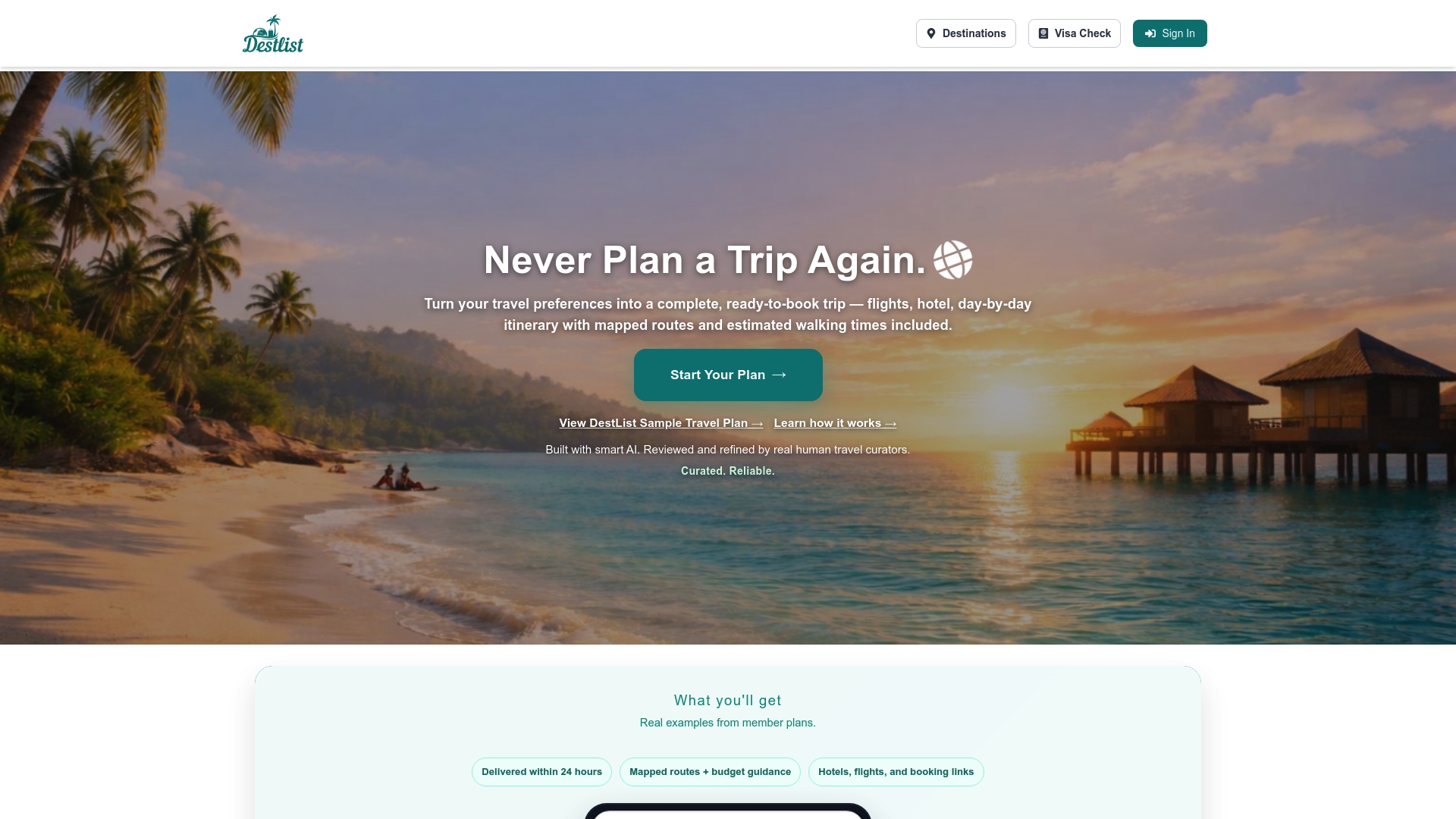
Whether you are a Luxury traveler who needs a flawless five-star experience or a Family traveler who needs kid-friendly pacing and built-in flexibility, Destlist's AI and human curators handle the details. Every plan includes matched flights, hotels, day-by-day activities, mapped routes, and weather alerts. You get a custom travel itinerary built for your specific traveler type, not a generic template you have to adapt yourself. For travelers who want curated options across destinations, Destlist's curated travel plans cover a wide range of trip styles and budgets.
FAQ
What are the most common types of travel personas?
The most recognized travel personas are Adventure Seeker, Cultural Explorer, Relaxation Lover, Nature Enthusiast, Organized Planner, Spontaneous Traveler, Luxury Traveler, Family Traveler, Solo Traveler, and Budget Traveler. Each reflects distinct motivations and planning behaviors.
Can I have more than one travel persona?
Travel personas are fluid, and most travelers exhibit hybrid traits that shift depending on the trip. A luxury traveler on a work trip may behave as a budget adventurer on a personal one.
How does knowing my travel persona help with planning?
Identifying your travel style helps you filter destinations, accommodation, and activities faster, reducing decision fatigue. It also helps you book within your persona's natural window, which improves availability and pricing.
Do travel personas affect hotel and accommodation choices?
Hotels use traveler types to design targeted packages and prioritize amenities, so matching your persona to the right property directly improves your experience and satisfaction.
How do I find out which travel persona fits me?
Start by identifying what you want to feel at the end of a trip, rested, stimulated, culturally enriched, or physically challenged. That emotional goal points directly to your core traveler archetype.