
TL;DR:
- Aligning trips with mood and budget involves choosing destinations and accommodations that fulfill your emotional and financial needs before booking. Most travelers underestimate variable costs and neglect early planning, leading to overspending and stress. Using experience-focused planning and AI tools can help create personalized, affordable trips that match your emotional goals.
Aligning trips with mood and budget means choosing destinations, accommodations, and activities that satisfy both your emotional needs and your financial limits before you book a single flight. 71% of Americans actively budget for their trips, yet most still return home feeling either drained or overspent. The gap between a good trip and a great one almost always comes down to one overlooked step: defining what you need emotionally and financially at the very start. Tools like Destlist, ChatGPT, and budgeting apps like YNAB now make that process faster and more accurate than ever.
How to align trips with mood and budget: start with emotional goals
The professional term for this approach is experience-first travel planning. It puts your emotional goals ahead of flight deals, trending destinations, or social media pressure. Defining clear emotional goals before choosing a destination reduces misaligned expectations and produces more satisfying trips.
Understand your social battery and sensory tolerance
Your social battery describes how much interaction with crowds, strangers, and noise you can handle before you feel depleted. Your sensory tolerance covers how you respond to heat, chaos, unfamiliar smells, and constant stimulation. Planning around these two factors helps you select destinations that fit your actual mood, not just your aspirational one.
A traveler craving calm and restoration needs a different destination than one seeking energy and challenge. Bali's rice terraces and Portugal's Alentejo region suit low-stimulation moods. Bangkok, New York, and Marrakech suit travelers who want to feel alive and overwhelmed in the best possible way.
Build your must-haves, nice-to-haves, and avoids list
Experience-first frameworks use three categories to cut through decision fatigue:
- Must-haves: Non-negotiable emotional needs. Examples include nature access, solo time, cultural immersion, or physical activity.
- Nice-to-haves: Preferences that improve the trip but won't ruin it if absent. Examples include rooftop pools, Michelin-starred meals, or guided tours.
- Avoids: Conditions that drain you. Examples include large tour groups, extreme heat, or party-heavy neighborhoods.
Write these down before you open a single booking site. The list becomes your filter for every destination and accommodation decision that follows.
Pro Tip: Anchor your trip choice to your emotional goal first. If you need rest, a cheap flight to a loud, crowded city is a bad deal no matter the price.
How do you build a realistic travel budget?
Budget travelers need a real-cost perspective, not just a headline flight price. Comparing destinations solely by flight price is misleading. A comprehensive travel budget includes lodging, daily transport, food, activities, and a buffer for mistakes.
Build your budget in this order:
- Set your total trip ceiling. Decide the maximum you will spend before researching anything. This prevents scope creep.
- Separate fixed costs from variable costs. Fixed costs include flights and accommodation. Variable costs include food, local transport, and activities.
- Research daily cost benchmarks. Use resources like Rome2Rio, Numbeo, or Destlist's destination guides to estimate realistic daily spending per city.
- Add a 15% contingency buffer. Unexpected costs appear on every trip. A missed connection, a pharmacy run, or a spontaneous boat tour will happen.
- Factor in the "mistake tax." This is the money you lose to poor decisions: overpriced airport meals, wrong train tickets, or a bad hotel you leave after one night.
Apps like YNAB, Mint, and EveryDollar work well for tracking travel savings before departure and daily spending while you're on the road.
Pro Tip: Calculate your full trip cost, not just flights and hotels. Add $20–$30 per day for incidentals and you'll arrive home without a financial hangover.
71% of American travelers budget actively for trips. That majority still overspends because they skip the variable cost and contingency steps. Getting those right is what separates a trip that feels affordable from one that creates post-vacation debt stress.
Destination vs. budget: which alternatives actually deliver the same vibe?
The most powerful move in affordable vacation planning is destination substitution. You keep the emotional experience and swap the expensive location for a cheaper one with the same energy.
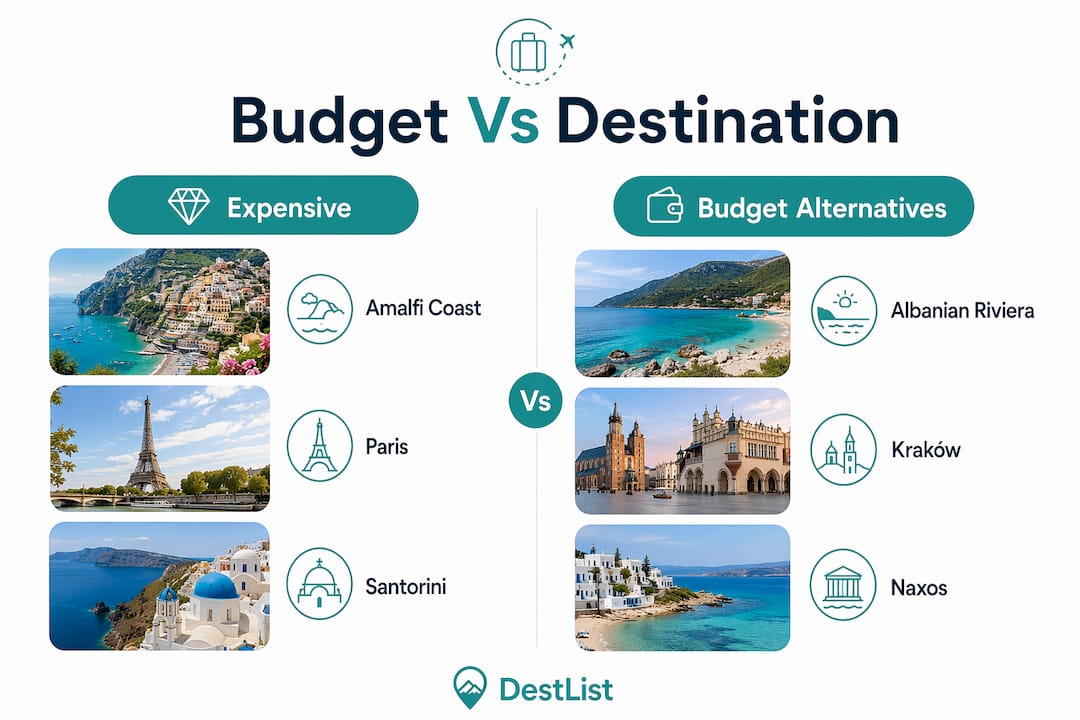
| Expensive destination | Budget alternative | Savings |
|---|---|---|
| Amalfi Coast, Italy | Albania's Riviera | 70–80% lower daily cost |
| Prague or Vienna | Kraków, Poland | 40–50% lower daily cost |
| Santorini, Greece | Kotor, Montenegro | Significantly lower overall |
| Bali, Indonesia | Lombok, Indonesia | 30–40% lower daily cost |
| Paris, France | Porto, Portugal | Substantially lower cost |
Albania's Riviera offers a comparable experience to the Amalfi Coast at 70–80% lower cost. Daily budgets for two people in Albania run €60–80 per person. That figure makes a two-week trip financially viable for travelers who assumed coastal Europe was out of reach.
Accommodation choices that protect both mood and money
Where you sleep shapes your emotional experience more than most travelers admit. A noisy hostel dorm destroys a restorative trip. An overpriced hotel drains the budget and creates anxiety. Community-led stays and local guesthouses reduce accommodation costs by 30–60% while producing more immersive, emotionally satisfying experiences.

For accommodation types that match both budget and mood, the key variables are noise level, social environment, and cancellation flexibility. Book only your first 3–7 nights before arrival. This gives you time to feel out the neighborhood before committing to a longer stay.
Pro Tip: Book direct with guesthouses and small hotels whenever possible. You often get a better rate, a room upgrade, and a host who actually knows the city.
When should you start planning to reduce stress?
Starting travel planning 6–12 months ahead is the standard recommendation for international trips. Visa processing alone takes approximately 4–8 weeks. Health consultations for vaccinations or travel medicine should happen 4–6 weeks before departure.
Early planning also protects your budget. Flights booked months in advance consistently cost less than last-minute purchases. Hotels in high-demand cities sell their best rooms first.
A stress-free trip planning timeline looks like this:
- 6–12 months out: Set your budget ceiling, choose your destination, book flights.
- 3–6 months out: Book first-week accommodation, research visa requirements, schedule health consultations.
- 1–3 months out: Plan your skeleton itinerary with one anchor activity per day.
- 2–4 weeks out: Confirm bookings, prepare documents, build your packing list.
- 1 week out: Check weather forecasts, download offline maps, notify your bank.
The skeleton itinerary concept is worth emphasizing. Over-planning every hour increases stress and reduces the flexibility you need to respond to your mood on the ground. One anchor activity per day gives you structure without rigidity. Everything else stays optional.
What tools actually help with mood-based and budget travel planning?
The right tools reduce decision fatigue and surface options you would never find through manual research alone. 73% of Americans using AI for travel planning do so primarily to save money. That number reflects a real shift in how travelers approach the research phase.
Useful tools by category:
- AI trip planners: ChatGPT and Gemini generate low-cost itineraries, compare accommodation options, and suggest budget-friendly alternatives quickly. Destlist combines AI planning with human curation for ready-to-book results.
- Budgeting apps: YNAB tracks savings goals before departure. Mint and EveryDollar monitor daily spending while traveling.
- Community intelligence: Facebook travel groups, Reddit communities like r/solotravel and r/shoestring, and first-person walking tour videos on YouTube provide ground-level vibe information no algorithm captures.
- Booking flexibility tools: Google Flights' price calendar and Skyscanner's "Everywhere" search surface cheap dates and destinations simultaneously.
The human intel sources matter more than most travelers realize. A subreddit thread from someone who visited Tbilisi last month tells you more about the actual mood of a city than any travel magazine feature. Flexible itinerary structures with optional extras reduce fatigue and keep your emotional goals intact when the unexpected happens.
Pro Tip: Use ChatGPT to draft a day-by-day itinerary, then cross-check every recommendation against recent Reddit posts and Google reviews. AI gives you speed. Community gives you accuracy.
Key Takeaways
Aligning trips with mood and budget requires defining emotional priorities and real costs upfront, then choosing destinations and accommodations that satisfy both criteria before booking.
| Point | Details |
|---|---|
| Emotional goals come first | Build a must-haves, nice-to-haves, and avoids list before researching any destination. |
| Real-cost budgeting wins | Include fixed costs, variable daily costs, and a 15% contingency buffer in every budget. |
| Destination substitution saves money | Budget alternatives like Albania or Kraków deliver comparable experiences at 40–80% lower cost. |
| Book short-term stays first | Reserve only 3–7 nights initially to test a city's vibe before committing further. |
| Start planning 6–12 months out | Early planning secures better flight prices, visa processing time, and accommodation choices. |
Why most travelers get this backwards
Most people I talk to plan trips the same way: find a cheap flight, pick a hotel nearby, and figure out the rest later. That sequence feels efficient. It almost always produces a trip that costs more than expected and delivers less than hoped.
The real problem is that flight price has nothing to do with emotional fit. I've watched people book a bargain flight to a city that exhausted them within 48 hours because the energy was completely wrong for what they needed that month. The cheap flight became an expensive mistake once you added the hotel they left early, the activities they skipped, and the flights home they changed.
The travelers who consistently report the best experiences do the opposite. They decide what they need to feel first. Rest, adventure, connection, solitude. Then they find the destination that delivers that feeling at a price they can sustain. Mood-based trip curation isn't a luxury approach. It's the most practical one.
The other mistake I see constantly is treating the budget as a ceiling rather than a plan. A ceiling says "I won't spend more than $3,000." A plan says "I'll spend $800 on flights, $900 on accommodation, $700 on food, $400 on activities, and keep $200 as a buffer." The plan version almost always comes in under budget. The ceiling version almost never does.
Give yourself permission to adjust the destination based on what you actually need right now. A trip that costs slightly more but matches your mood will feel like a bargain compared to a cheap trip that leaves you needing a vacation from your vacation.
— Helen
Plan your next trip with Destlist
Destlist builds personalized travel itineraries that match your emotional goals and your actual budget. You answer a few questions about what you need from a trip. Destlist's AI, reviewed by real human travel curators, produces a complete day-by-day plan including flights, hotels, mapped routes, and estimated walking times. The result is a ready-to-book travel plan delivered within 24 hours. Whether you want a restorative week in Bali, a custom city itinerary built around your budget, or a curated adventure that fits both your mood and your bank account, Destlist removes the research burden entirely. Stop spending weekends planning. Start traveling with a plan that actually fits you.
FAQ
What does "aligning trips with mood and budget" mean?
It means choosing destinations, accommodations, and activities that match both your emotional needs and your financial limits before you book. The professional term for this approach is experience-first travel planning.
How much of a budget buffer should I add to a trip?
Add a 15% contingency buffer on top of your total estimated costs. This covers unexpected expenses like missed connections, pharmacy runs, or accommodation changes.
What are the best budget alternatives to expensive European destinations?
Albania's Riviera offers a comparable experience to the Amalfi Coast at 70–80% lower daily cost. Kraków, Poland delivers a similar cultural experience to Prague or Vienna at 40–50% less.
How far in advance should I start planning an international trip?
Start planning 6–12 months ahead for international travel. Visa processing takes approximately 4–8 weeks, and health consultations should happen 4–6 weeks before departure.
Can AI tools really help with mood-based travel planning?
Yes. Tools like ChatGPT and Destlist generate itineraries based on your stated preferences, compare costs across destinations, and surface options that match both your emotional goals and your budget quickly.