
TL;DR:
- Mood-based trip curation designs travel experiences around emotional needs, not just destinations.
- Aligning itineraries with mood reduces stress, decision fatigue, and activity mismatch.
- Combining AI tools with flexibility ensures personalized, meaningful, and satisfying travel experiences.
Most travelers spend weeks researching flights, comparing hotels, and building packed itineraries, then return home feeling strangely flat. The logistics were flawless, but the trip just didn't feel right. That disconnect has a name: mood misalignment. When your vacation doesn't match where your head actually is, even the best-planned trip can feel like a chore. Mood-based trip curation, the practice of designing travel experiences around your current emotional state and desired mental outcome, is reshaping how smart travelers plan their time off. This article breaks down exactly how it works, why it matters, and how to use it.
Table of Contents
- What is mood-based trip curation?
- Why mood matters: The impact on your travel satisfaction
- Mood-based curation vs. traditional planning: A direct comparison
- The future of mood-based planning: Trends, innovations, and industry insights
- Here's what most experts miss about mood-based trip curation
- Enhance your next vacation with DestList's curated travel plans
- Frequently asked questions
Key Takeaways
| Point | Details |
|---|---|
| Mood matters most | Matching your itinerary with your desired emotional state leads to greater travel satisfaction. |
| Efficiency and wellness | Mood-based trip curation helps you save time and supports mental health during vacations. |
| Balance technology with intuition | Blending AI curation with human input and spontaneity gives you the best of both worlds. |
| Flexible, not rigid | Leave room for changes so your trip aligns with how you actually feel in the moment. |
What is mood-based trip curation?
Mood-based trip curation means building a travel itinerary around your emotional needs rather than a destination checklist. Instead of asking "What should I see in Lisbon?" you start by asking "Do I need quiet restoration, creative stimulation, or pure adventure right now?" Your answers shape everything from your destination choice to your daily schedule and accommodation style.
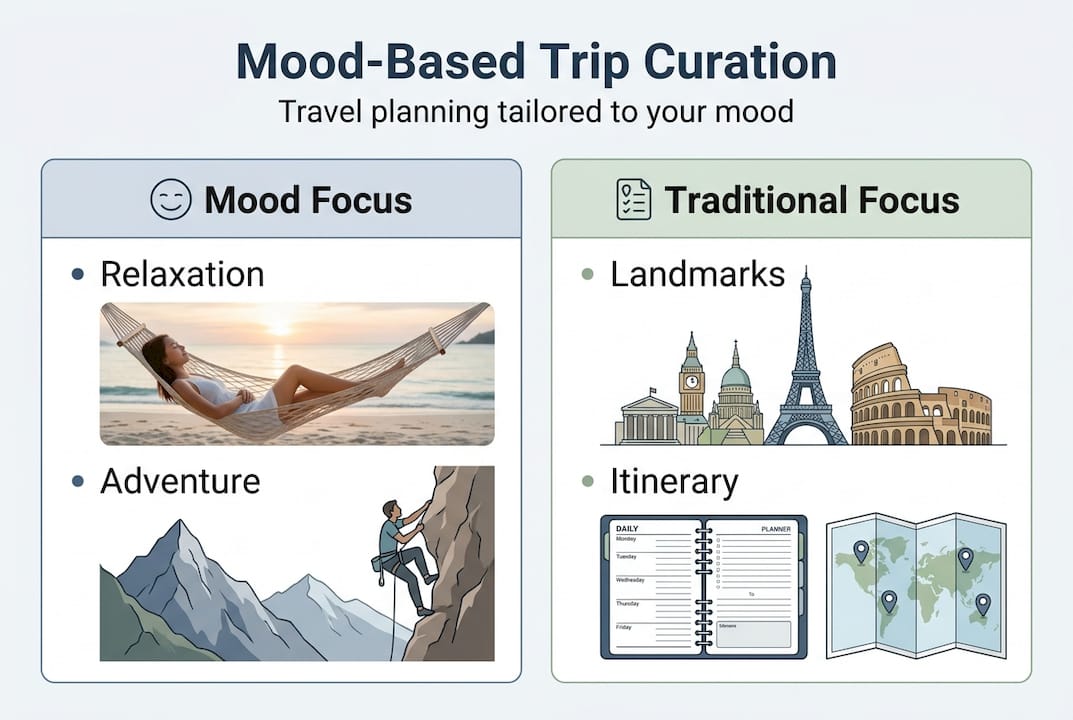
This approach is emerging fast. Travelers are increasingly seeking personalized travel that speaks to how they feel, not just where they want to go. The shift is driven by a growing awareness of mental wellness, burnout culture, and a demand for experiences that genuinely recharge rather than simply distract.
Here's what mood-based curation actually considers when building your trip:
- Your energy level: Are you running on empty and craving stillness, or are you ready to explore and push limits?
- Your social appetite: Do you want solo reflection, an intimate partner trip, or group energy?
- Your restoration goal: Are you trying to escape stress, spark creativity, or celebrate an achievement?
- Your sensory preferences: Beaches vs. mountains, noise vs. silence, structure vs. wandering.
This is fundamentally different from traditional planning. Classic trip planning prioritizes logistics: flights, hotel ratings, and "top 10 must-see" lists. Mood-based planning, in contrast, treats your emotional state as the core variable and builds the experience outward from there.
"AI, mental wellbeing, and sustainability are redefining travel value for modern travelers, with proponents highlighting efficiency, mental health reset, and vibe-driven trends."
To fully understand the vocabulary behind this shift, it helps to explore travel curation terms that are reshaping the industry. Understanding the language helps you ask better questions and get sharper results from any planning tool you use.
The experience-first model, rather than sight-first, is what makes mood-based curation so resonant with busy professionals. You're not collecting attractions. You're investing in how you want to feel when you come back.
Why mood matters: The impact on your travel satisfaction
Here's a number worth sitting with: industry research shows that travelers increasingly cite emotional wellbeing and mental reset as their primary travel motivators, yet fewer than half actually plan their trips with those goals in mind. The result is a planning gap that leaves people returning from vacation almost as stressed as when they left.
Mood alignment shifts travel planning from a logistical exercise into a genuine mental health reset. When your itinerary matches your emotional state, you stop fighting the trip and start being present in it.
One of the biggest silent killers of vacation satisfaction is decision fatigue. Decision fatigue is a well-documented cognitive phenomenon where making too many choices exhausts your mental reserves. When you're juggling 47 browser tabs about restaurants, museum hours, and transport options, you arrive at your destination already depleted. Mood-driven curation front-loads all the decision-making before you leave, so every choice you face on the ground feels smaller and more intuitive.
Here's what mood-based trip curation actually protects you from:
- Analysis paralysis: Too many options with no emotional filter leads to indecision and regret.
- Activity mismatch: Booking adventure tours when you're burned out, or quiet spa retreats when you crave stimulation.
- Pace problems: Itineraries that are too dense for a worn-out traveler or too slow for someone full of restless energy.
- Social friction: Group dynamics that don't align with your need for solitude or connection.
One-size-fits-all trips assume everyone wants the same thing from travel. They don't. A New York finance professional recovering from a brutal quarter needs a different trip than the same person celebrating a promotion. Both trips might go to the same city, but they'll look entirely different when mood is the organizing principle.
Pro Tip: Before you book anything, spend 10 minutes writing down three things you want to stop feeling and three things you want to start feeling by the end of your trip. These six words become your mood brief, and they'll guide every decision from destination to daily schedule.
For a deeper look at how customized travel itineraries save you time and improve satisfaction, it's worth understanding how the structure of a personalized plan differs from a generic one. The difference isn't subtle. It's often the difference between a trip you'll remember and one you'll forget.
Mood-based curation vs. traditional planning: A direct comparison
Understanding the theory is one thing. Seeing the practical difference side by side makes it concrete. Here's how the two approaches stack up across the dimensions that matter most to busy travelers.

| Planning dimension | Mood-based curation | Traditional planning |
|---|---|---|
| Starting point | Emotional state and desired feeling | Destination, dates, and budget |
| Activity selection | Filtered by energy and restoration goals | Filtered by popularity and reviews |
| Pace control | Built around traveler's current capacity | Built around maximizing sights covered |
| Flexibility | High, with built-in buffer time | Low, often over-scheduled |
| Technology used | AI-driven with human oversight | Manual research and booking tools |
| Risk | Can miss serendipity; may feel over-optimized | Can miss emotional fit; can overwhelm |
| Best for | Burned-out travelers needing real recovery | First-time visitors wanting maximum coverage |
The table above shows something important: neither approach is universally superior. Mood-based planning wins on personal satisfaction and stress reduction. Traditional planning wins on thoroughness and discovery.
That said, mood-focused planning demonstrably enhances guest satisfaction through more personalized experiences, particularly for repeat travelers who've already checked the major boxes at a destination.
For busy professionals, the choice usually isn't about picking one approach or the other. It's about knowing when each applies. First trip to Tokyo? Traditional planning might serve you well. Third trip to a favorite city when you need to decompress? Mood-based curation is where you'll find the most value.
Pro Tip: Use AI travel tips to automate the logistical foundation, then apply mood-based filters on top. This hybrid approach saves time without sacrificing emotional fit.
Modern travelers are also discovering that the best trip planners are the ones that blend both philosophies, giving you solid logistics as a backbone while shaping activities and pace around your actual emotional needs. A rigid grid of sightseeing slots won't restore you. But a completely unstructured trip can create its own kind of anxiety. The blend is where the magic lives.
It's also worth noting that mood-based curation pairs especially well with customized itineraries that have already been filtered for budget and logistics. When the practical layer is handled, you can focus entirely on the emotional layer.
The future of mood-based planning: Trends, innovations, and industry insights
The travel industry is investing heavily in tools that can detect, interpret, and respond to traveler mood at scale. Here's where things are heading and what's already available.
| Tool/system | Core capability | Key strength |
|---|---|---|
| AI mood-matching engines | Interprets preferences into emotional profiles | Speed and scalability |
| Hybrid AI and human curation | Blends automated logic with expert intuition | Nuance and flexibility |
| Disruption-resilient planning | Adapts itineraries in real time to delays or changes | Stress reduction during travel |
| Experience-first booking platforms | Filters destinations by emotional outcome, not just price | Alignment from the start |
Emerging research is benchmarking systems like TripCraft and TripTide that balance AI scale with human-like intuition for superior vacation planning. These hybrid systems are setting new industry standards for what emotionally intelligent trip planning can look like, moving beyond keyword matching into genuine preference modeling.
Here are the key trends shaping this space in 2026 and beyond:
- Real-time mood adaptation: Tools that adjust your itinerary mid-trip if you report feeling overwhelmed or understimulated.
- Wellness-first filters: Hotel and activity searches filtered by restoration type, not just star rating or price.
- AI disruption buffers: Systems that automatically reroute plans around delays, weather events, or closures without requiring manual rebooking.
- Community mood data: Aggregated traveler sentiment helping platforms recommend destinations based on collective emotional feedback.
For travelers planning multiple trips, multi-trip planning tools are incorporating mood tracking across trips, so each successive vacation builds on what worked emotionally in the last one. Think of it as a travel wellness record.
If you're currently using a tool that doesn't seem to understand your preferences deeply enough, exploring Destinations.ai alternatives can surface platforms that prioritize emotional fit over generic popularity scores. And having a solid grasp of the emerging industry terms for travel curation will help you evaluate any platform you consider.
The industry is moving fast. Travelers who understand this shift now will be ahead of those who still plan trips the same way they did five years ago.
Here's what most experts miss about mood-based trip curation
Most coverage of mood-based travel planning focuses on the upside and the technology. We want to share something less comfortable and more useful.
Mood-based tools are only as good as your self-awareness going in. If you tell a platform you want "relaxation" because it sounds right, but you're actually someone who gets restless after 48 hours of stillness, the algorithm will hand you a spa retreat in the mountains that you'll quietly resent by day three. The tool does what you tell it. Your job is to tell it something true.
Overreliance on AI curation also carries a real risk. Critics rightly argue that AI-driven planning can lead to cognitive atrophy, automation bias, reduced autonomy, and plans that feel generic despite appearing personalized. When an algorithm builds your day, it optimizes for stated preferences. It can't account for the lunch spot you wandered into by accident, the street festival you stumbled on, or the local you struck up a conversation with who changed how you saw the city.
Serendipity, the unplanned moment that becomes your favorite travel memory, lives in the gaps between curated experiences. If your itinerary is airtight, serendipity has no room to show up. That's not a feature. That's a loss.
Our honest take: use mood-based curation to set the emotional tone and handle the logistics, then deliberately leave unscheduled time every day. Treat those gaps as protected space for whatever happens to happen. The curated parts get you in the right place. The open parts let you actually live there.
One more reality worth naming: your mood will change during the trip. You might arrive craving solitude and find yourself wanting connection by day two. Build in enough flexibility to pivot. A done-for-you travel planning service that includes flexibility checkpoints is worth significantly more than one that hands you a rigid schedule and considers the job done.
The best mood-based travel isn't about a perfect plan. It's about a plan that's perfectly flexible enough to meet you where you actually are.
Enhance your next vacation with DestList's curated travel plans
If this article has convinced you that your next trip deserves more than a spreadsheet of flight times and hotel reviews, here's a practical next step.
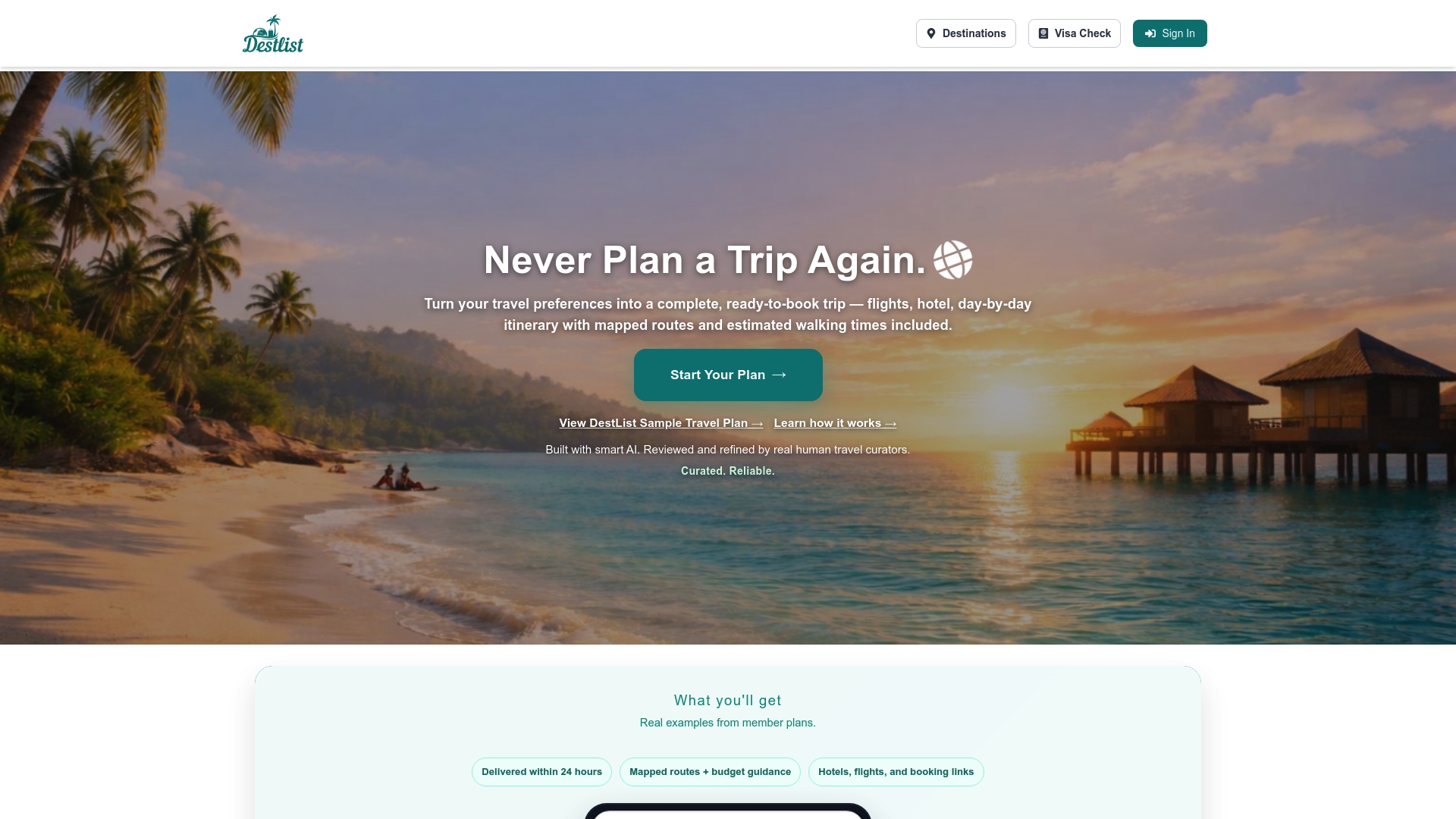
DestList builds custom travel itineraries for busy professionals who want their trips to actually feel right, not just look good on paper. Every plan is built using a blend of AI efficiency and human expertise, meaning you get fast, detailed, ready-to-book itineraries that account for your mood, budget, energy level, and schedule. If you want someone else to handle the entire process, the done-for-you travel planning service delivers a complete trip plan within 24 hours. Browse adventure destinations to start exploring what's possible, and let the platform match your mood to the right place.
Frequently asked questions
Can mood-based trip curation really improve my travel experience?
Yes, aligning your itinerary with your current emotional state can significantly enhance relaxation and satisfaction. Industry research confirms that mood alignment shifts travel from a logistical exercise into a genuine mental health reset.
Isn't there a risk of missing spontaneous experiences?
Mood-based planning can reduce serendipity if applied too rigidly, which is why a flexible approach, with intentional open time built into the schedule, consistently delivers better results. Critics note that AI-driven itineraries can reduce autonomy and unplanned discovery, so balance is key.
What's the technology behind mood-based curation?
Most leading systems now blend AI insights with human editorial review for both scale and nuance. Emerging benchmarks like TripCraft demonstrate how this hybrid approach outperforms purely algorithmic planning on real traveler satisfaction metrics.
How much time can I save using mood-based trip curation?
Many travelers report dramatically reduced planning stress and hours saved on research, with meaningful improvements in overall trip satisfaction. Proponents consistently highlight efficiency and mental reset as the two biggest practical benefits of this approach.